
Every time I go into Shoal Waters’ cabin I wince at seeing the clock. It is a brass clock that has lost its clock bit, leaving just the outer case. A modern, plastic clock had been put into the case and the gap between the case and the clock filled with some type of foam strip.
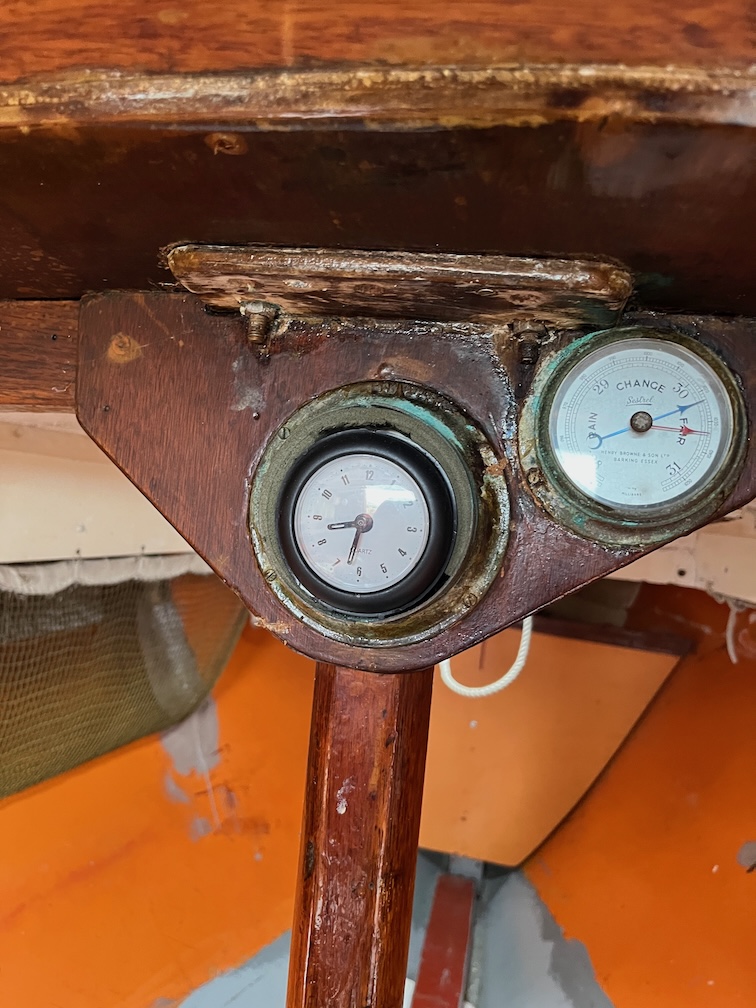
Here it is. It’s quite good fix especially if you don’t want to spend the money on a new one, and they are expensive, but to me, it just looks wrong.
So, I’ve ordered a new brass clock.
Now with a forecast high of zero degrees Celsius today, it’s just 1 Celsius according to my weather station, I didn’t expect to get any work done today, but I decided that I could remove the old brass clock as it’s inside the cabin and therefore would not be so cold. The wind chill is pretty fierce outside today.
So I did.
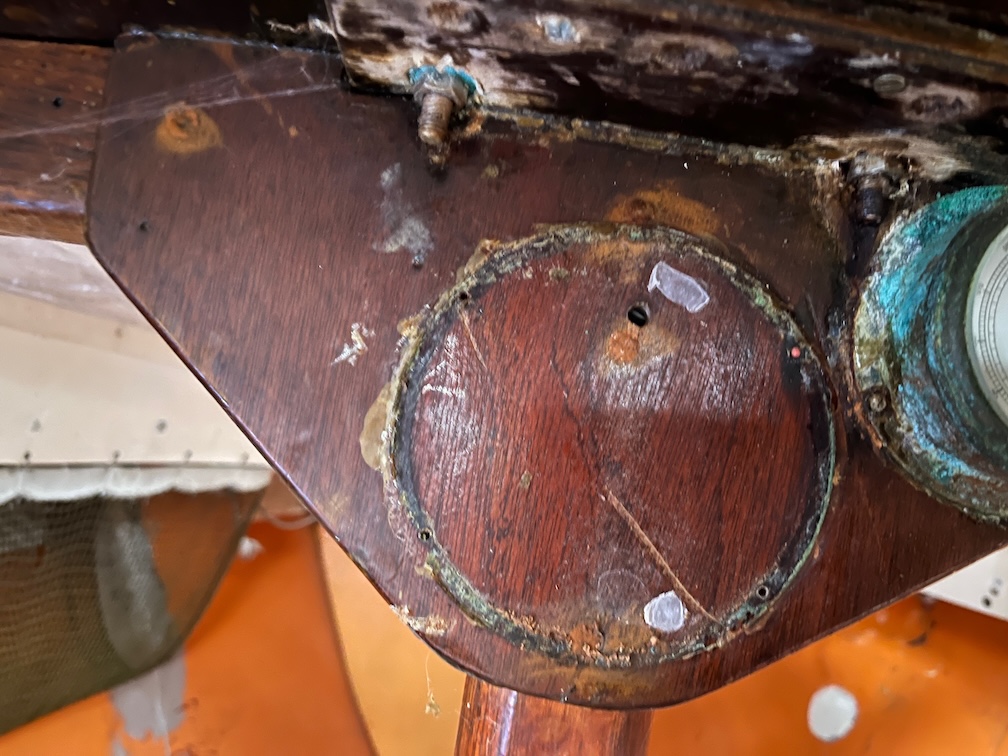
And here is the result. the camera is wonky as I’m trying to hold a light to illuminate the area and hold the camera steady enough to take a non-blurry photo whilst also half kneeling in a small space.
But whilst I was attempting to take this photo I noticed that one of the bolts that holds the tabernacle to the boat is rusted. You can see it right next to the barometer to the right which has a lot of verdigris on the outside which is what rust on brass is called. This is not good. The bolts are stainless and rust on stainless steel is never a good sign. I’ll also have to remove the barometer and clean that up although the verdigris on the small screws holding it to the wood may not come loose. Still, I’ll cross that bridge when I come to it.
I had a look at the tabernacle from the outside since water was obviously getting in from outside and that meant that the bolt was no longer sealed.
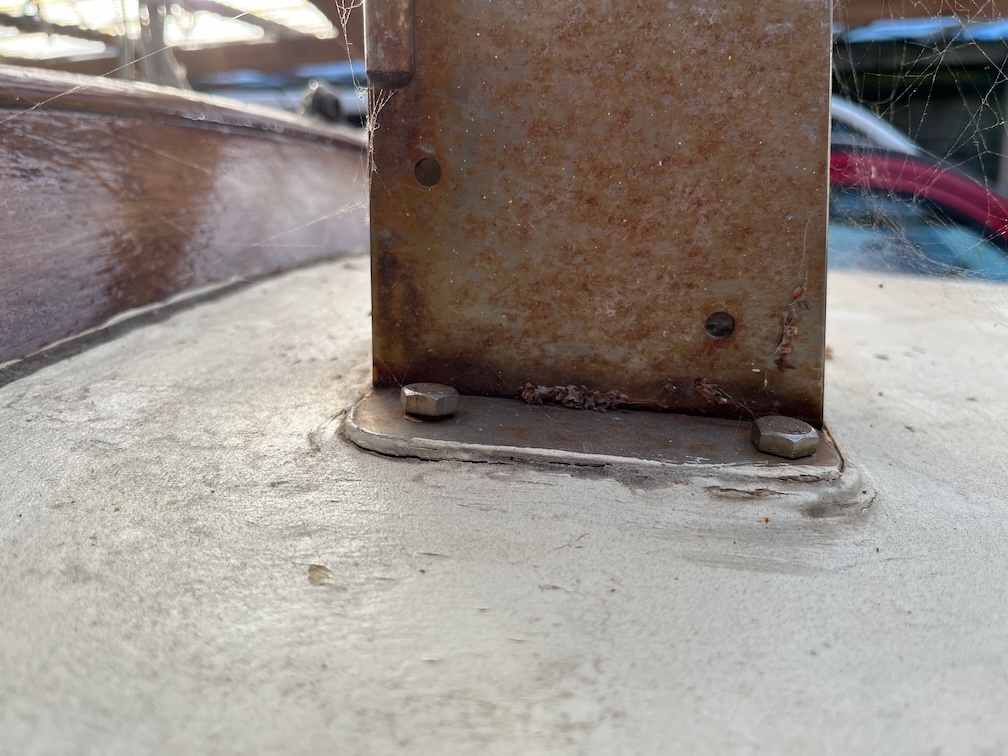
Sure enough, the bolt is no longer tightened down properly, the tabernacle has lifted a little and the sealant has cracked. With rapidly numbing fingers I got out the requisite tools, removed the bolts and the tabernacle and took them into the workshop.
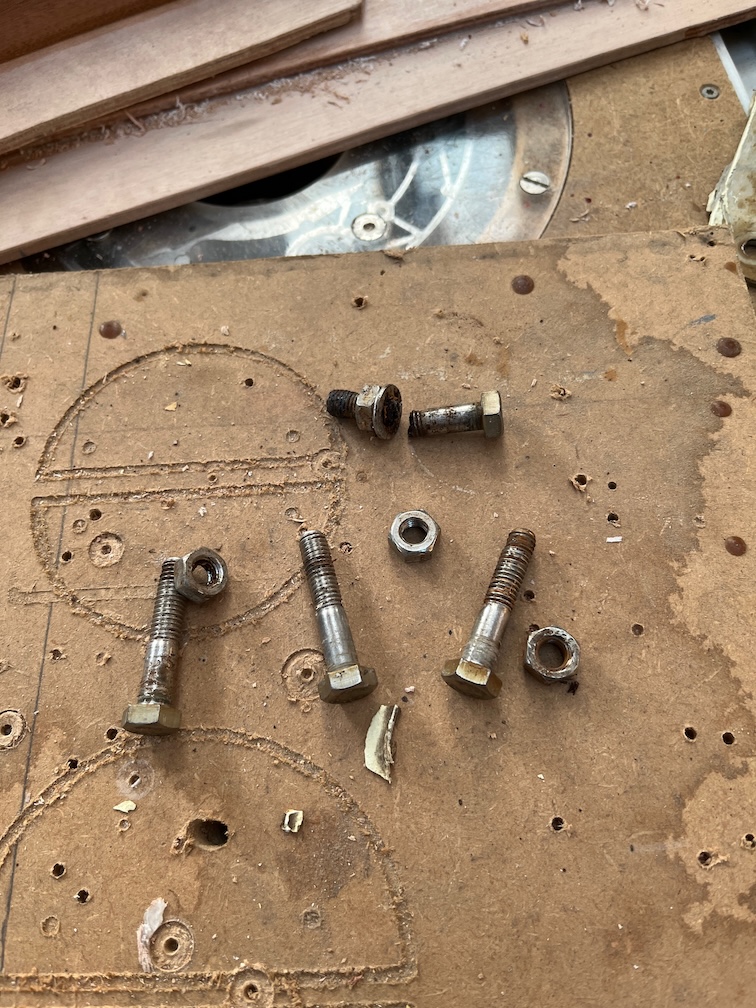
As you can see from above, the severely rusted bolt immediately sheared off the first time I tried to loosen the nut with a spanner. The bolt was rusty just about all the way through. I suspect therefore, that the bolt was originally bolted down tightly but the seal cracked over time and allowed the water in, which in turn caused the bolt to rust and that allowed the tabernacle and thus the bolt to lift making the issue worse. Ferrous Oxide, also known as rust has a volume that is ten times larger than the non-rusted steel and that is how the bolt was allowed to “stretch”.
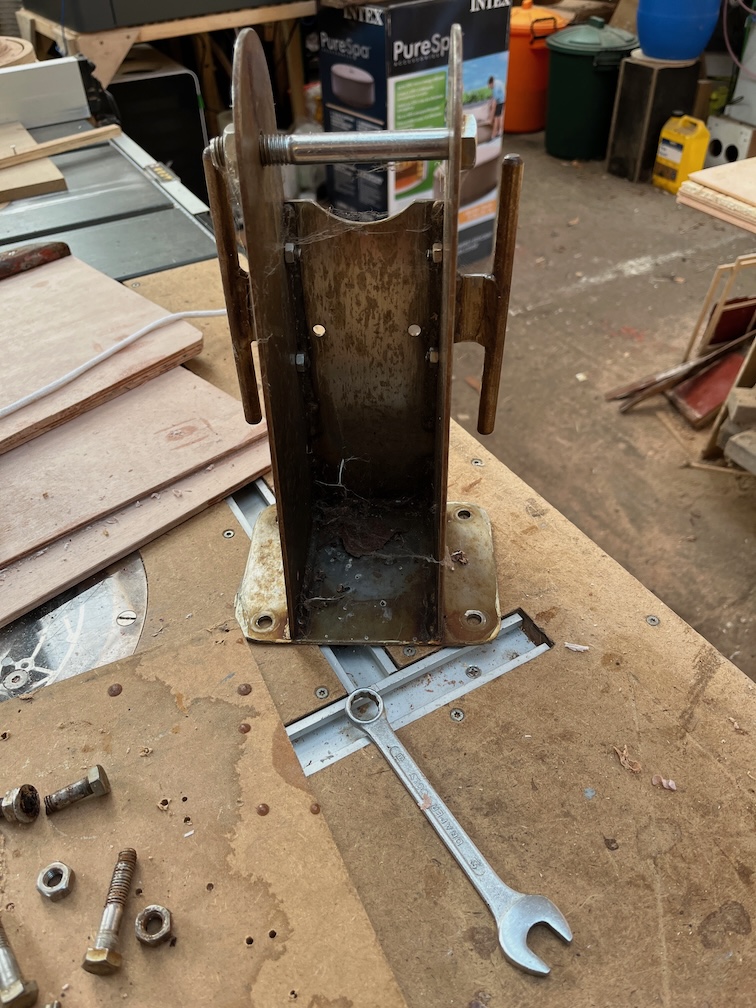
The tabernacle itself is in good condition with a little surface discolouration. I’ll have to replace the bolts and I’ll make sure that they are marine grade 316, also known as A4, to try and prevent this from happening again. Normally you would only use 304 (or A2) stainless steel above the waterline, and the 316 grade below the waterline, but since these bolts are stainless but still rusting, I’ll pay the extra cost for the 316 grade.
I’ll also need to check the decking under the plywood and the beam underneath for rot and deal with that before I replace the bolts.
At this point I had to pack everything up and go back indoors. My fingers were totally numb and working with tools and numb fingers is never a good idea. I lasted just 30 minutes. The cold tools and the wind chill were too much. The tabernacle bolts had to be removed from the outside and the wind is from the North-West, straight into the Hay Barn.
Now I have to go through the slightly uncomfortable process of warming up very cold fingers.
Time for a cup of tea.
Once my fingers had warmed up I decided to try a few other short jobs. the first was to clear the old sealant from the deck where the tabernacle stands.

This is the state of the deck before I started work…

… and here is the after view. A lot of the deck under the tabernacle seems to be epoxy and I recall Charles writing in “Sailing Just for Fun” p37 footnote:
In May 1997 while Shoal Waters was on a trailer the mast hit an obstruction and ripped the tabernacle out of the foredeck. It was quickly and easily repaired.
I presume that the epoxy I found is part of that repair. I’ll have to clean up more of the remaining sealant and then I’ll probably skim that area with thickened epoxy to smooth it all off and to give it some more rigidity.
You’ll note the piece of Mahogany at the front of the cleaned up area, This is to tip the tabernacle aft a little to compensate for the slope of the foredeck in that area. If this were not done, when the mast was fully upright in the tabernacle, it would lean forward due to the slope.
Having done that and still being able to feel my fingers I moved into the cabin and set about removing the barameter.
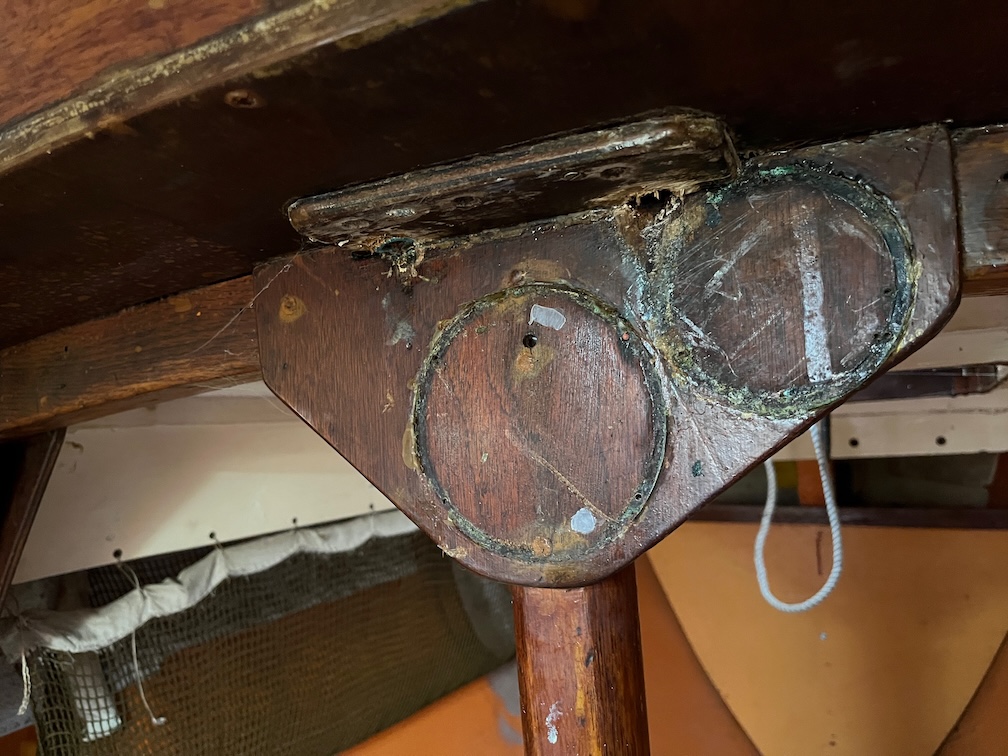
The exterior of the barometer has been coated with varnish over the years but this has not prevented the retaining screws from degrading to the point that they could not be unscrewed. I resorted to slipping a flat-bladed screwdriver under the lip and levering the instrument off. It released very easily since the screw threads were now virtually non-existent and thus not gripping the wood any longer. It seemed that the barometer stayed in place due to the varnish than the retaining screws.
With the barometer removed I can now easily sand and revarnish the instrument board. It will also make it easier to replace the one bolt that almost touches the barometer.
I did take the opportunity to give the wood around the bolt holes a good poke with a sharp tool and found that the wood seems to be free from soft spots although there is quite a bit of salt residue that will need to be sanded away before the tabernacle is replaced. I also noted that the piece of wood upon which the clock and barometer were mounted fouls the two aftmost bolt holes and has been partially cut away to allow the bolts to protrude. However, the one on the starboard side hasn’t been removed enough causing the bolt to be canted slightly aft and this will have contributed to the leak,
As part of the work in refitting the bolts, I shall cut the backing board away completely around these holes such that the bolts can sit perpendicular to the deck.
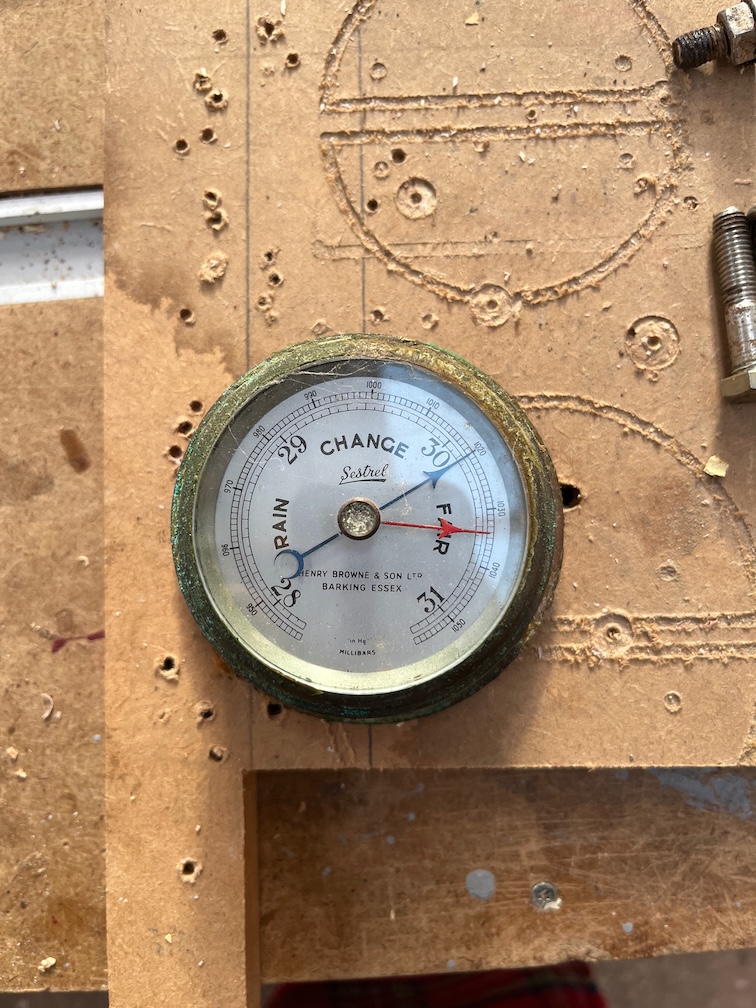
The barometer seems to be in fairly good condition. It is partially covered in old varnish and part of the retaining lips has turned to copper, the zinc having been leached away by the water..
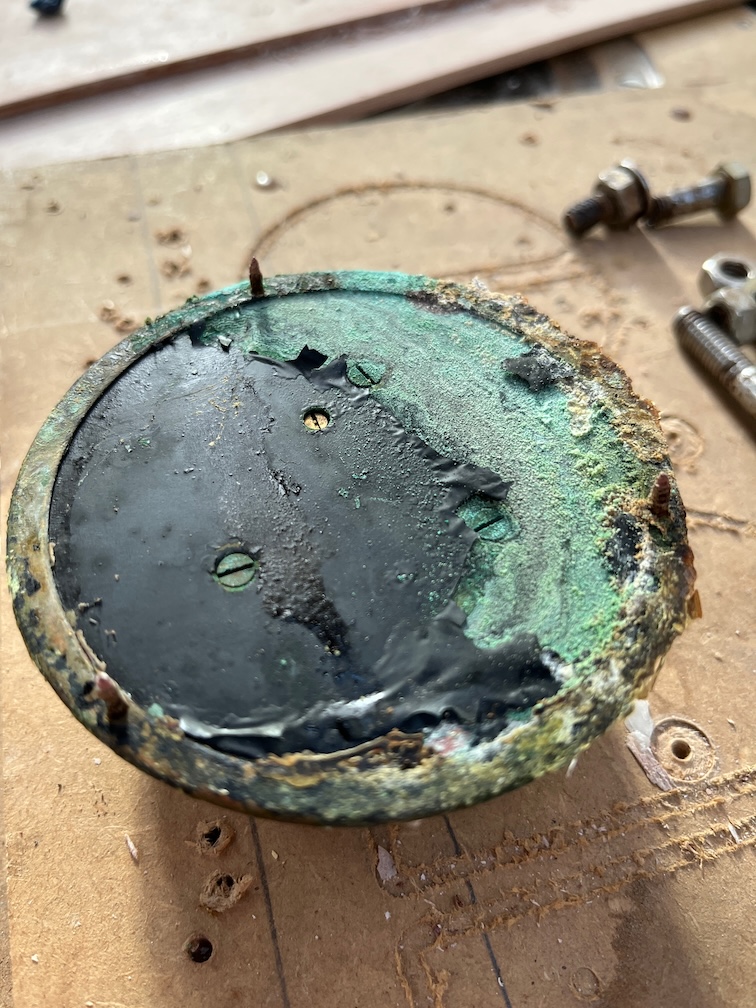
It is quite clear which is the upper side from the level of verdigris on the back and you can clearly see the old varnish and the three screws.
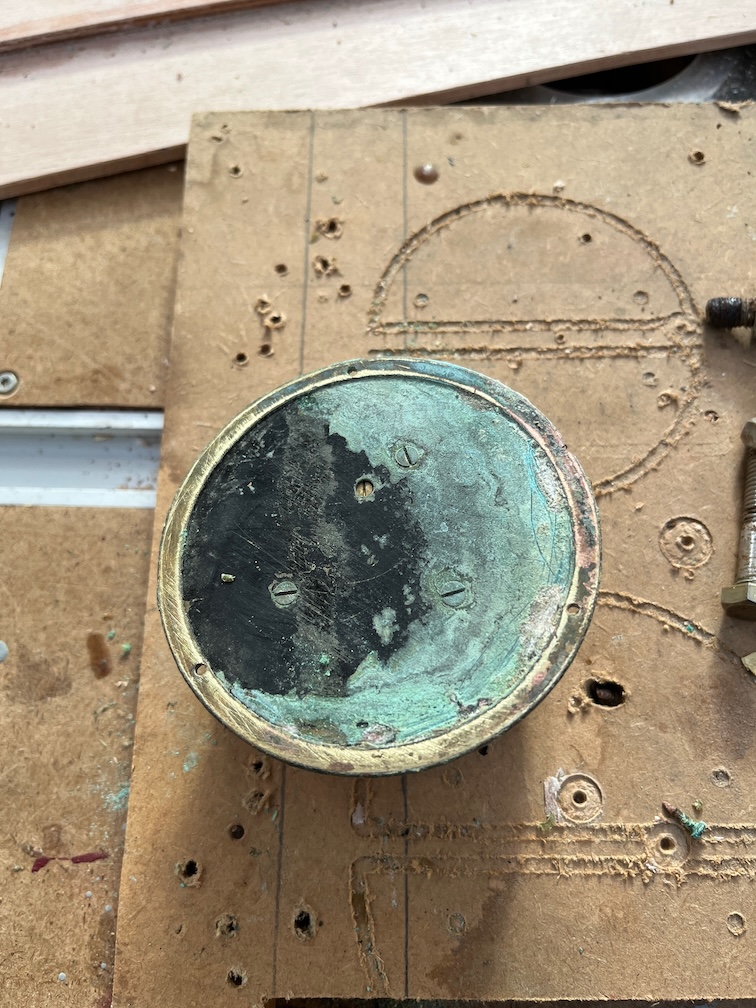
Here it is again but cleaned up a little. You can see the pinkish hue on the rim where the brass has turned to copper.
I don’t know if the barometer still operates, so having cleaned it up a bit more I took it inside to my office where I have the repeater for my weather station. I used the set screw in the back of the instrument to set it to the same value as the pressure reading on the station and I’ll keep an eye on it over the next few days to see if it tracks the same pressure.
If it does then I’ll replace it, if not then it will be retired and a new one purchased and installed in its place. Assuming that I can find one that small in solid brass, that is.
Time for a cup of tea.