
As we are having warmish weather currently, around 10º Celsius, I decided that one of the day’s tasks would be the sanding and varnishing of the mounting board in the cabin, the one upon which the clock and barometer will be mounted. I decided this yesterday after hearing the weather forecast and this morning set to with sandpaper and varnish to get the job done. The board already had two coats of new varnish but the last one didn’t go on very well. It’s a condition known as Crawling Varnish and I’ve come across it before when varnishing Naiad.
The solution is simple. Sand it well and try again.
Prevention in this case is also simple. Sand between coats, making sure that the surface is not too shiny and is free from grease.
It was that last one that got me. I thought that since the varnish had been applied less than 24 hours earlier, it would still be chemically active and the new coat would bond to the previous coat. I was wrong ! It was too shiny and smooth.
I also worked on the top runner. One of the sides of the runner, the one that will be glued and screwed to the case side, has been scraped and sanded away to remove the soft wood. If left as is this would form a potential water trap, something I am very keen to avoid, so I need to fill the wood so that it will fit flush against the side.
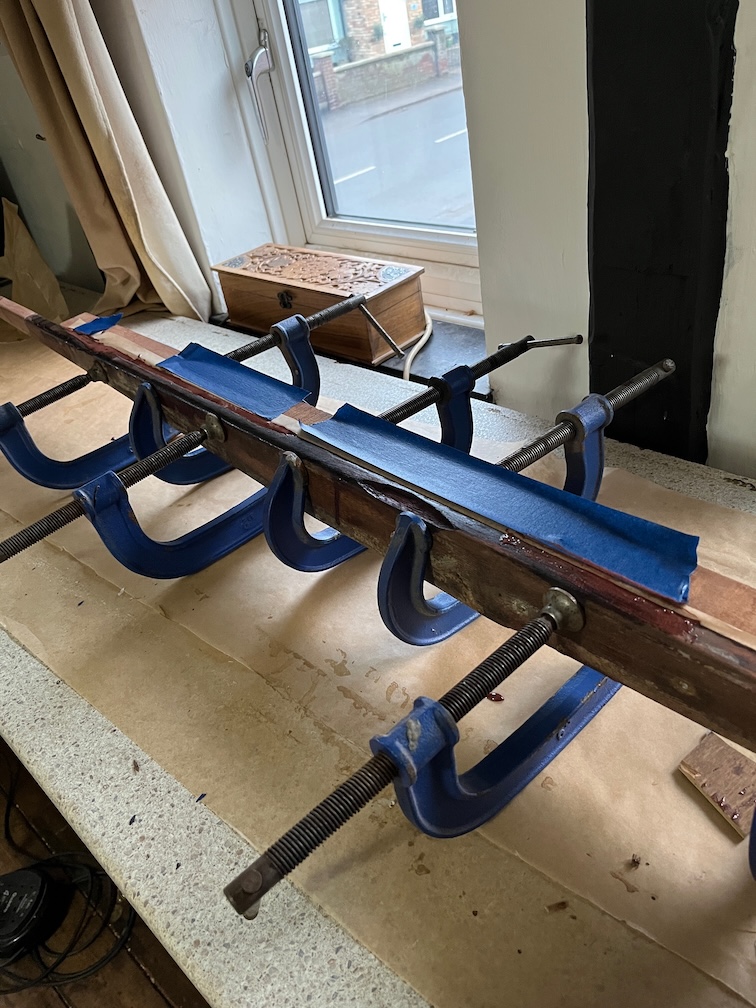
I clamped a long flat piece of wood to the side of the runner with a length of baking paper between the two to prevent unwanted adhesion. The gaps left by the wood removal were then filled epoxy slightly thickened with low density filler. The epoxy was intentionally quite runny despite the filler such that it flowed into the gaps.
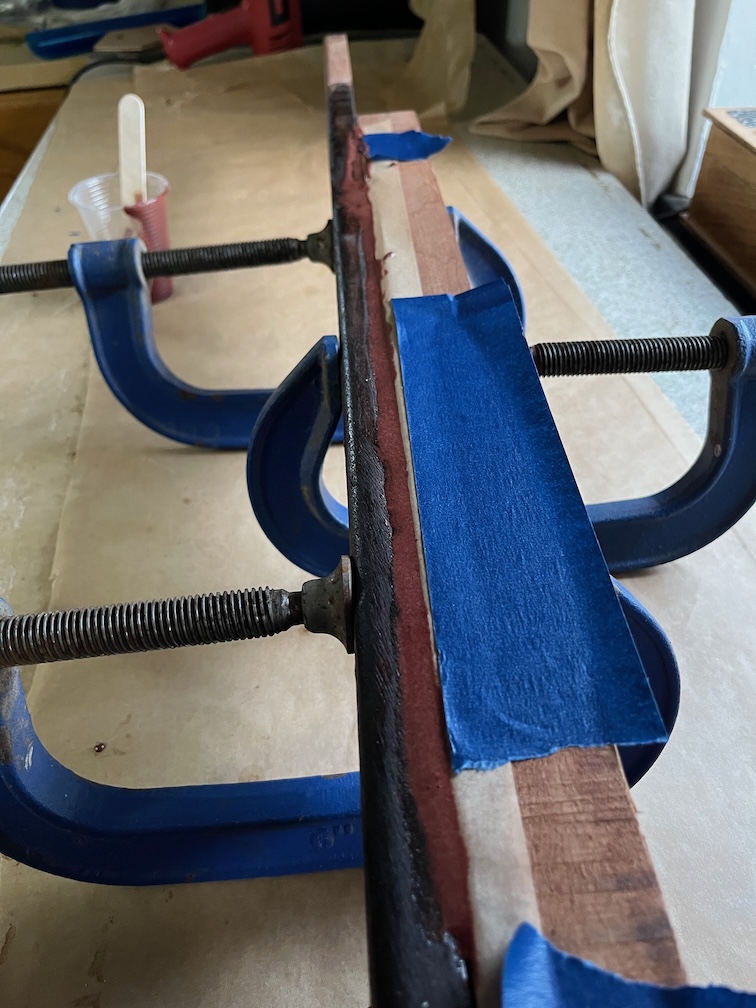
Once the epoxy has cured I shall remove the clamps, wood and baking paper, tidy up any splotches and the runner should be ready at that point to be fixed to the case side without fear of trapping any water in the future. This is probably taking things to an extreme, but it isn’t going to hurt.
The next small task I undertook was to start work on removing the remains of the port side of the centerplate case from the stern block. This was only a small area but the access is from the cockpit in which it is too cramped to kneel. The work has to be done whilst half sitting on the thwart and half crouching down to reach the work area.
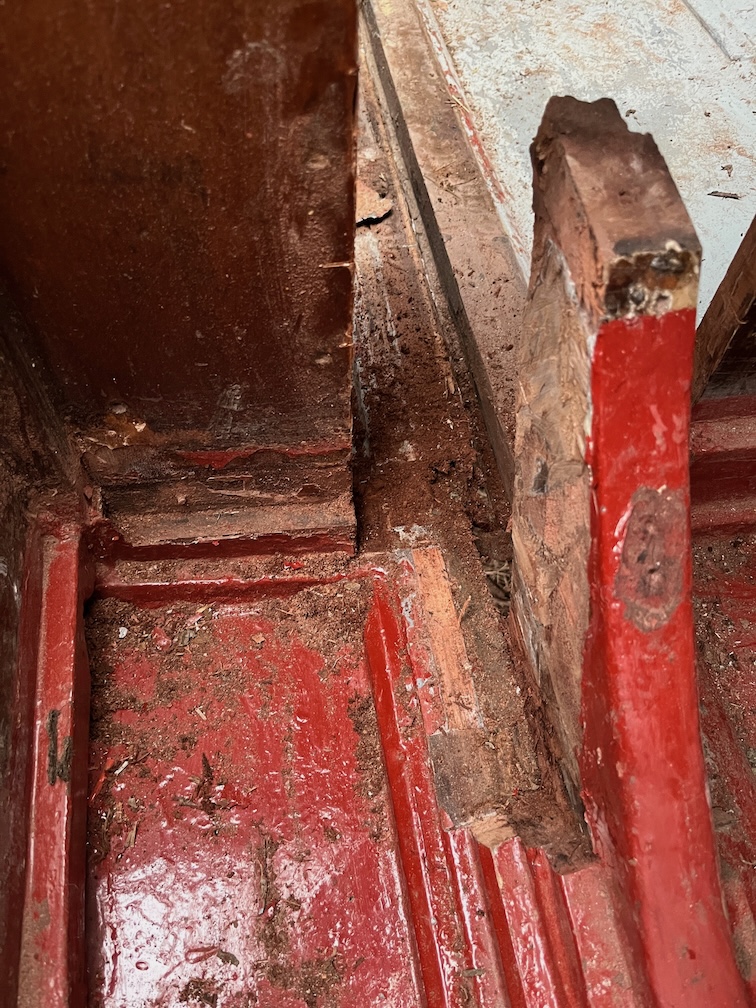
This is not completed yet, there is still some plywood attached to the aft block but I cannot get at the plywood using the multi-tool and have to use a sharp chisel. Even then it is not an easy job.
However, I did manage to get all three runners removed to the port of the block almost down to top of the keel. I say almost since there seems to be a thin piece of wood laid on top of the keel and under at least one of the runners. This will have to be removed with some careful chisel work as well, so I’ll leave it for the moment and make the remainder of the removal a separate task.
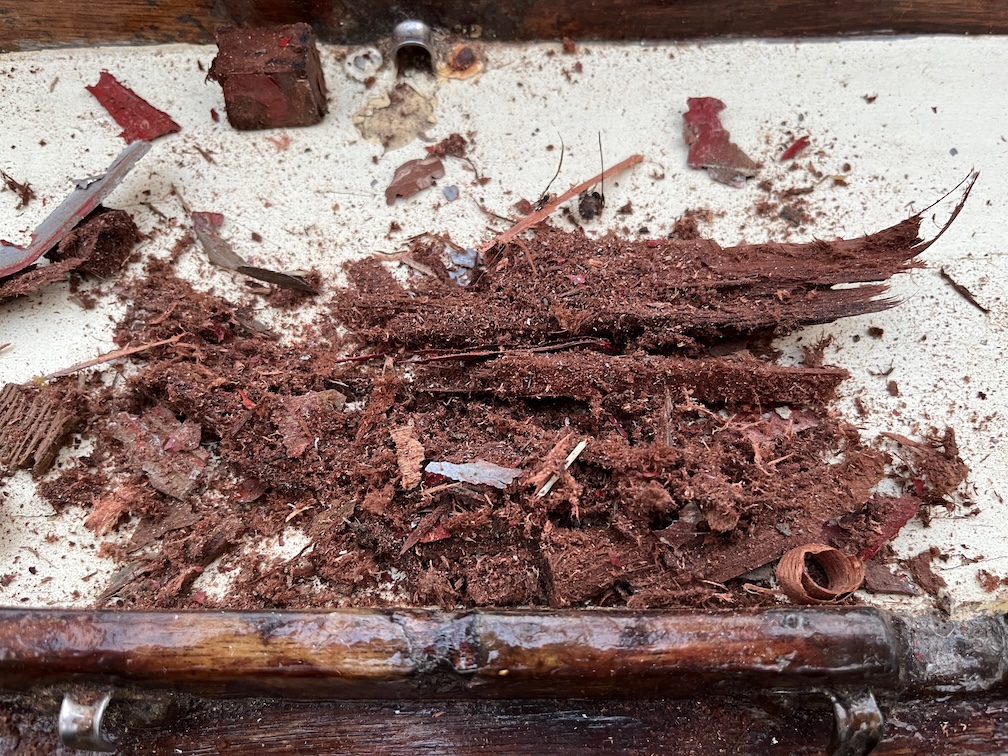
Once again, most of the wood removed was damp and lacked much structural integrity, however, from what I can see of the keel it has not extended to that timber.
Time for a cup of tea.