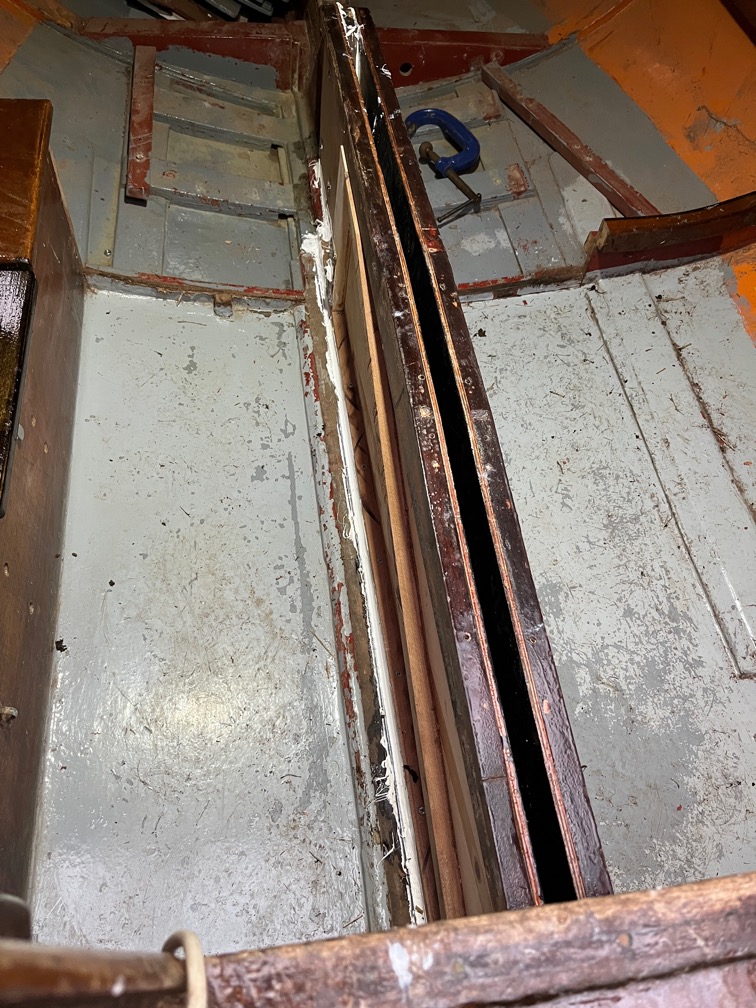
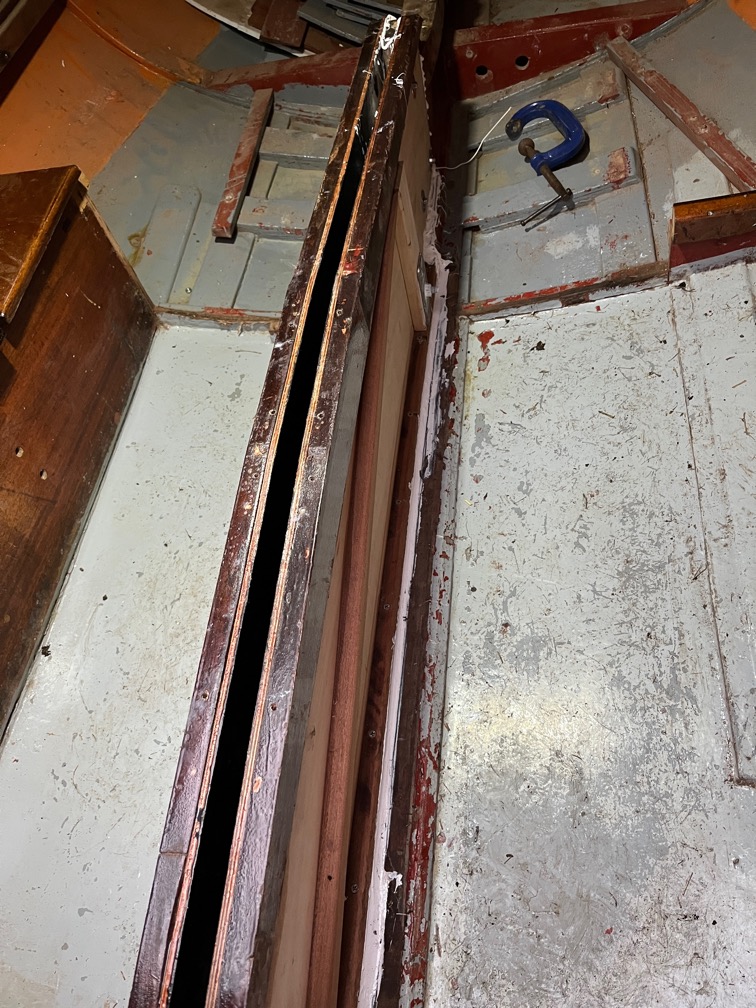
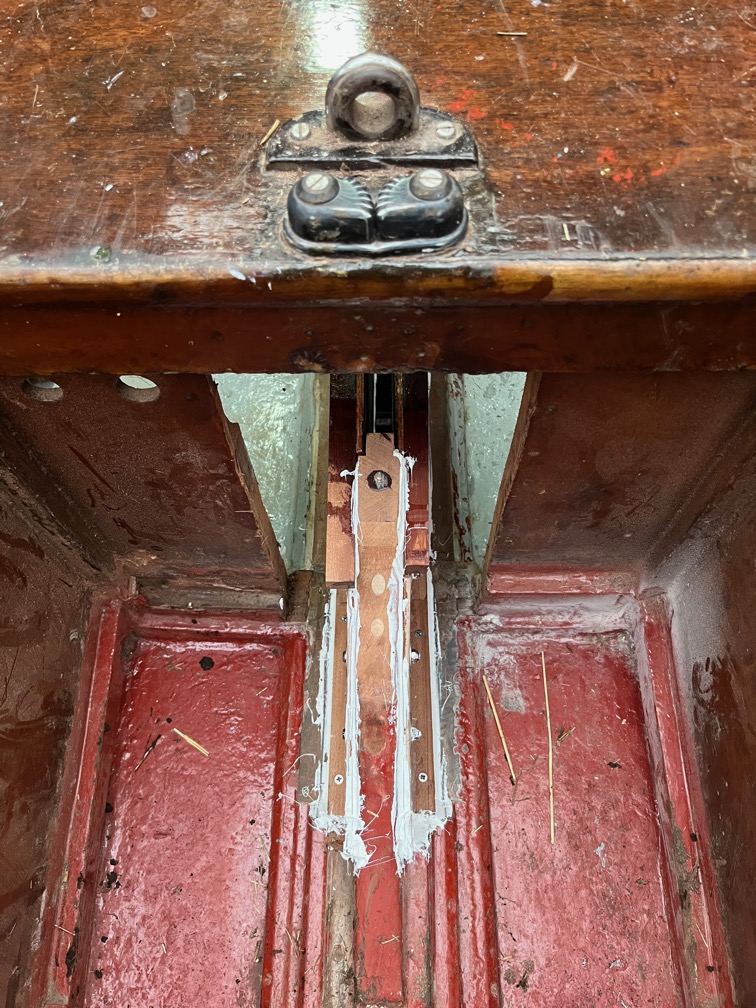
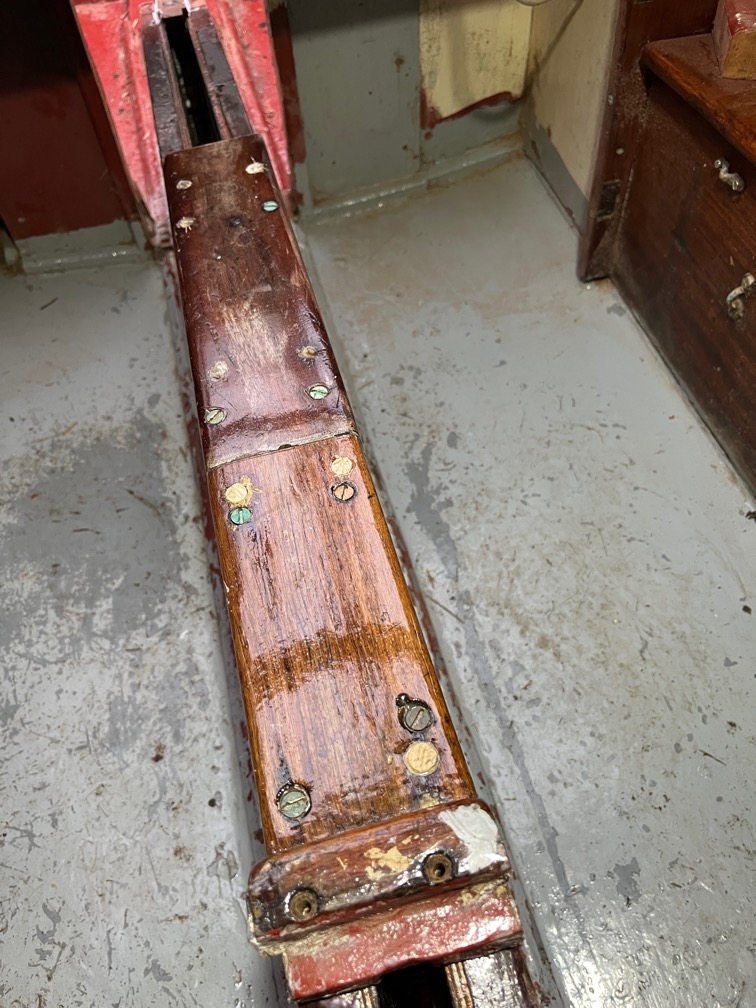
Today I started the construction of the gantry crane, which is really two gantry cranes that will be used in tandem to lift the boats, one at a time.
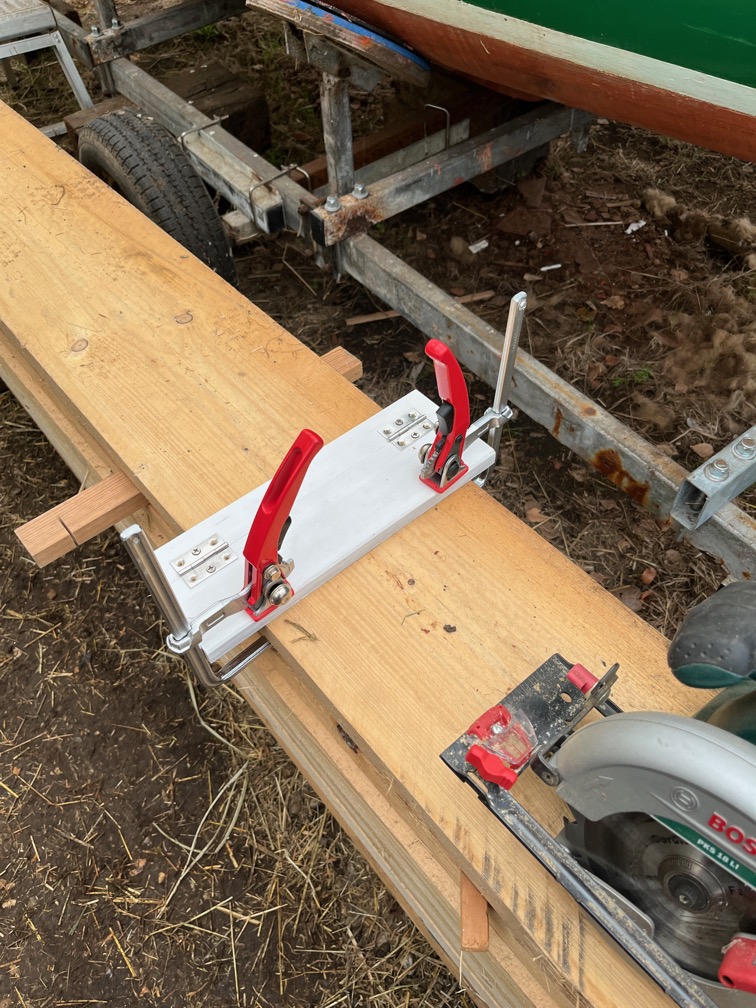
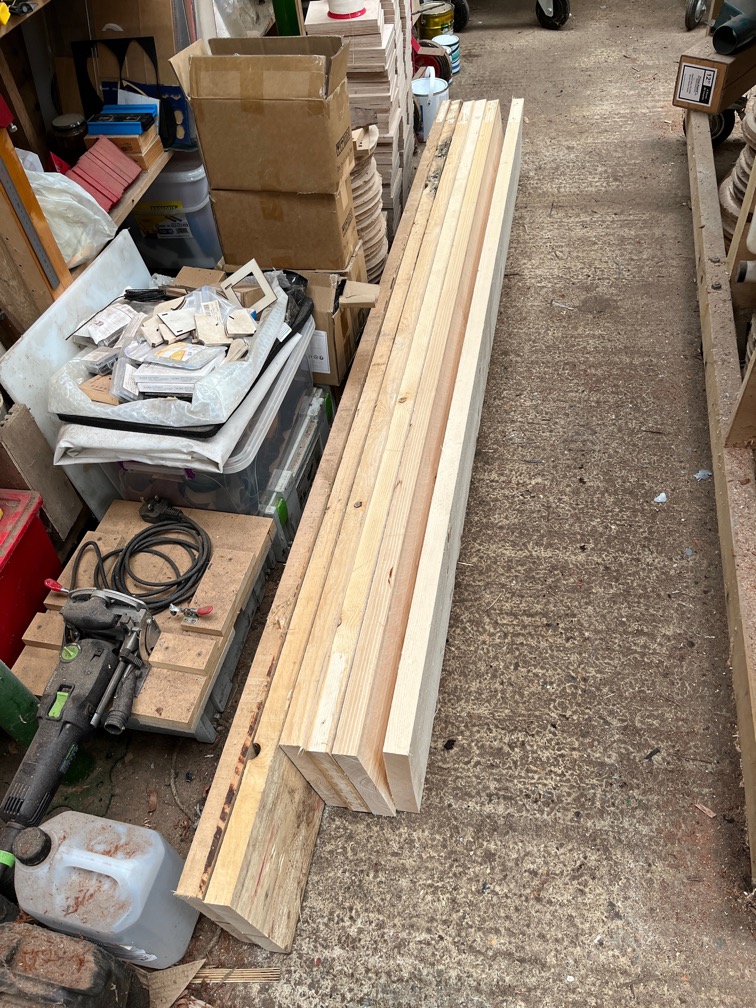
Initially I started cutting on the pile of planks, putting two spacers under the plank being cut.
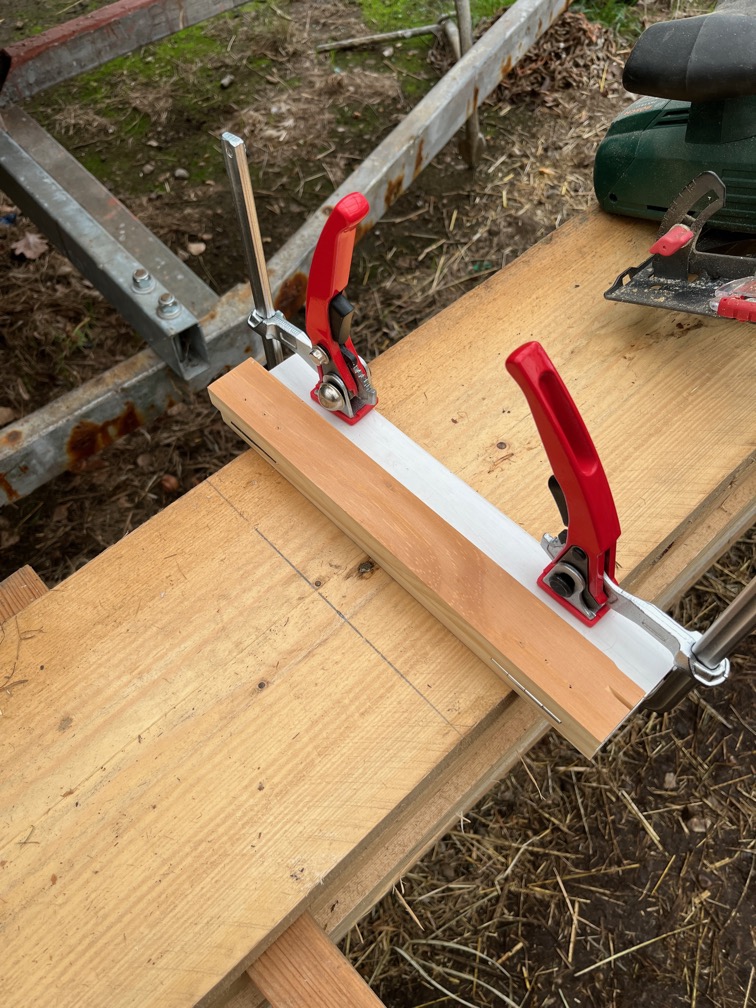
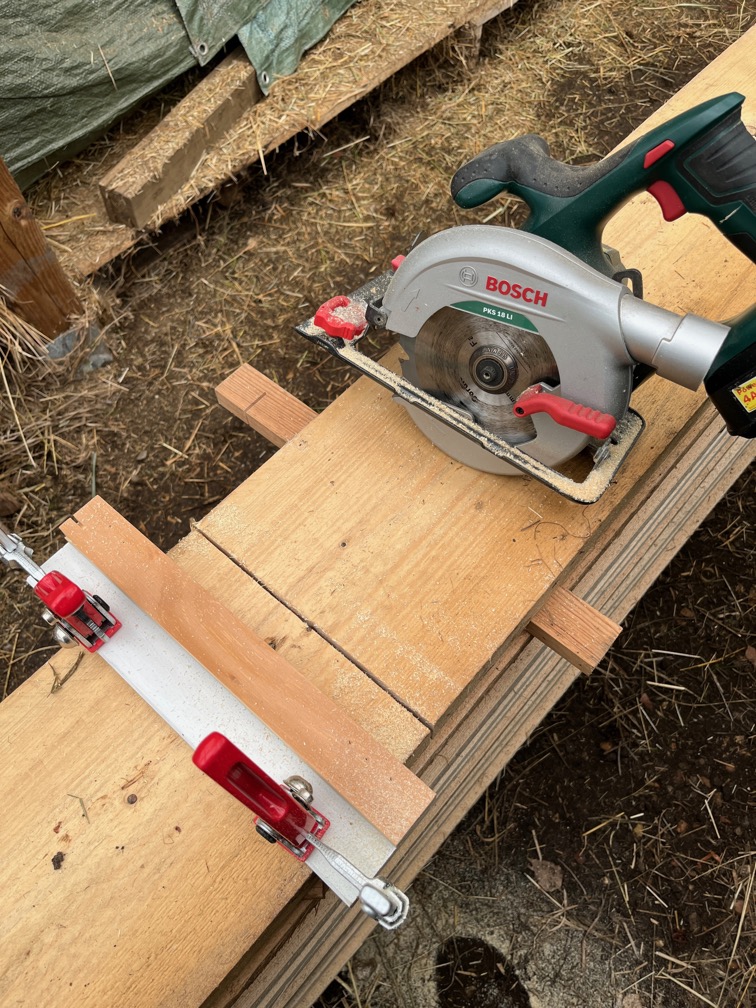
The jig I made last night worked very well and allowed me to make the cuts with ease.
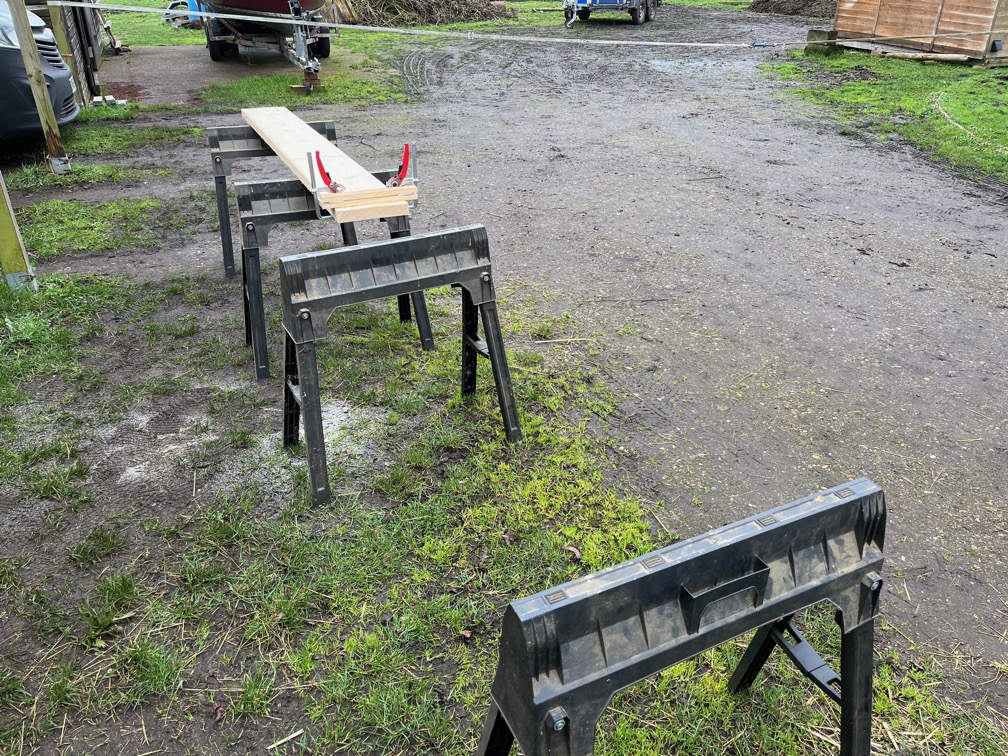
The first two planks were cut like this, but I found that this was a bit too low for comfort and decided to use the work horses instead. The planks would only get lower as each one was cut.
A lot more comfortable.
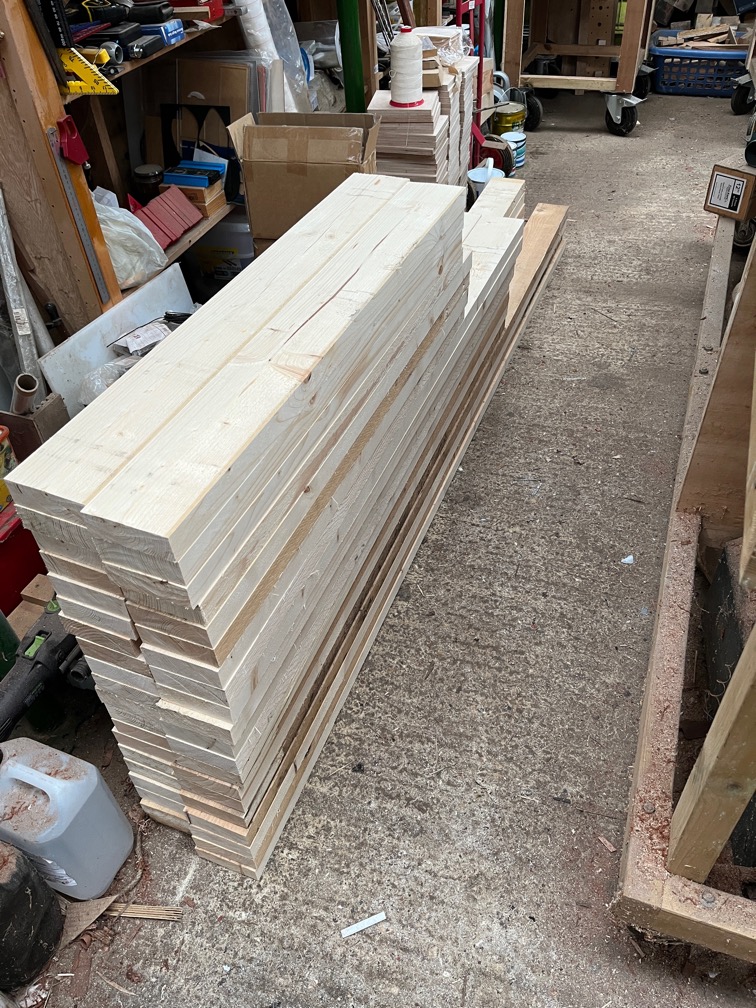
At the end of the length cutting phase, these are the results:
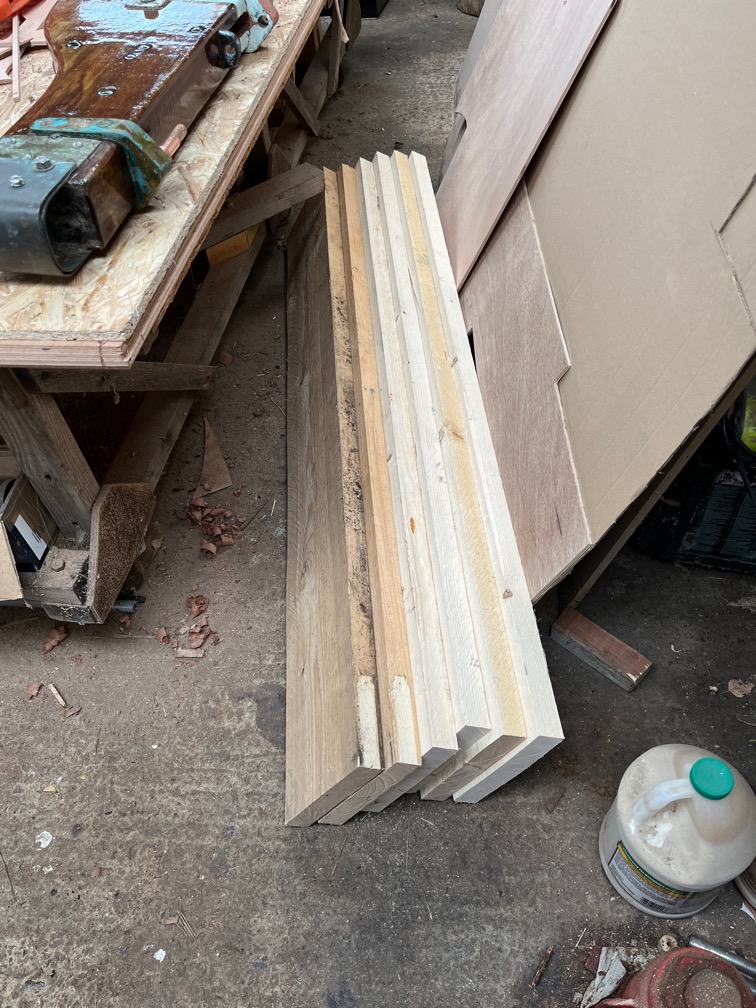
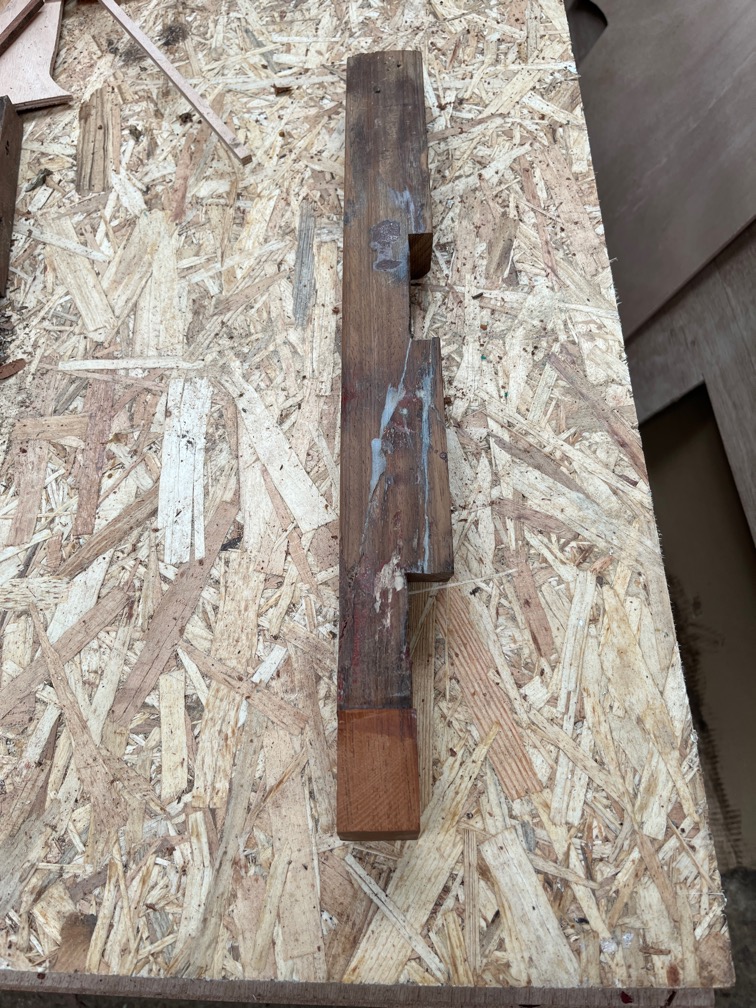
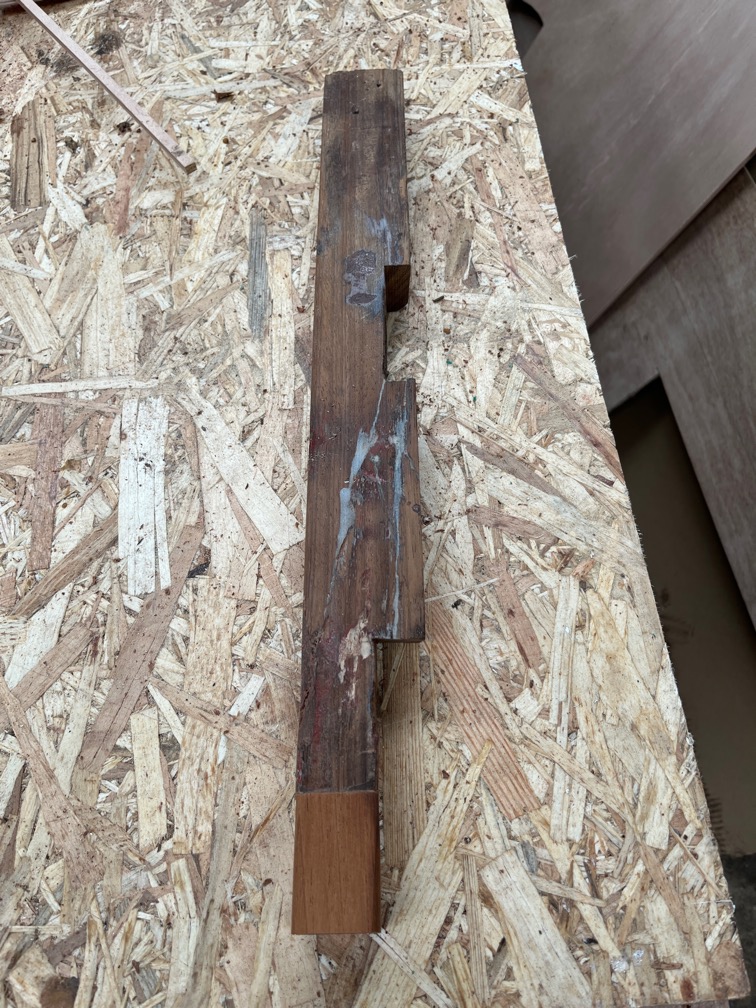
These will form the four legs, consisting of three pieces, one long and two short.
These are the feet upon which the legs will rest, consisting of three pieces for each foot.
These will be the diagonal braces between the feet and the legs, each brace consists of two pieces, one long, one short and there are two braces per leg.
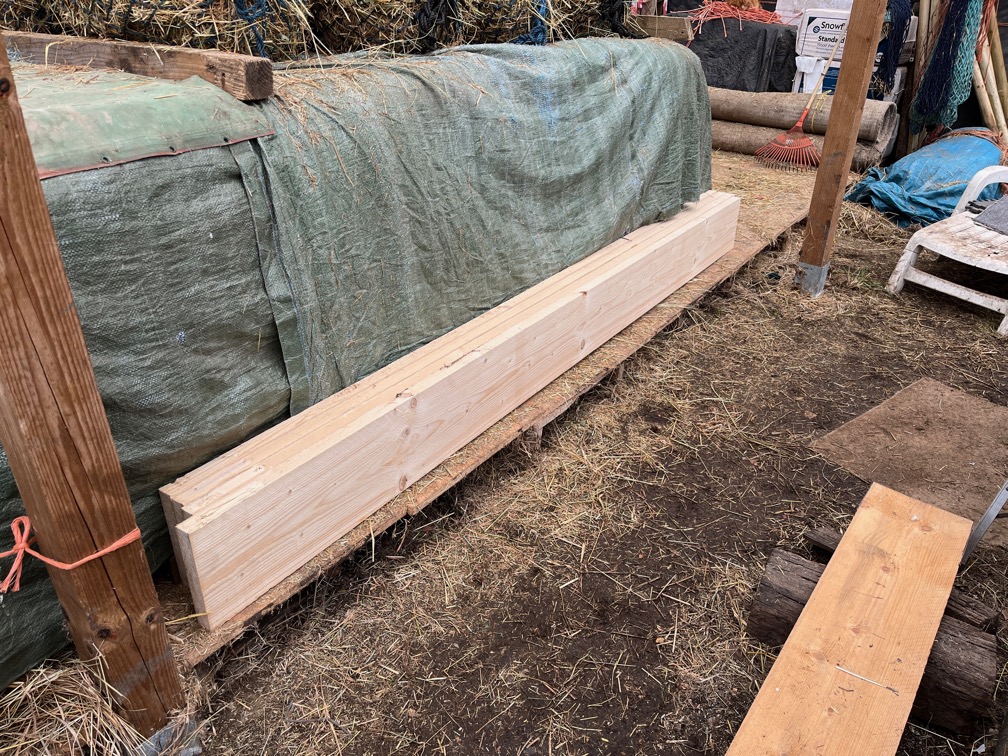
These are the cross beams at the top of the gantry, two on each gantry.
All of the pieces except the cross beams will be cut lengthwise in half, which will be the next task after a break.
The cutting was easy due to the circular saw jig.
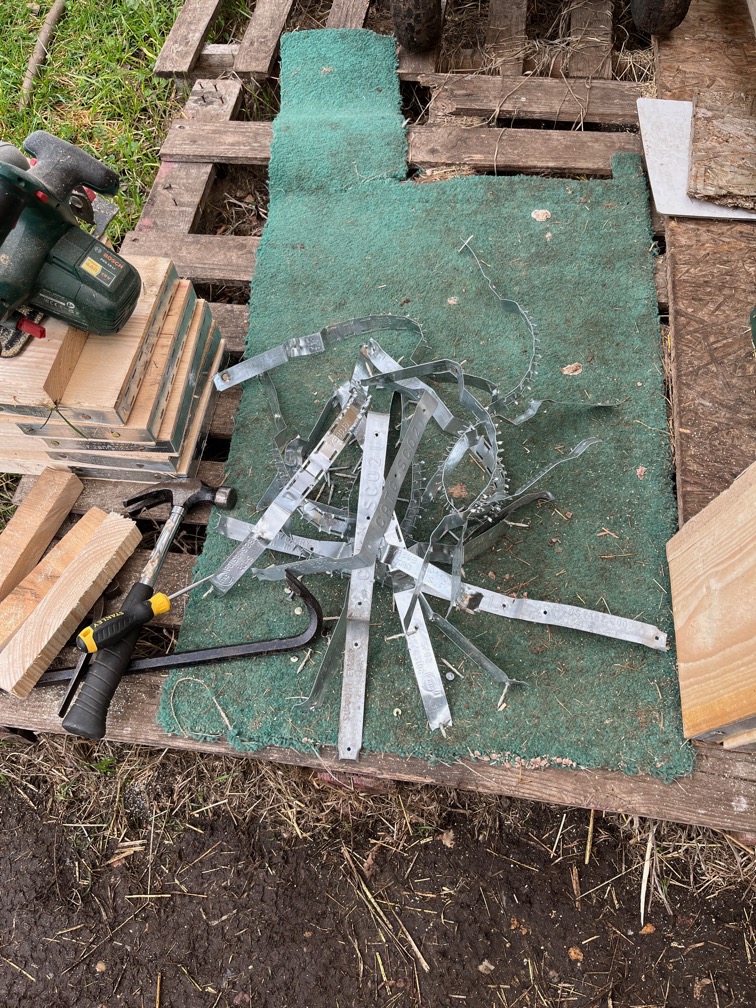
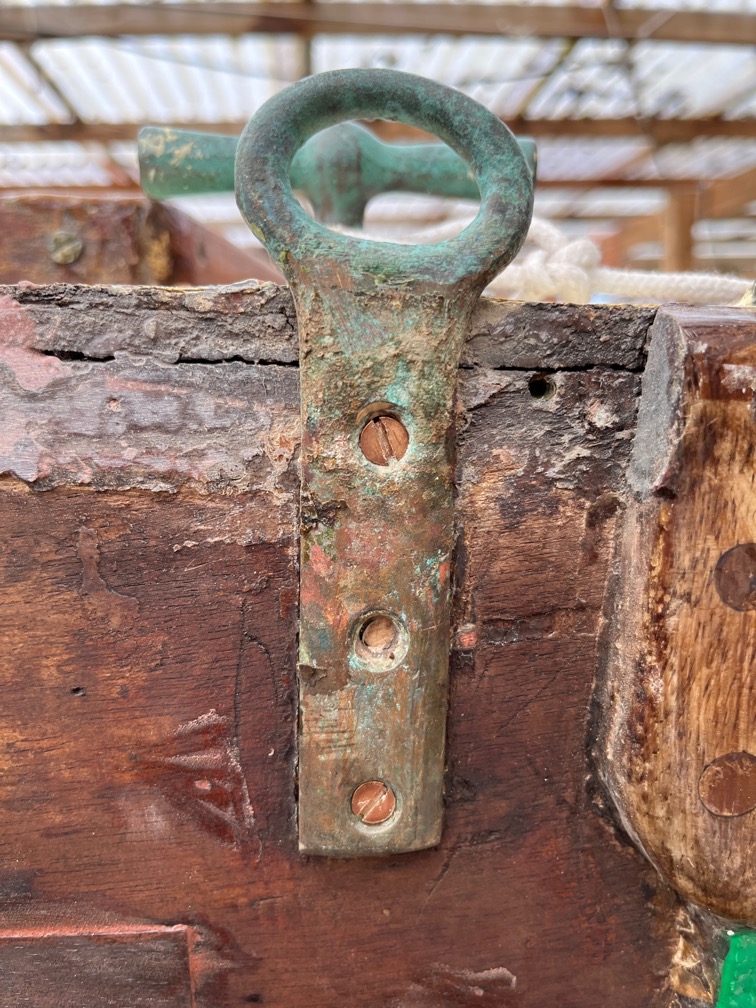
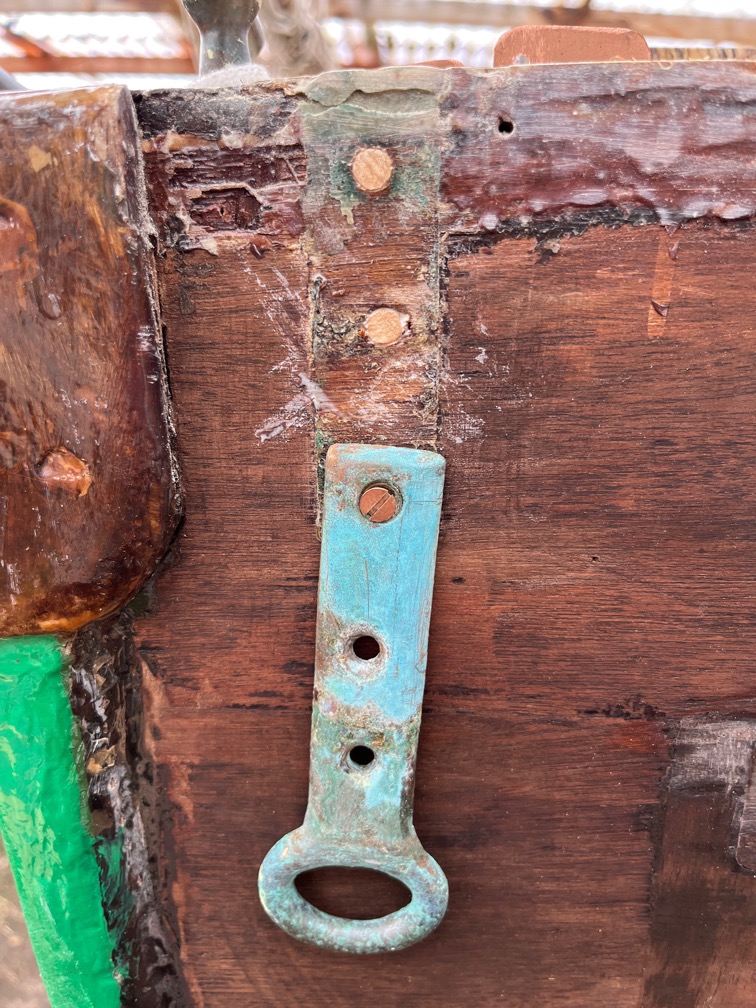
This was the hardest part, getting the metal straps of the ends of the planks. It took as long to do that as it did to cut the planks. And there’s more to come !
Time for a cup of tea.
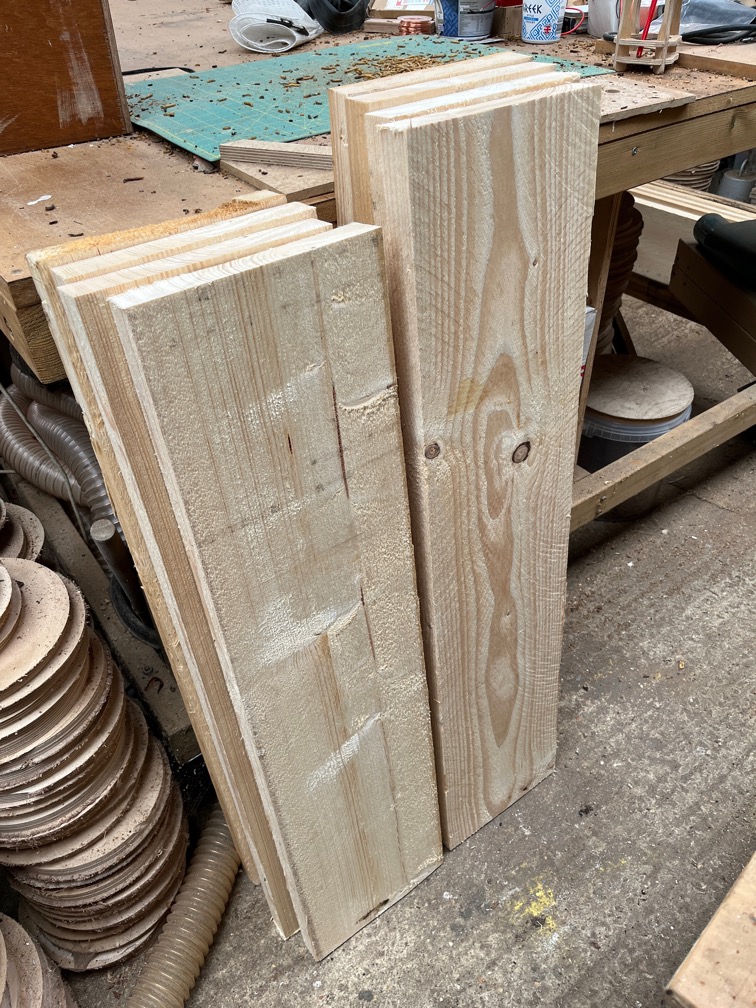
After a break I started on cutting the timber lengthwise.
An hour later I had a stack of cut timber almost ready for the construction. I say almost as the diagonal braces need the ends cutting to 45º. But I needed another break before I tackled that task.
Time for a cup of tea.
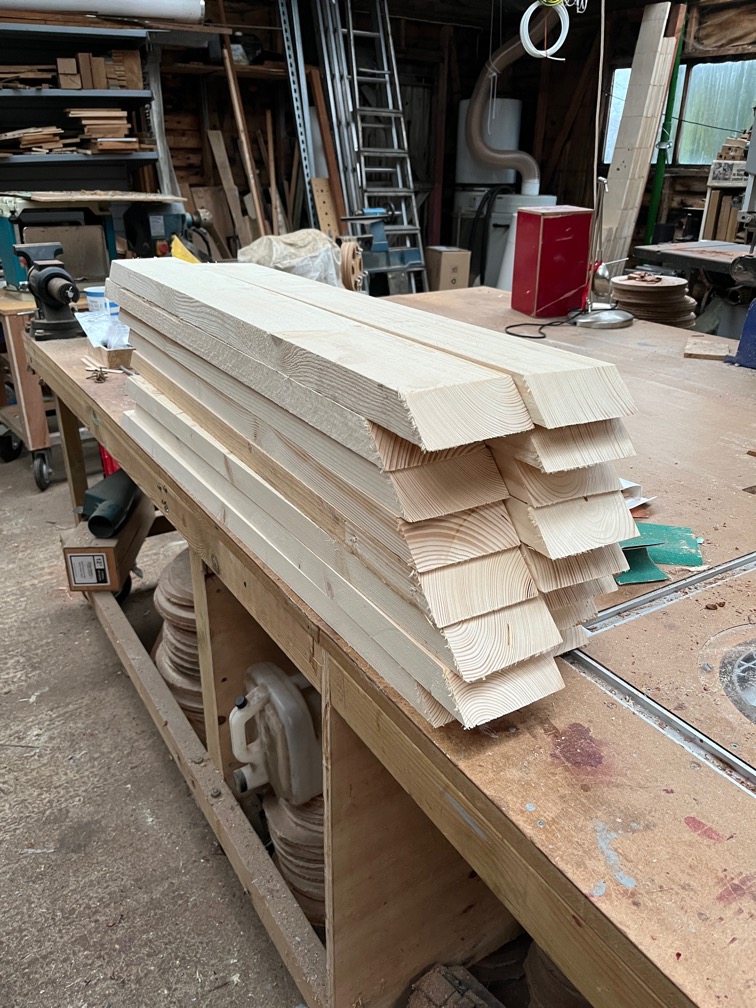
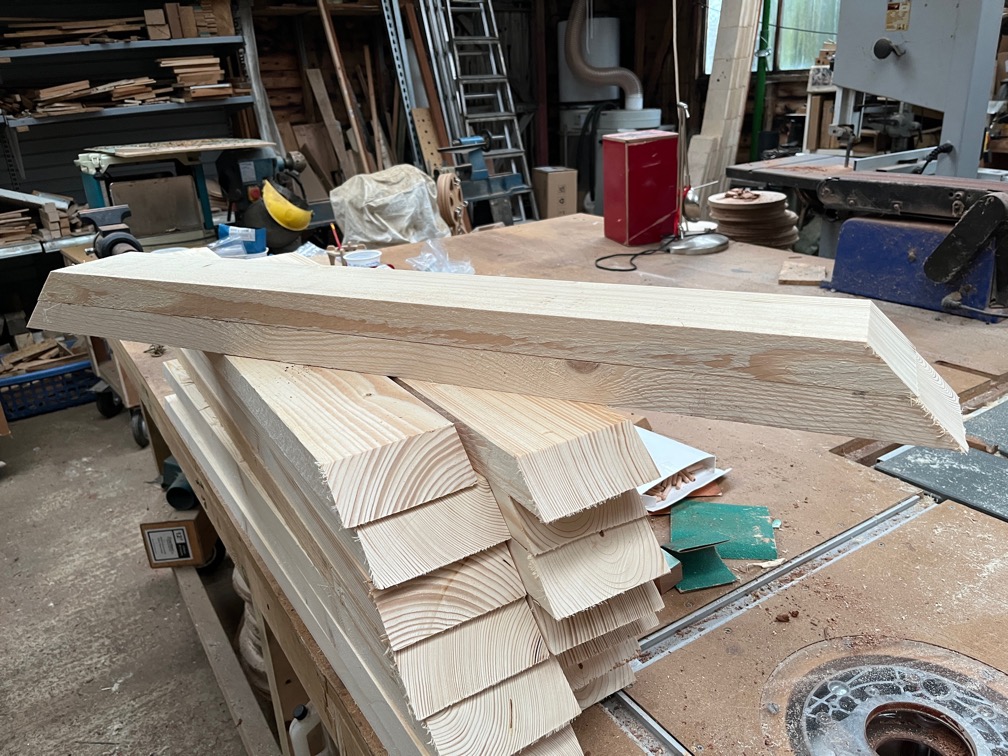
The foot braces were cut on the table saw with the blade set to 45º. Once set up this didn’t take very long to get through both ends of the sixteen pieces of timber.
All sixteen pieces cut.
This is how they will be when fitted. A pretty close fit. Good enough for this project.
Now I am ready for the construction which is tomorrows task.
The day started overcast with little wind but chilly, so I decided to do a small task, just to get things moving, so to speak.
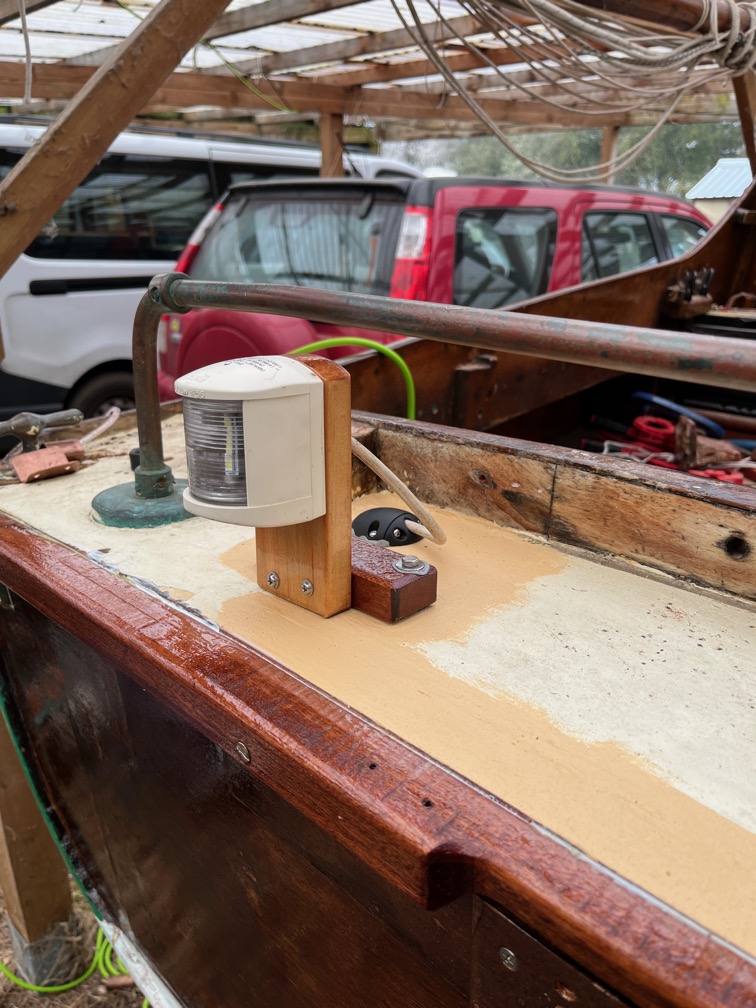
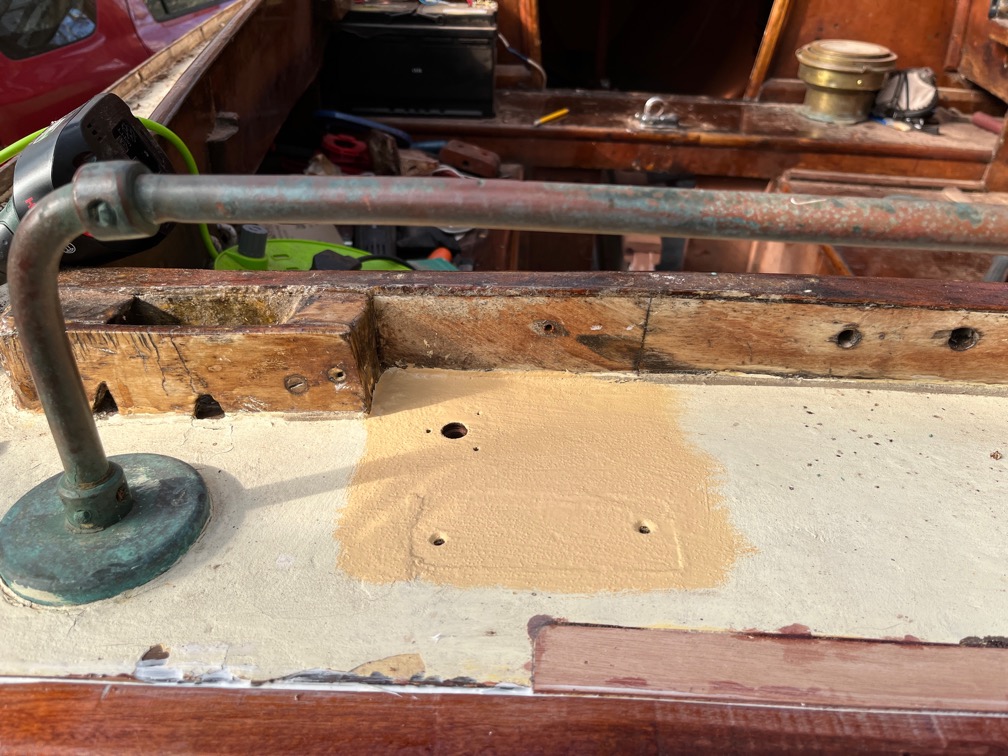
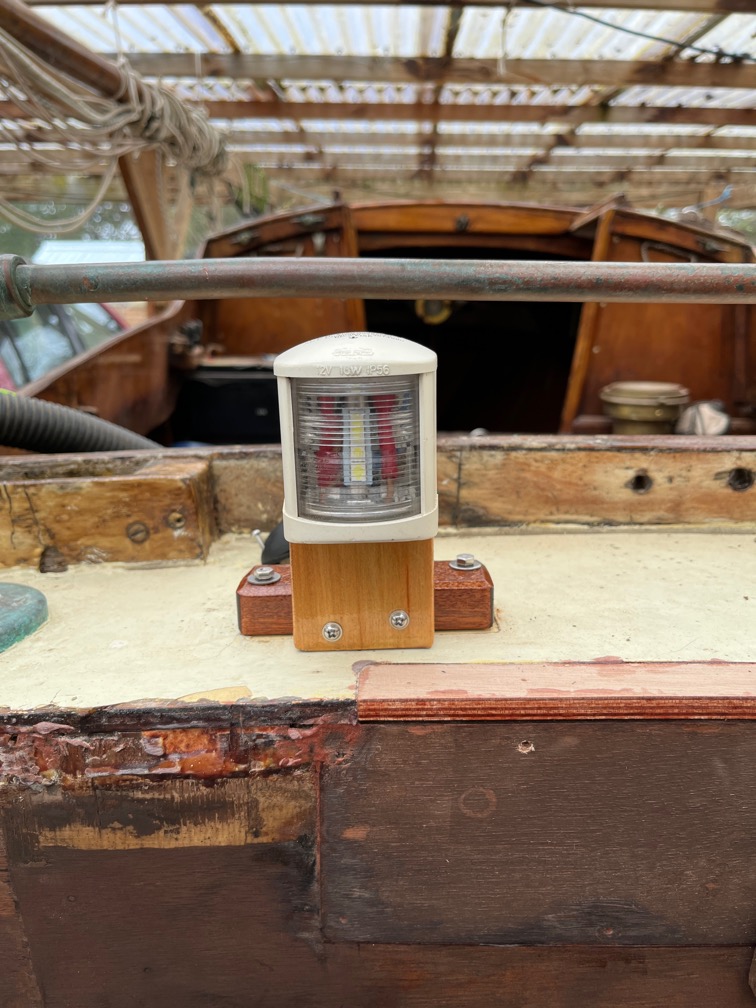
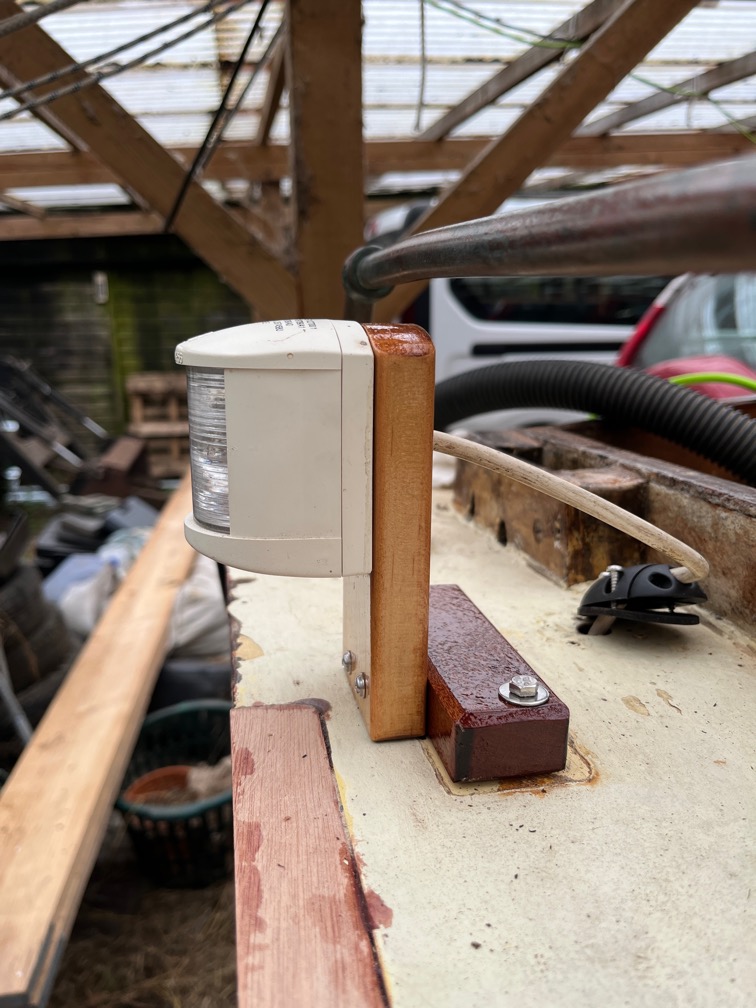
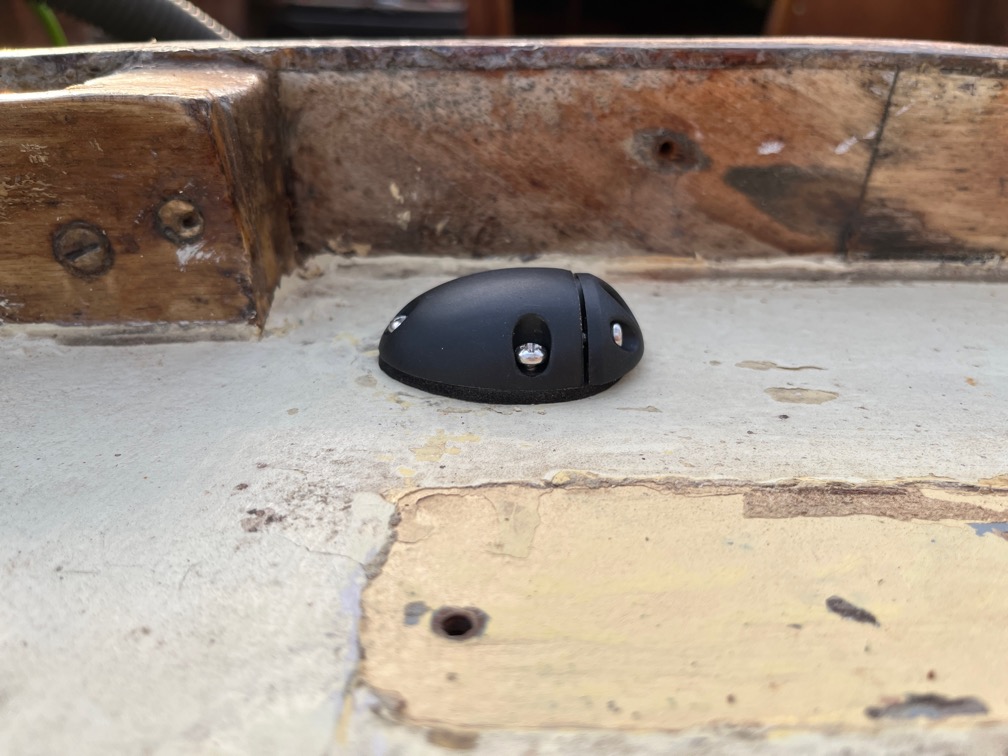
A nice, simple job, installing the aft navigation light. The various bolts and screws had butyl tape wrapped around the shank as was the underside of the deck gland. The fixings were all tightened up, but not overly tight, to allow the tape to spread into the gaps.
During the next break I took, I lightly sanded the transom and applied a third coat of varnish.
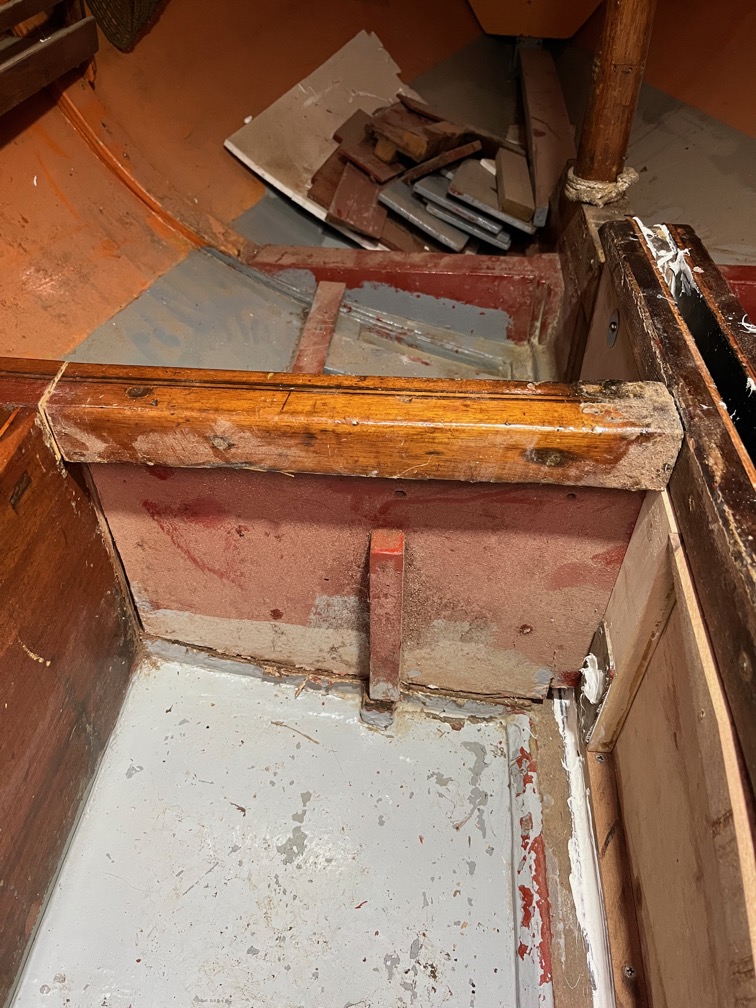
The next part of the necessary preparations for the leak test was to put the half-bulkhead back on the port side of the case.
Putting it back in place is easy, just apply some epoxy and stick it in. The problem is that if there are leaks, then I may need to take it out, so for now, it needs to be temporarily fixed in place.
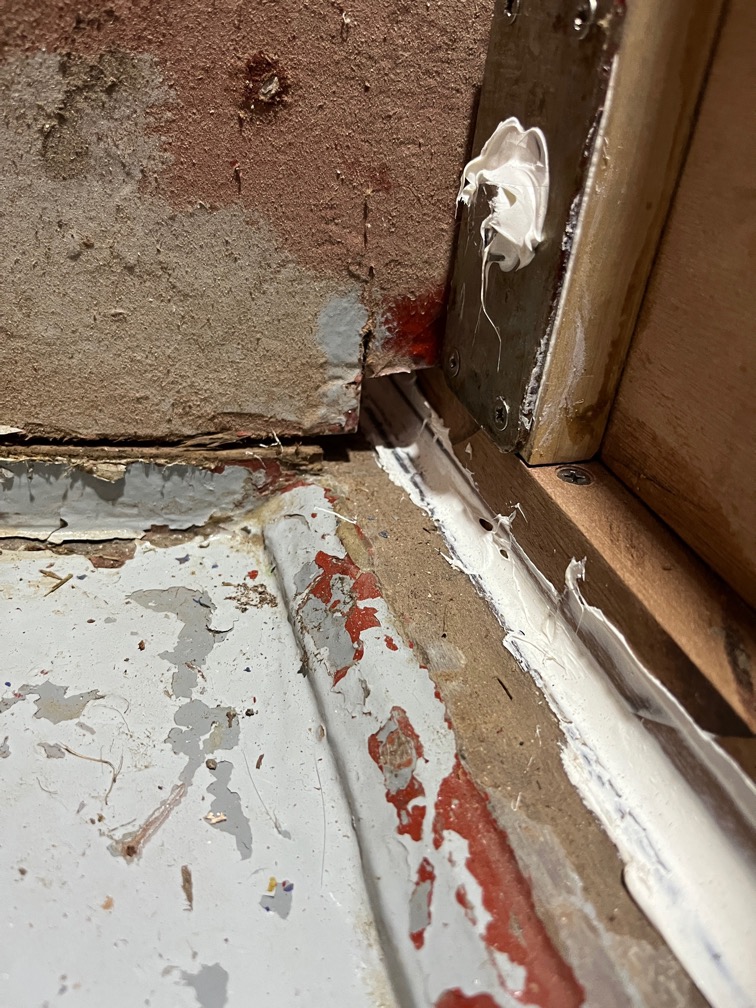
I also need to put in the second and third bottom runners on each side of the case, you can see the gap in the bulkhead where one of those is meant to go.
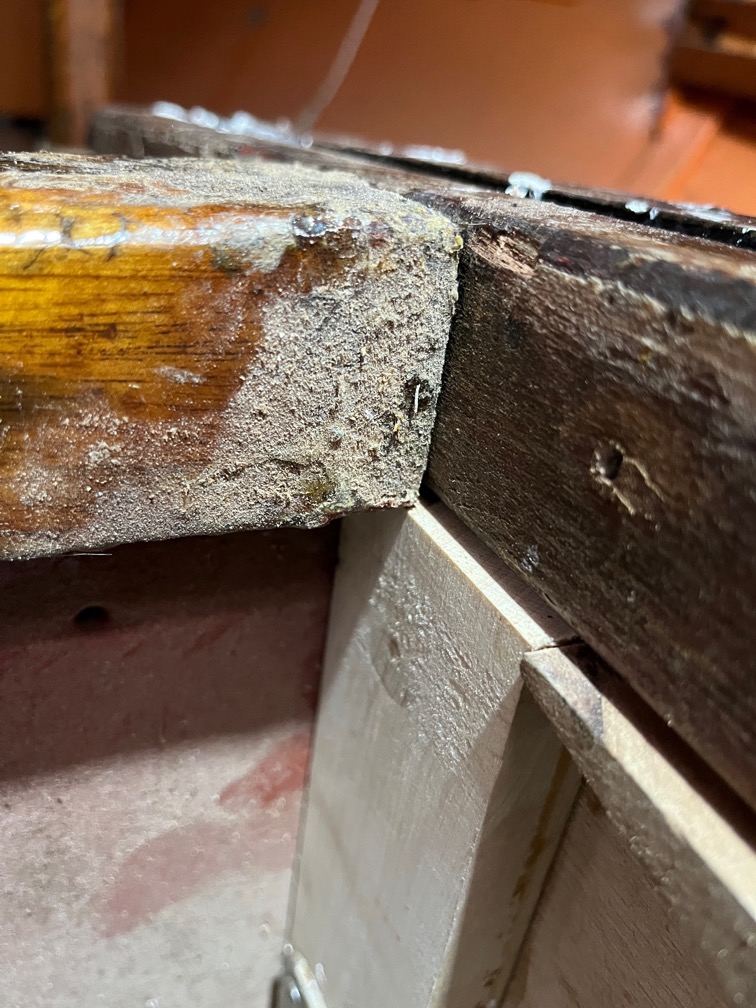
The top need to be adjusted slightly as the case side reinforcement is slightly wider than the original. The bulkhead also need to be well cleaned as it is covered in sawdust.
I stepped back and restated the problem. It is not how to fix the bulkhead in temporarily, it is instead how to brace the centerplate case for the journey on the trailer to Ely and back again and for the launch and recovery.
Stating it this way made the solution very simple. All that is required is a stout piece of timber the width of the cabin at the pivot bolt position, some scraps of wood and some cramps.
Sort of.
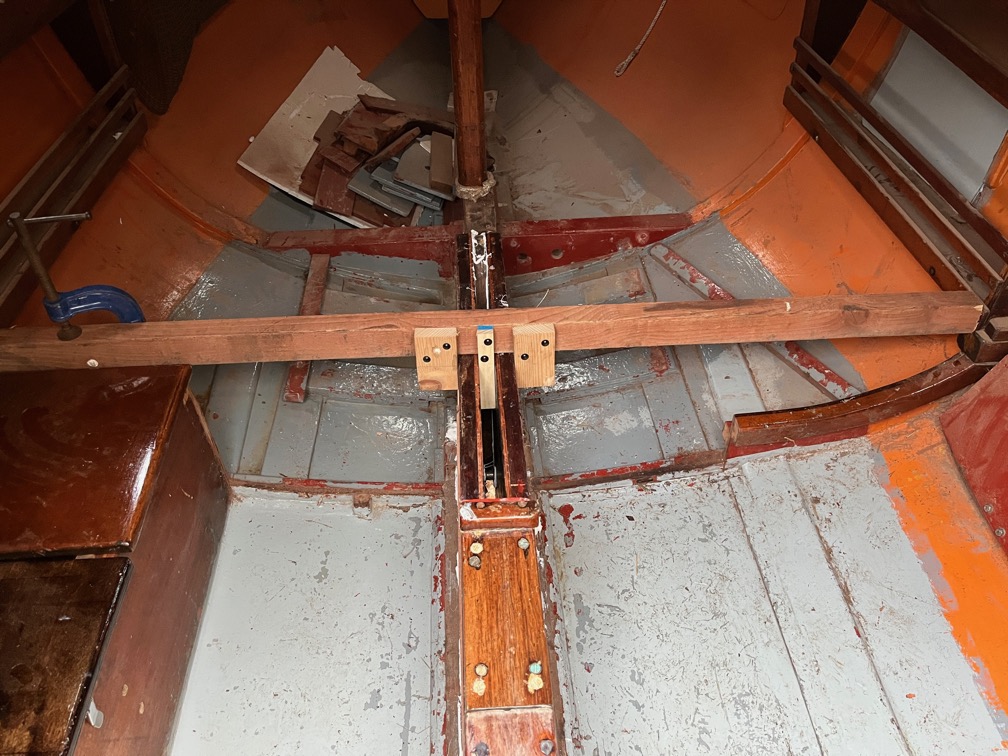
Like this. The starboard side is braced against the woodwork on the starboard side of the cabin and the port side is clamped to the remaining section of the half bulkhead. That should be enough bracing for the leak testing procedure.
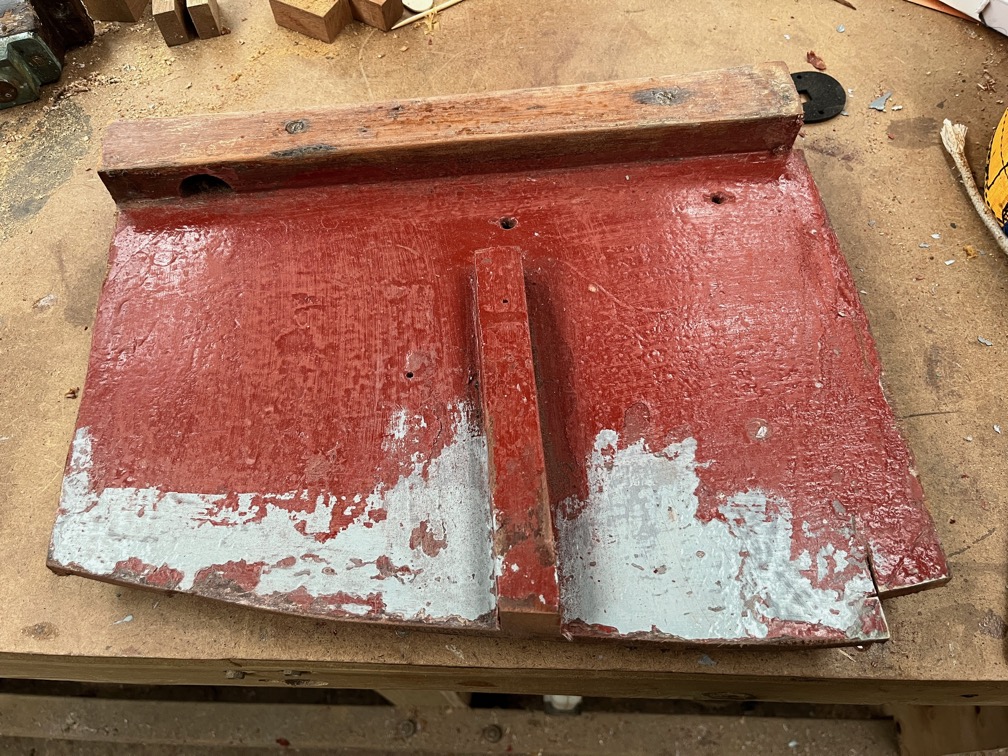
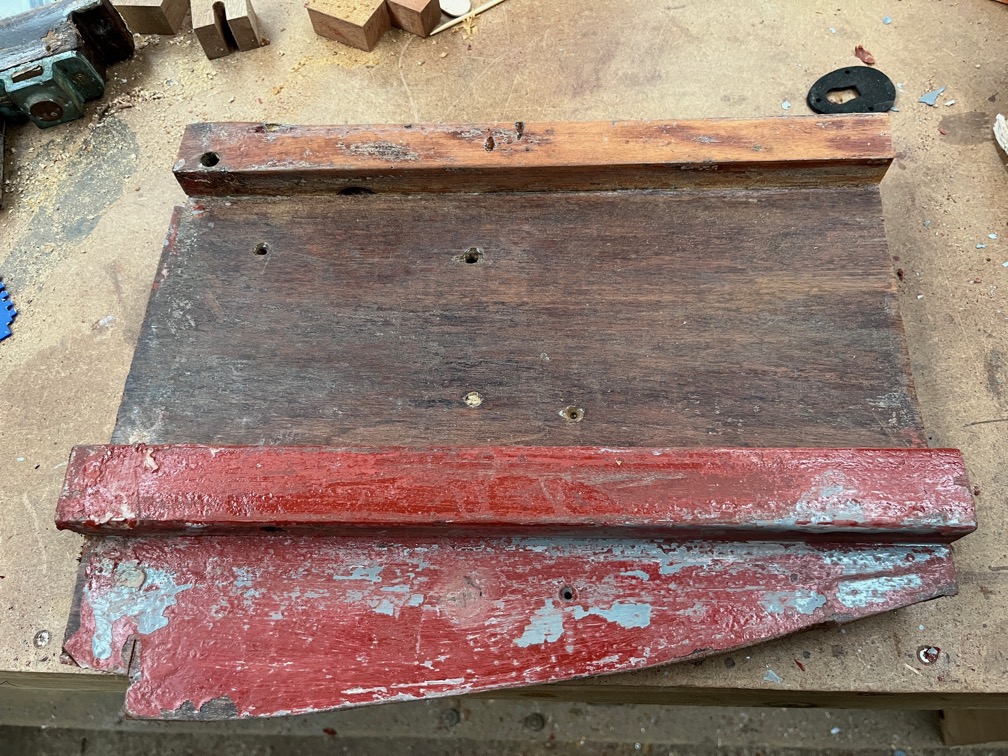
I took the cut out section of the half bulkhead into the workshop to give it a clean and a sand and it looks as though the last coat of varnish was applied without cleaning or sanding the workpiece first. The top layer of varnish just flaked off. I’ll have to go over it properly and make sure that all that top layer is removed. The forward part of the bulkhead is half painted and half varnished. Since this part is rarely if ever seen, I’ll paint it and just varnish the top part. The aft side of the wood is painted.
I took the time to sand the cut section of the half bulkhead during a tea break. This is the aft side.
And this is the forward side, the side which was varnished and I have scraped off. This entire piece was not sanded before the last coat of paint and varnish was applied, it was all flaky. I expect that piece of the bulkhead remaining in the boat is the same. I probably will leave the rest of the interior “redecoration” for another season.
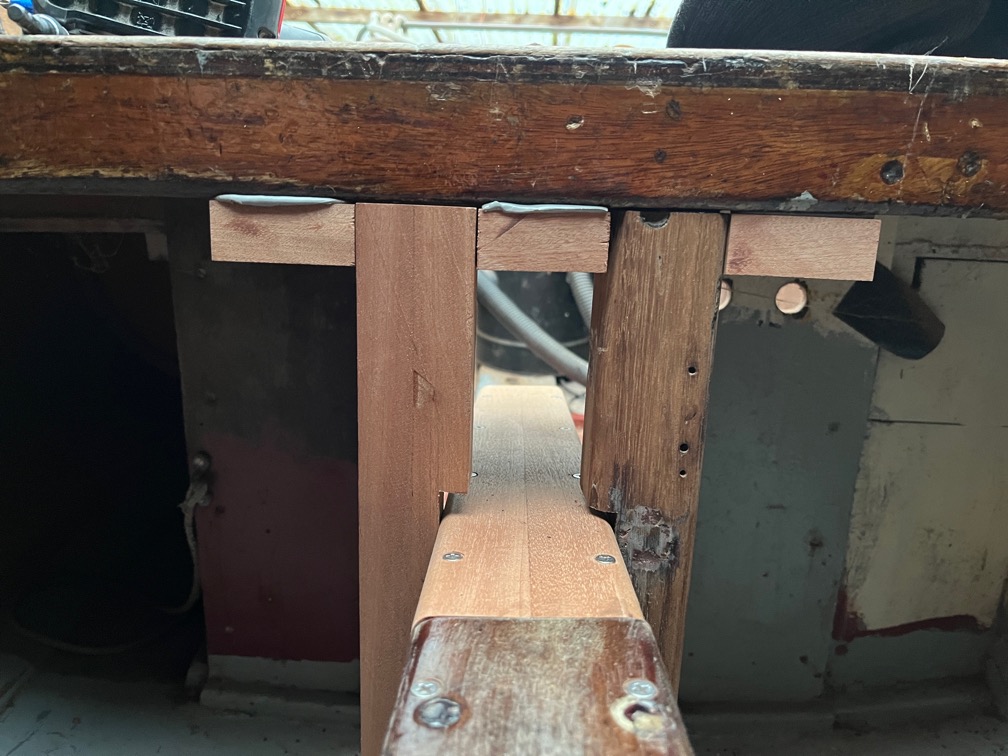
The next task lined up for the day was to restrict the lateral movement of the bridge deck supports such that they are effective.
Like this. These three blocks are screwed into the underside of the bridge deck with butyl tape in the joint and they are tight up against the two supports. They will be sanded and varnished when the supports are varnished. However, the port side block now prevents the door to the battery compartment from closing, so the next task is to deal with that.
The first attempt was close but not quite good enough so I took little pieces of the door away until it fit.
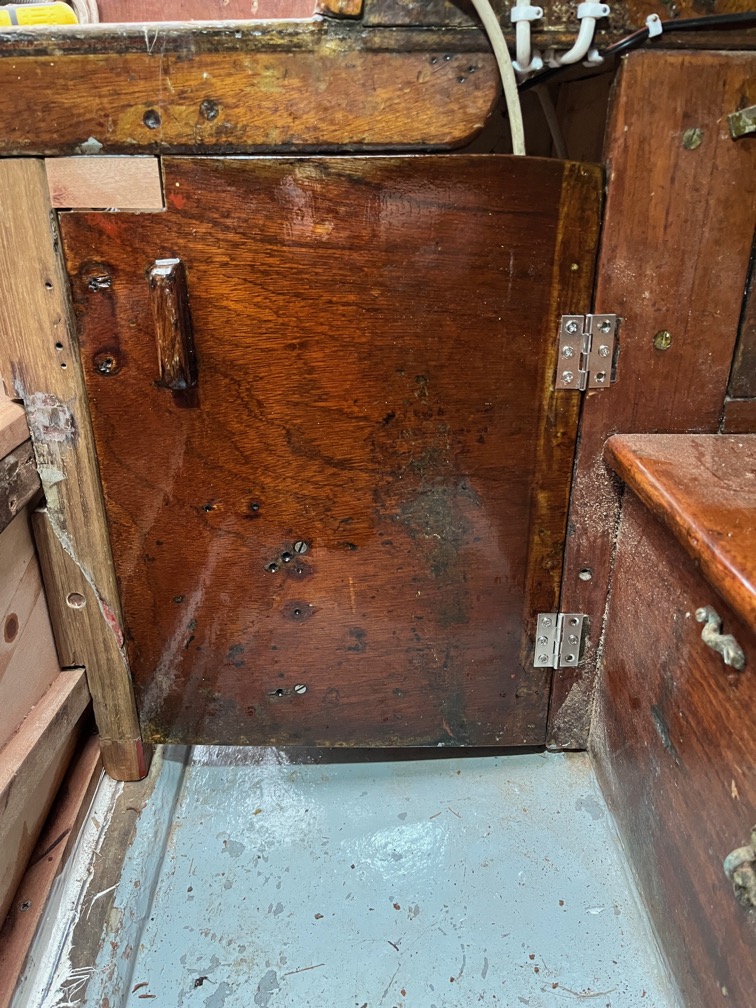
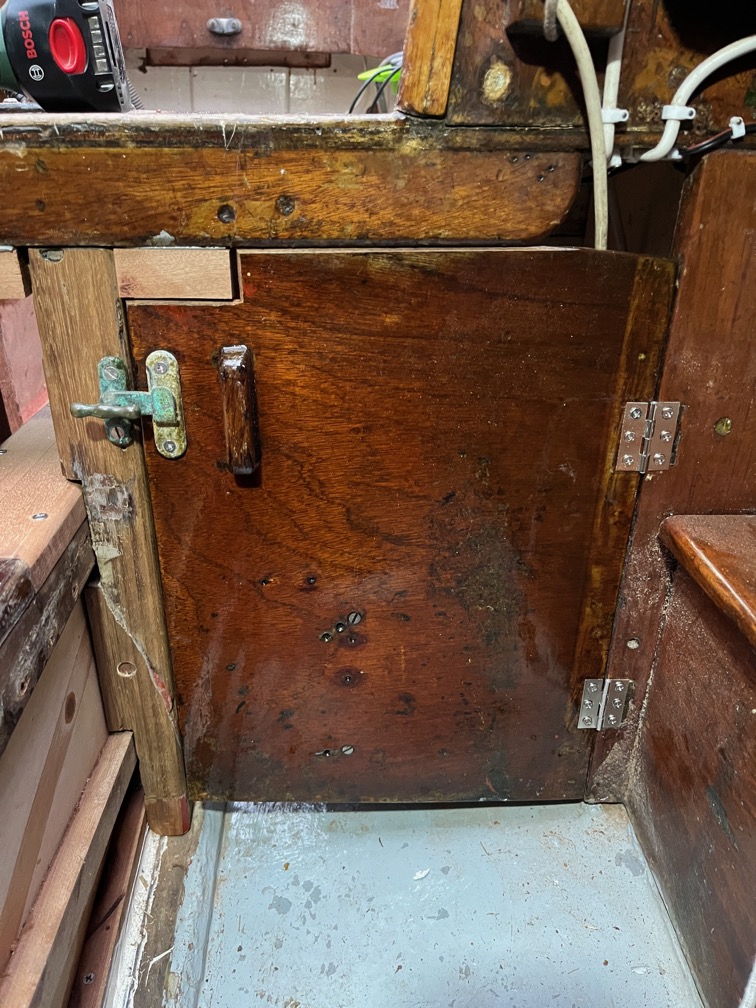
This is the adjusted door with the catch fitted. The plywood at the top of the door and where the cut out has been made needs to be varnished, so it was taken off and returned to the workshop to do that very thing. It will only need a couple of coats and will be finished tomorrow.
For now…
Time for a cup of tea.
The first task tomorrow will be marking out and cutting the scaffold planks to length and then to width. To make the cutting to length easier I make a circular saw jig.
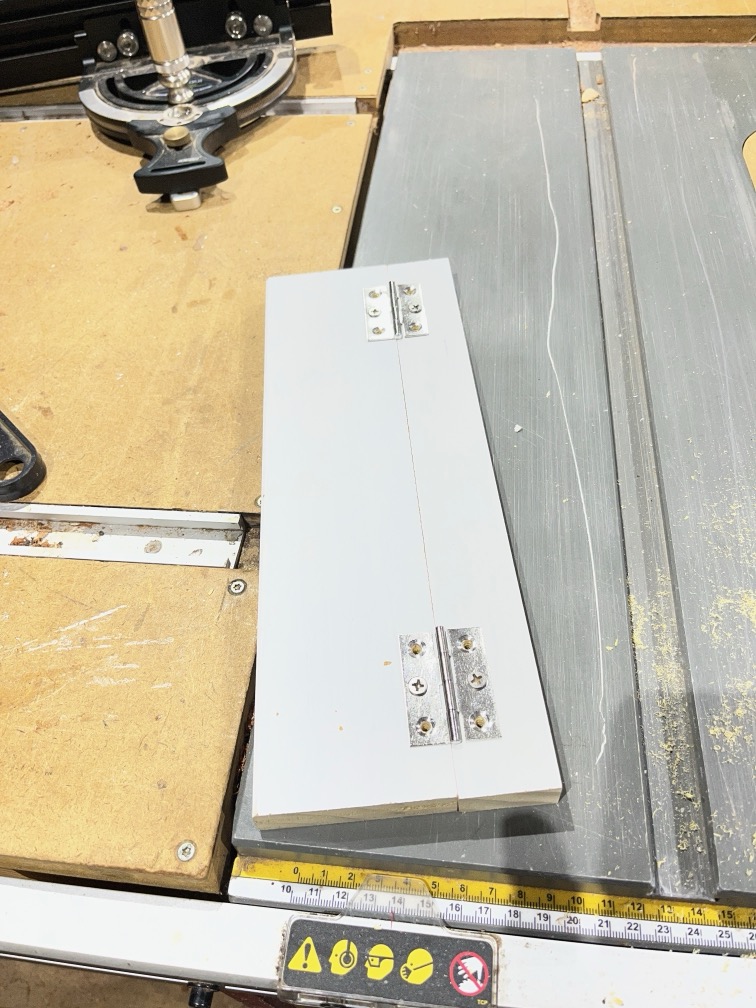
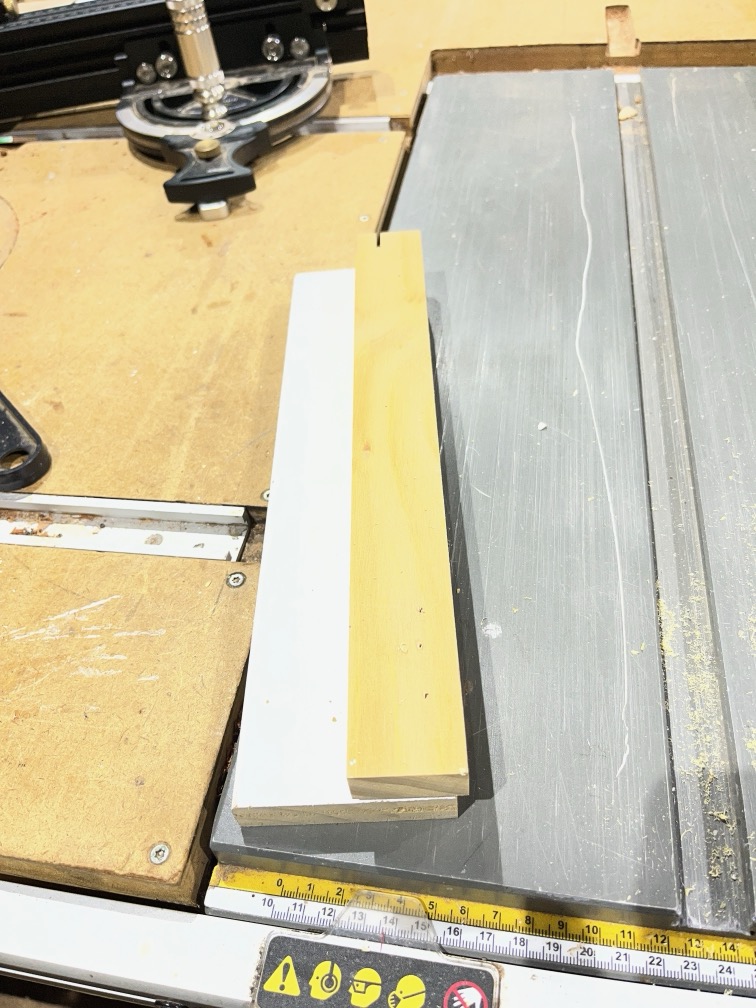
It is simply two piece of wood hinged together with the narrower piece being exactly the distance from the edge of the case to the cut made by the blade.
You open the jig out, put the right hand edge on the line you want to cut, clamp the jig in place…
…fold back the narrow piece and then use the edge of the wider piece to guide the saw. Simple and easy. Since I have twenty-four cuts to make, this is going to make it a lot easier to carry out.
With only a week to go before the leak test, the tasks over the next week will be concentrated on getting the boat ready. The day started out fine and sunny with little wind but with condensation everywhere. The forecast was for around 16º C so as soon as the sun had driven off the dew, I took the varnish down to the workshop to make a start.
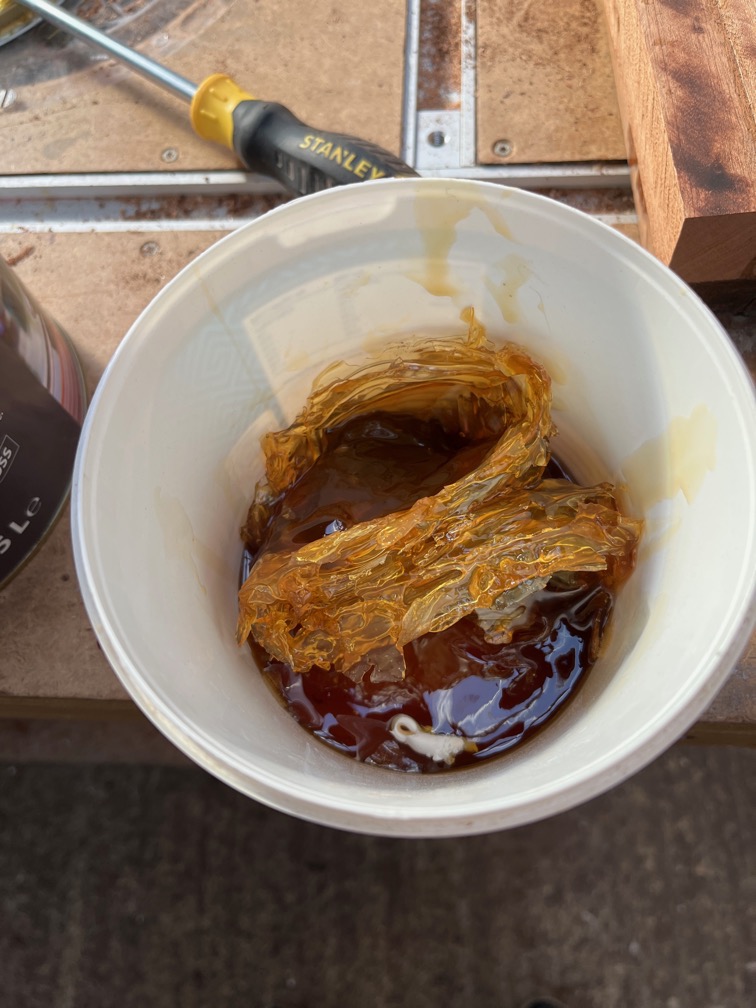
After cutting off the protruding ends of the plugs I glued into the redundant holes in the transom yesterday, the next task was to remove the skin that had formed on the surface of the varnish. Over the past few weeks I have just poked a hole in it each day and dipped a small brush in the hole. However, today I needed to use a large brush and that method would work no longer. I used a large screwdriver to detach the skin from the sides of the tin and lifted the whole skin out. I was wearing nitrile gloves, so it wasn’t that messy.
A few minutes later and Shoal Waters had a varnished transom. Well, one coat at least. The overcoat time for this varnish is 6 hours meaning that I should be able to get another coat on later this afternoon. It looks pretty good although I do seem to have made one mistake and that is to use a silicone based sealant. I read the small print on the cartridge after using it yesterday and it clearly states that this product cannot be over painted. I say clearly, the language is clear but the lettering is very small. So, I’ll put that aside and use it for something else and get a non-silicone based sealant for the rest of the job.
Still, the transom does look nice with the varnish. It will never cover over the dings, scratches, repairs and so on. The only way to do that would be to paint it. You have to remember that at this time, Shoal Waters is sixty-three years old and is not in pristine condition any more. The scars she carries eloquently show that she has not been sitting idle for those years but was a well-used and cared for boat and not a museum piece.
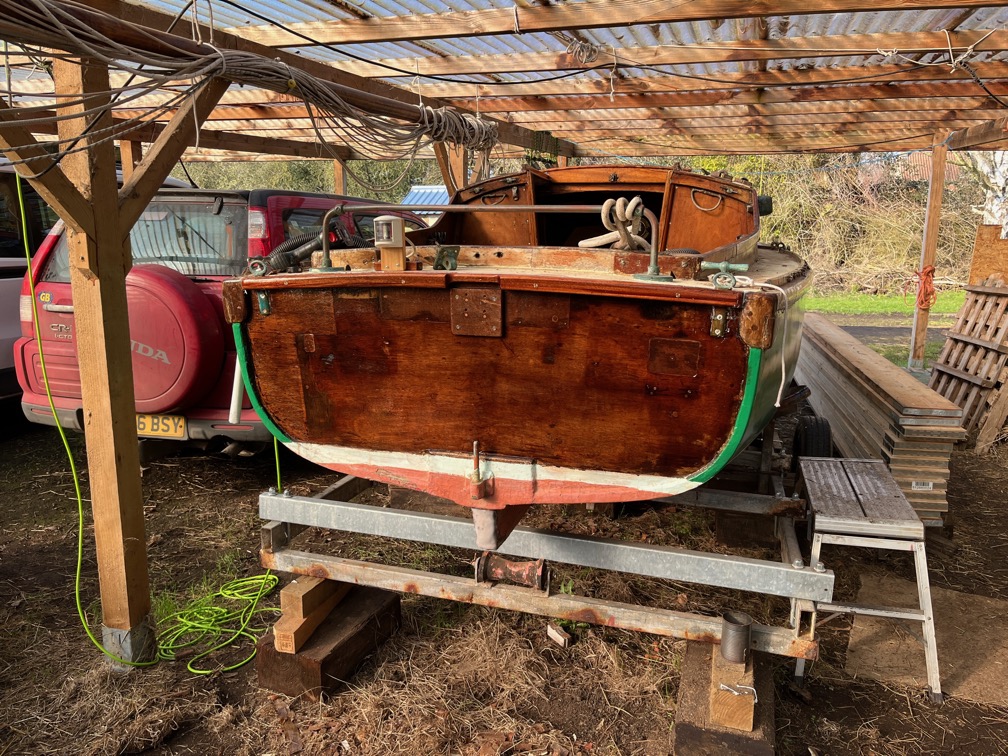
The next major task in the next week is to build the gantry crane. That stack of scaffold planks you can see next to the boat are for that purpose and the task at the weekend, come hell or high water, is to convert those planks into two gantry cranes. Which reminded me that I need to find the heavy duty wheels I bought for this purpose sometime last year !
Oh, and service the chain hoists.
And inspect the lifting strops.
Yet more tasks for the to-do list.
Of course, having thought that I needed to find the wheels and strops, I couldn’t concentrate on my work and had to take a break to find them !
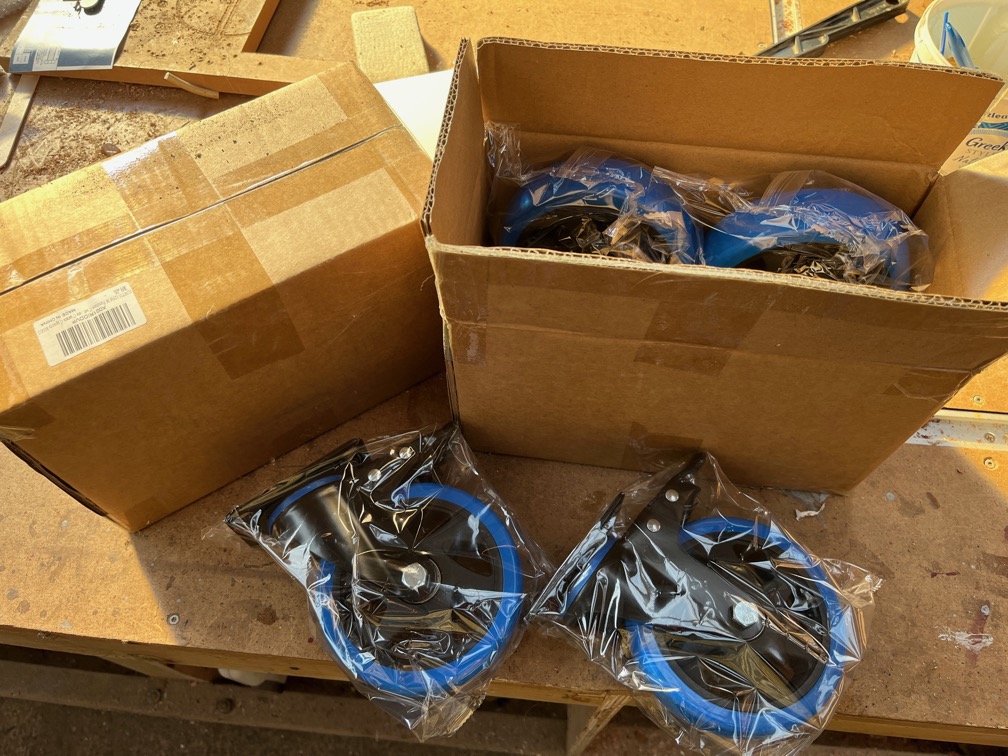
Fortunately, neither were hard to find. Eight heavy duty lockable wheels, each rated at 200 kg.
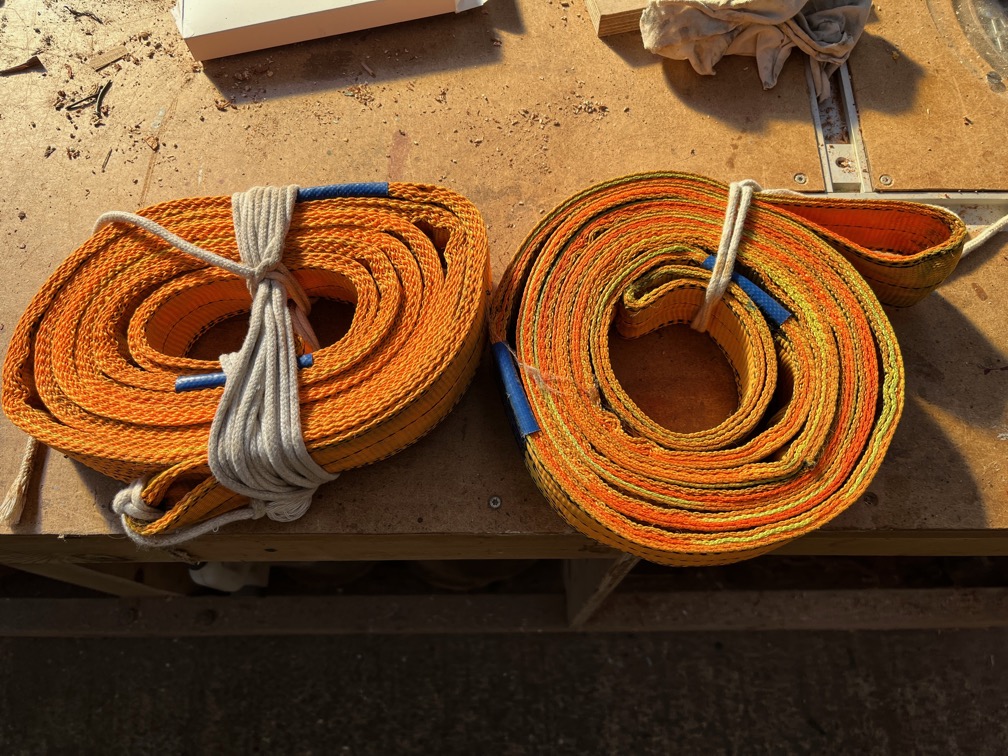
And the strops. Now that I’ve found them I shall inspect them later.
Oh, and another thing for the to-do list, buy new waders. I threw out my old ones after they developed a leak.
Since the weather is so good right now, there are a few painting tasks that need to get done and since they don’t take long, I decided to get on with it.
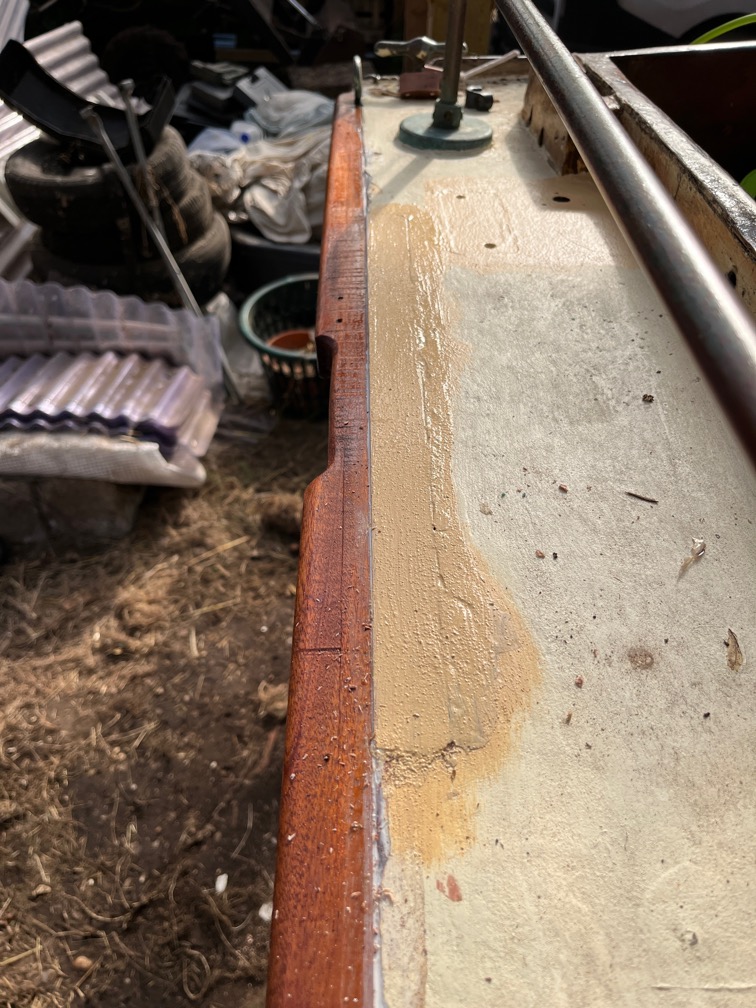
The patch on the aft deck so that I can finish the aft navigation light.
Time for a cup of tea.
I looked back at the photos and realised that I should have painted the new aft deck piece, so I went back to the boat.
That took very little time, but since I was out here and the weather is really nice…
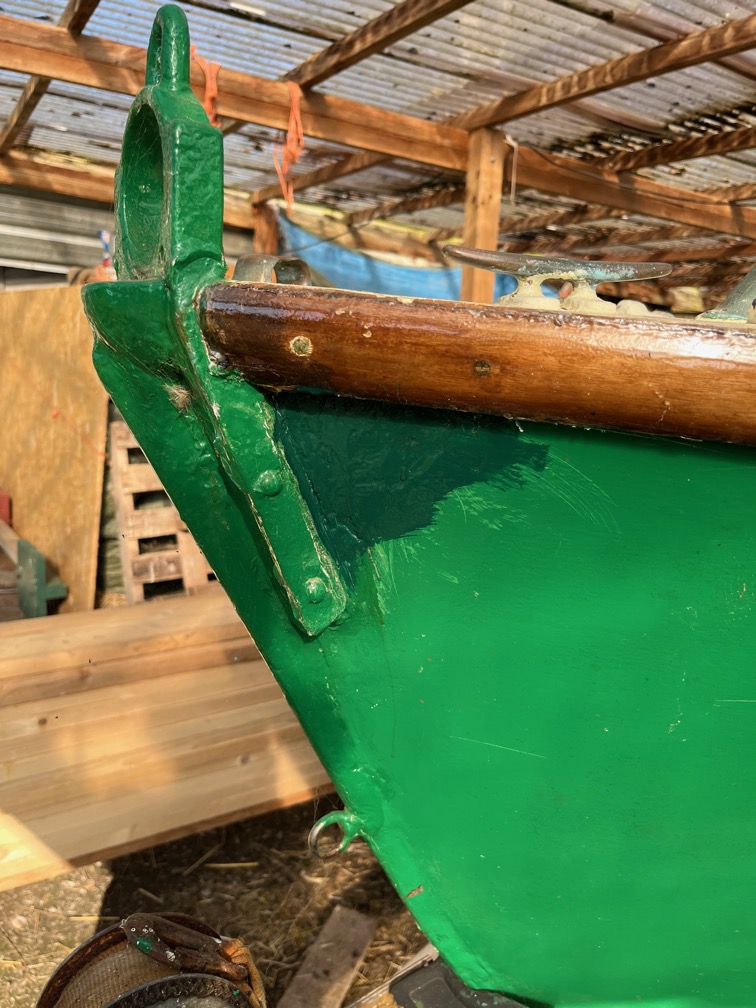
…I also painted the section on the port bow that was treated with epoxy.
You can see that the new paint is much darker than what she is currently wearing. The current colour is ‘Norfolk Green’ according to the old tin of paint that came with the boat and that colour is no longer available. The nearest colour and one that is likely to remain available for a long time to come is ‘British Racing Green’, affectionately known as BRG. So, Shoal Waters will be BRG and from what I can tell from older photos of the boat, she has been that colour before.
After work I continued the under bridge deck case supports. BUt not before putting another coat of varnish on the transom and a second coat of deck paint on the deck as previously.
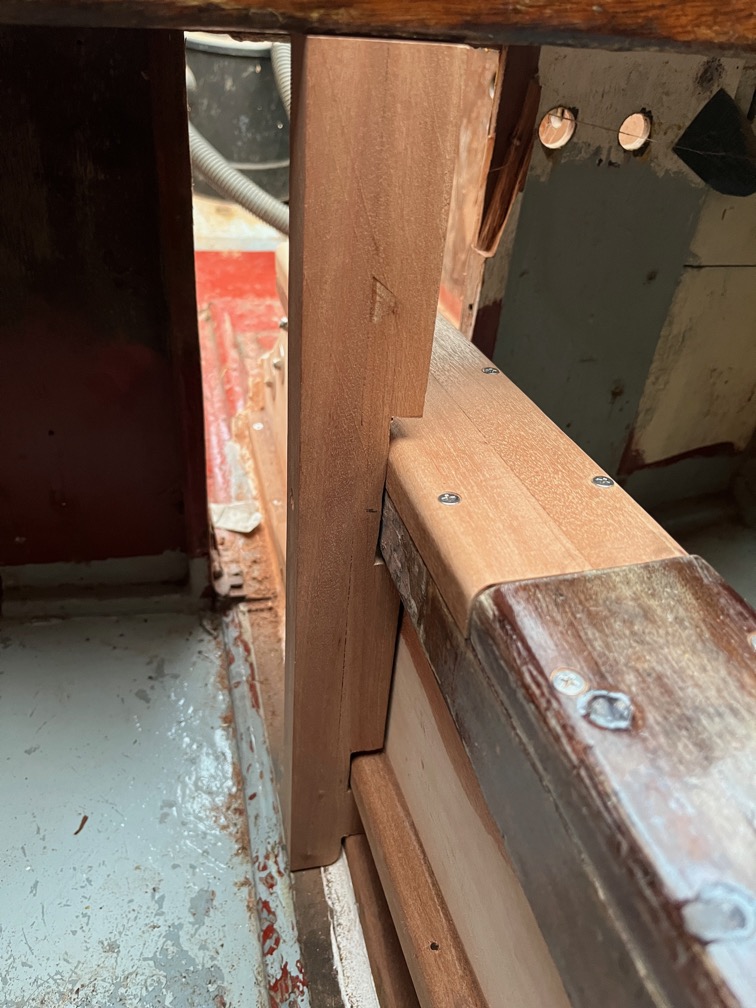
After some measuring and cutting this is the starboard side support, screwed into place but not permanently fixed.
The is the port side support also screwed into place.
The gap above the case top allows it to be unscrewed and removed without first having to take off the supports. Hopefully it will never be needed.
After this I completely ran out of energy, so called it a day.
No varnishing today so the first task was to finish the support extension started yesterday.
The new extension piece was firmly attached after sixteen hours or so of clamping and drying.
A few minutes work with the belt sander shaped the workpiece to match the original, more or less.
The extension piece was made a little too long and it does not fit as expected.
The excess was cut off using the table saw and now it is a good fit. I will need to adjust the fit widthways a little more as this originally rested against the original case side and now the case side is 6mm thicker.
During my next break I assembled the aft navigation light and mount. It is still not fitted finally, as I need to sand the deck and put on some new paint under the mount before it can be fitted properly.
Likewise with the deck gland. Still a good start to the day.
The next break I had allowed me to cut a thin strip of wood off the support.
The result is a much closer fit an about as good as I can get. Sealant will fill the gaps when it is fitted.
Now I need to make another one for the other side to replace the one that had to be destroyed to remove it. It looks to be shorter that the port side support and it is since it does not need the half-lap on the top to help resist the pull of the pate uphaul. It is, in fact, about 3mm longer than it needs to be (I checked, twice) so that I can sneak up on the correct size.
After work I spent some time under the boat, on my back, checking the bottom of the keel slot. It was difficult to see much but I could see that the SikaFlex had squeezed out all along both sides of the keel slot under the new sides. Hopefully this will mean that it has made a good seal.
I cut a few of the larger lumps off, but left the rest. The will be covered with antifoul paint before launching and the action of lowering and raising the plate will wear away most of the squeezed out sealant over time.
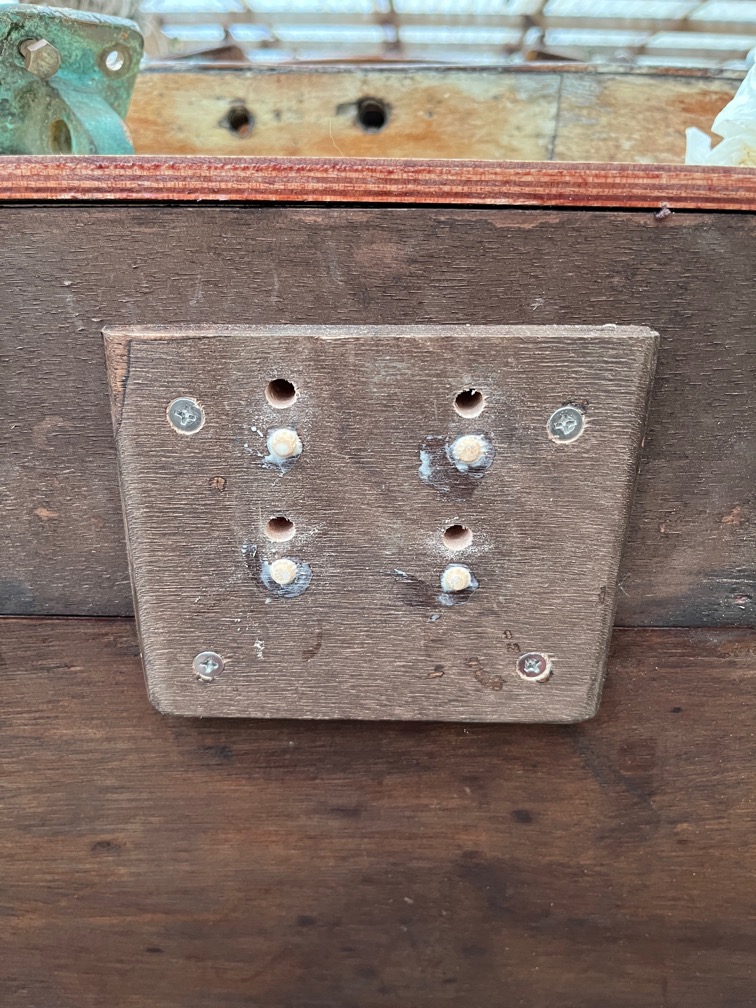
I raised the gudgeon fitting up a little and then needed to plug the old holes. Which is what you can see here.
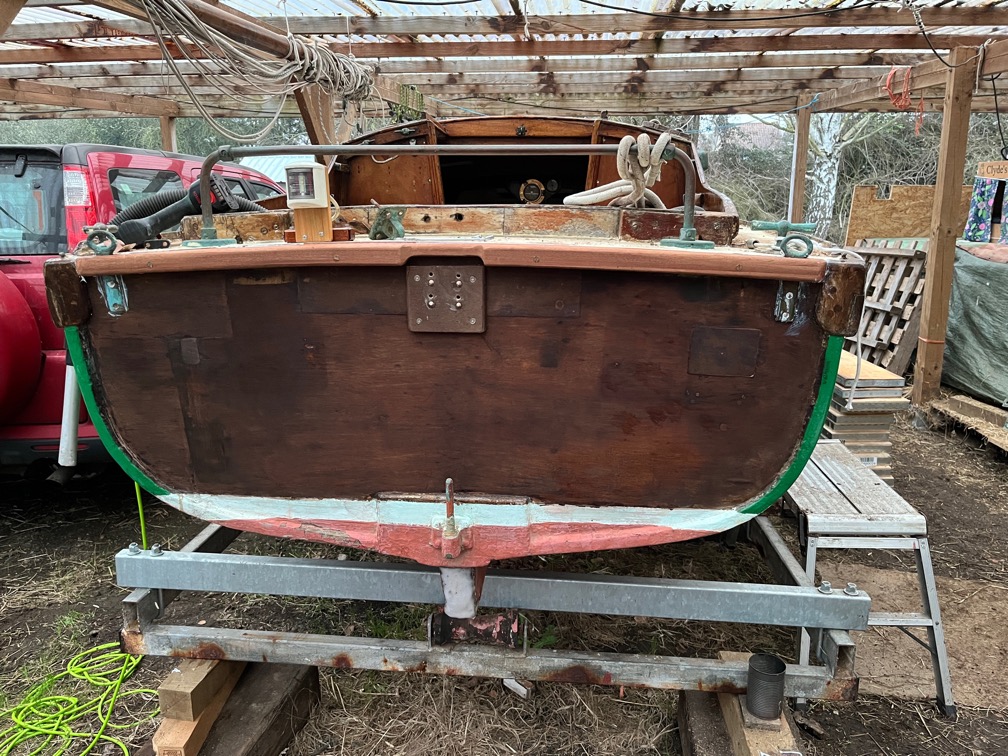
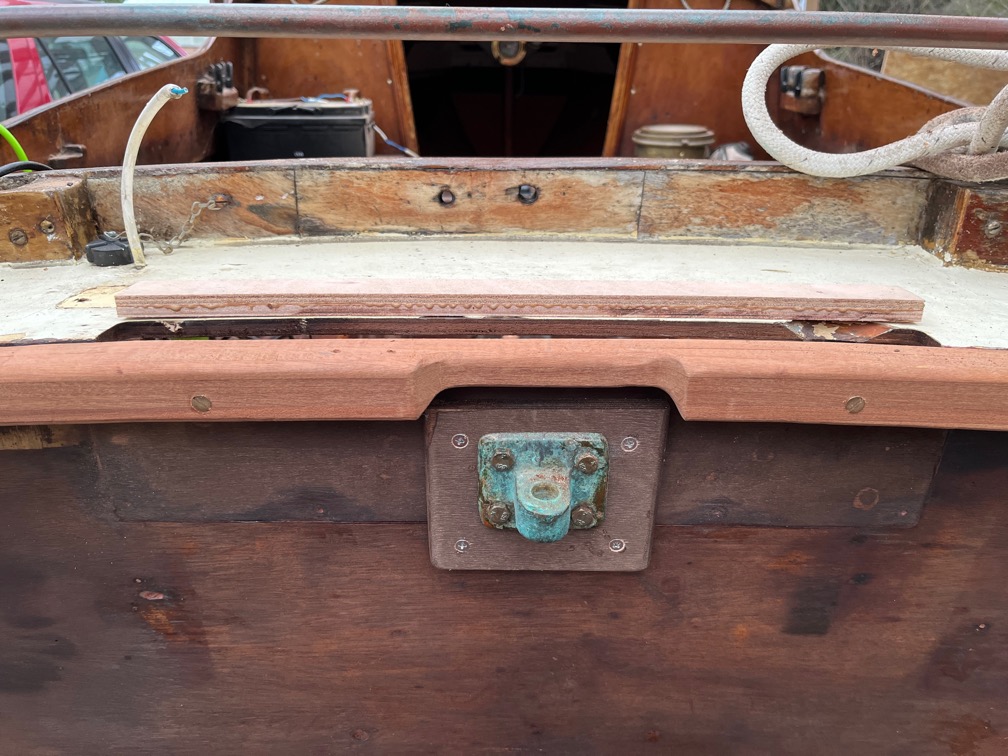
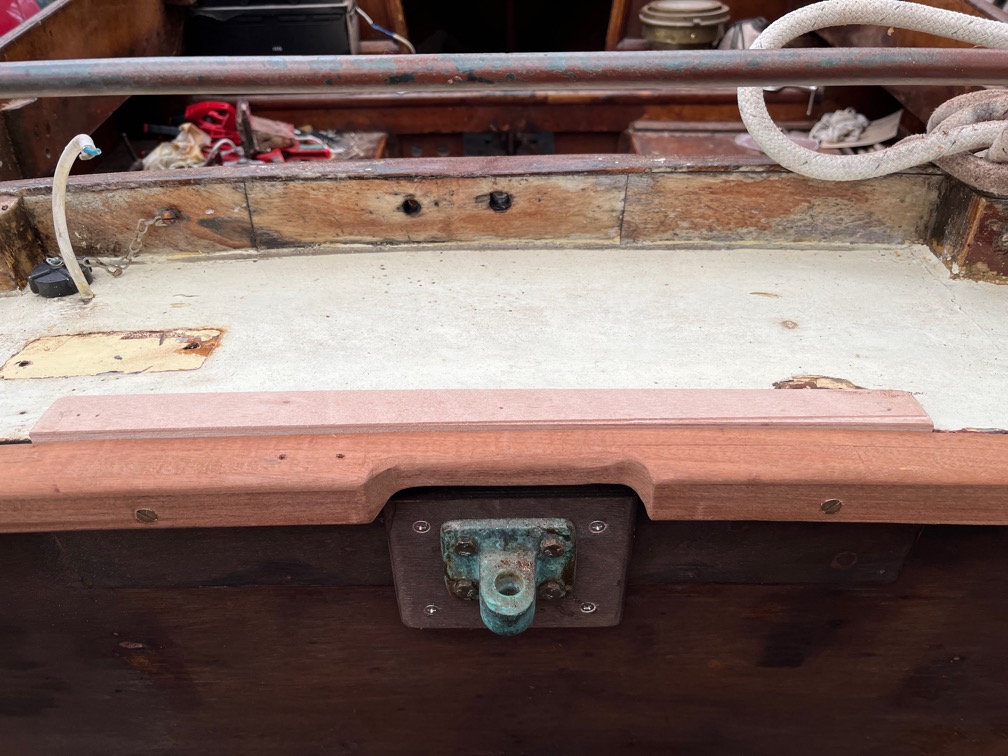
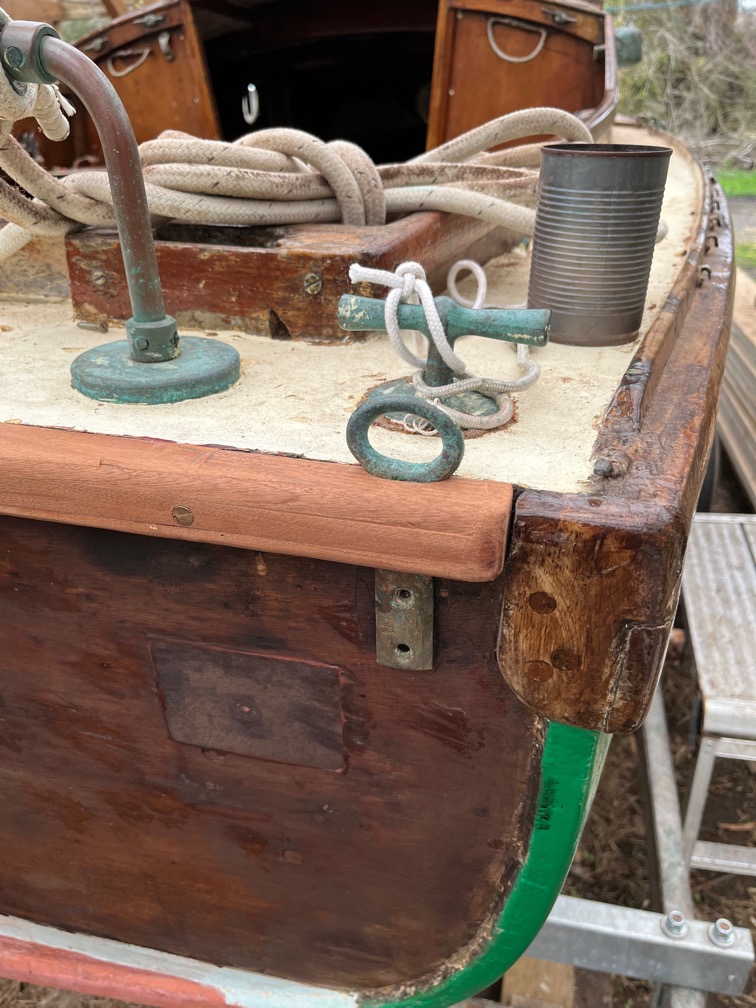
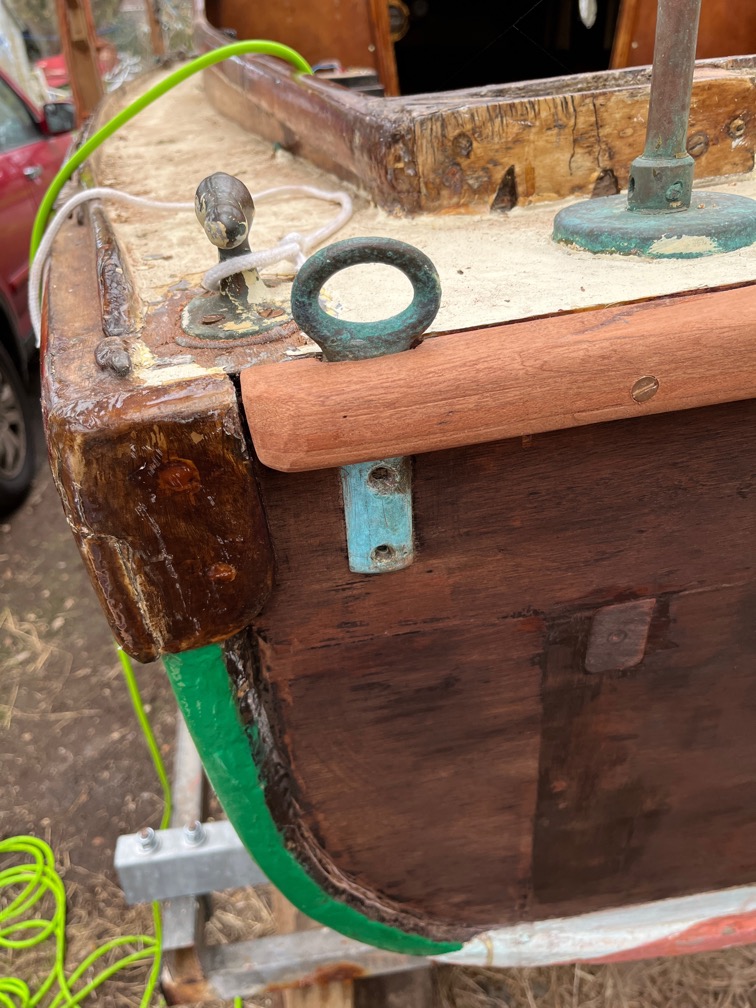
The transom eyes and the rubbing strake were also fitted. The excess sealant you can see will be cleaned off with a chisel once it has dried.
The first task of the day was the fourth coat of varnish on the new aft navigation light mount and that before breakfast to get it out of the way and done.
For my first tea break I cut then end of the dowel that was glued in last night, flush with the transom and gave the entire area that will be under the rubbing strake a sand to get rid of any high spots.
Following that I put some new screw hole in the case top that was on wonky and screwed that down to the case. As you can see, it is no longer wonky. I also gave this a quick sand as it will get a coat or two of varnish in the near future and I had the sandpaper to hand.
Finally, I checked that the new piece still aligned correctly and marked the cut line at the aft end.
Then it was back to work.
The lunchtime tasks started with putting the screw holes in the new case top and fry fitting it, just to check.
A pretty good fit ad the slight mismatch is due to the rounding on the old piece not being quite the same as the new. Not going to worry about it, though.
At the other end the fit is good and there is plenty of space to mount the plate uphaul jamming cleat.
With a new sanding disk in the angle grinder I started to shape the remaining untouched part of the top of the block. Not easy due to the space restrictions, but this is close enough for the rough work and I’ll resort to something a little less aggressive to finish it off.
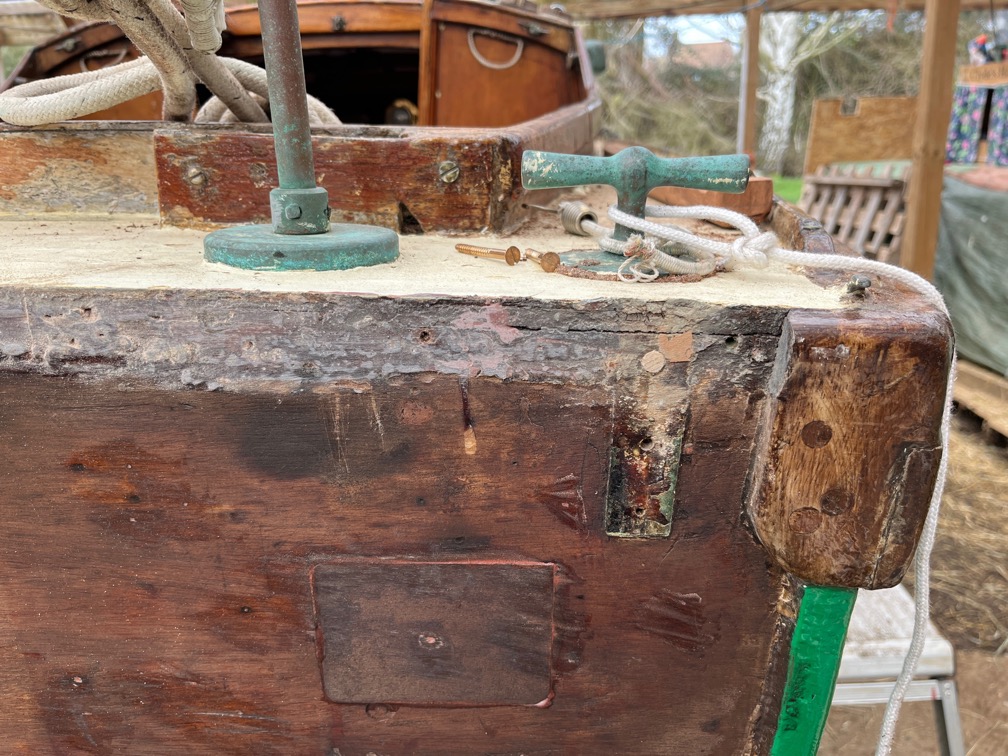
Next up was the transom eye replacement only this didn’t go as planned. There was another broken screw in the middle hole, so I had to stop what I was doing, drill out the broken screw, plug the hole and put the eye on. I’ve left the screw out of the middle hole until the glue has dried.
The other side was just as bad only this time the holes were too big for the screws. These also were drilled out and plugged and will be drilled with the pilot holes for the screws once the glue has dried.
Still, not bad for a lunch break, so it is back to work.
I had a reply from one of the local boatyards regarding my proposed leak test. They said that they could do it but the cast would be £504 including VAT. Far too much so after work we took a trip to other one of the local boatyards and asked then about using their launching slip. The charge would be £50 if I launched her myself or £150 if they used their launching tractor to push the trailer into the water.
We settled on my trying with out Honda CRV, which should do the trick without problems, but if I did get into trouble, then they would use the tractor to sort things out. Next Thursday is leak test day ! I need to visit the cash machine.
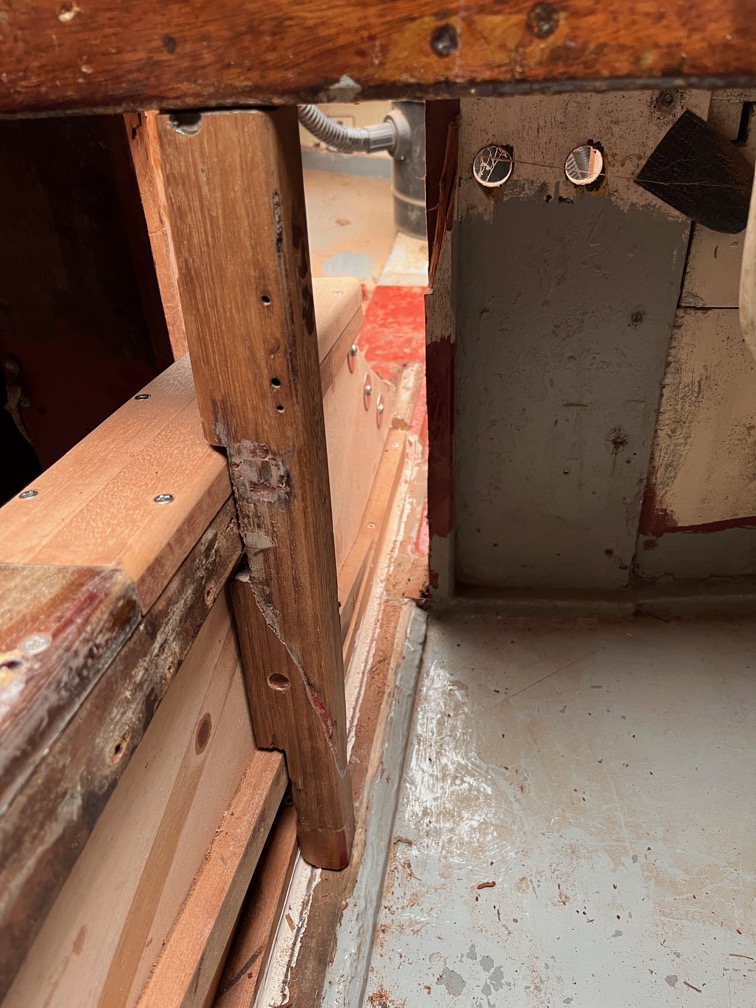
On arrival home I started work on one of the case supports for which I have the original timber. It needed some adjustment as the new case side is slightly different to the old and it was also too short having been cut out of the bottom runners.
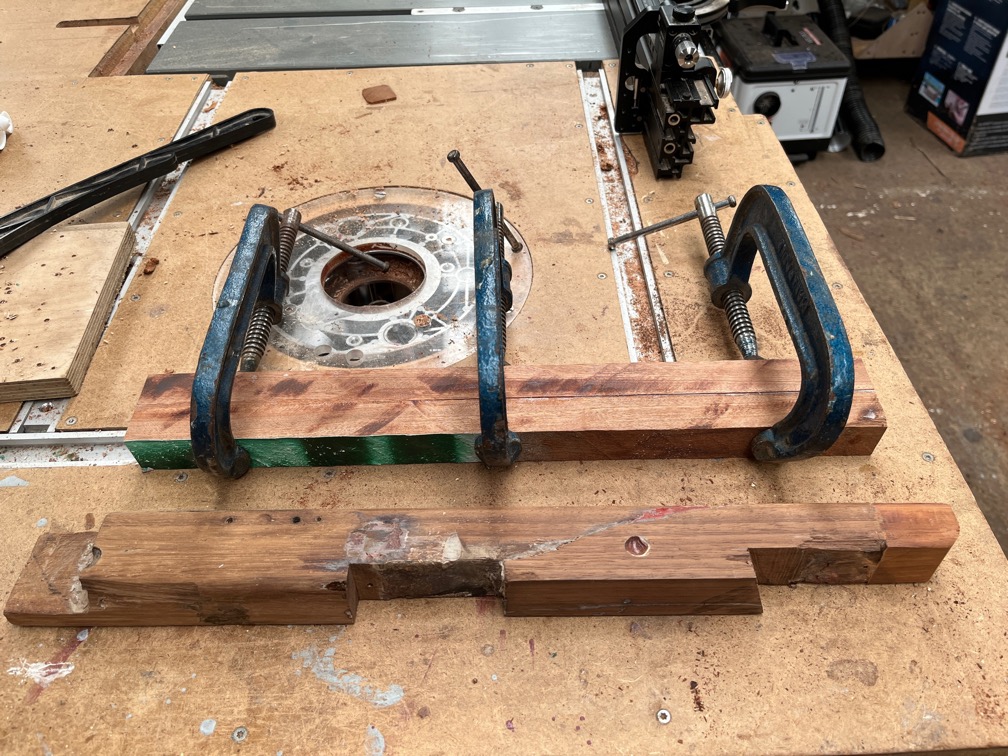
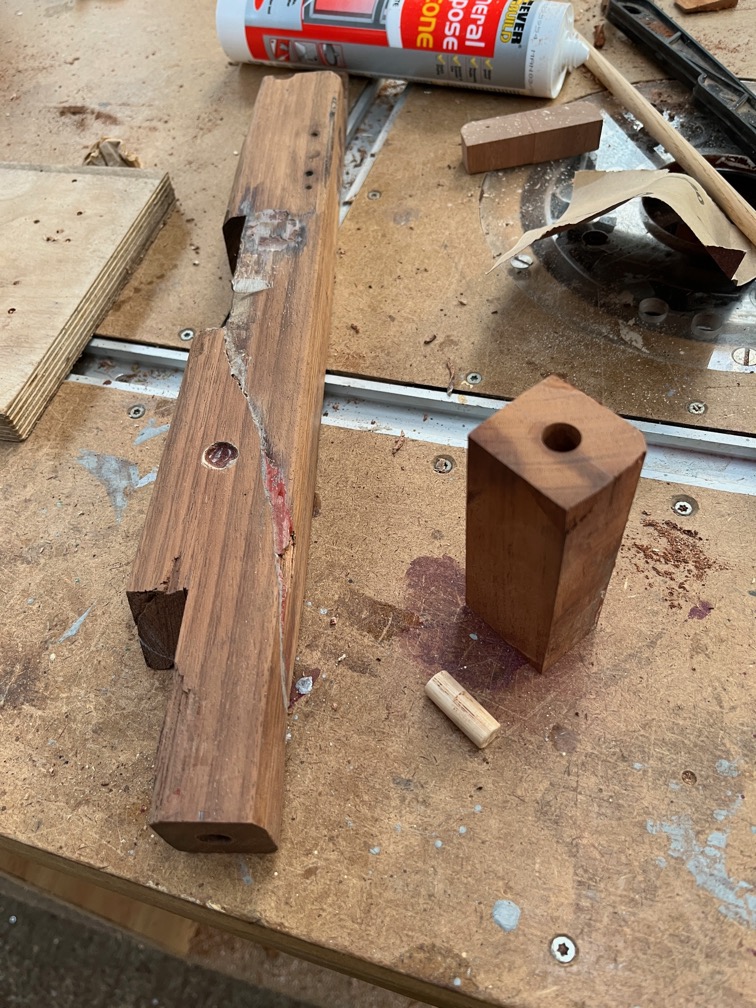
So, here are the pieces, the original support and the extension which will be glued to the bottom and located with a dowel.
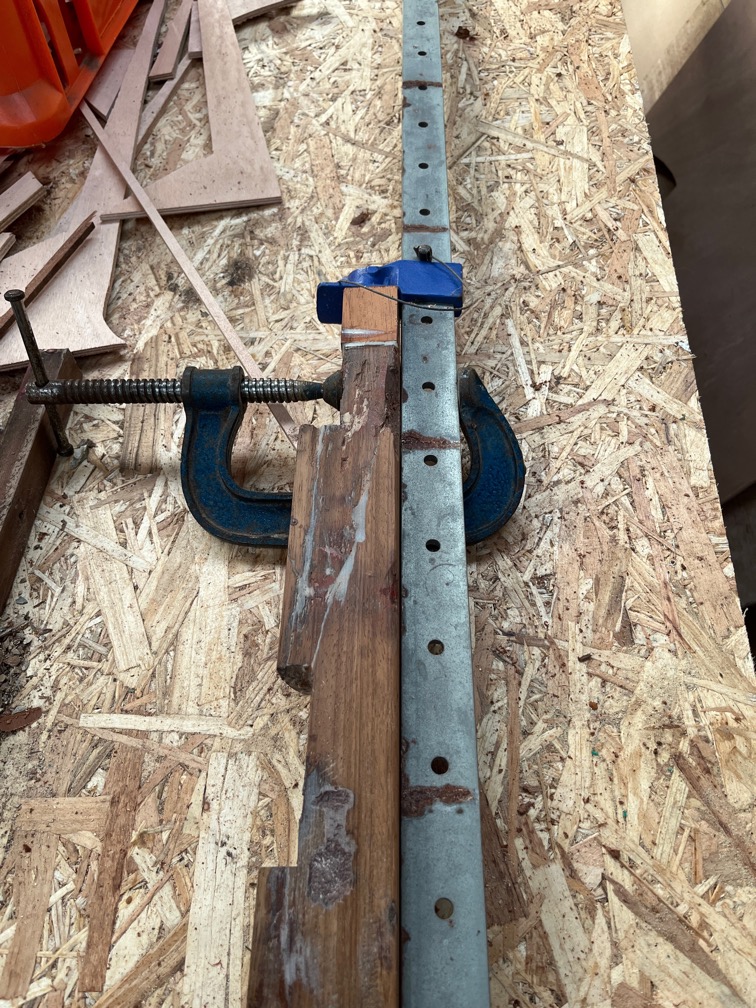
The pieces were clamped together to ensure a tight joint.
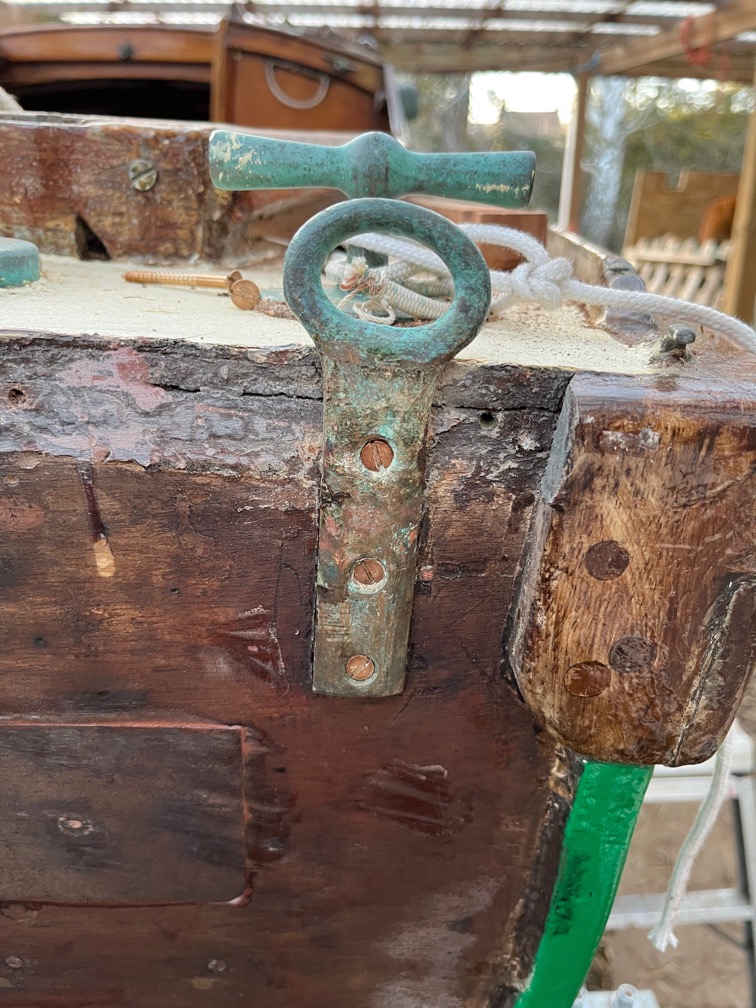
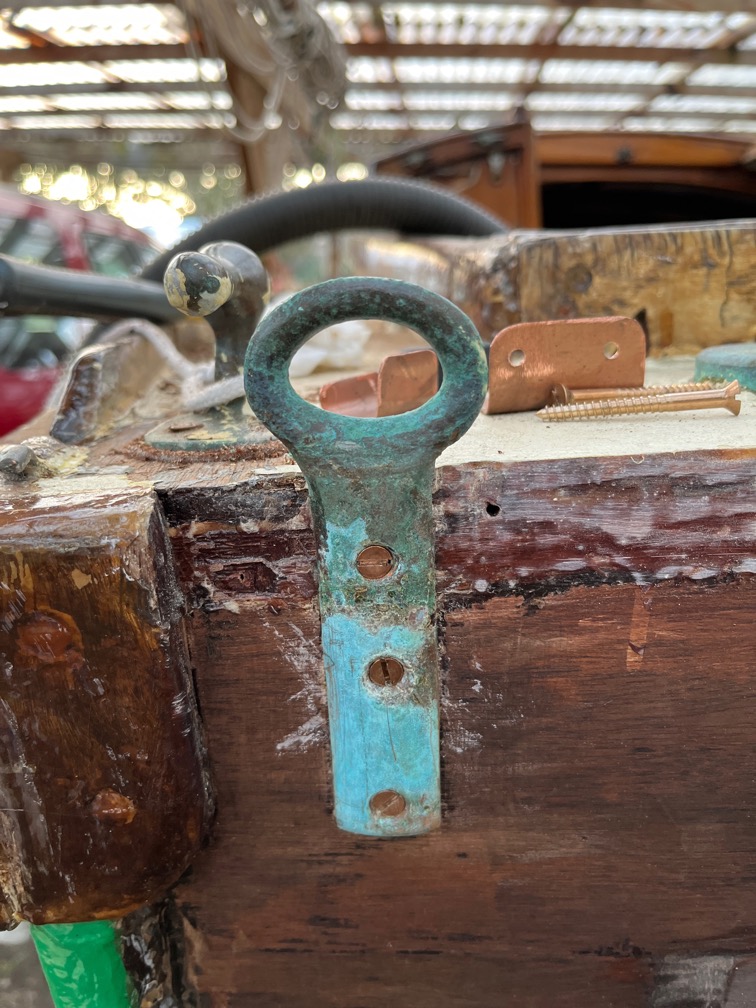
After that I went out to the transom and completed the dry fitting of the eyes.
Both of these are now a good fit and ready for the assembly.
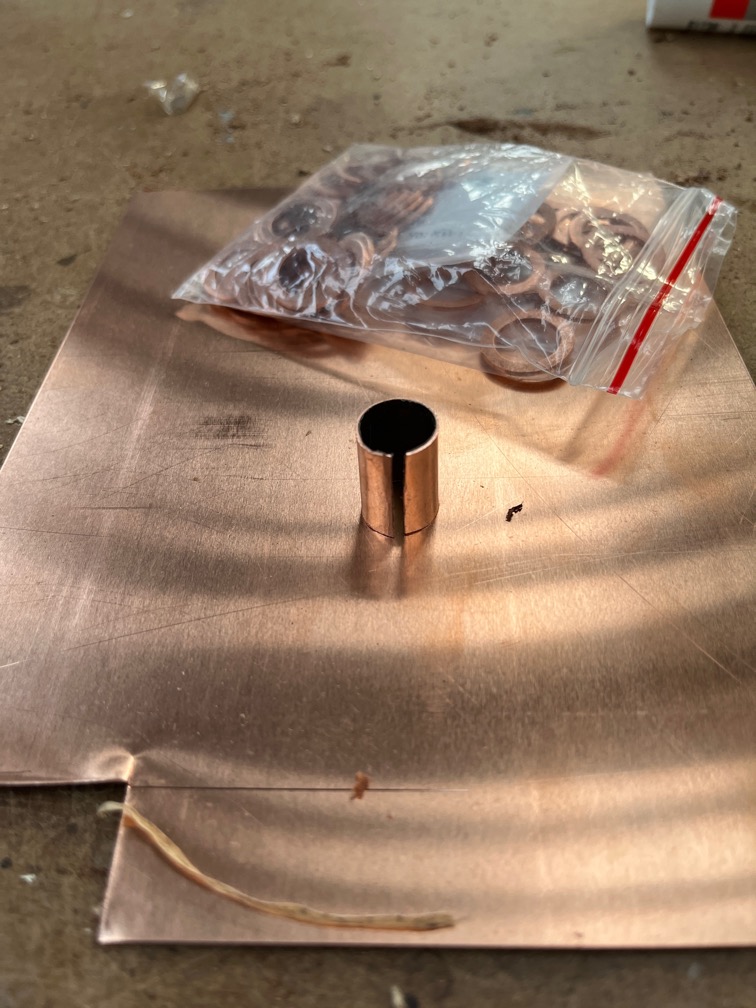
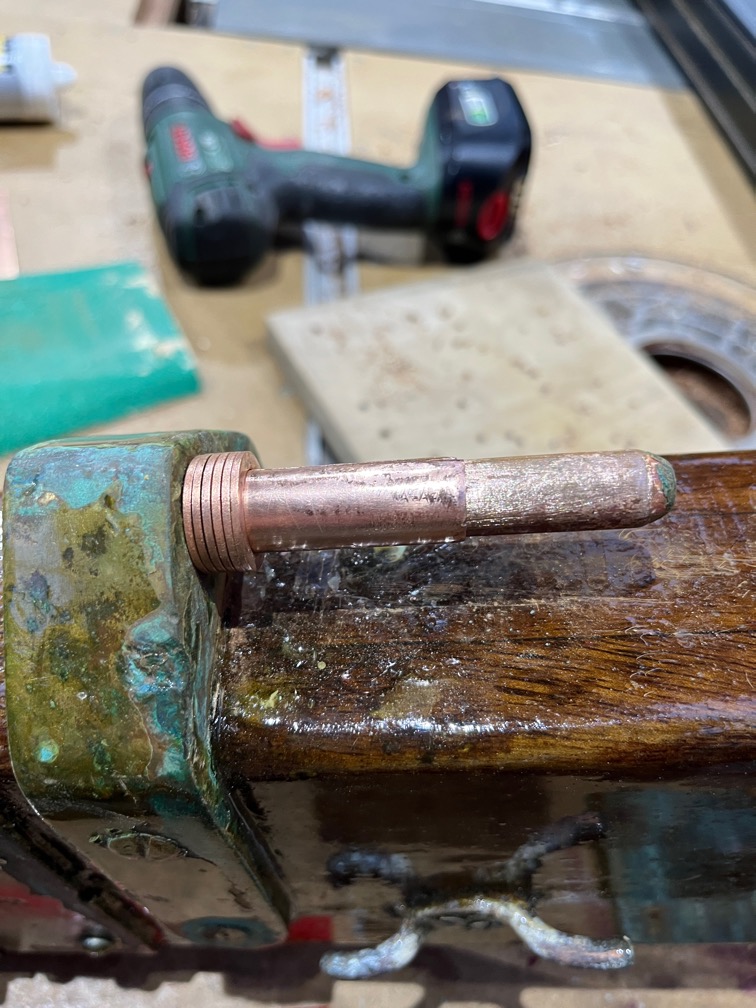
The thin copper sheet arrive this afternoon in the post, so the next task was to make a small copper cylinder for the pintle on the rudder stock. The trick with making rings or cylinders from sheet material is to shape the ends first. You never get a good result if you start in the middle and work towards the ends, they always turn out flat. The mechanics part of my degree in Electronics was useful for something !
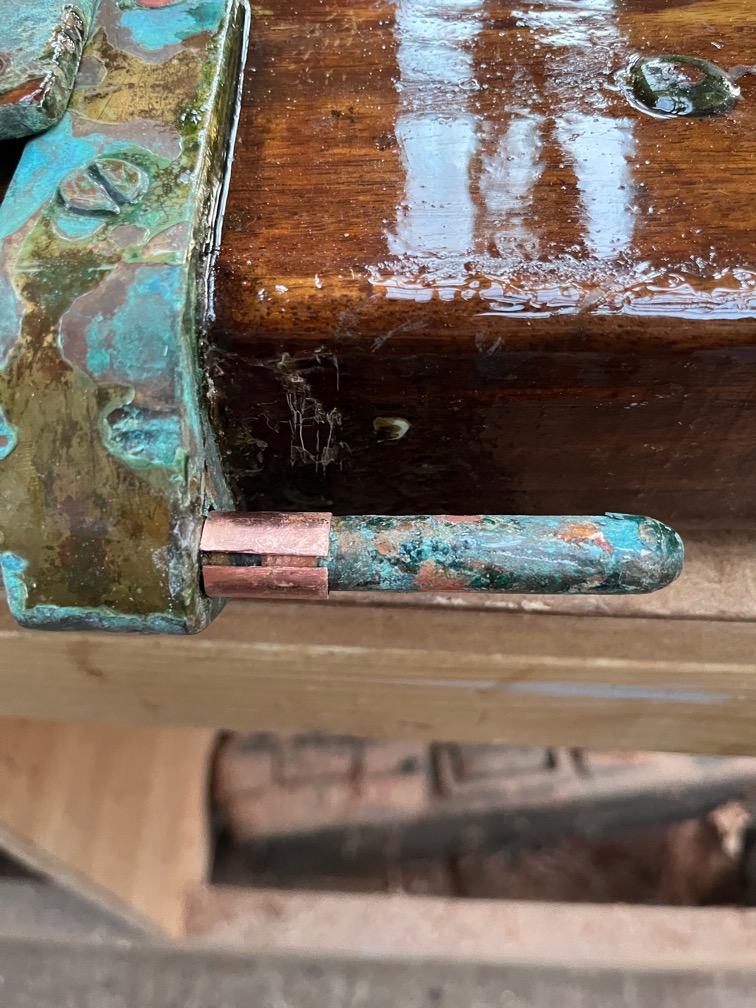
The cylinder was made just a little short of completely around the pintle, as you can see here, to allow for the cylinder to be put on over the slightly larger end.
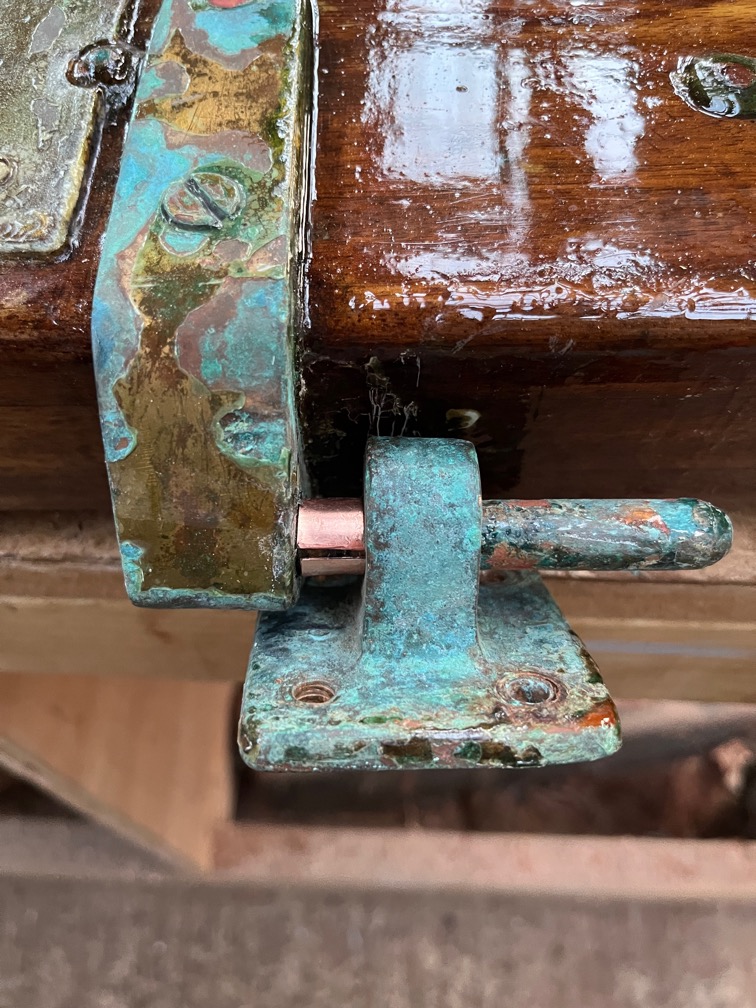
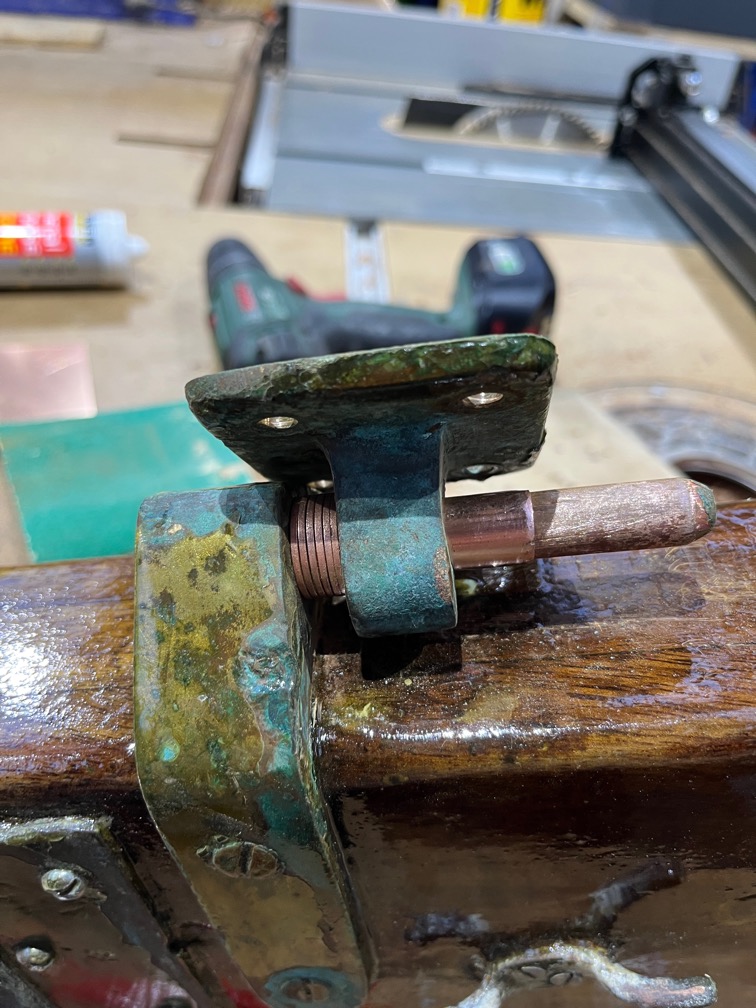
The gudgeon slips on quite nicely, so this part of the task was a success.
The copper washers also fit onto the cylinder.
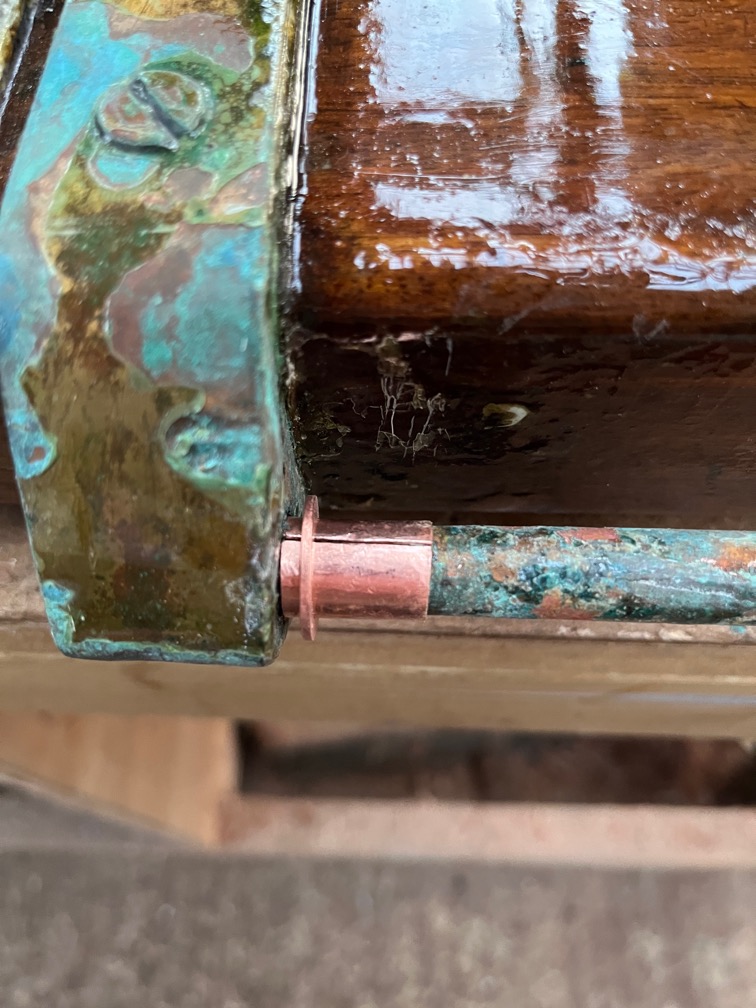
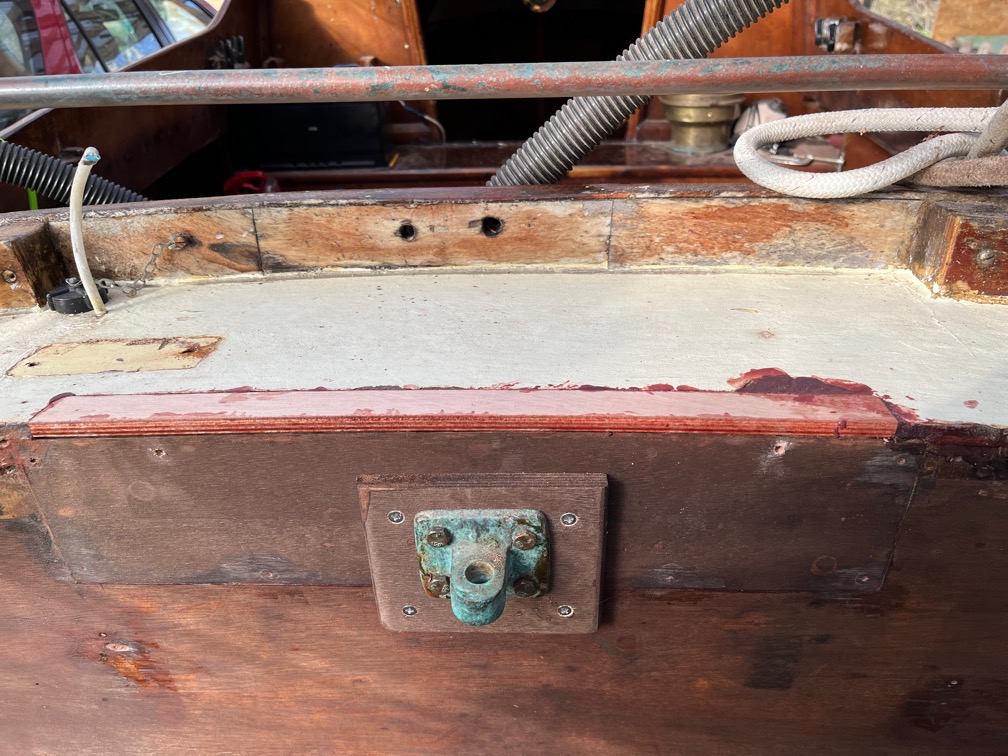
This raises the issue that the gudgeon can be mounted on the transom higher than it is now. So I cut a larger piece of copper and made a longer cylinder.
I have to clean the varnish and verdigris of the pintle, but the larger cylinder went on well as did the washers although these were quite tight. A good thing as they stop the cylinder from just falling off. I’ll still need to put some glue on, but it is good that they are a tight fit.
The gudgeon also fits well over the longer copper and is a snug fit, no play at all. This makes me wonder about doing the same thing for the pintle on the transom.
I’ll think about that. Maybe another time.
So, a very productive day with things moving one. Just as well since I now need to make the gantry crane before Wednesday next week.
The first thing on my list of tasks for the day was the varnishing. There’s not much to it, takes about ten minutes, but it still needs to be done.
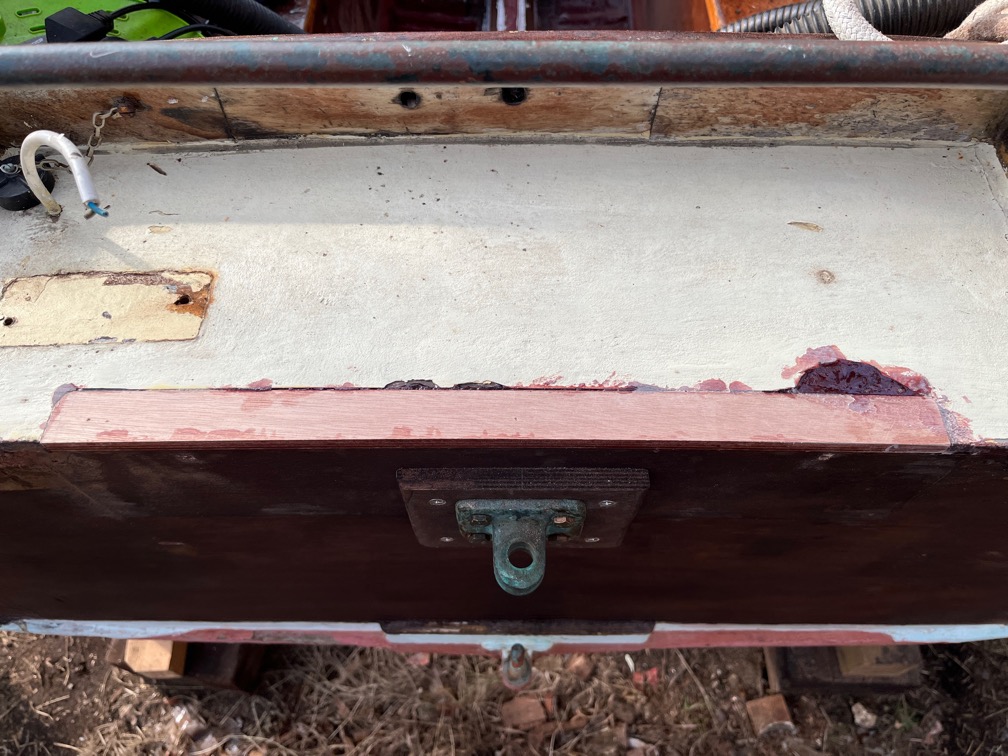
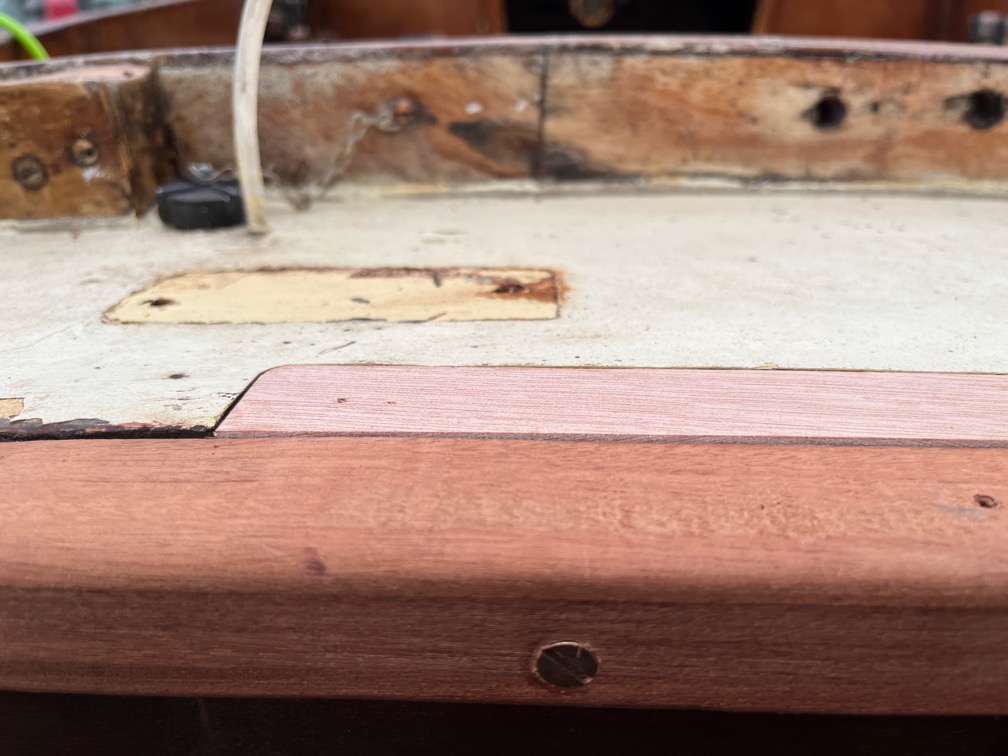
After that it was time to see how the aft deck is doing. With the clamping piece and baking paper removed, the result is looking slightly messy but good.
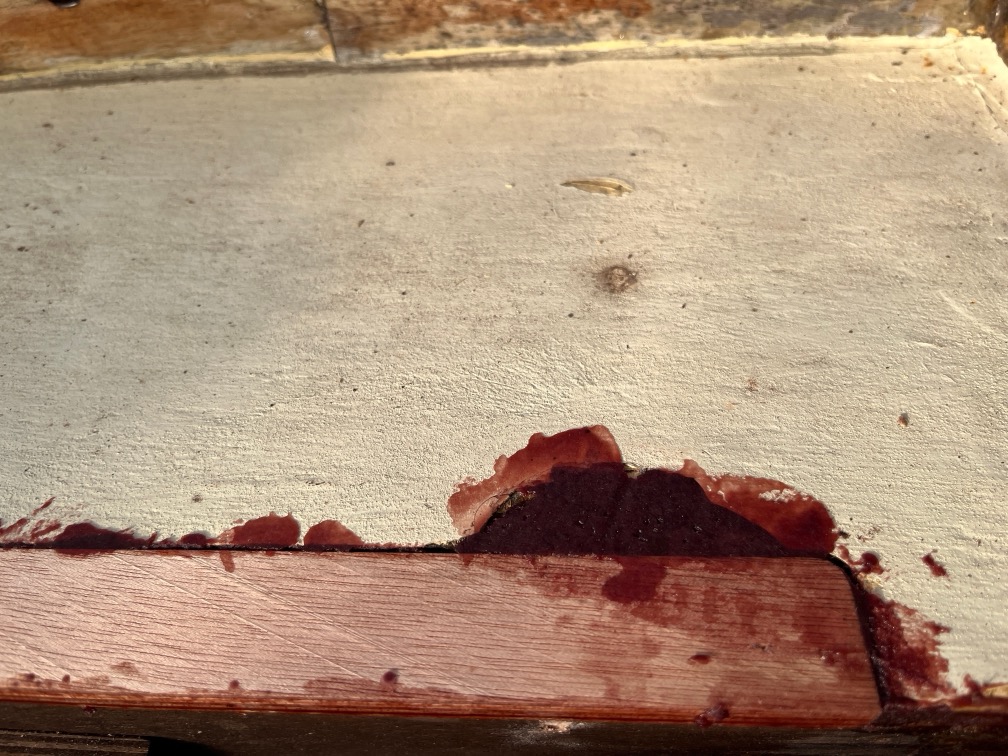
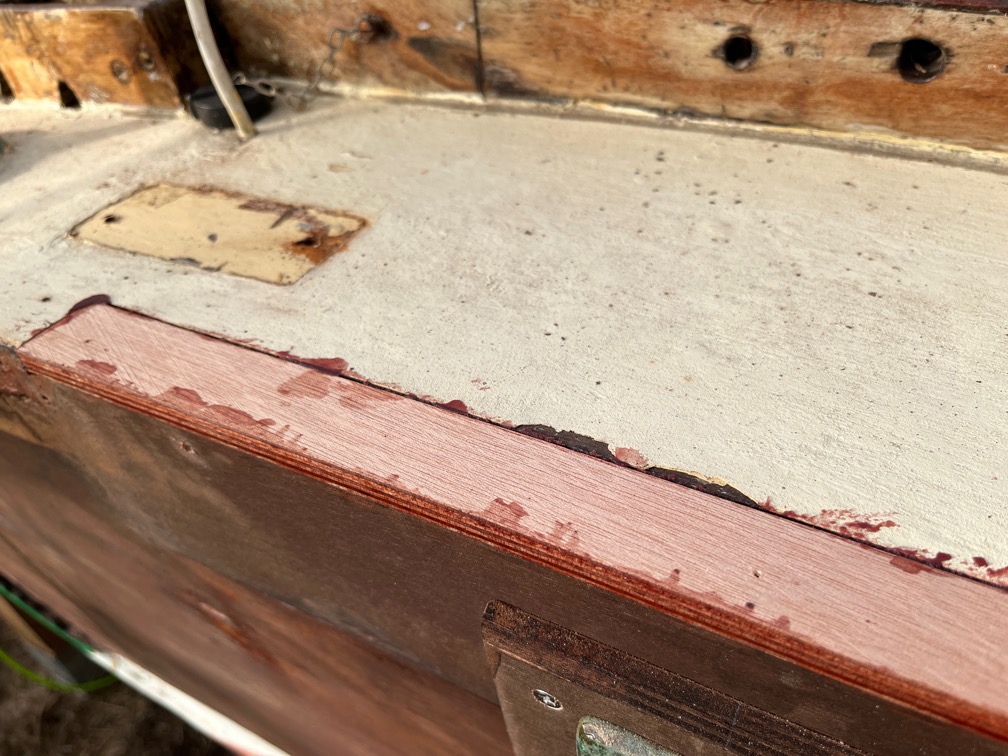
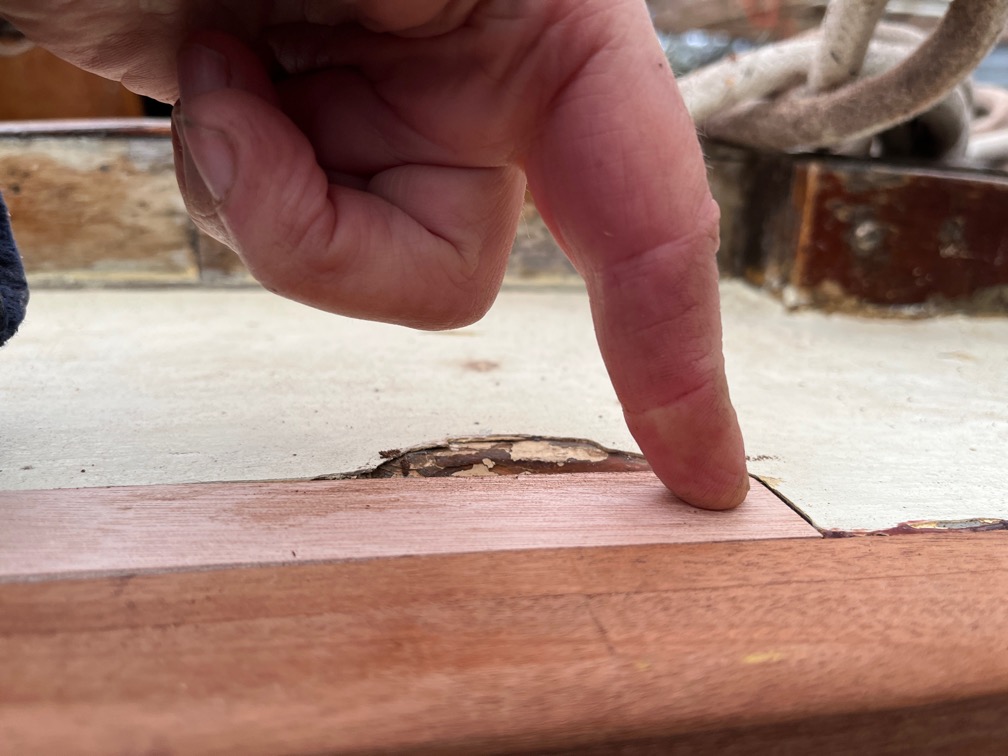
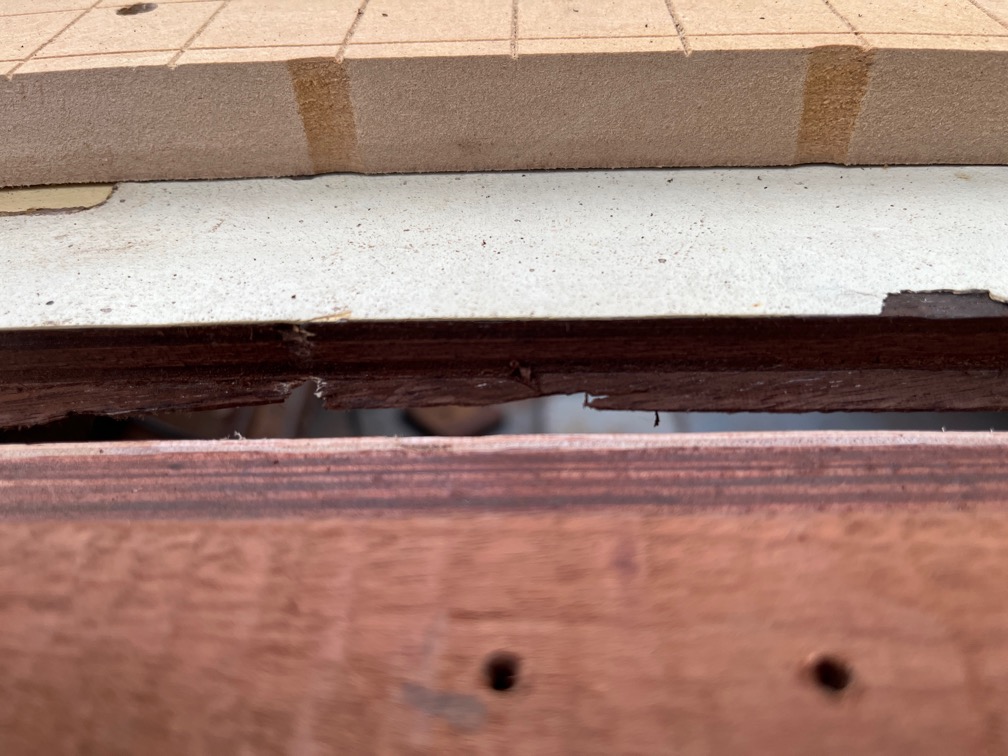
The major ding in the deck has filled well, but there are a few areas that need a little more epoxy to filling the parts where the epoxy has sagged down a little into the seams and left a void.
Nothing important, but needs to be filled. Tapping the area on and around the new piece gives a sound return, so it looks like that graving piece has worked.
The whole area and transom will be finished in the coming days.
The next in a sequence of tasks is to shape the top of the new aft block.
This is the start of the centerplate case reinforcement, essential to keep the case from moving from side to side under the stress of the plate when sailing. There are three supports in Shoal Waters, one just in front of the pivot bolt consisting of two half-bulkheads and provide the main reinforcement. The pivot bolt is where the most lateral stress will be applied to the case.
The next support is at the forward edge of the bridge deck and the function of this support is three-fold. Firstly it provides support to the case. Secondly it provides support to the forward edge of the bridge deck and thirdly, it provides an anchor point for the plate uphaul.
The third support is found at the aft edge of the bridge deck. The primary purpose of the support is to provide an edge to the half bulkhead that forms the front of the cockpit well. It is sealed against the case such that any water that gets into the cockpit does not immediately drain into the cabin. As a secondary function, it also supports the case but is not really required at this point as only the tip of the plate reaches this far back in the boat and when the plate is raised up that high, the sideways force on the case is very small.
However, all three supports need to be put back but in such a way that they may be easily removed. They will not be permanently fixed until after the leak test.
The sealant has dried well here so I can cut the top off with a pull-saw.
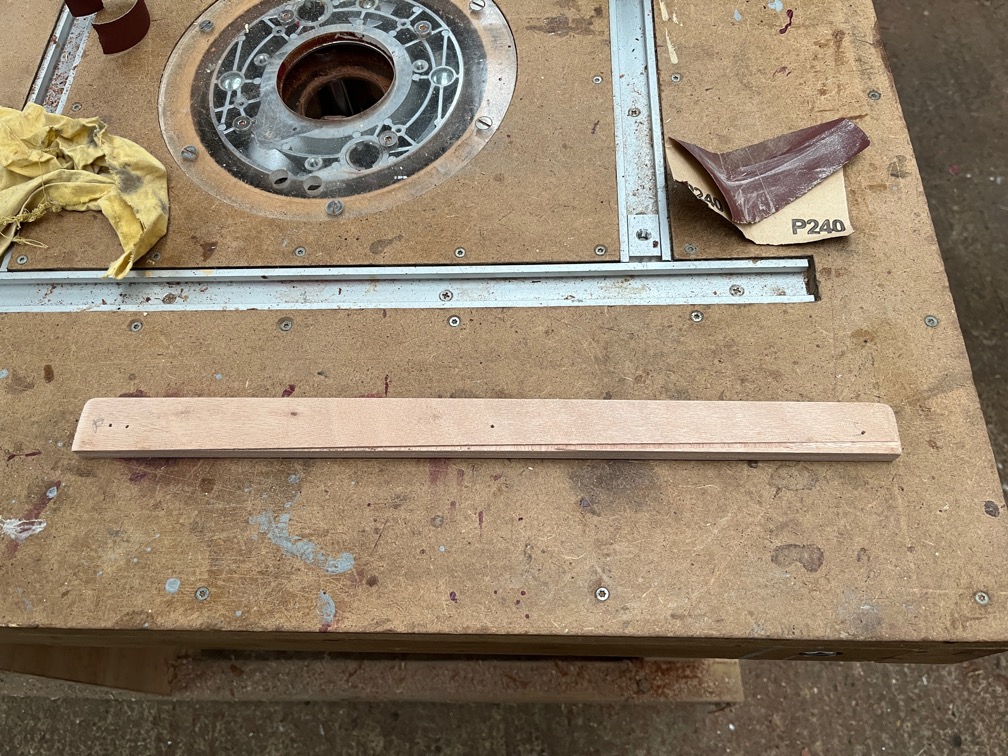
This did not take long and the is the result after a quick sand to remove any saw marks.
The piece of timber for the new top cover was placed into position after squaring off what will be the forward end and the shape of the underlying case drawn in pencil.
I shaped one side first using a bandsaw followed by the belt sander. I offered the workpiece up to the case again and checked that the pencil mark was still correct before shaping the other side.
Having carried out the check I shaped the other side and gave the top side corners a round over.
The top was given a light sanding as this will be varnished, although not much of it will be seen.
At this point I decided that I would remove the piece to which this piece buts on the top of the case as it has gone on slightly skew. I knocked out as many of the old, broken screws as I could, taped the underside and filled the holes with neat epoxy.
I didn’t thicken the epoxy as I wanted it to run down into the holes. The disadvantage of doing this is that the bubbles you get when mixing the epoxy rise to the surface as you can see here.
The solution to this is either to use a vacuum pot to suck out all the bubbles before you use the epoxy, or heat the surface of the epoxy with a hot air gun or a flame from a gas lighter. The result is pretty to watch but you do have to be careful not to burn the wood or varnish.
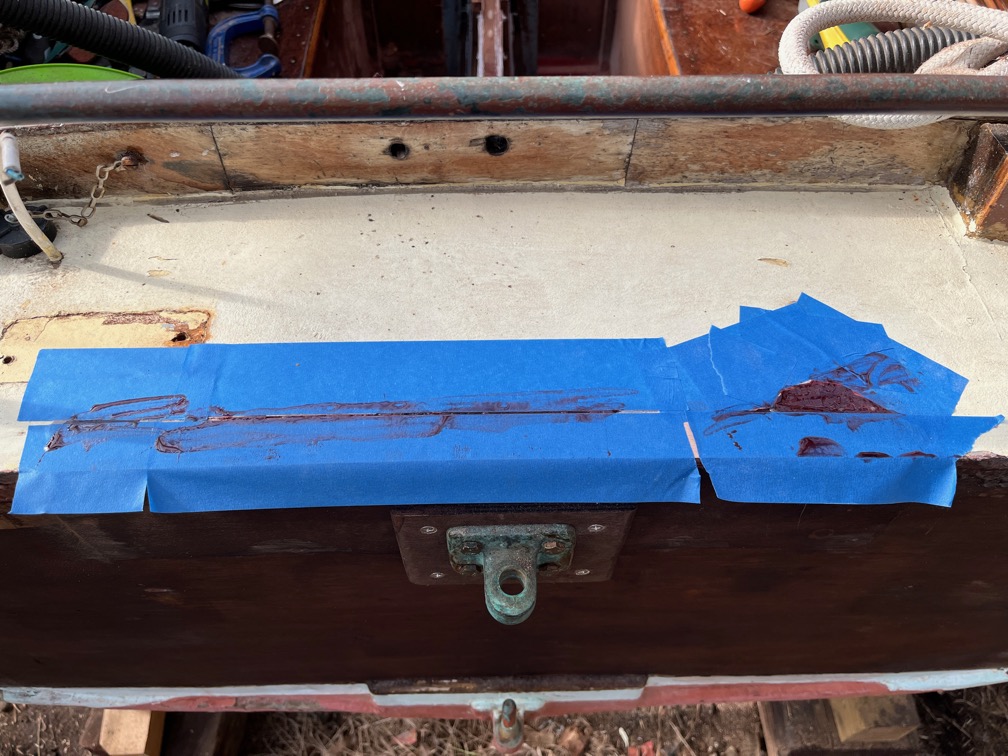
I had quite a lot of epoxy left over after filling the holes, so I taped up the aft deck and used some of it to fill in the gaps here. I noticed whilst doing this that the epoxy still left in the pot was getting very hot indicating that it had already kicked off. Hopefully that will mean that the epoxy work I’ve just done will cure quickly as well.
Since the epoxy looked as though it was curing quite rapidly, it was 16º C at the time, I went out during my afternoon tea break and pulled the tape off.
Removing the tape before the epoxy cures hard is fairly easy as long as you were nitrile gloves otherwise you get semi-cured epoxy all over your hands and if you are not careful, your clothes as well.
Messy!
Still, the result is quite good.
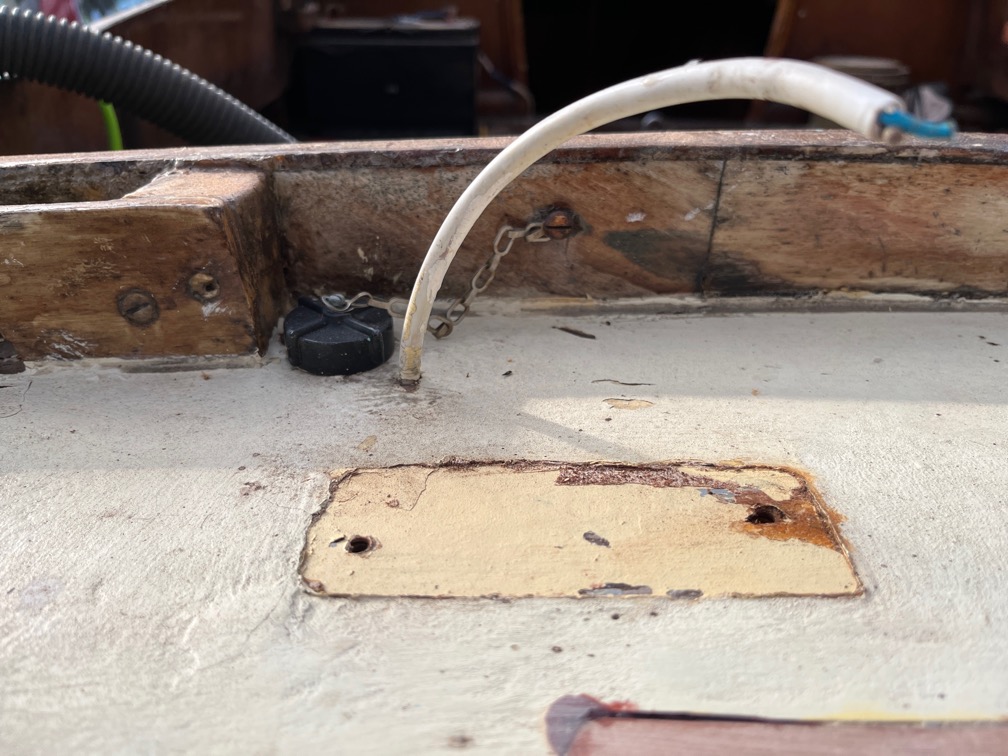
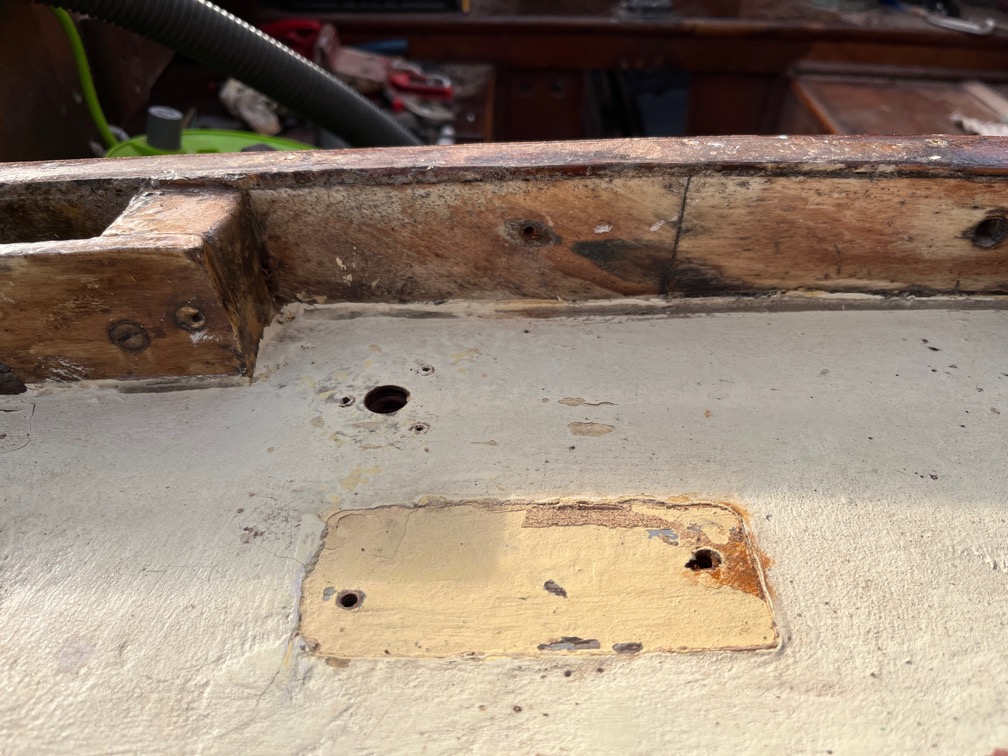
This is the place where the aft navigation light is mounted and I decided that I’d finish my tea break by cleaning the area up a little. The nav light used to have a through deck power fitting that was a socket in the deck and the plug on the end of the cable attached to the light. The deck fitting that was removed sometime ago, but the cap left behind, so that came off. The cable was pulled through from below, the hole drilled out to 14mm and the screw holes for the through deck fitting drilled.
That’s all I had time for, so I went back to work.
After work had finished for the day I put the deck gland on the aft deck. It is not screwed down completely since I need the light moung to be fitted first and that is still being varnished. It is, however, one less thing cluttering up the work table.
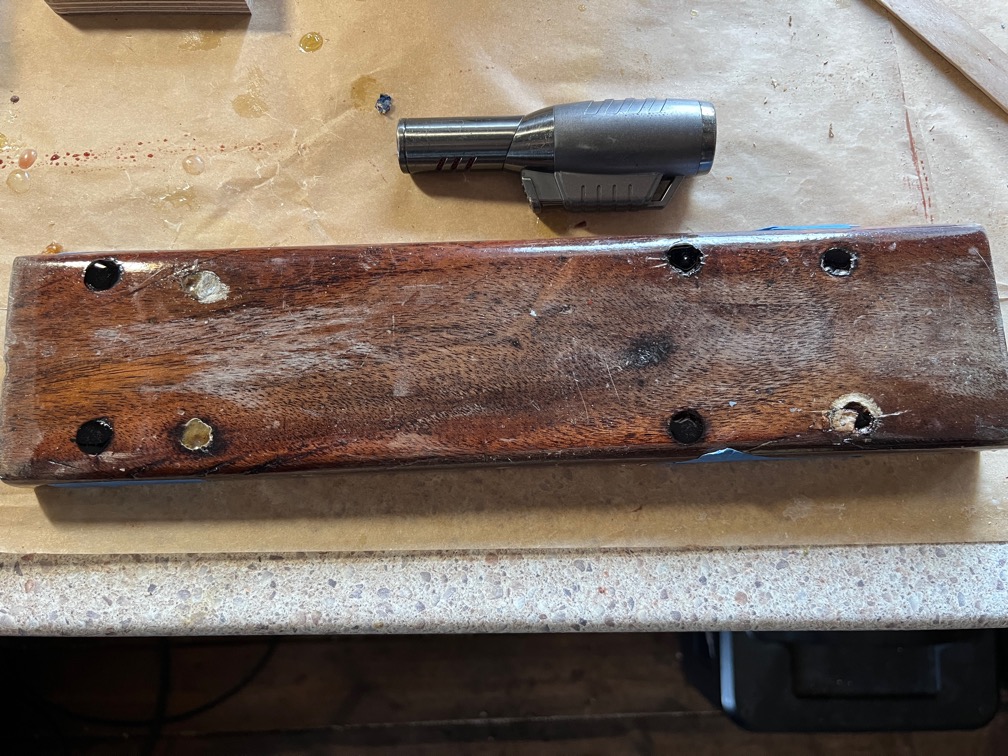
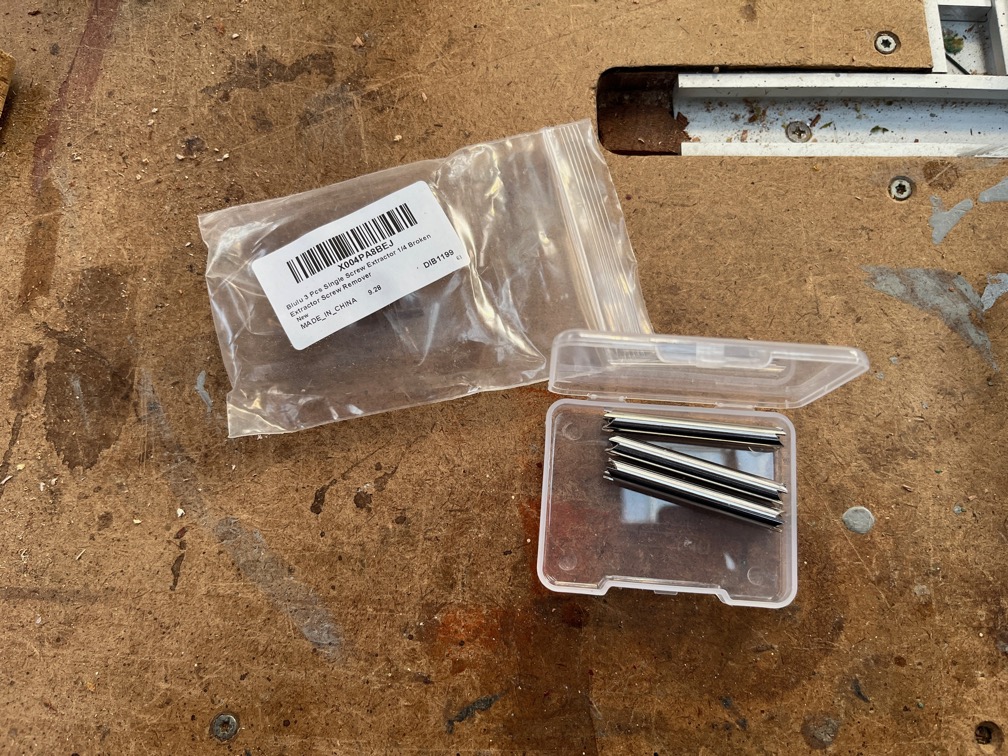
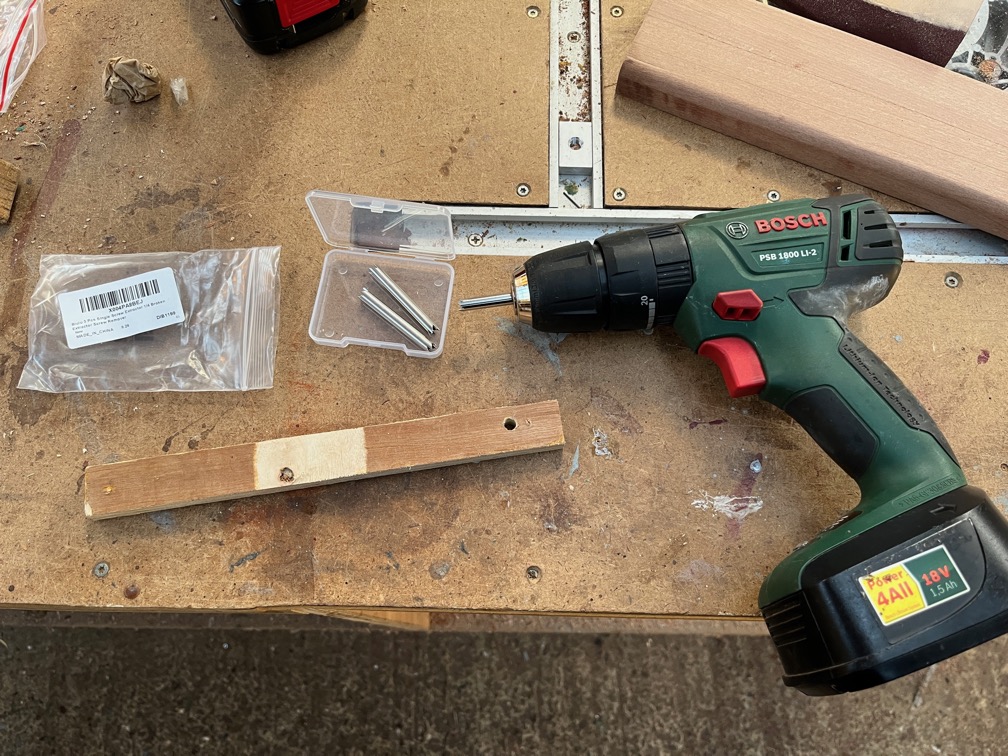
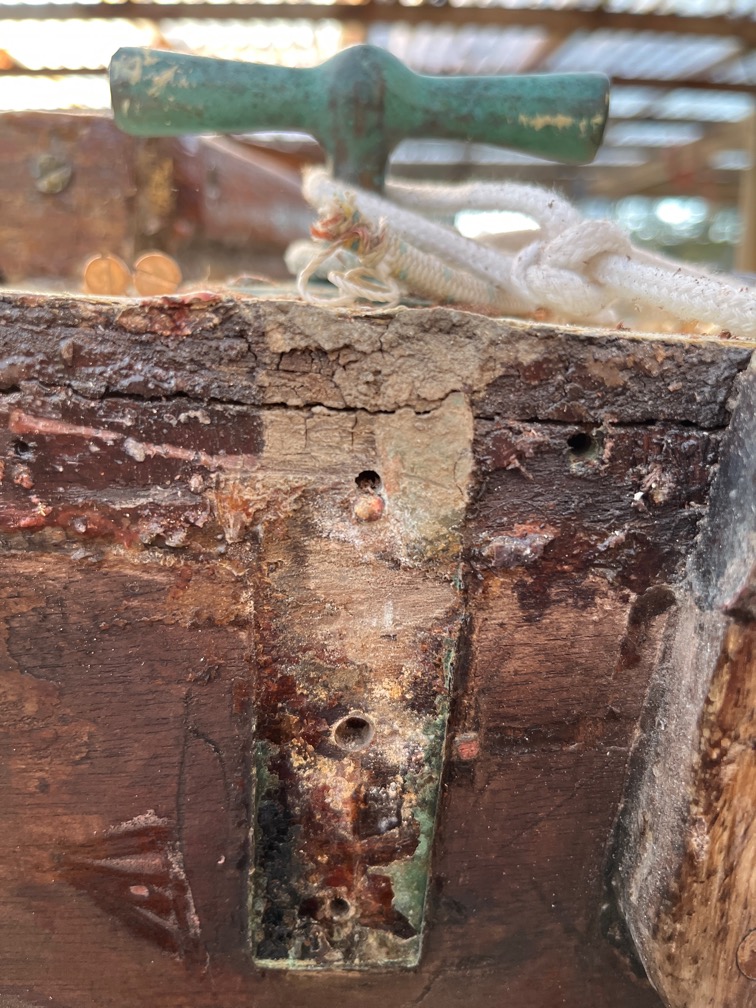
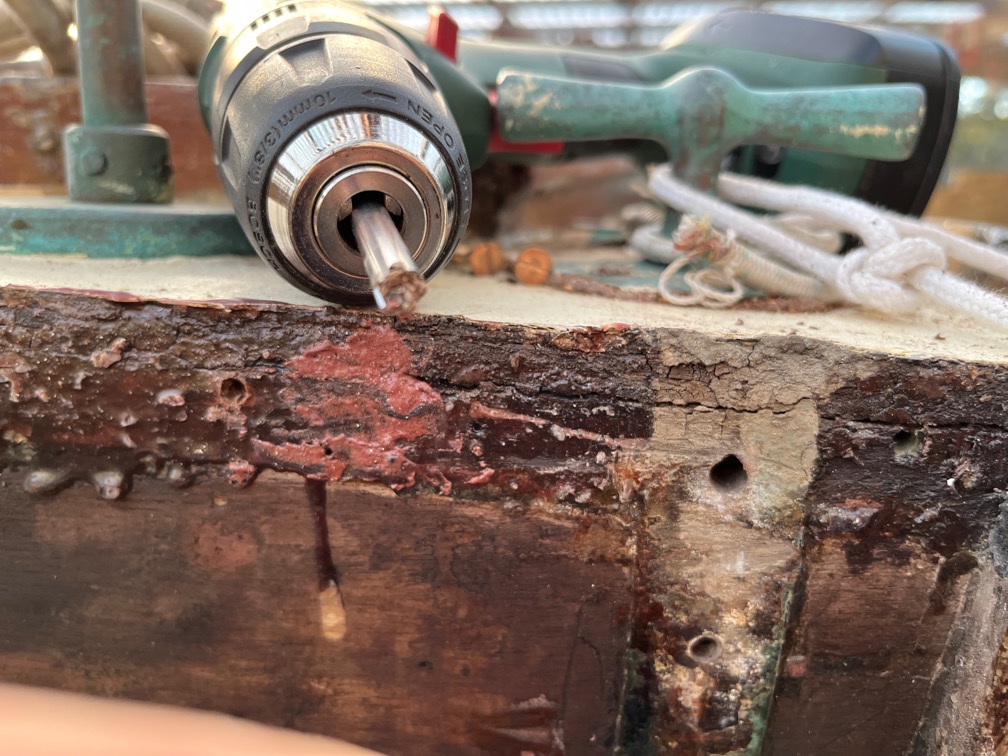
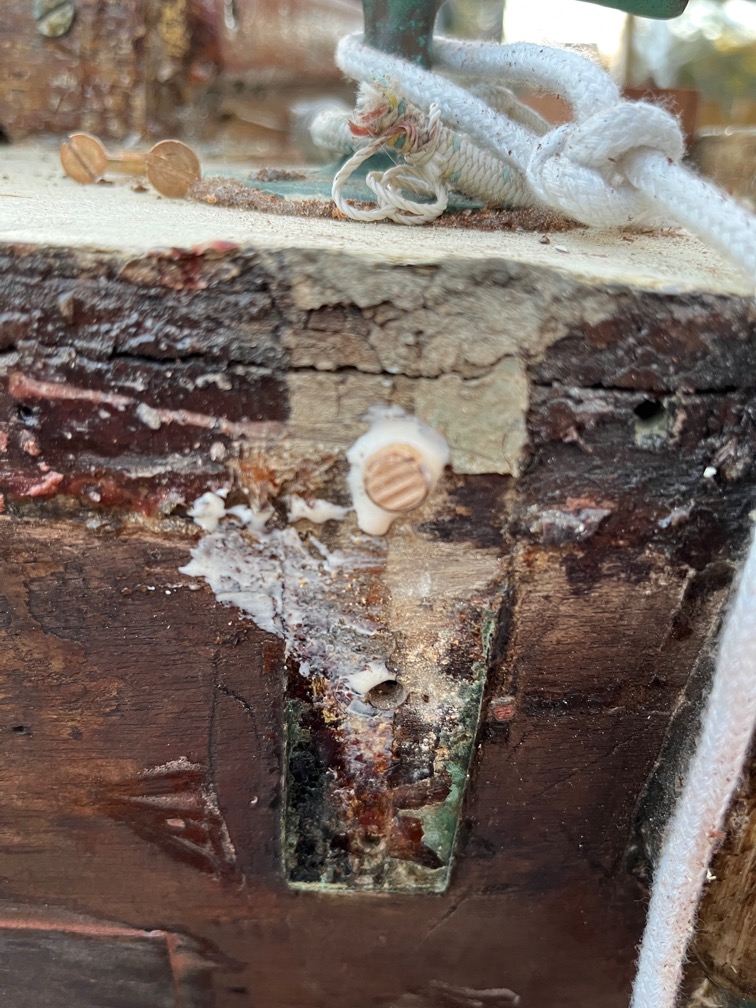
These gizmos arrive in the post, broken screw extractors. Basically a hollow 1/4″ drill bit. They are great but almost impossible to use unless guided. Try using these by hand as the tip goes all over the place.
I drilled a suitable hole in an offcut which will act as mu guide.
This is one of the screws that has broken off and I need it to be out of there.
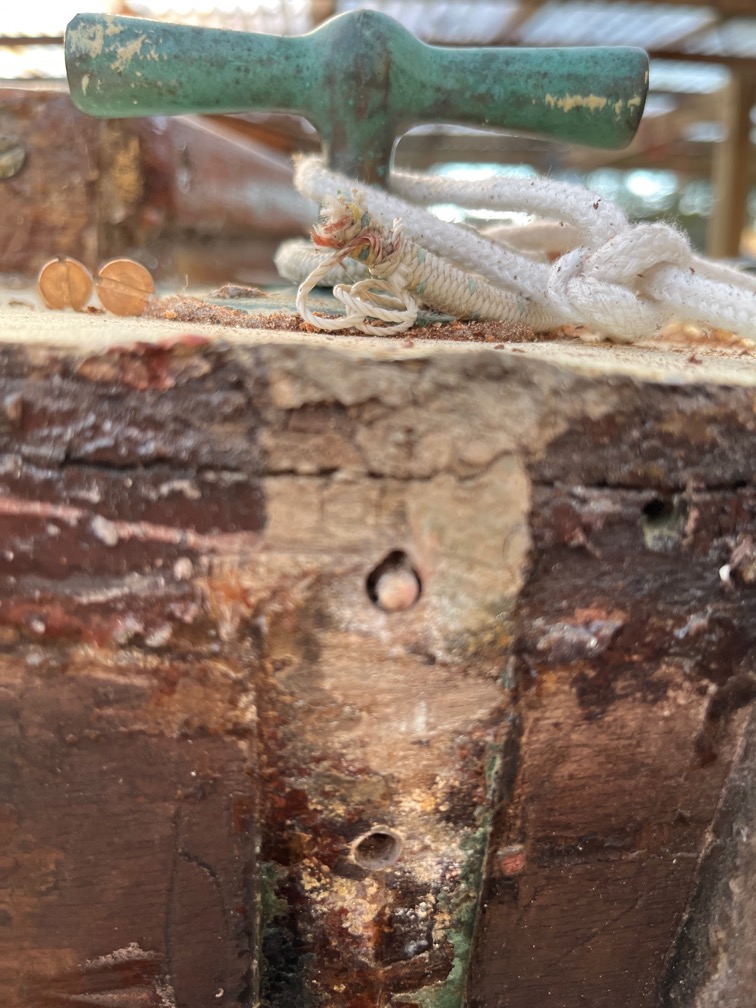
Here I have started the hole, as you can see, and once you have the hole started, you no longer need the guide to stead the extractor.
It doesn’t take long, just a few seconds, to drill out a core of wood in which the broken screw remains.
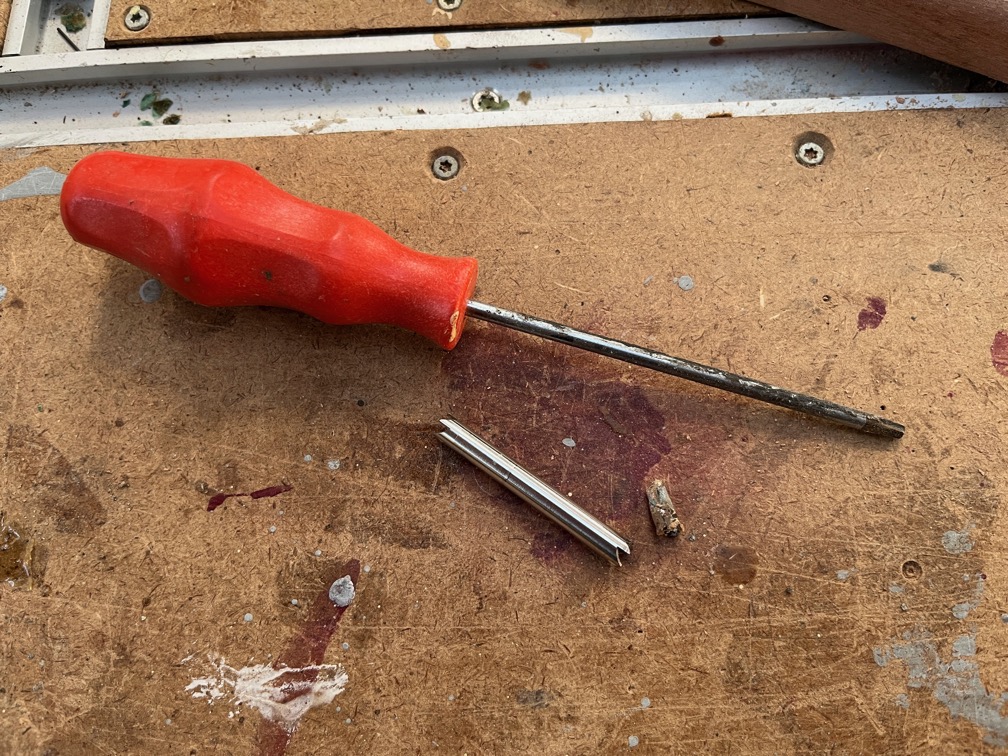
The extractor is cleared by pushing out the core with a suitable ram.
Then it was just a cse of opening up the hole and glueing in a dowel. Once the glue has fully dried I’ll cut off the end of the dowel flush with the transom and I will be in a position to mount the two bronze eyes and the rubbing strake.
Since it is Sunday today, I decided to take things a little easy, so the first task was one that I could carry out sitting at the kitchen table.
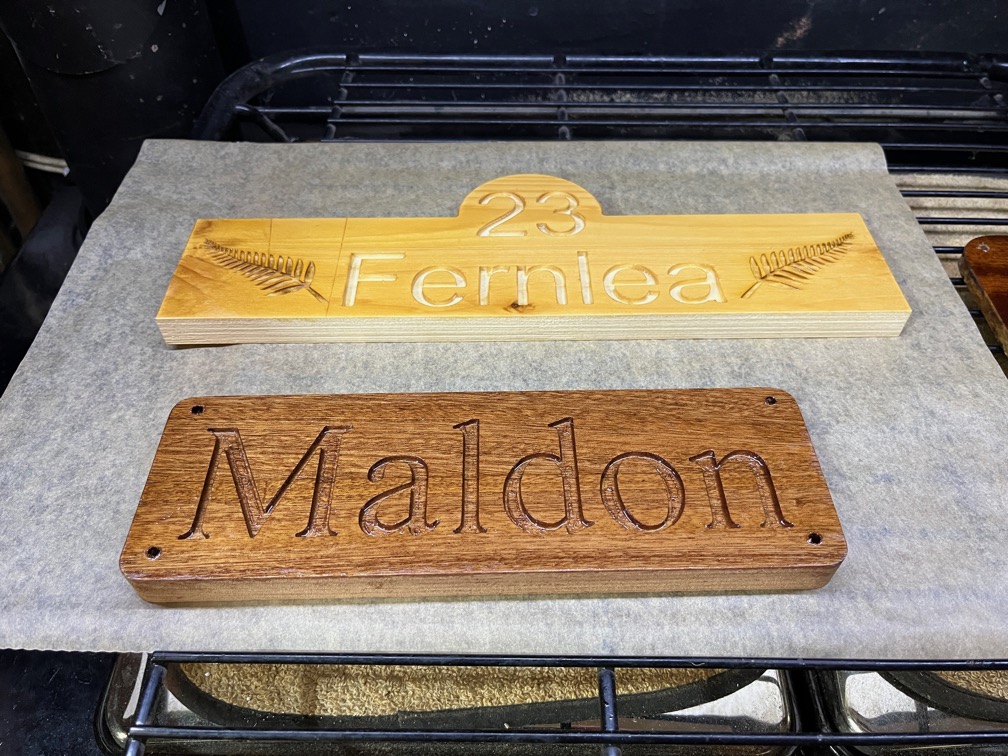
I had two signs that needed to be coated with epoxy to prevent pigmented epoxy bleeding into the grain later, so that was the first task. One of the signs is the Maldon name plate and the other is a house sign commissioned by a customer.
It is also the First of March and time for a little thought about the upcoming tasks. Despite having cracked on with many jobs including the major task of getting the centerplate case repaired, there are still quite a number of tasks that need to be done by the end of the month if at all possible. In no particular order, these include:
Finish and mount the name plates.
Finish the aft deck repair.
Fit the transom rubbing strake.
Rebuild all the bulkheads and lockers dismantled in order to work on the centerplate case.
Refit the sole boards in the cabin.
Refit the bottom boards in the cockpit
Paint the new wood inside.
Refit the bunks and thwarts in the cabin.
Refasten the ballast battens.
Sand and paint the coachroof.
Sand and paint the deck.
Sand and paint the topsides.
Scrape off all the old cracking antifoul.
Apply new antifoul.
Build a gantry crane.
Fit battery into its locker.
Move Naiad onto the working trailer and Shoal Waters onto the travelling trailer.
Carry out a leak test.
Add cleat to boom for luff reefing lines.
Stow the new anchor chain.
These are the main tasks, each of which may be made up of several sub-tasks. Like I said, still a lot to do. The most important of these is the leak test and for that I need the gantry crane.
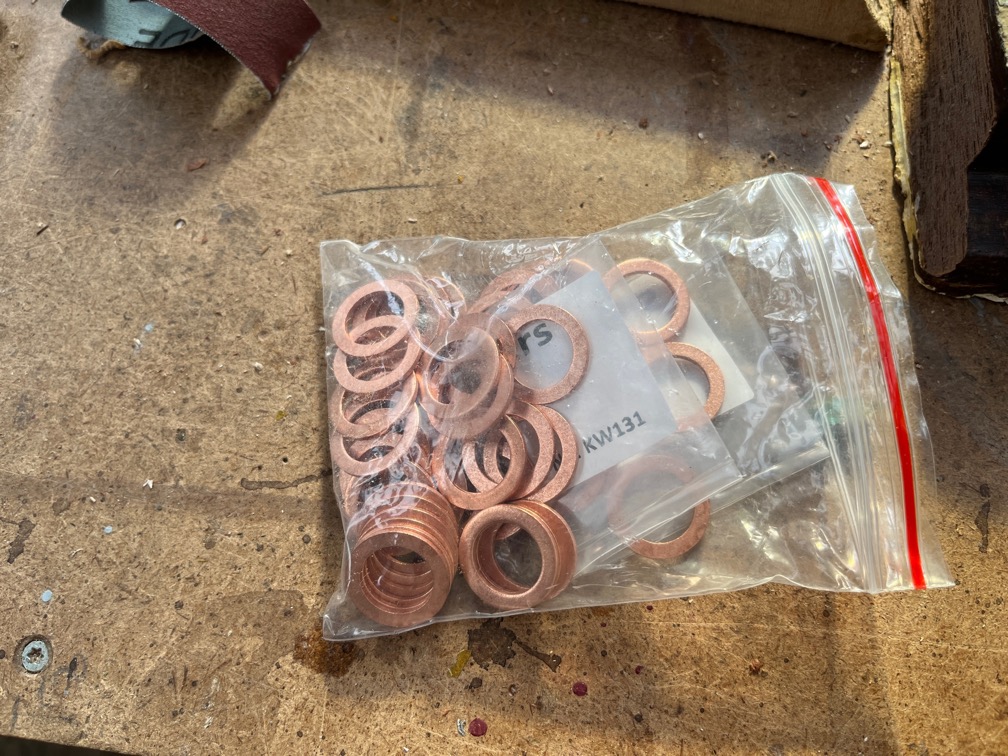
These arrived yesterday, the copper washers for the rudder fittings.
It turns out that what I thought was old copper put on to make the pintle fit in the gudgeon, was, in fact, nothing more than thin string wound around the pintle and glued applied to keep it in place.
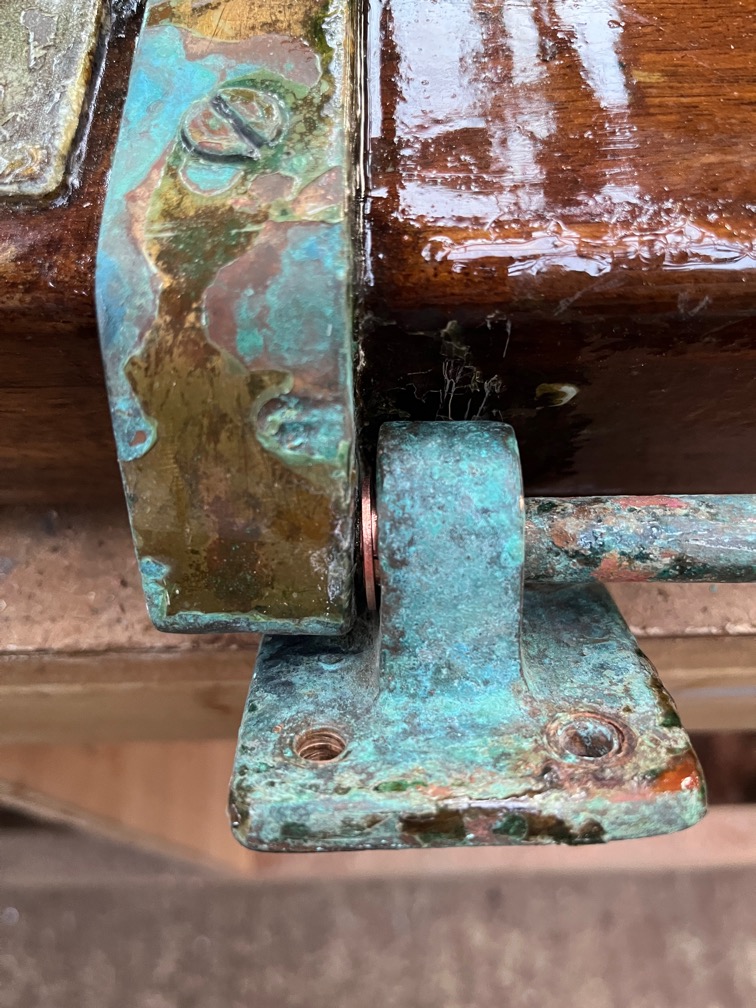
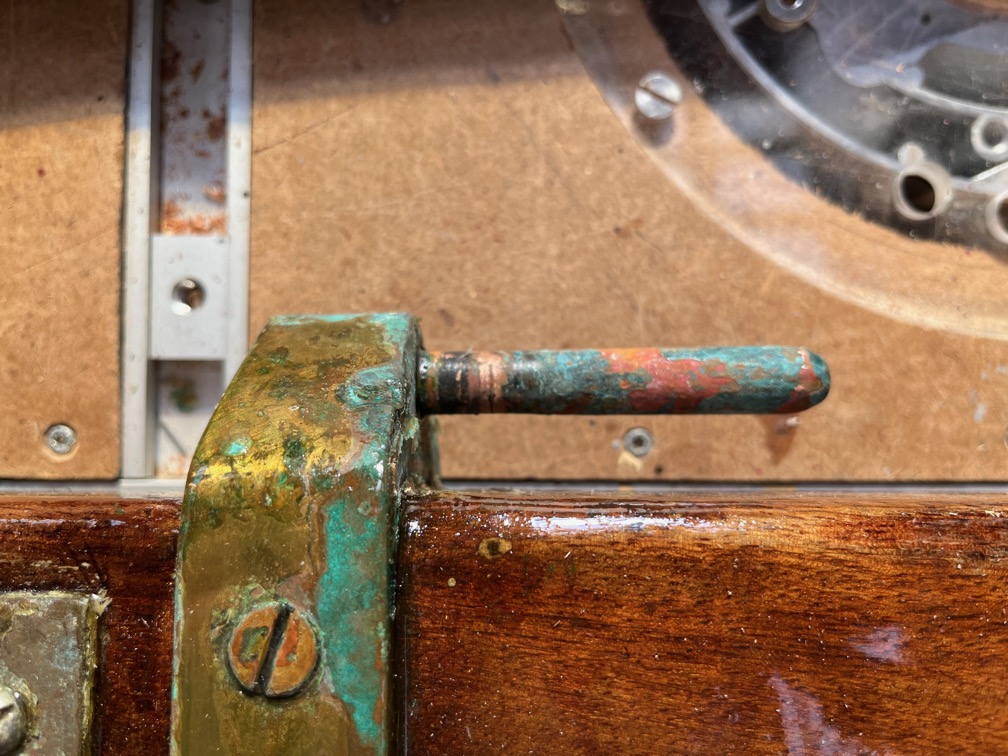
The problem is that it made the diameter of the pintle too large. I took it off and measured the pin and hole diameters and found that there is a 1mm difference which makes the pintle rock and click in the gudgeon when in use. I decided to try something else. I ordered a small piece of copper sheet a mere 0.5mm thick and from this I will make a small cylinder that fits around the pintle. You can see that the pintle is narrowed a little at the top (the left hand end in the photo) and the gudgeon is worn as well.
Now I could try putting string & glue on again, but getting the fit correct that way is not easy. With the copper sheet, if it is too thick, then I can hammer it with a soft mallet to thin it down a little. I will use a little glue to stop the cylinder from falling off and some on the washers for the same reason. I could have bought a bronze sheet and cut washers and made a cylinder out of that, but I chose the copper for two reasons. Firstly, it is softer than the bronze fitting and so it will wear away instead of the fitting. Secondly, it is so very much cheaper.
Once the copper has worn away and needs replacing, well, I have the washers and the sheet to make the repair easy.
The next task was the graving piece for the aft deck.
The rubbing strake was removed and all the exposed plywood edges on the deck and the graving piece were coated with neat epoxy. Some of the remaining epoxy was used to coat the small soft area on the port bow and also the worn areas on the rudder blade. The rest of the epoxy was thickened with wood fibres and spread on to the edges of the aft deck.
The graving piece was put into position, epoxy used to fill the semicircular cut out in the aft deck, the area covered with greaseproof paper and the whole lot pressed down using the router template from before.
I used the fast hardener since I want this to kick off before the temperature drops too much, it was 12º C at the time, so that should be sufficient. I’ll see tomorrow when I take the clamp off and inspect the result.
That was all the tasks I planned for the day, anything else done today will be a bonus. I will let the SikaFlex on the centerplate case sit for another day or two, the spec sheets says that it should be fully cured in a couple of days, but that also means not being able to work on anything in the cabin.
There are a few small tasks that need to be carried out and the mount for the aft navigation light is one.
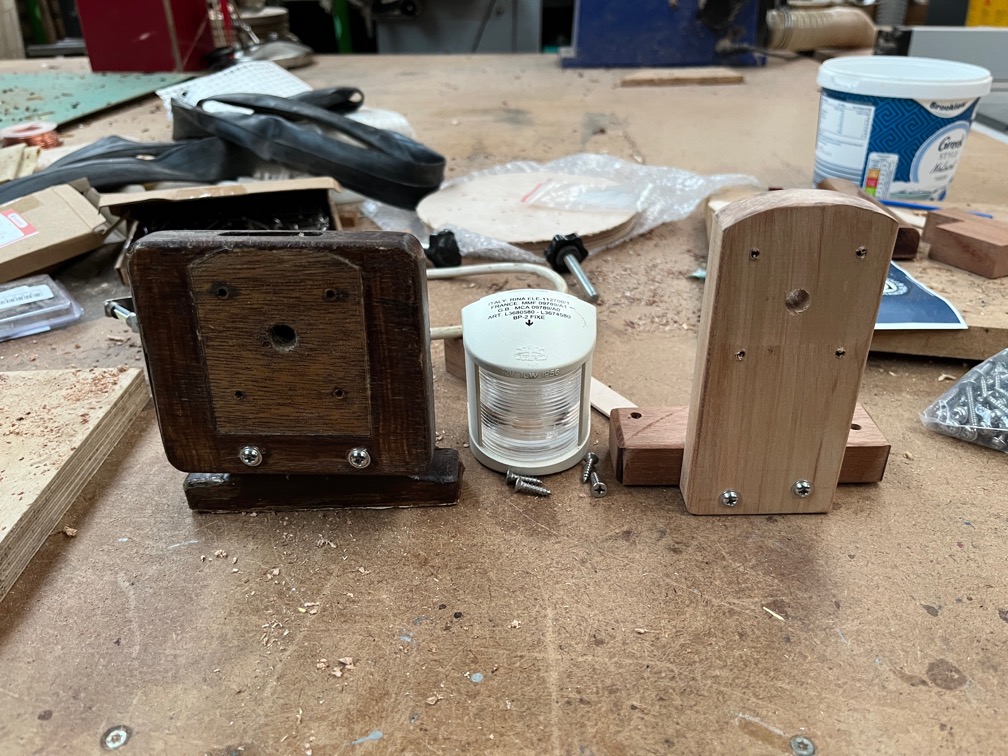
Here are the old (left) and the new mounts. The large base for the original mount was large because the original aft light was also large. A huge copper navigation light that must have been six to eight inches tall.
Here is a clip from an older photo showing the huge light on the aft deck.
However, a few years ago this was replaced by a small and more modern stern navigation light that you can see between the two mounts but the existing mount was only changed enough to suit the new light.
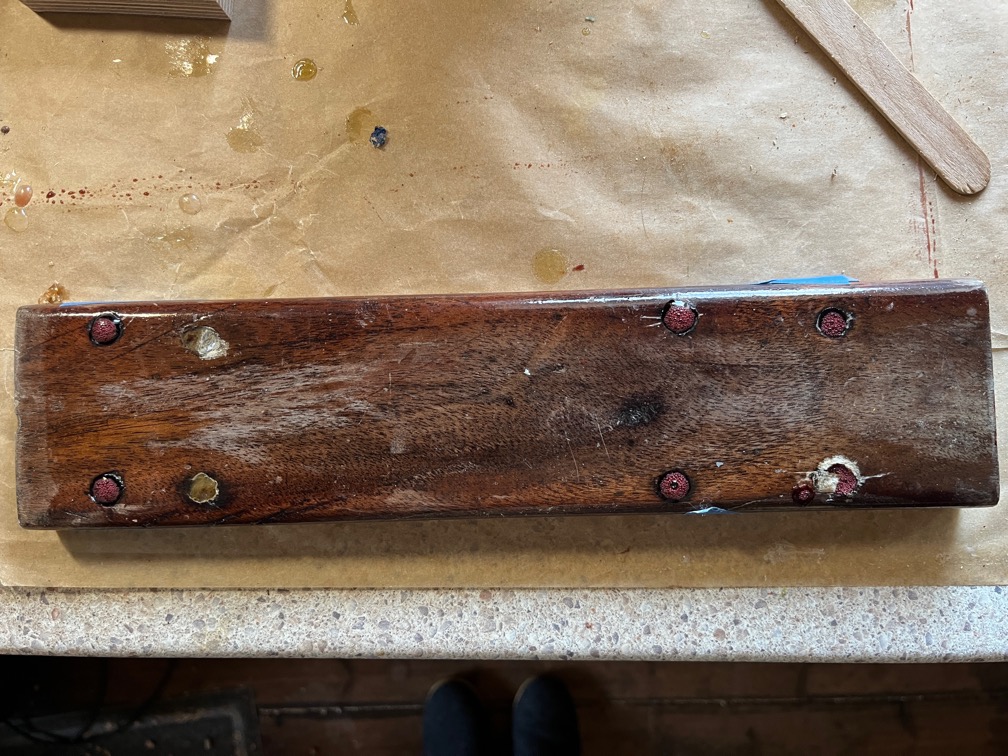
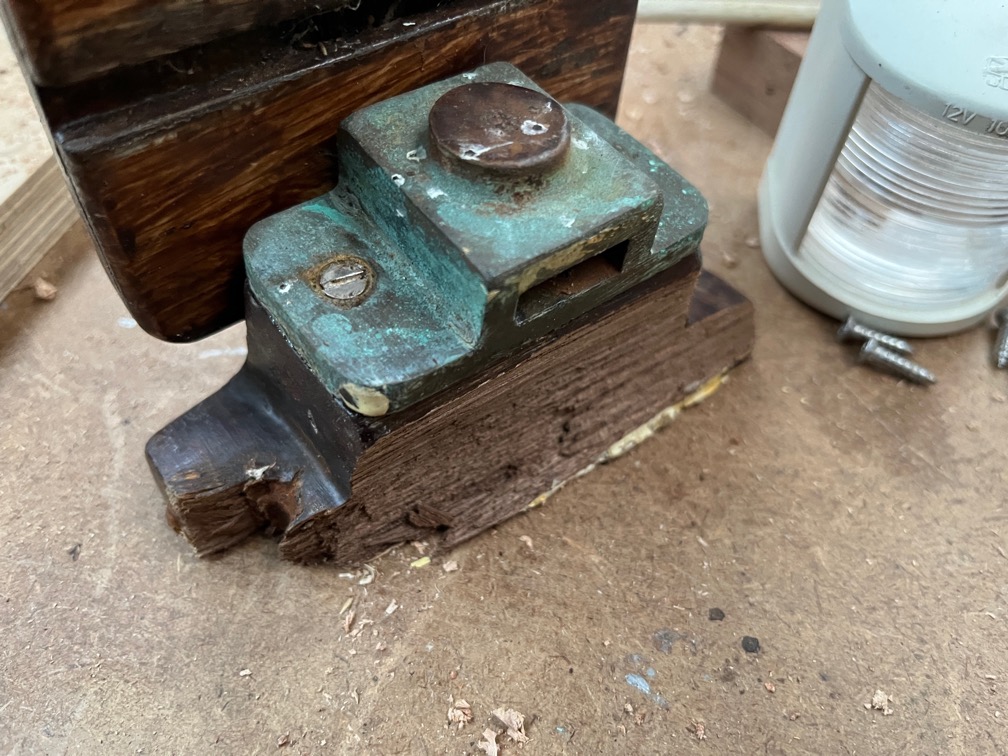
This is the reason for the replacement, the old one had to be broken off as the screw head disintegrated as it was originally brass. Unfortunate as there was nothing wrong with the mount itself, but I needed it out of the way in order to cut the aft deck back with the router.
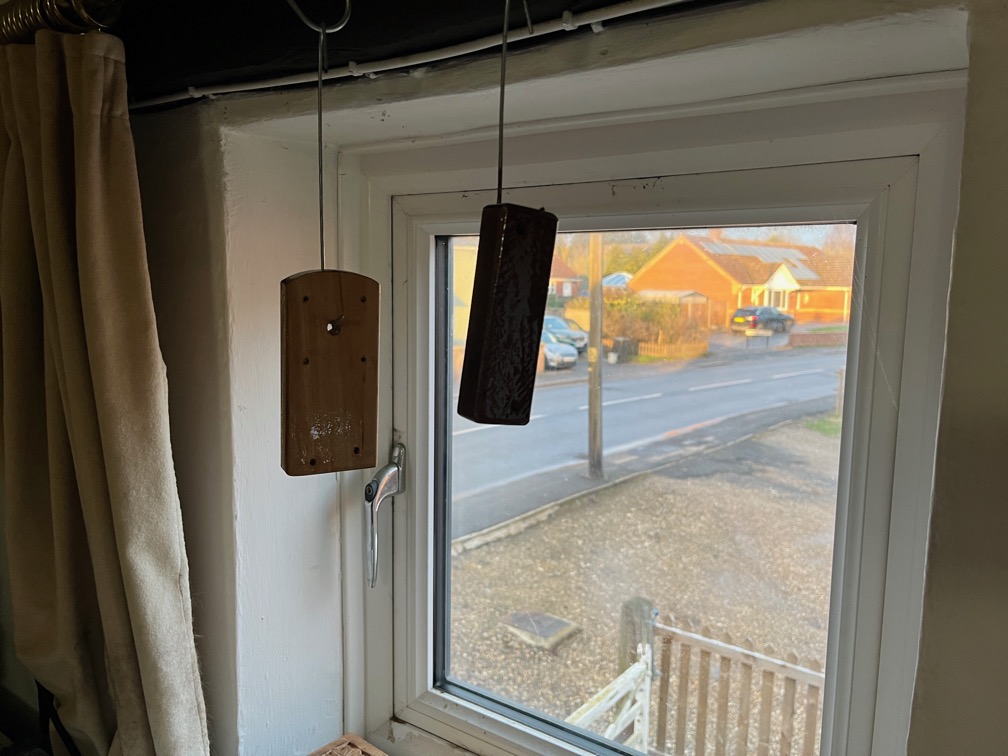
Here are the two pieces of the new mount hanging in the workroom with a coat of varnish. As usual, these will get at least four coats before being mounted on the aft deck.
The first task was to get the graving piece for the aft deck sorted out.
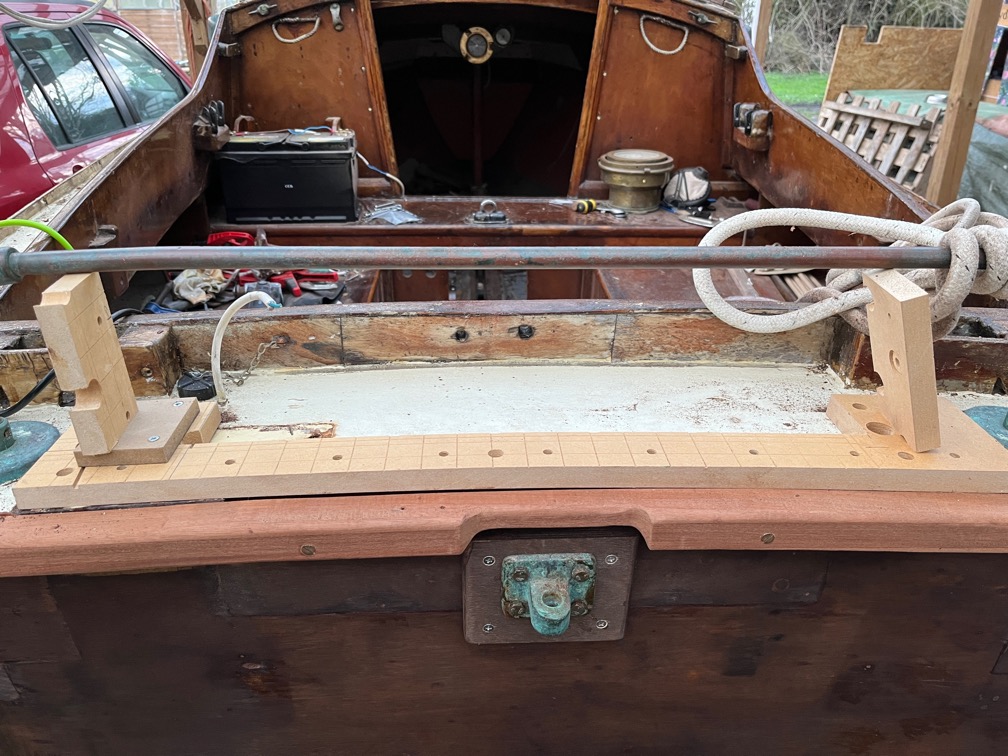
This is the graving piece with the weights remove and it is a pretty good match for the top of the deck. That does mean that it will be a little out when put in place, which is lower down, but not by much (I hope).
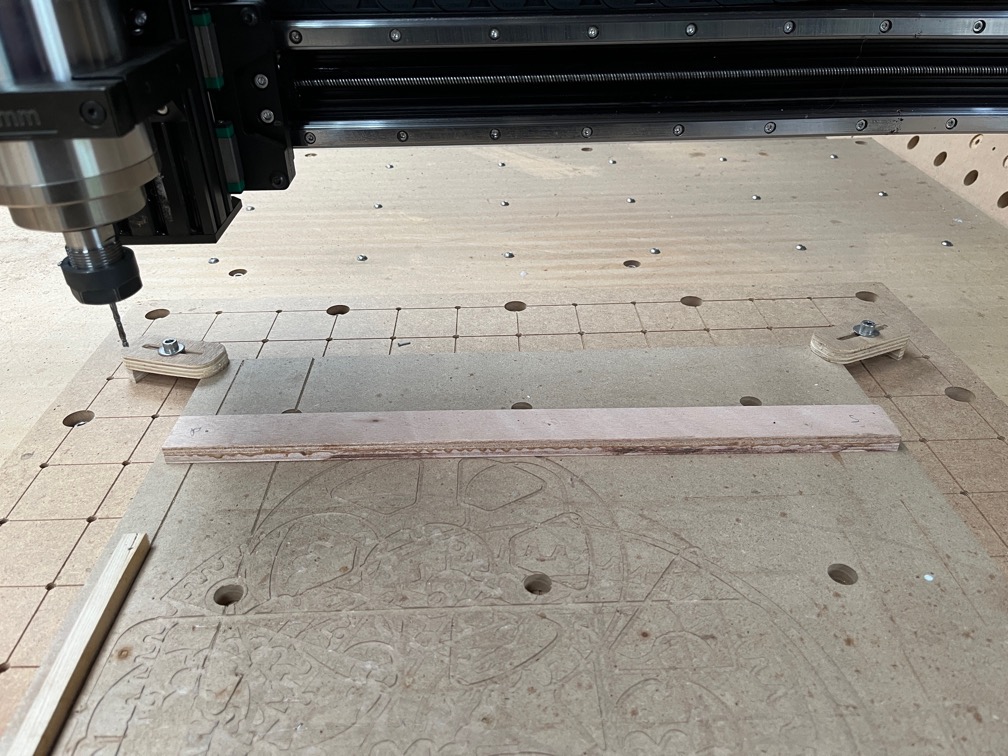
The shape of the graving piece is a slightly trapezoidal with two rounded corners and a prime candidate for the CNC Router.
And it was, except for the first cut of the first pass where I didn’t clamp down the right hand end properly and the cut went completely awry. The the rest was good. I set it up so that it was fractionally too wide and then used the belt sander to bring it down to the correct size.
Like this. You’ll probably note that the graving piece is too high and that is because the original deck is 3/8″ or 9.5mm and the laminated graving piece is 12mm.
That did not take long to fix, a few passes through the planer and this is the result. This also planed off the errant first cut, so that is very good.
The other end is a good fit also. Because the curve is not quite correct, I had to hold it down, but that will be taken care of when it is glued in place.
For now, I need to go and warm my fingers up.
Time for a cup of tea.
After lunch I spend the first part of the afternoon repeatedly dry fitting the case sides until the fit was about as perfect as I can get it. I also noted the places where I need to ensure that there is plenty of SikaFlex as the fit is not so good in those places.
It was a lot of up and down, rinse and repeat. By the time I took a break, my legs were aching. Still, the next task was to fit the case sides for real and they need to be done in one go so that when the bolts are tightened up, the sealant is still soft enough to squeeze out everywhere, filling all the gaps.
SikaFlex gets everywhere and is really sticky so I wasn’t able to get many on-the-go photos due to sealant on my hands. Well on the nitrile gloves, but you get the point.
Some time later…
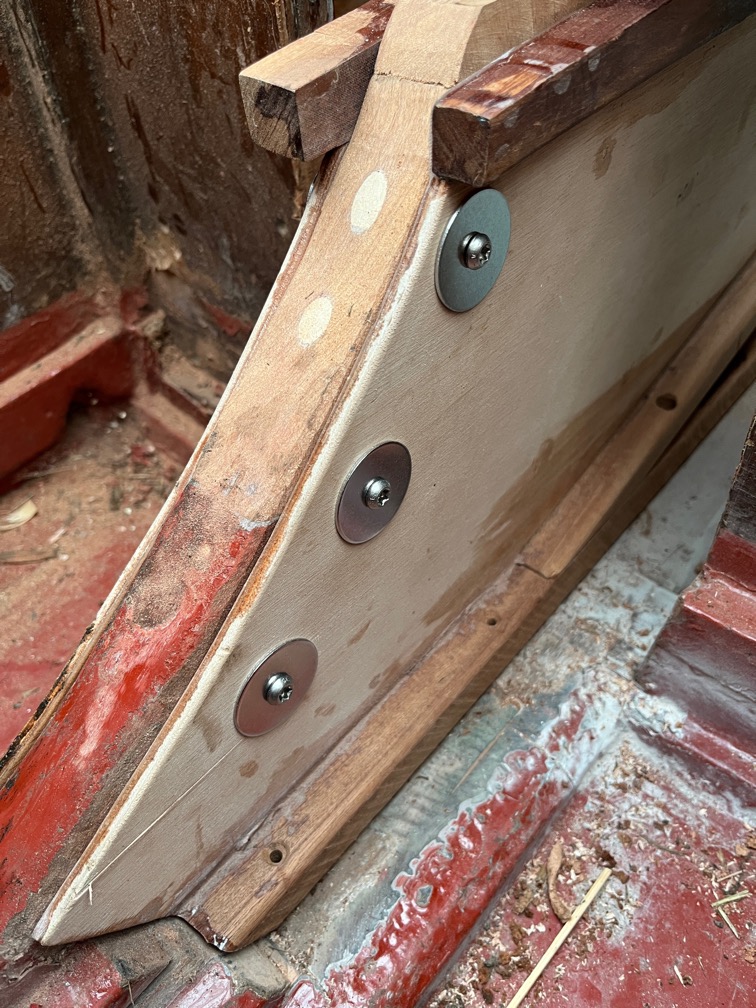
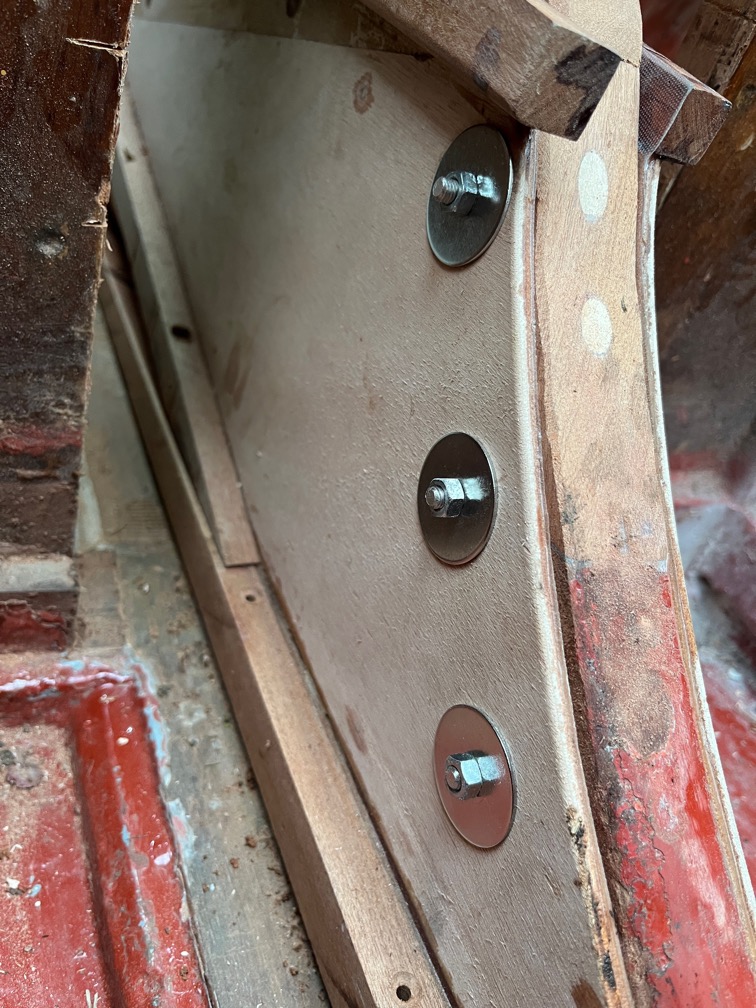
The final part of the dry fitting was to cut the bolts to length. You can see the very large washers in use here. Perhaps they are a bit too large, but that is not going to hurt.
And the nut side of the bolts, although still not the correct ones yet.
Third stage of the case side installation. The first stage was putting sealant on the parts of the sides that touch the keel. The second stage was putting sealant on the fore and aft blocks.
The bolts through the fore block have yet to be tightened.
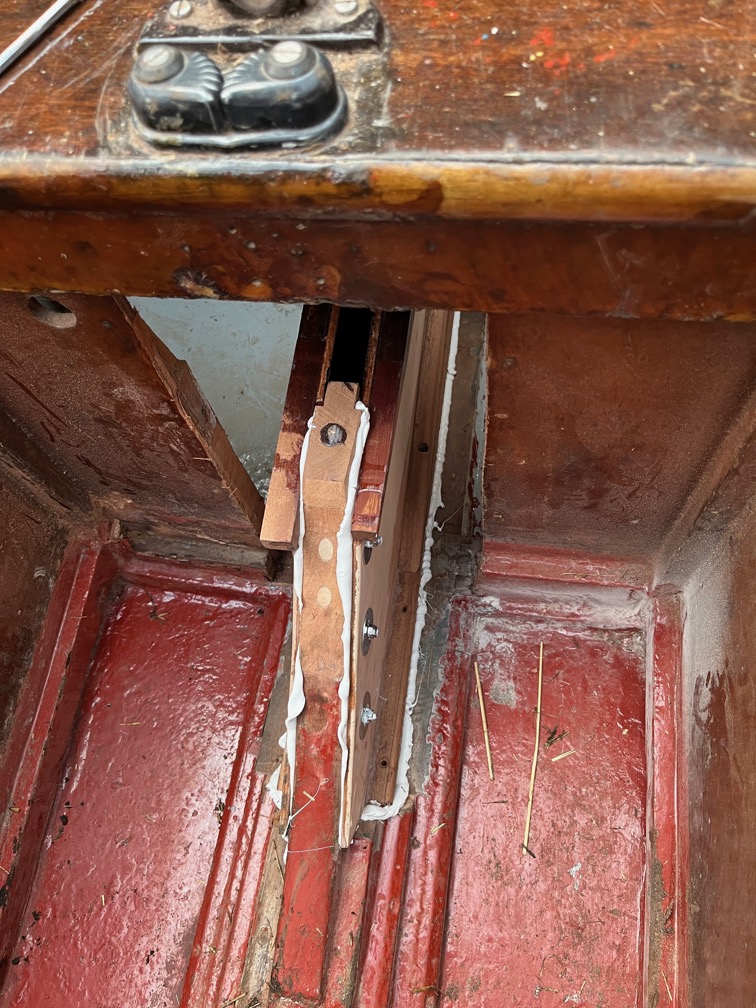
The screws are in through the bottom runners and into the keel and all parts of the squeeze out have been pressed over with the round ended stick, both to give a smooth finish and to ensure that sealant is pressed into any gaps.
It looks a bit messy but trying to get a good finish when the sealant is sticky is an exercise in futility. I find it best to go over everything with the aforementioned round-ended stick and then let the sealant cure. After that the stringy bits can be cut away with a knife or a chisel and the whole lot sanded if required.
This bit is especially messy.
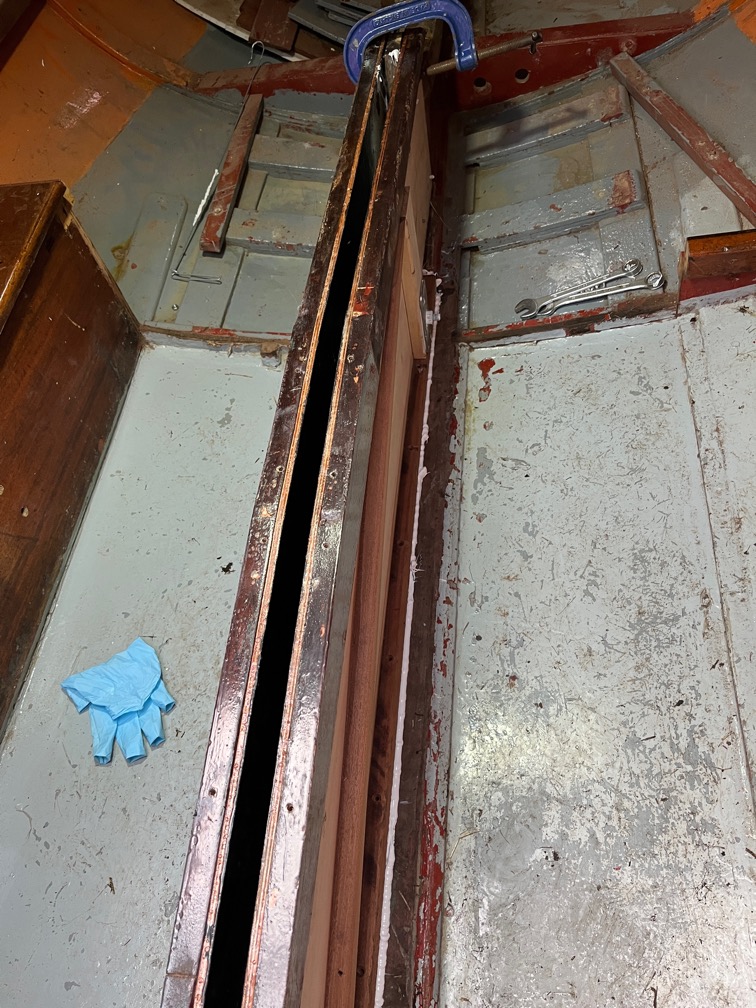
Still, the centerplate case sides are now in awaiting the next major task and that is the leak test.
For now, I’m knackered.
Time for a cup of tea.
Once I had rested for a while I decided to do a bit more.
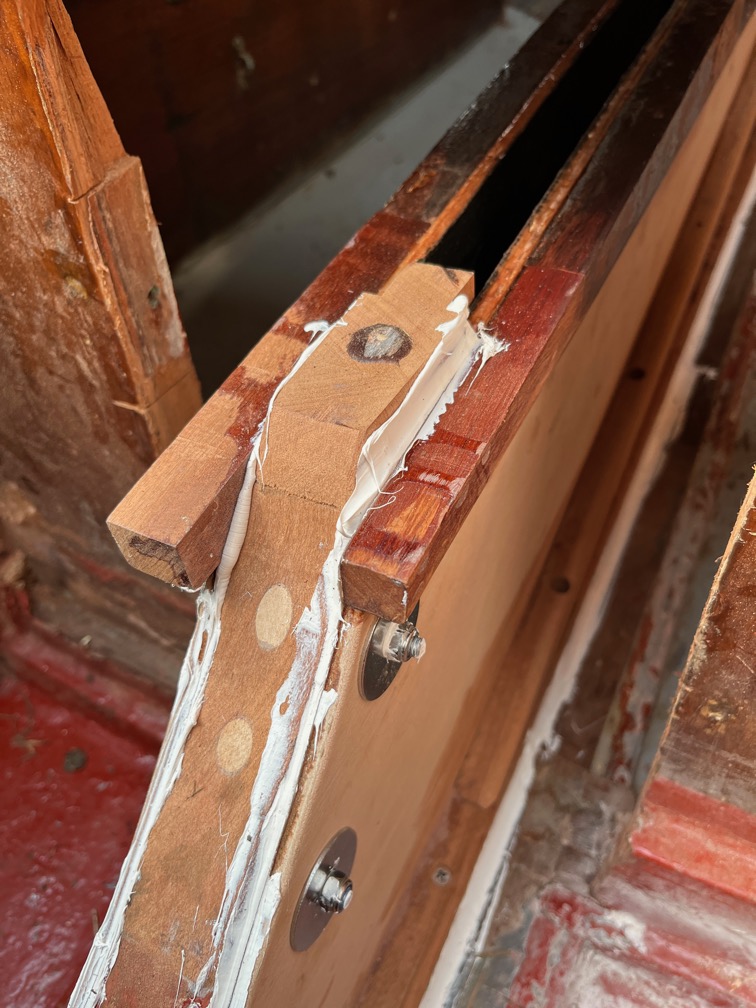
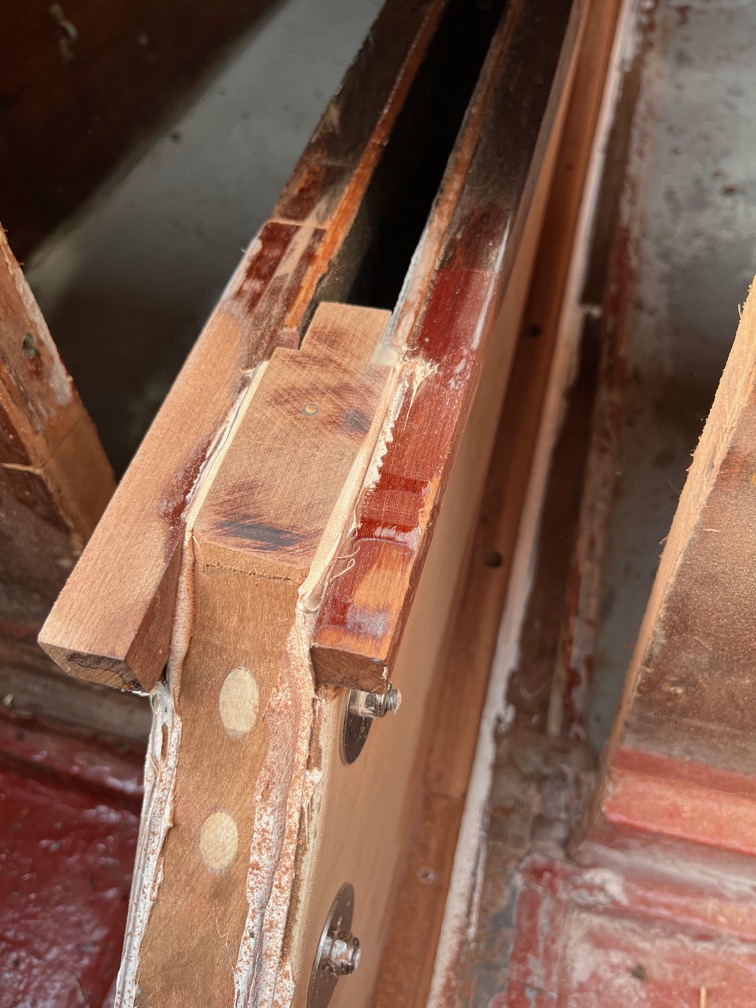
It is quite nice to find that things are going well when original pieces of the centerplate case fit back where they belong without having to modify anything. There the two intact top pieces of the case are screwed back on using the same screws in the same holes. The fact that it all fits indicates that my rebuilding of the case isn’t far off being correct.
The piece of timber that is going to be the replacement for the top that had to be cut away was put in place, more or less, to check that I had the dimensions correct.
As you can see, it is slightly wider and longer than required which is good. Once the aft block has been sanded to shape I can make the noew top piece.
I have some more brightwork to do, so today’s first task was to put another coat of varnish on the name board. No photos of that it’s not that interesting.
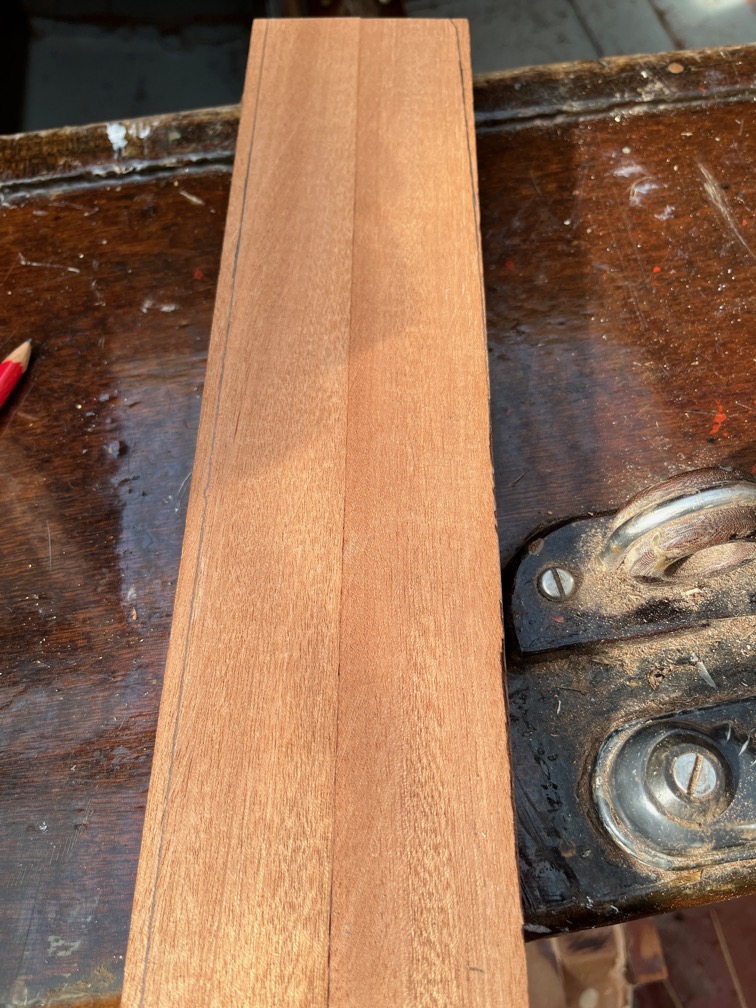
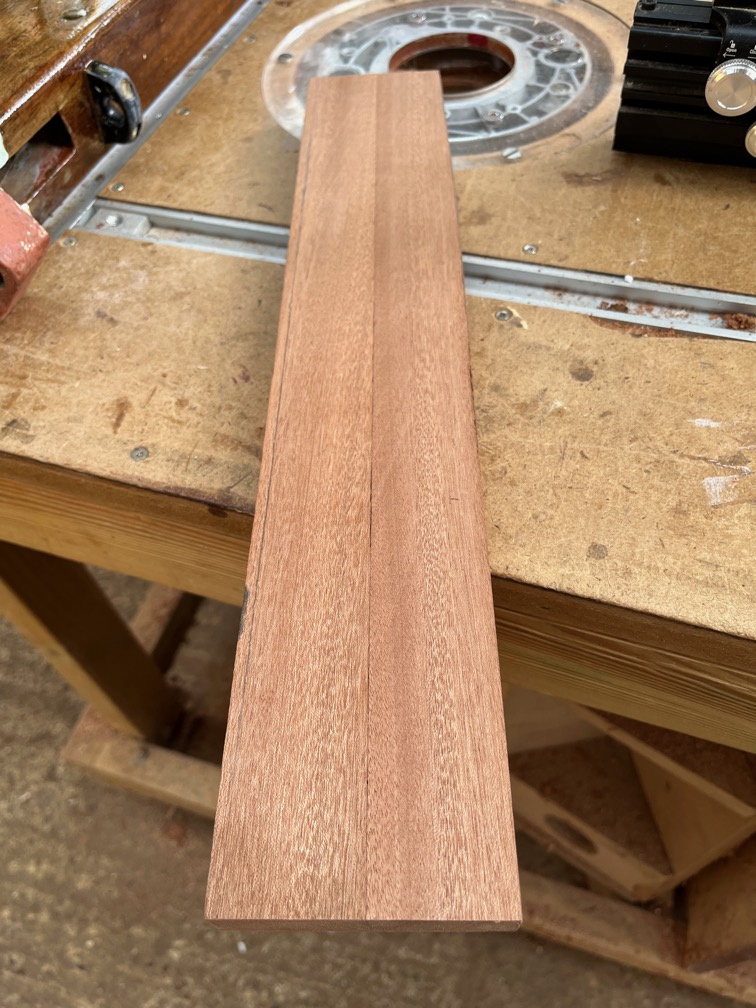
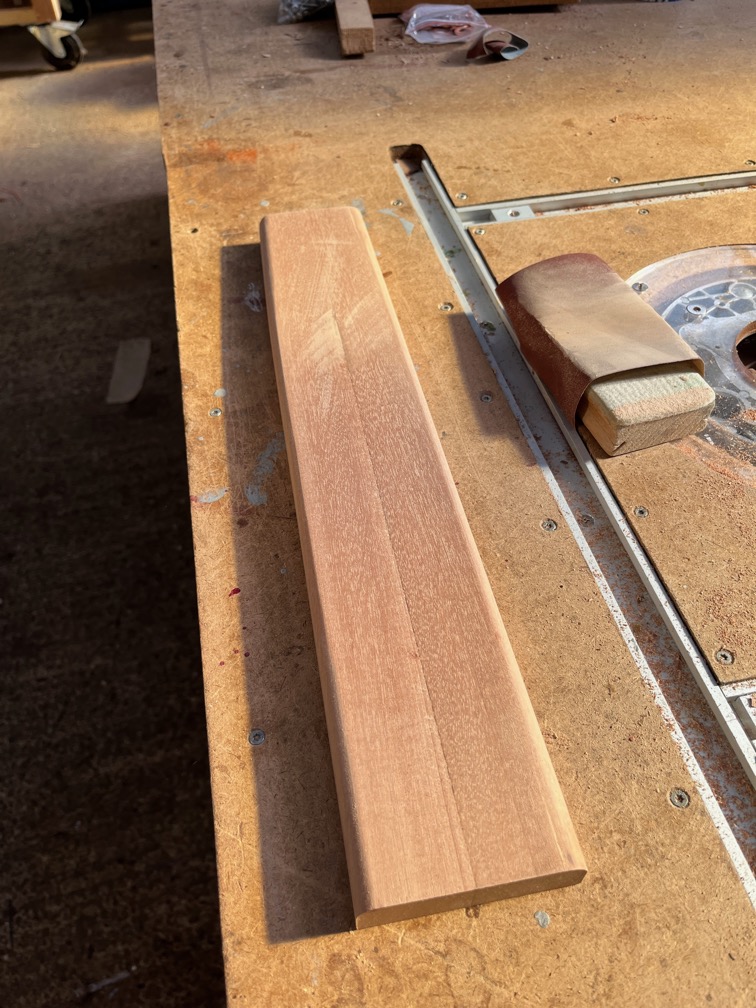
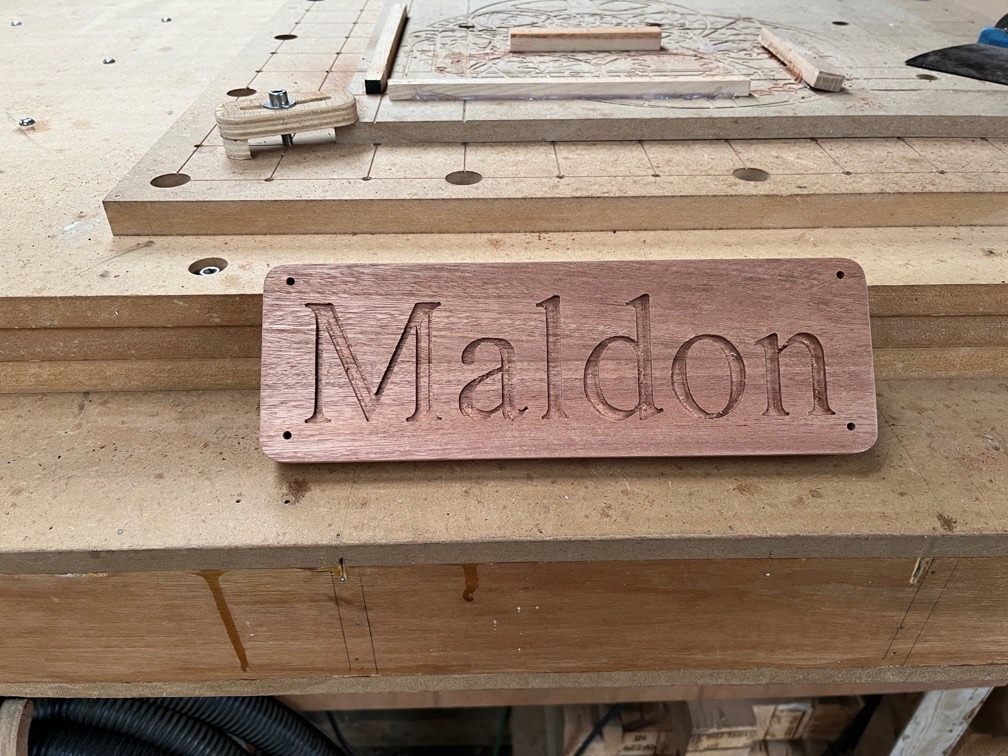
One of the bigger small tasks was to get on with the Maldon name board. Here is the board, glued, planed, surfaced, carved and cut out. Not a big task but oh so satisfying.
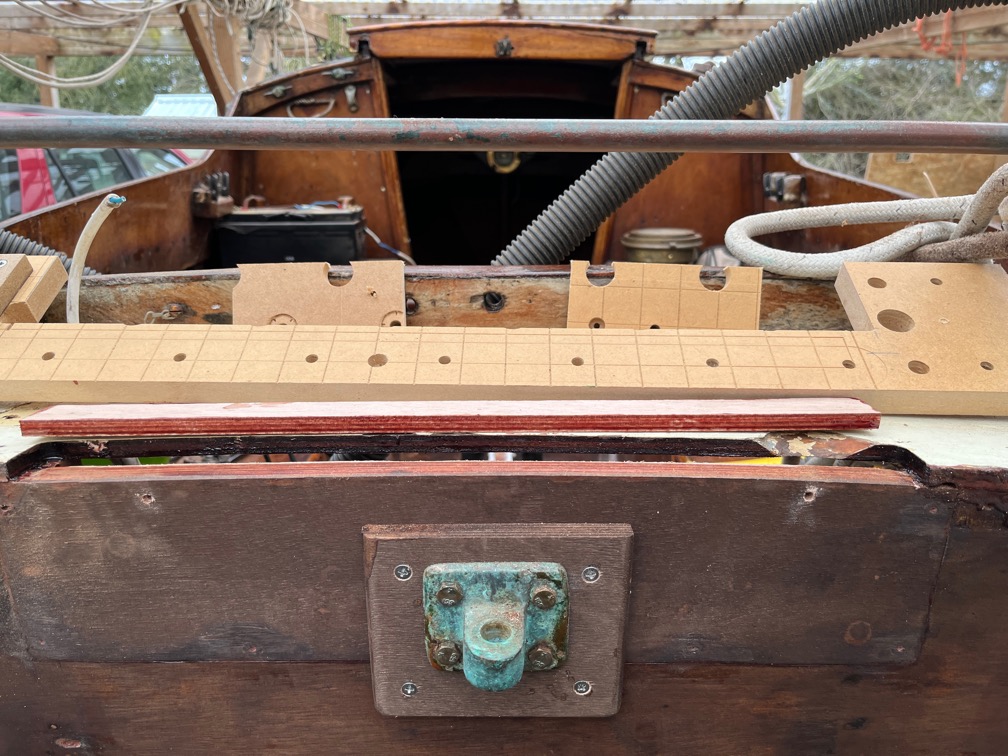
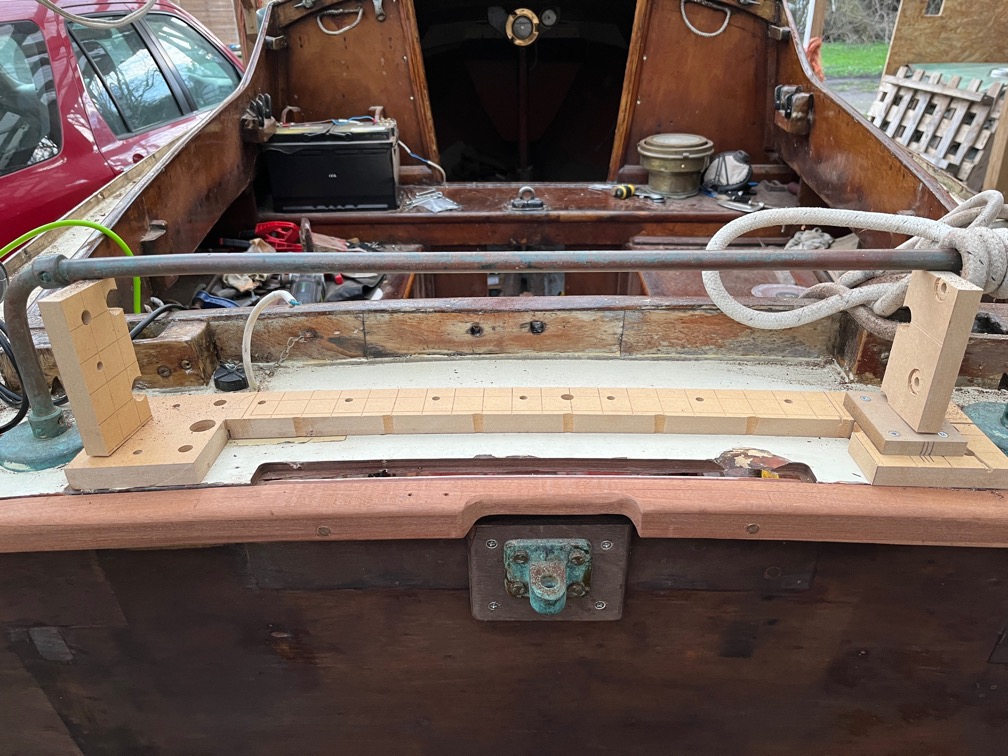
The next task is the aft deck. I had to cut this back to a regular shape so that I can grave in a new piece of plywood. This is the router template for the cut conveniently held down by braces to the horse.
The result was pretty good, but did not quite cut through the deck leaving what is known in CNC Router circles as an onion skin behind. This was easily removed with sandpaper and a chisel where required.
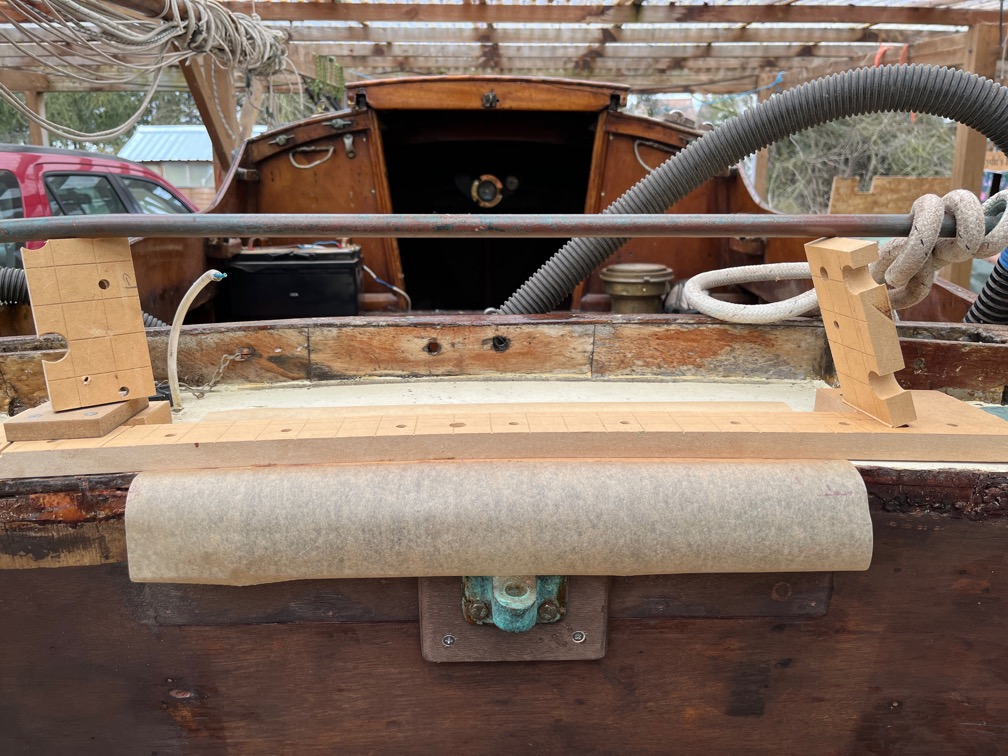
The piece used to guide the router will be used when the time comes to glue the graving piece in place like this. With suitable plastic protection so that it doesn’t get glued to the deck !
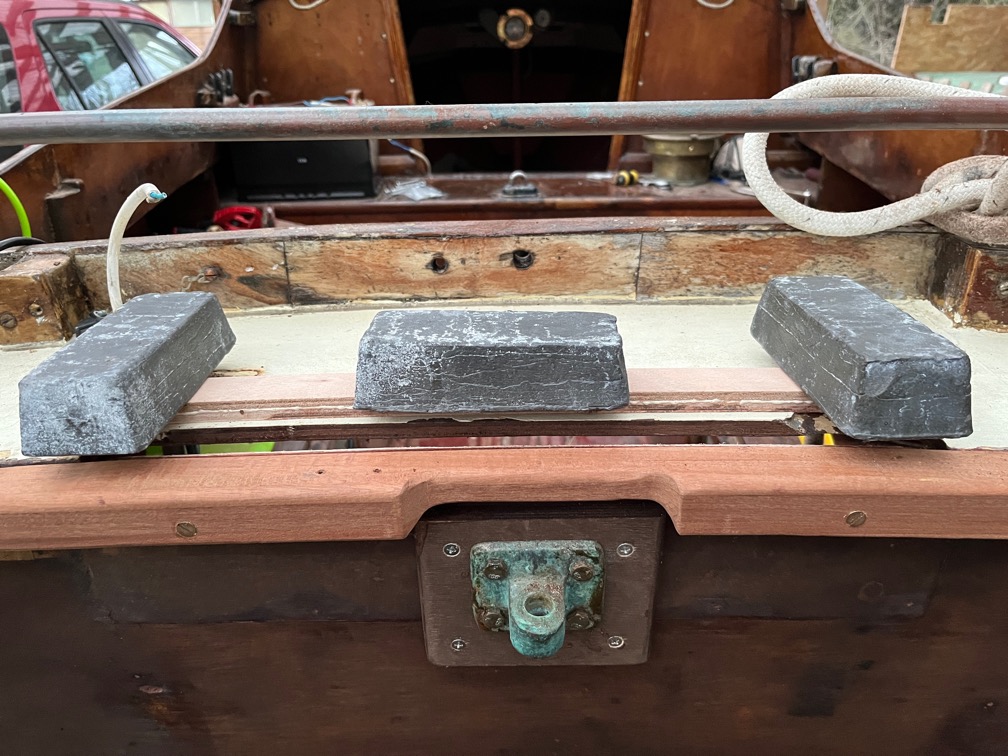
I cut two plywood laminates that are fractionally too big for the gap, glued them together and weighted them down on the deck with lead weights so that the resultant plywood is bent into almost the correct shape before glueing it to the deck.
There were various other small tasks carried out but nothing really worthy of photographing or describing.
Considering just how warm it was yesterday, the weather station recorded 16º C, it was a tad cold this morning. The difference, apart from the temperature, is that it was almost a dead calm yesterday and today it is blowing a hoolie.
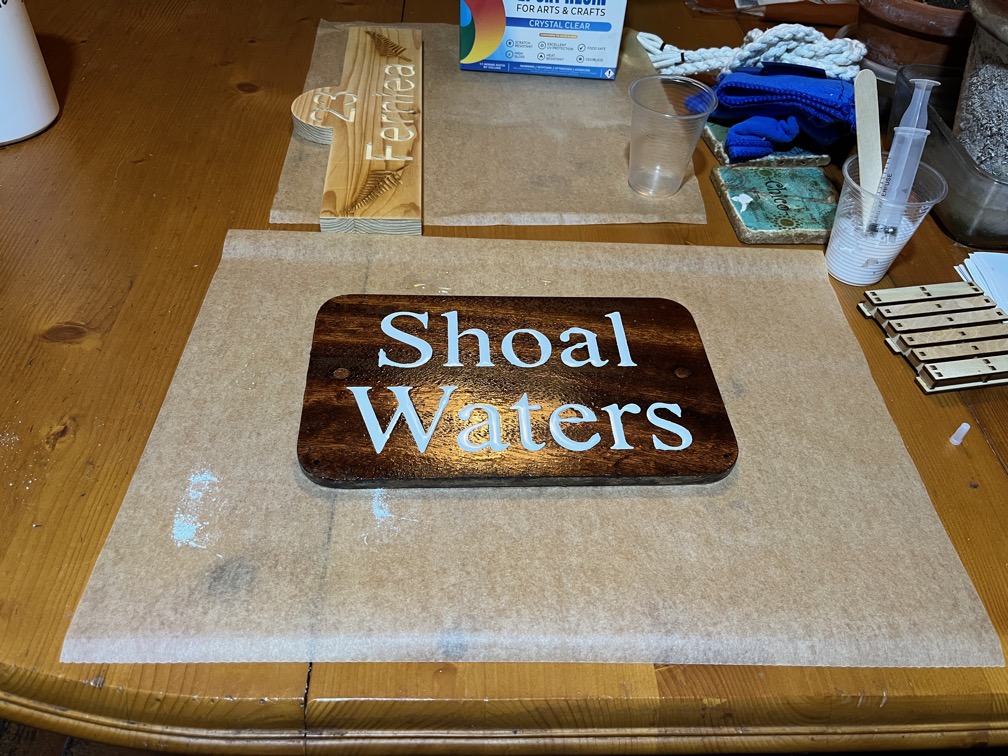
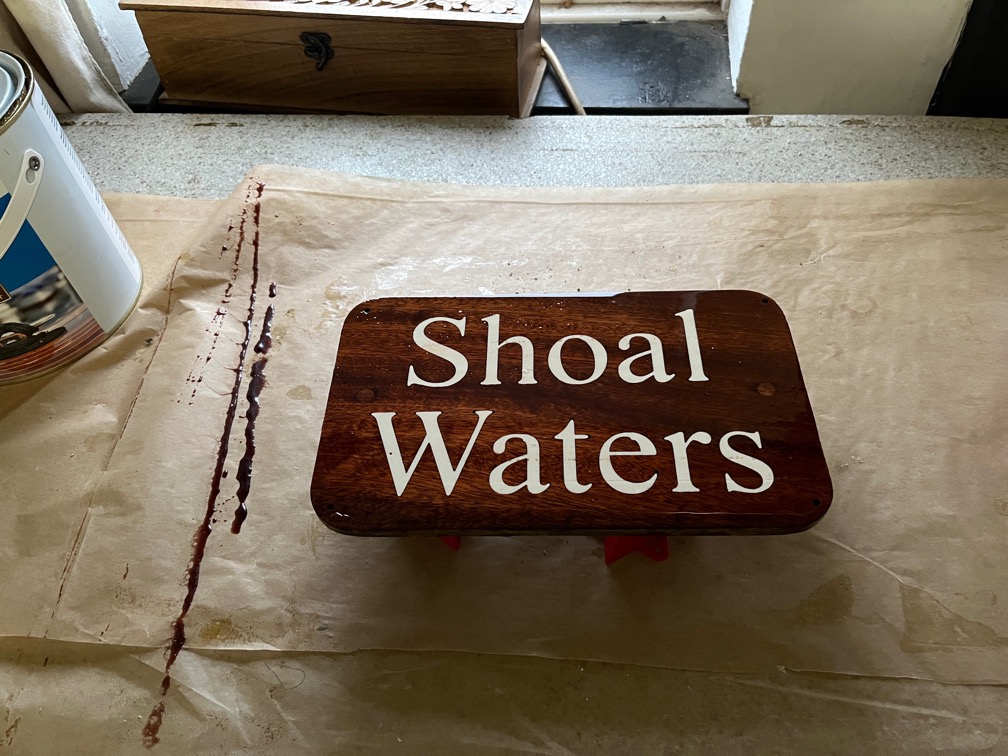
It will not surprise you to learn that inside tasks were high on the list. This is one of them. I filled in the carved out letters for Shoal Waters’ name board with pigmented epoxy and once the epoxy is dry it will be put back on the CNC Router and the top skimmed off in very small increments until all the surface epoxy is removed.
I have yet to make a ‘Maldon’ name plate, but that will be done as soon as I can find a suitable good piece of Mahogany or Sapele. If I don’t have any, then I may have to use plywood.
The next task was an inside the workshop task and that was to remove part of the back of the rubbing strake such that the chain plates on the transom may be refitted.
These modifications came out quite well and as soon as I can remove the two brass screws that broke off then I’ll be able to fit the strake in place. Well, after the aft deck is repaired.
Time for a cup of tea.
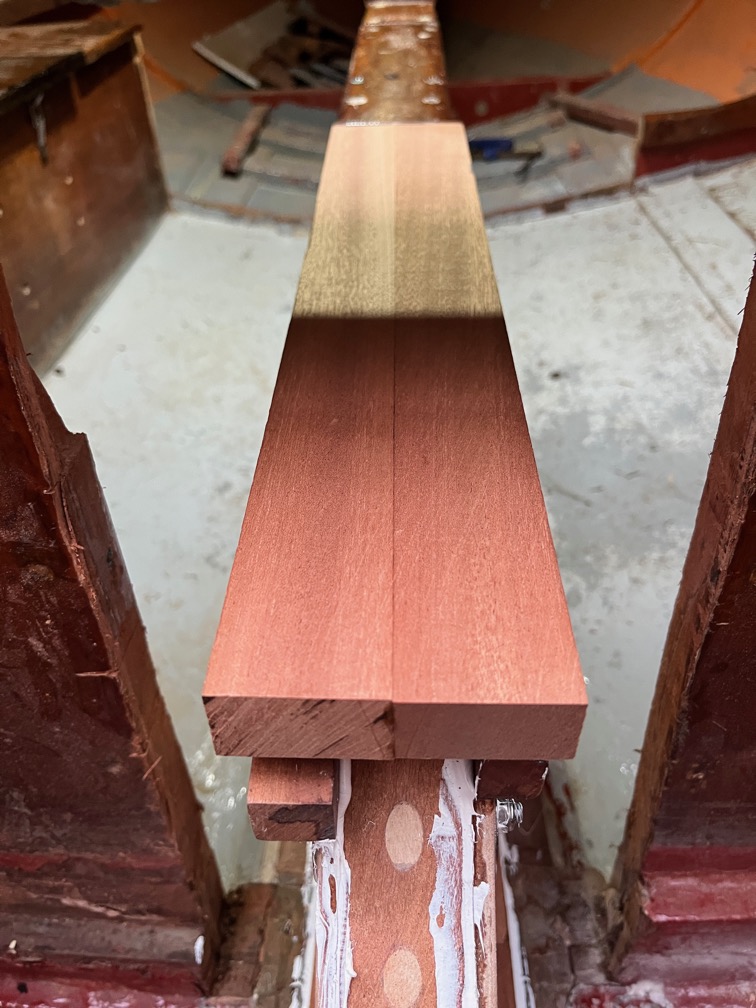
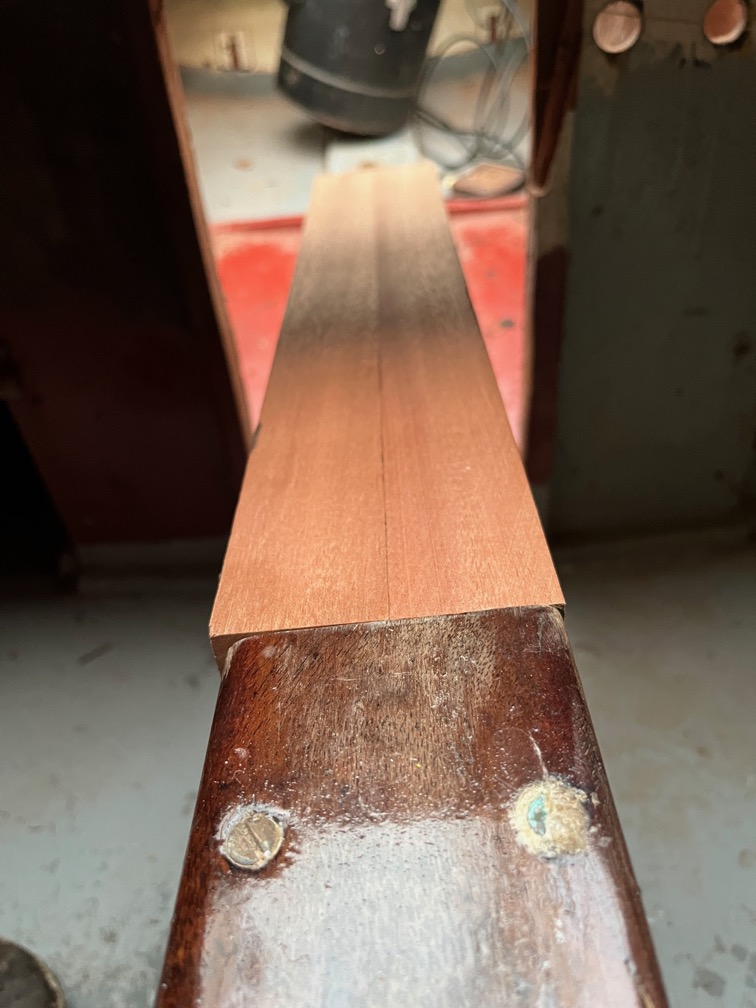
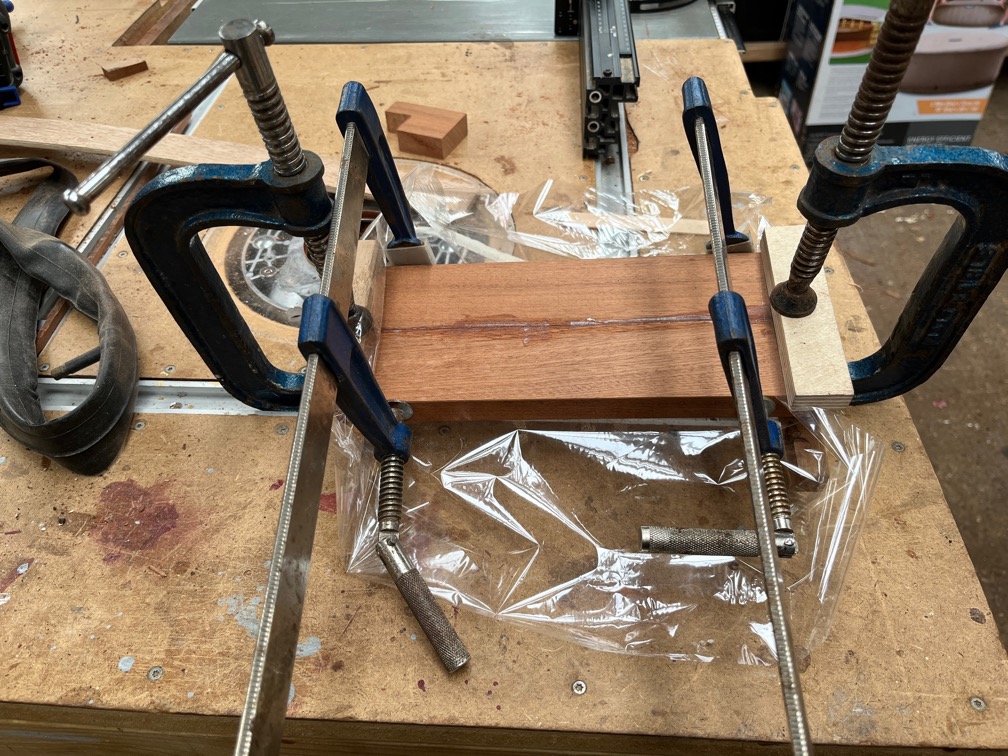
Well, I have to say that the suspense was doing my head in and I couldn’t concentrate on work, so I hied me down to the workshop and scrabbled through the offcuts wood piles to find a suitable piece of wood for the Maldon name board. Unable to find one, but able to find the parts for one I quickly glued and clamped two pieces together.
Back to work and also,
Time for a cup of tea.
An early finish for today, the large washers delivered this afternoon were not stainless but ordinary steel.