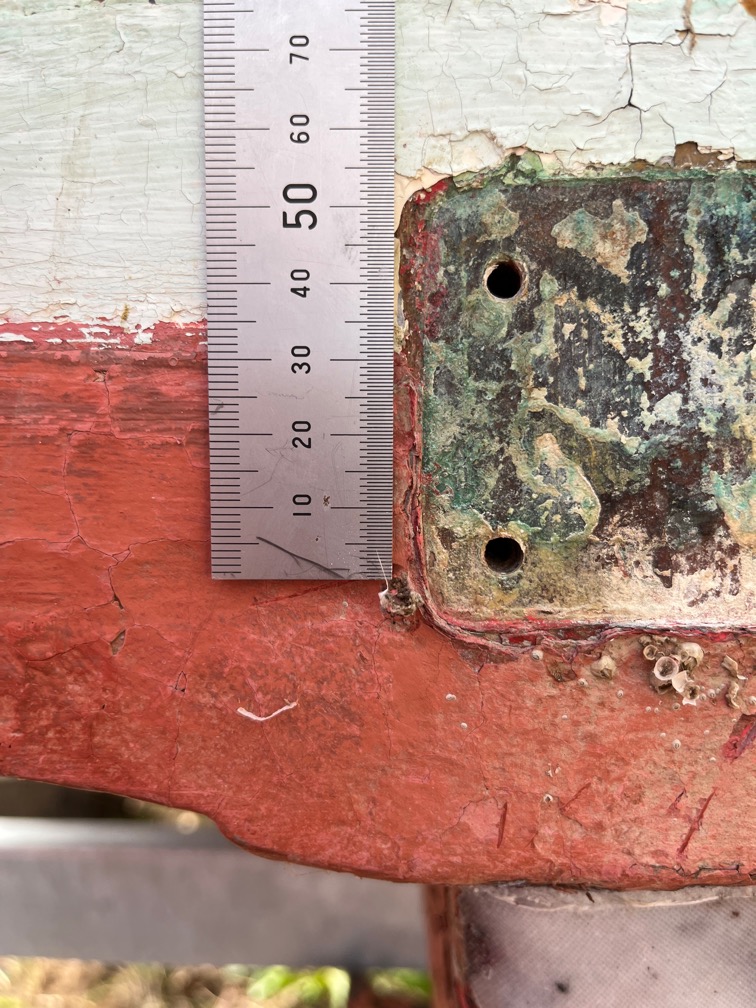
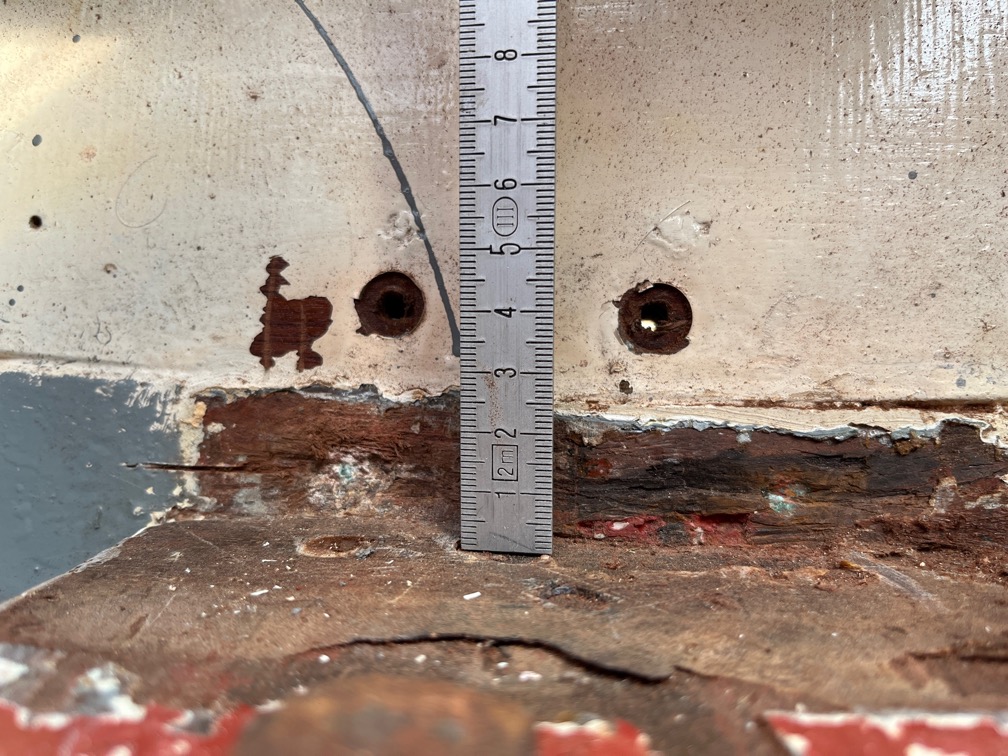
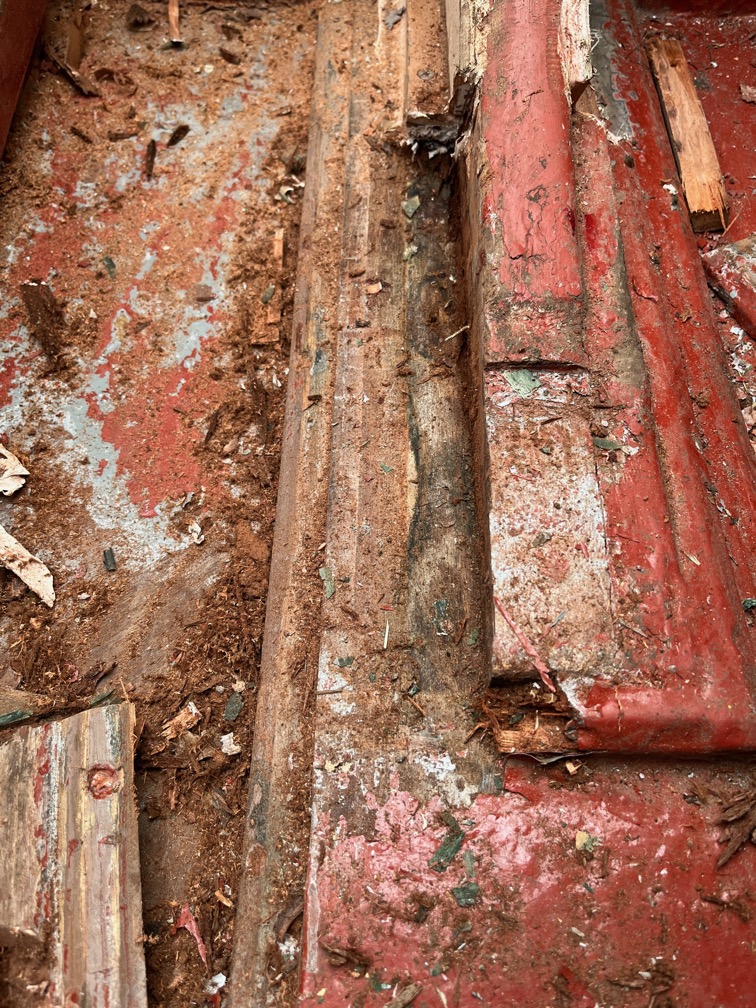
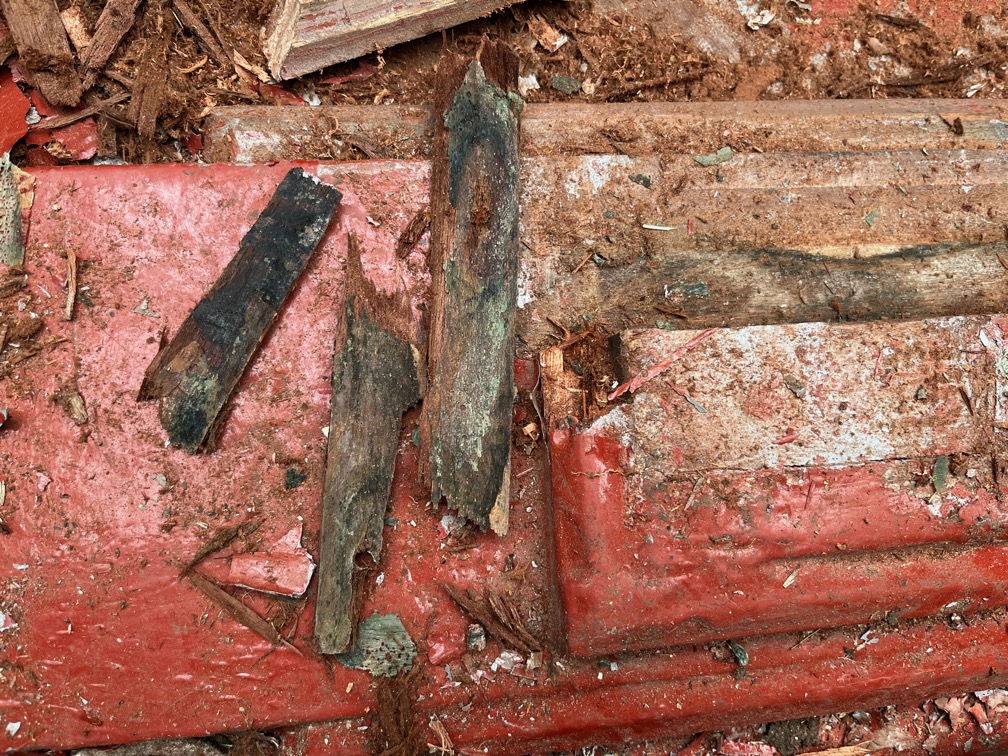
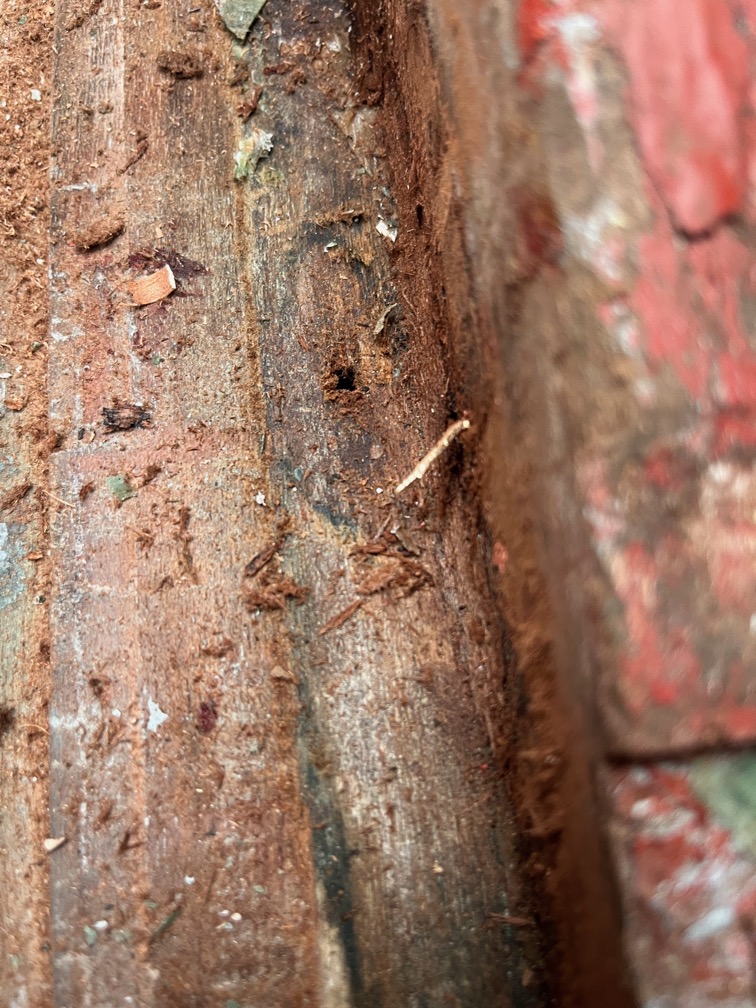
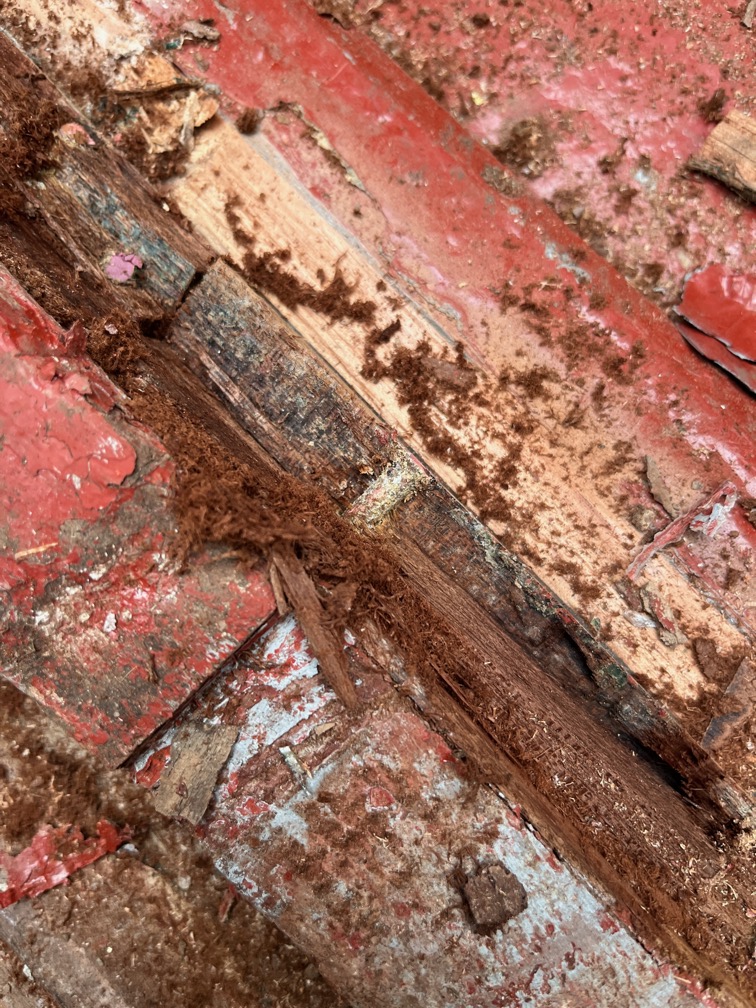
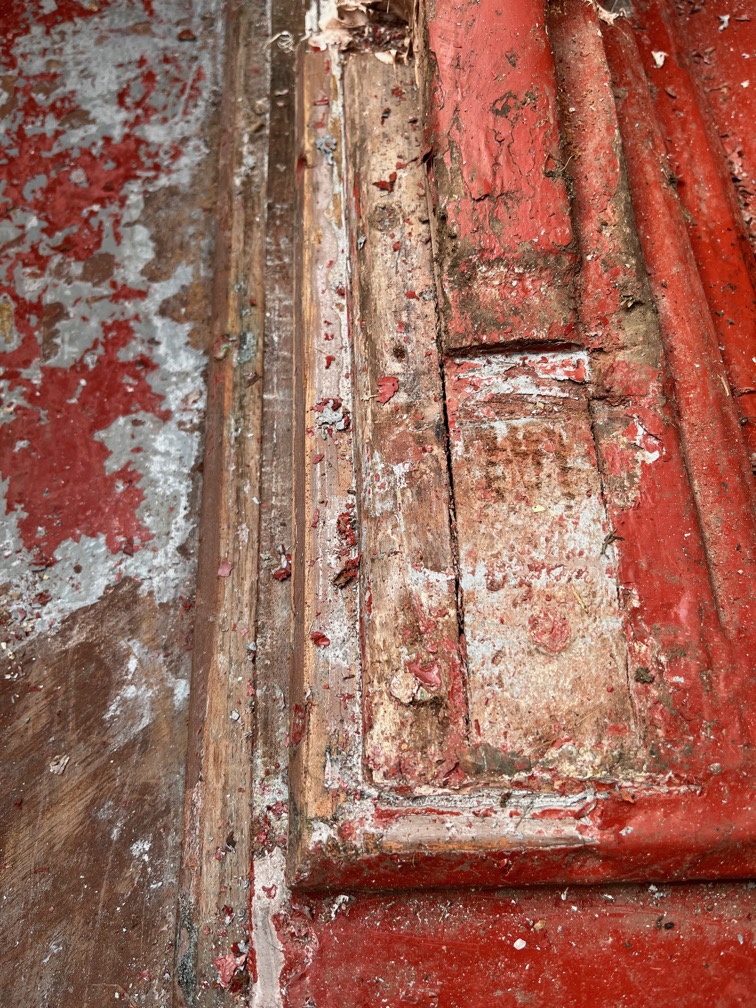
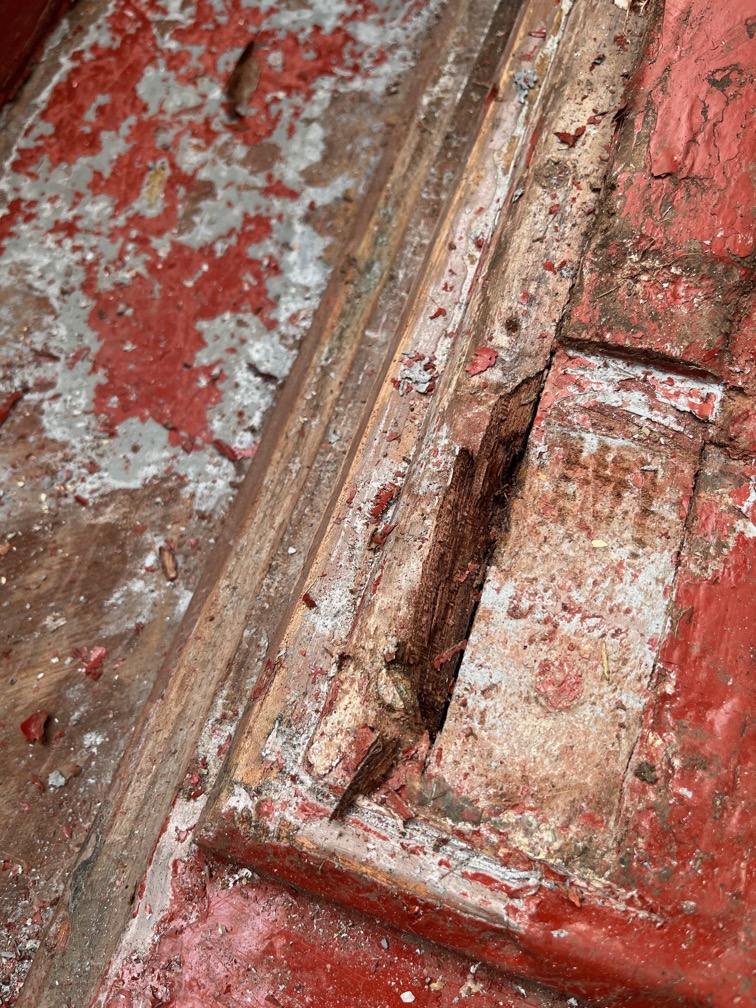
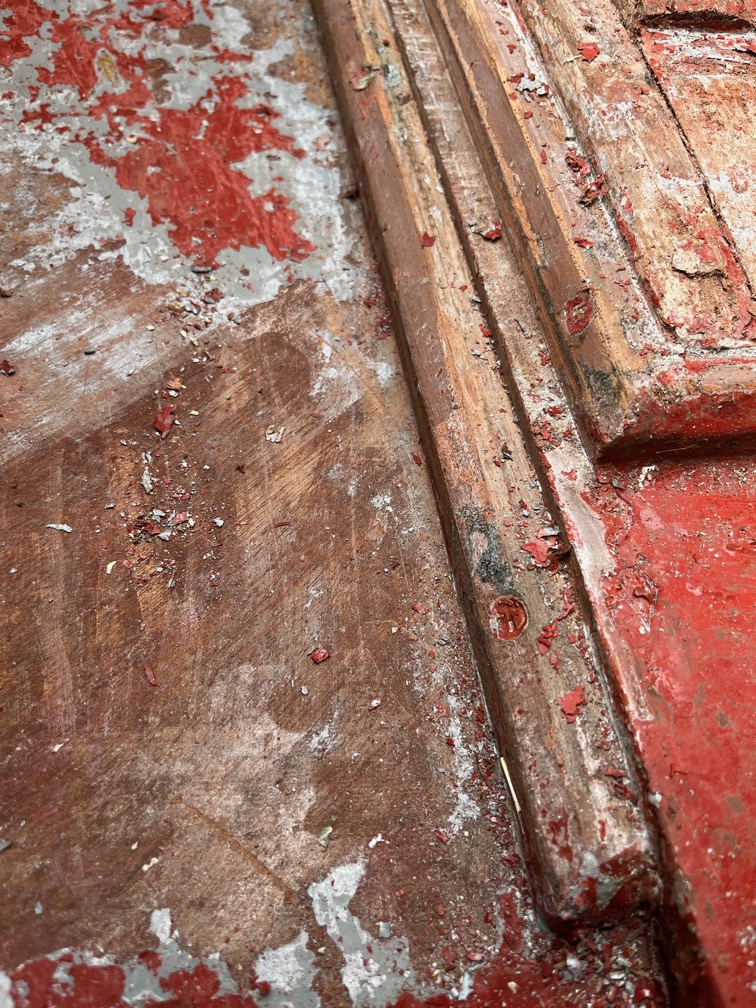
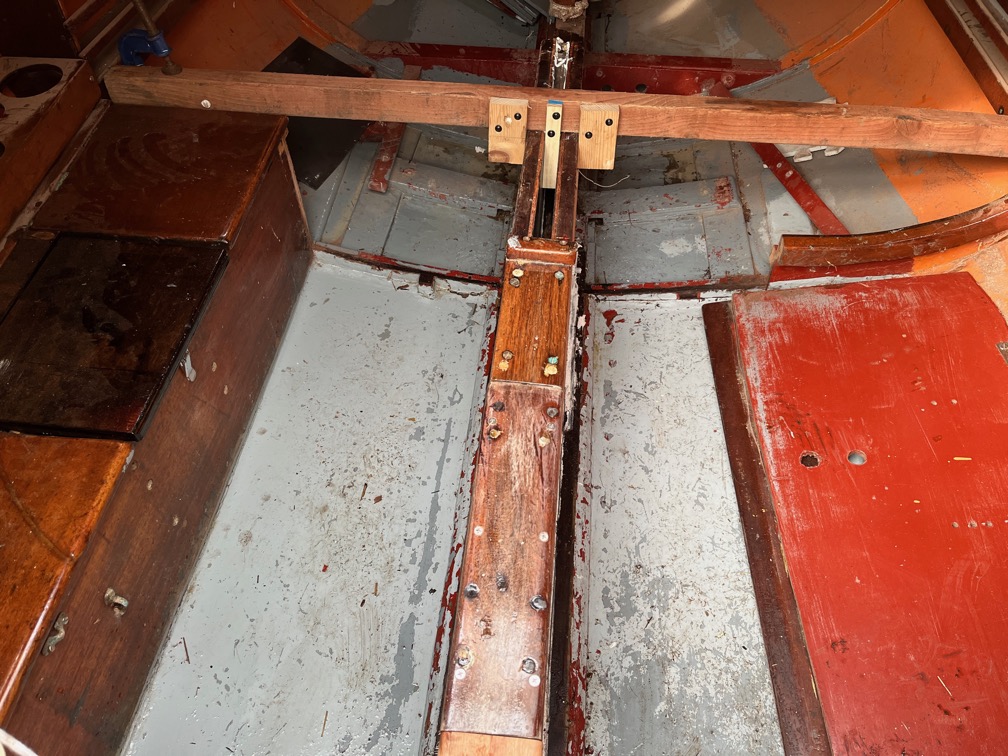
Since the source of the leak is not obvious, the next step was to remove the outer backing pad to see what was under it.
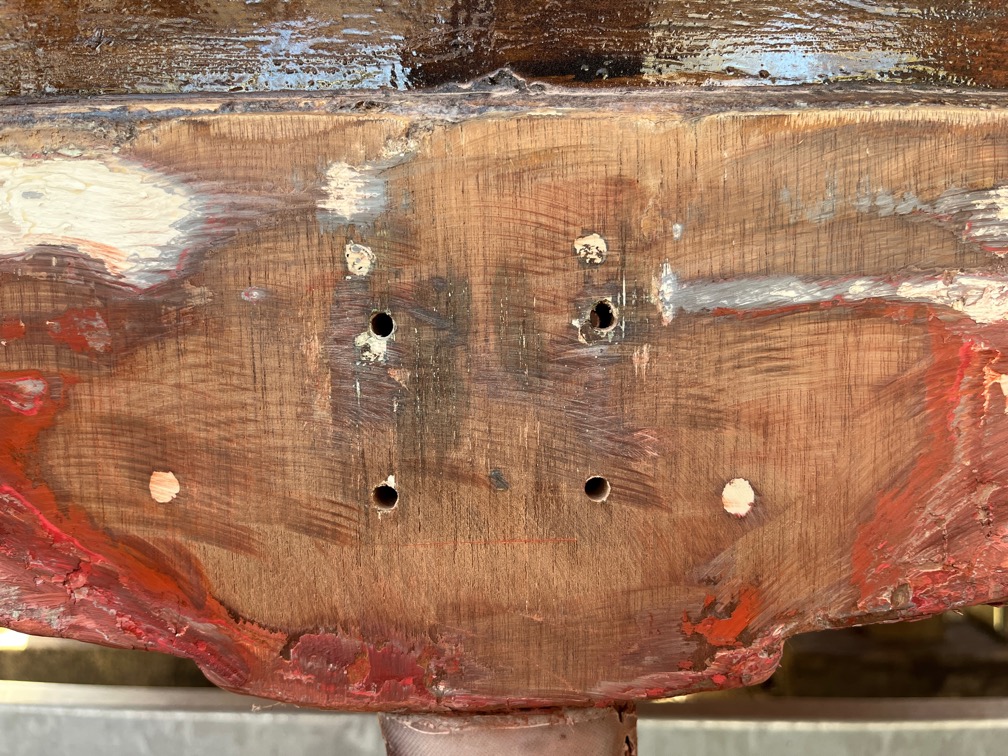
Firstly, I used a sanding disk to remove the antifouling paint from the pad. This revealed four fixings and the two old, plugged fixings.
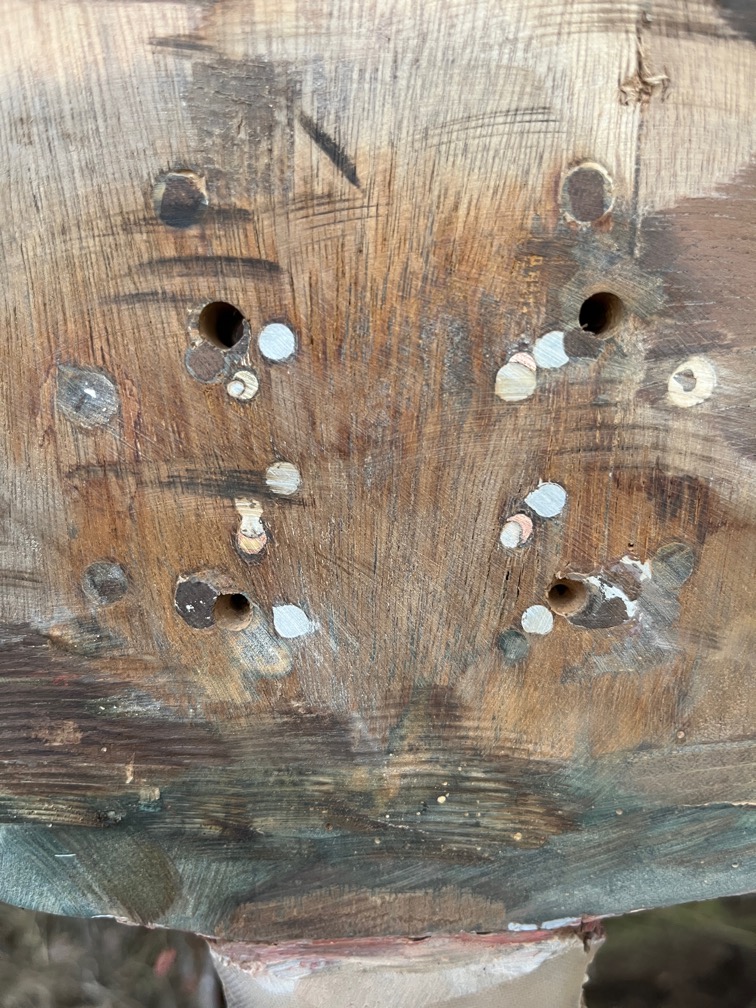
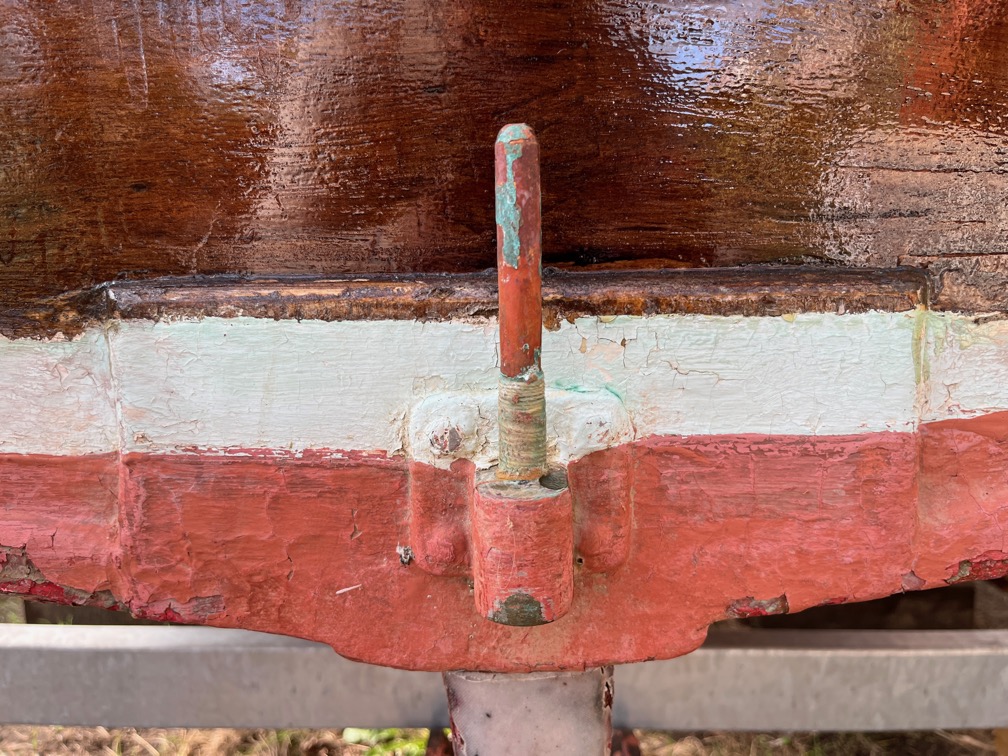
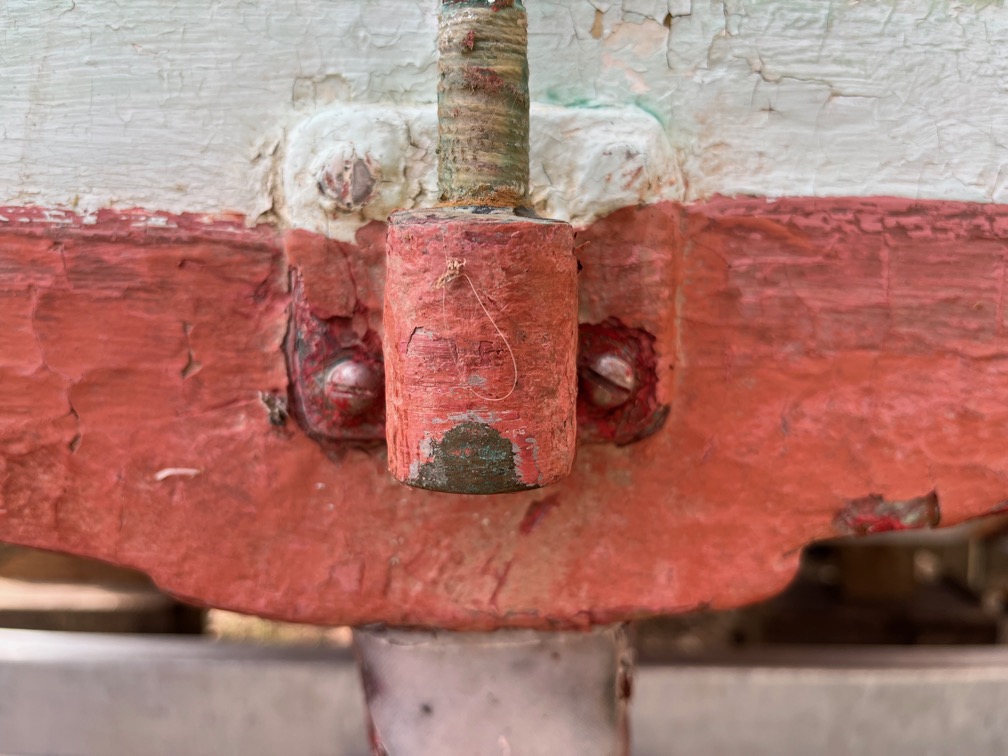
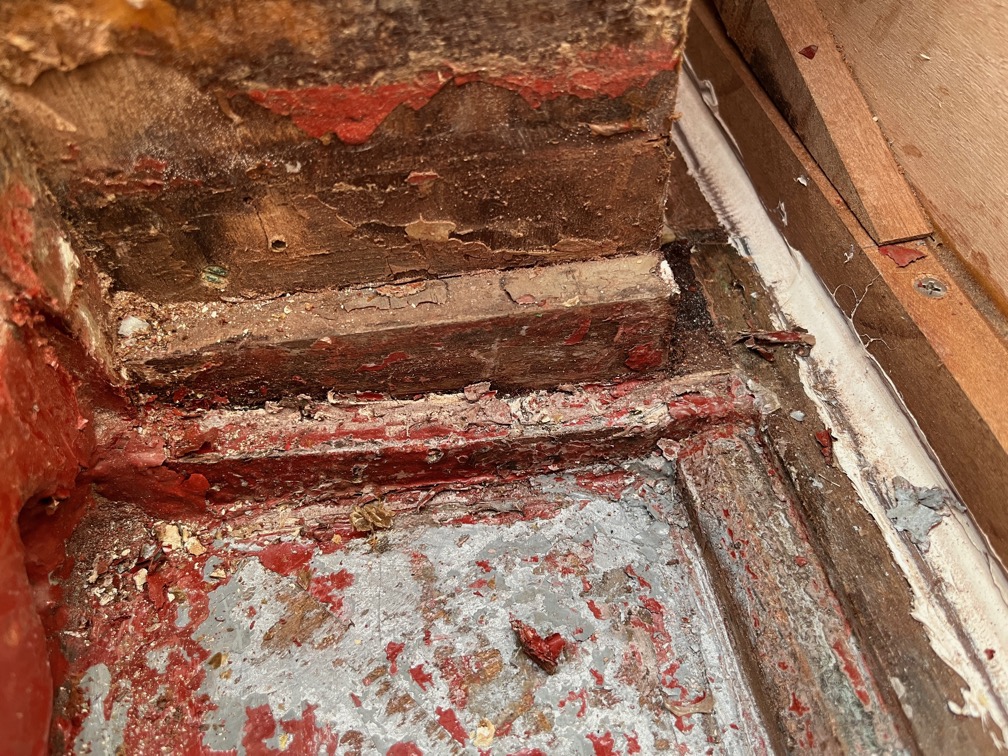
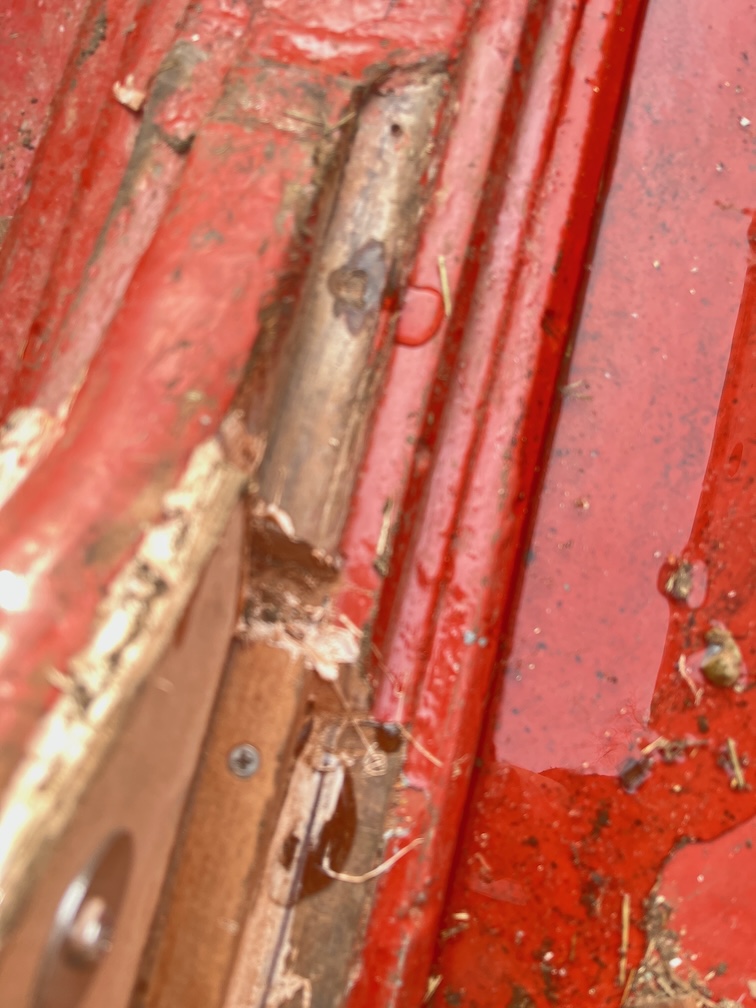
The screws, stainless ones, were removed and the pad removed in pieces using a chisel, followed by the sanding pad. Here it can be seen that the pintle has been positioned five separate times, there are 16 plugged holes and the four current ones . The old holes have been plugged and there is no obvious leak.
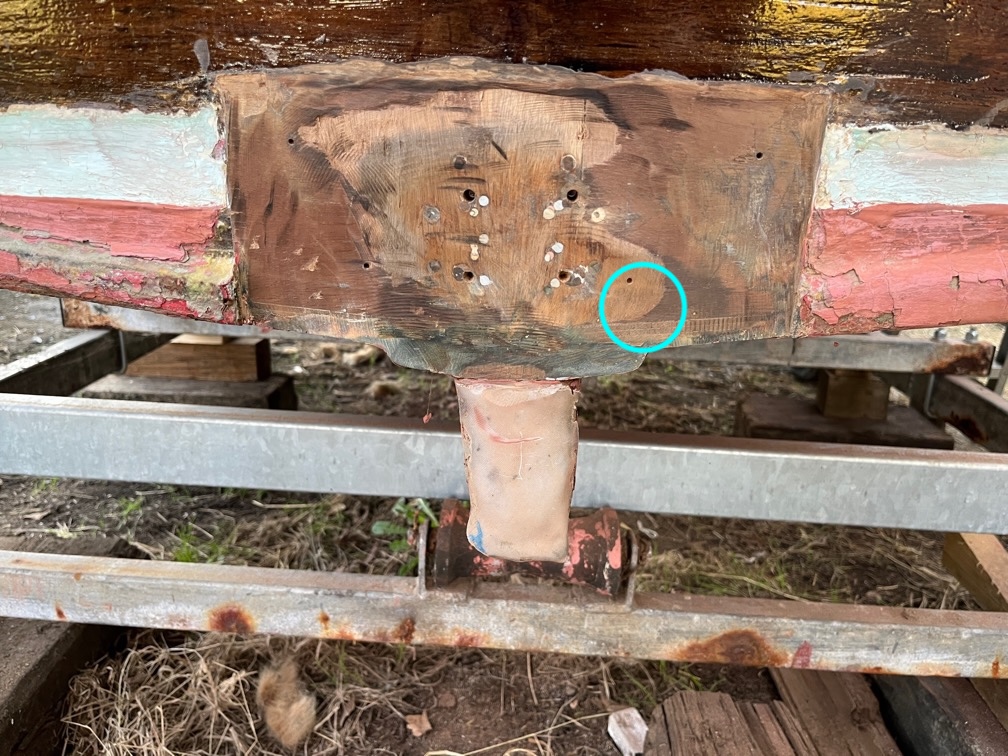
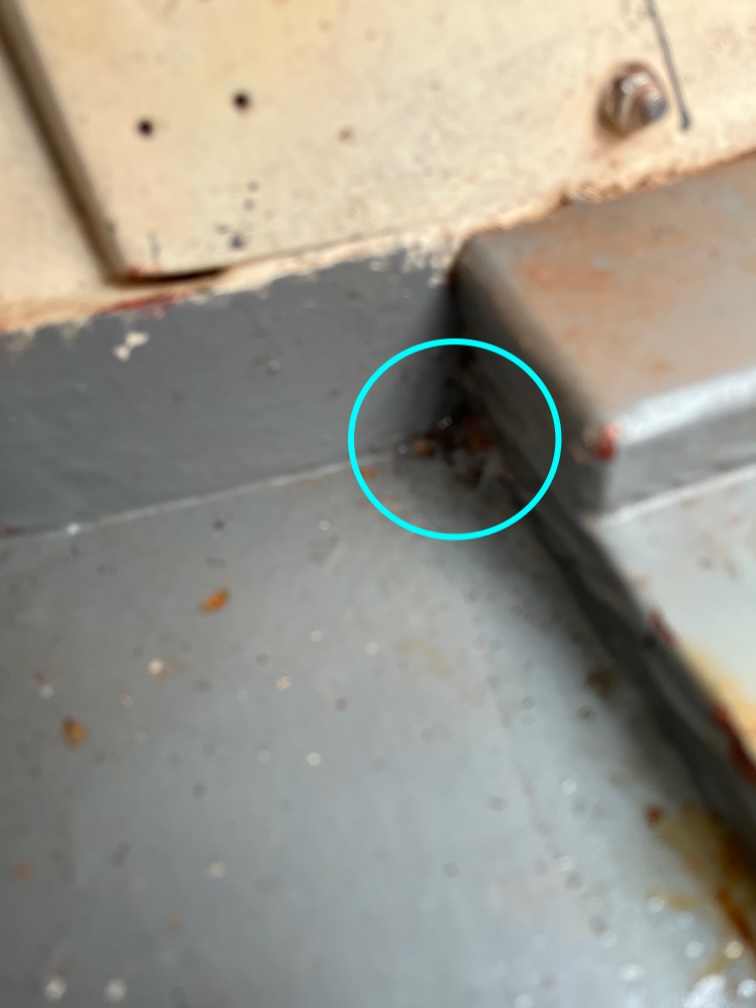
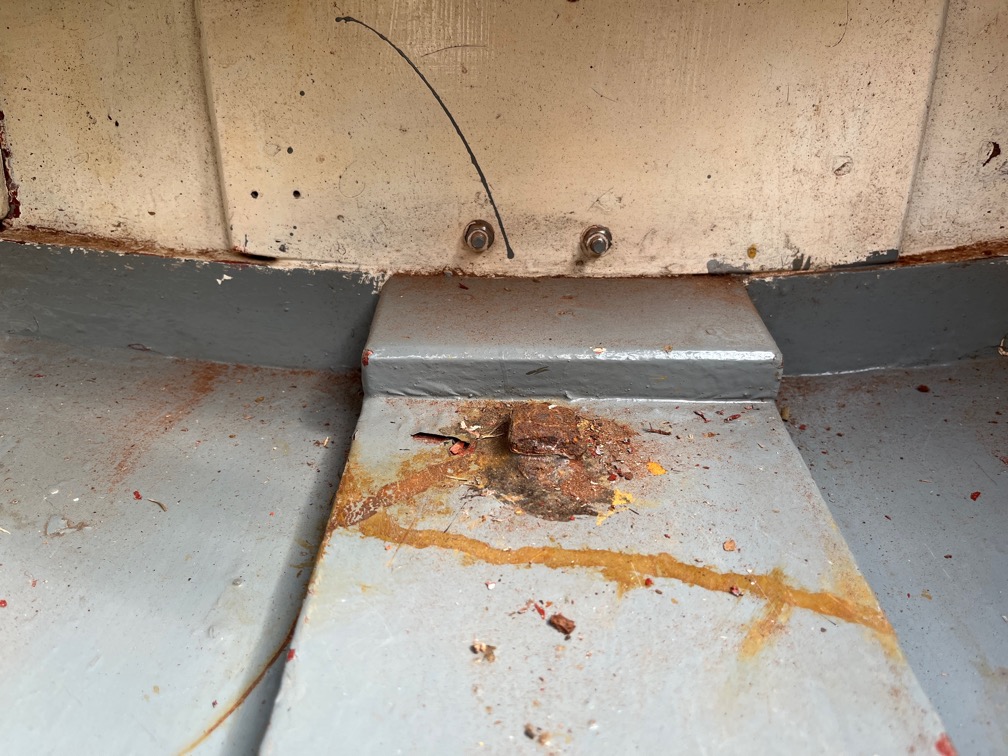
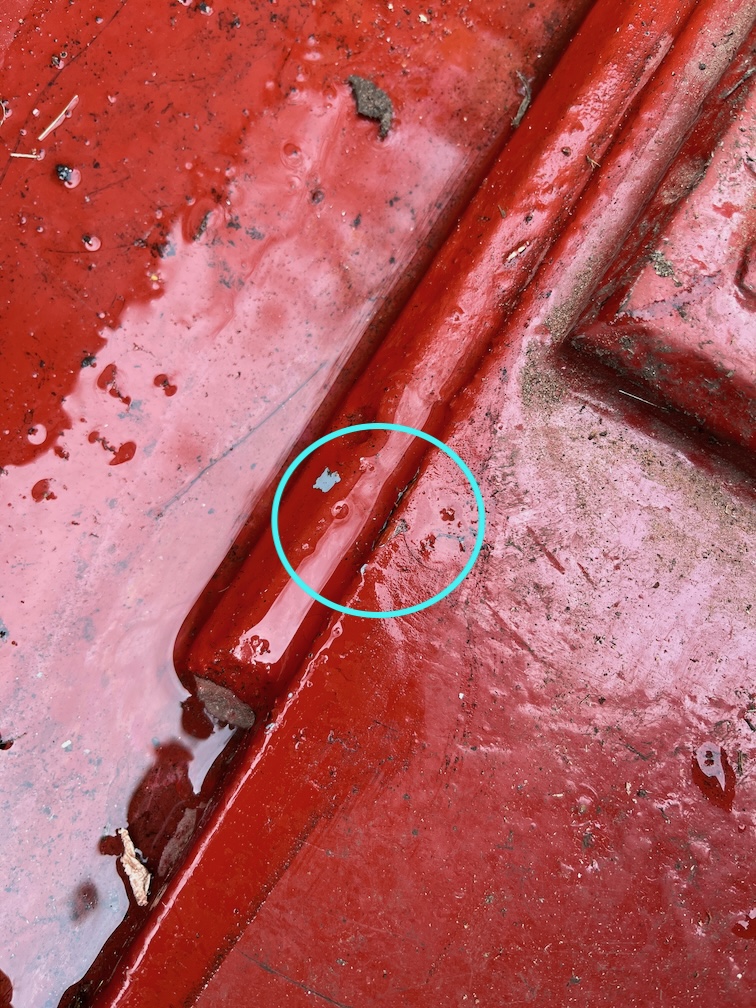
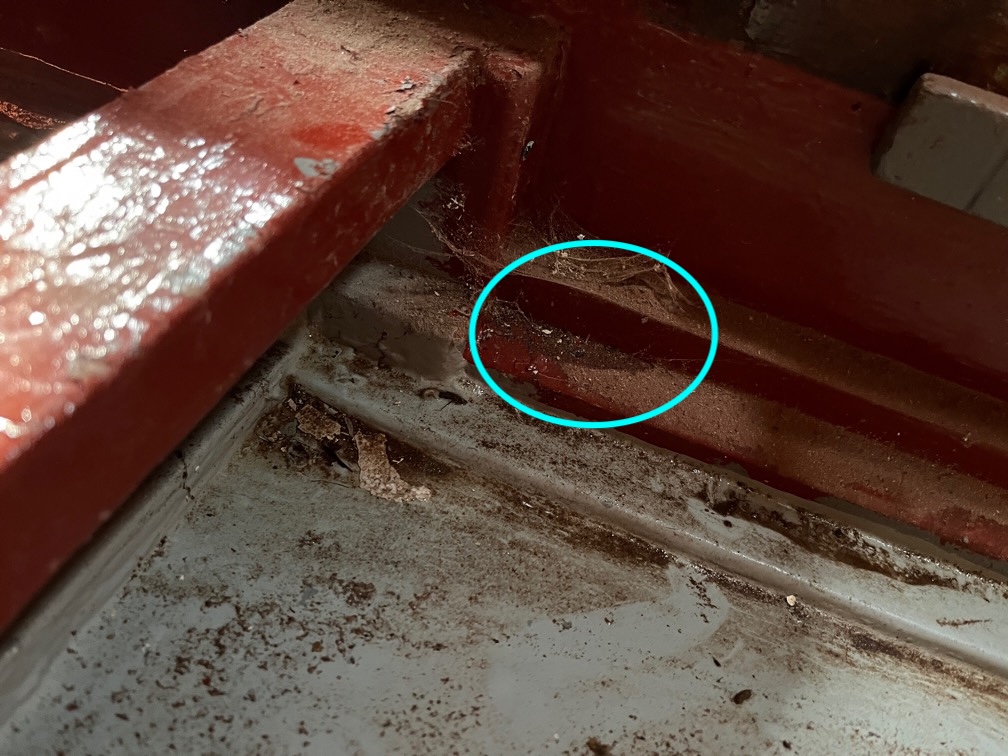
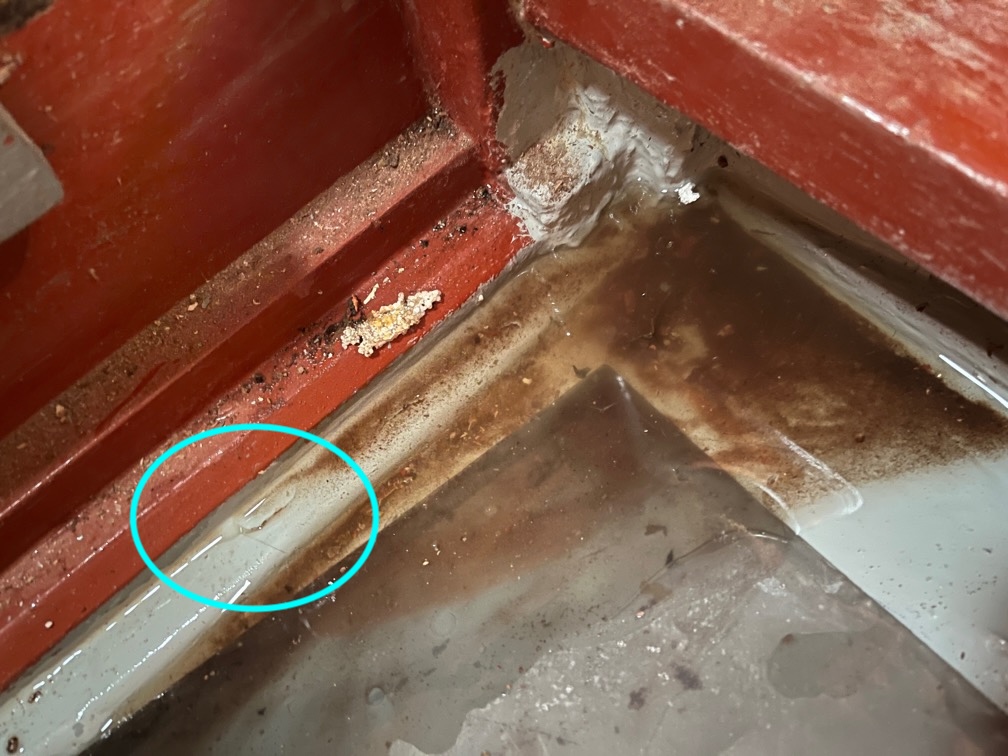
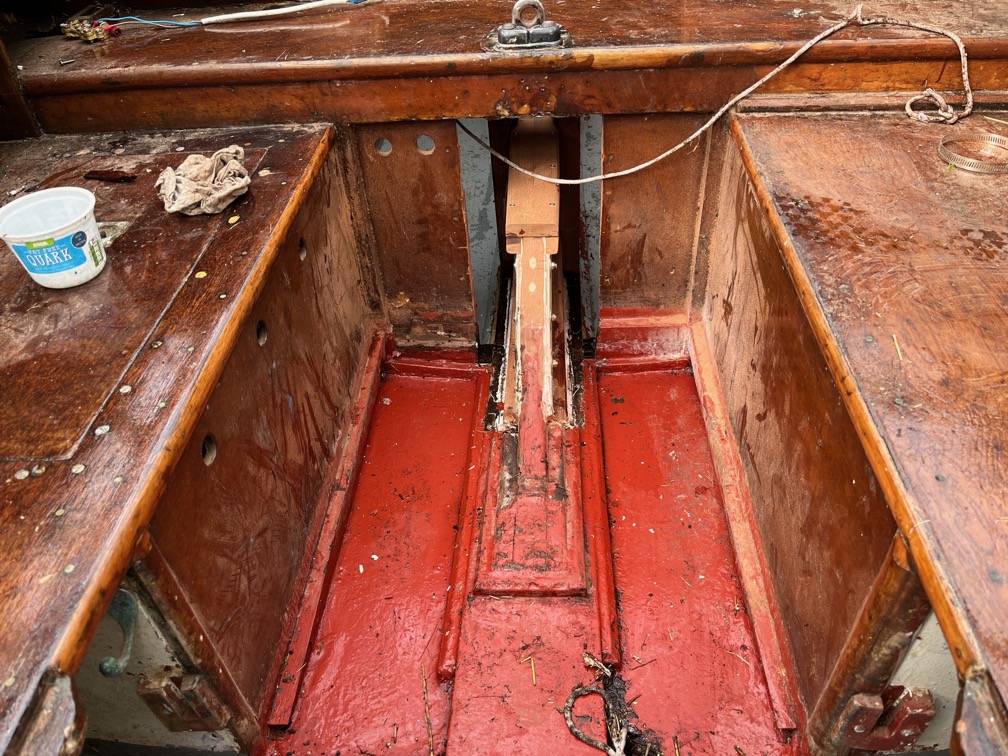
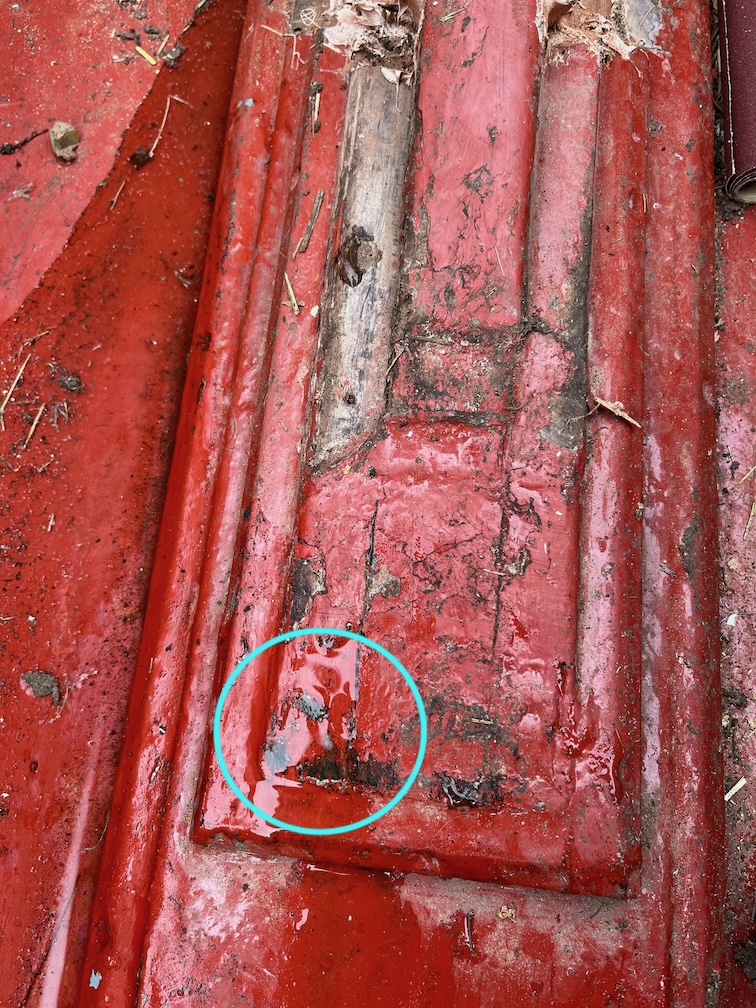
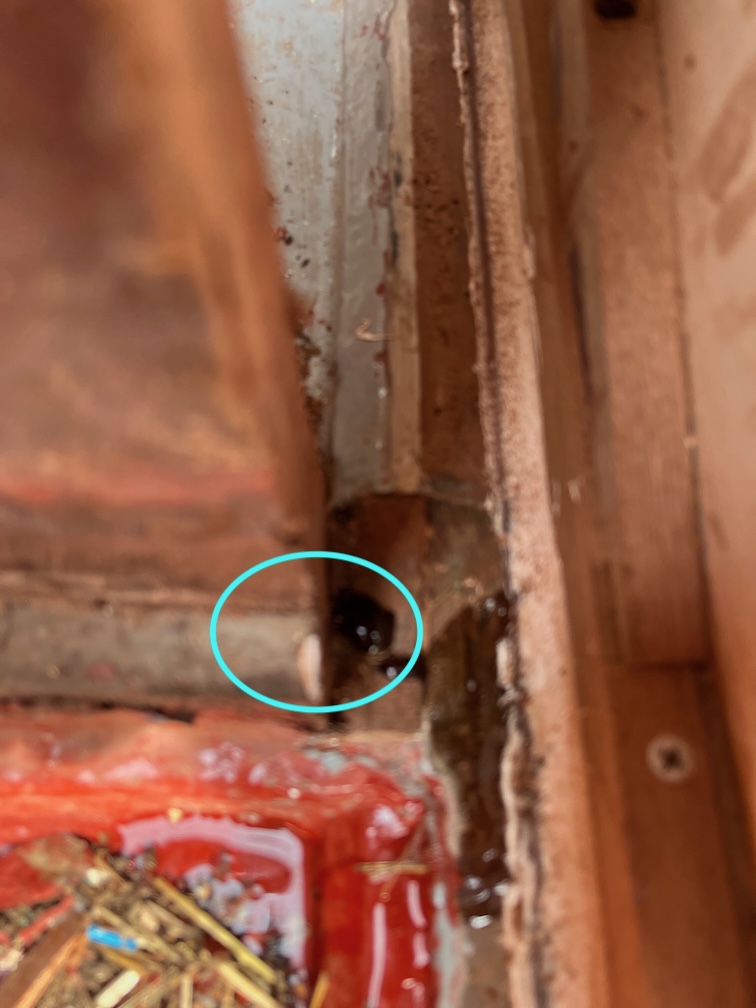
The leak on the inside is shown by the cyan circle on the image, and although there is a fixing hole within this area, it does not appear as though there is a leak here.
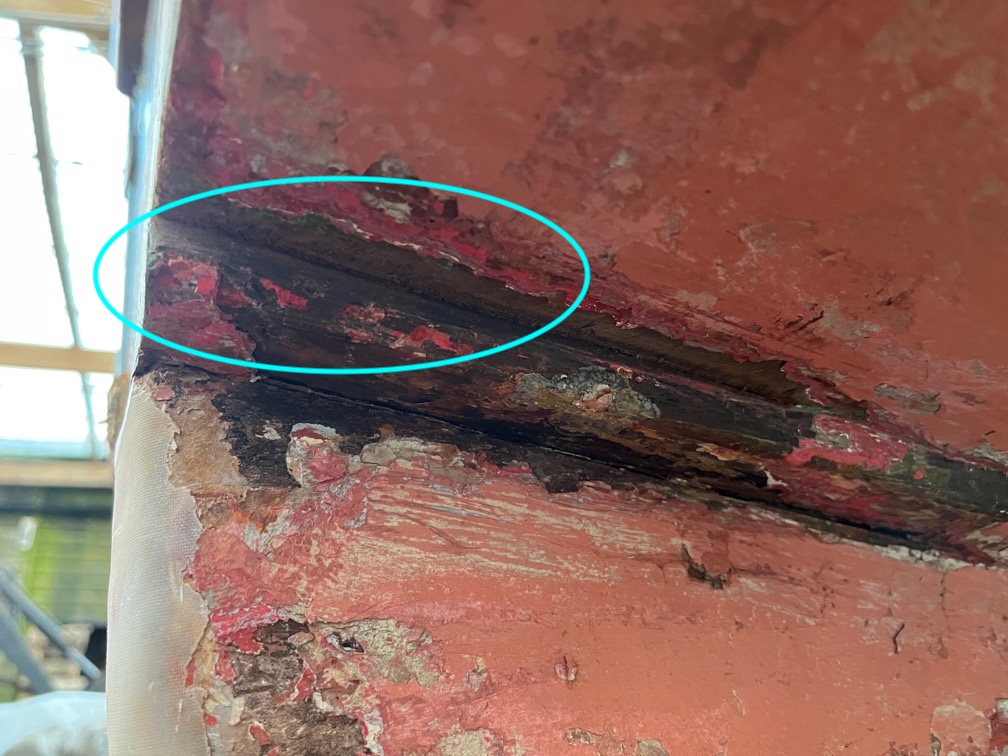
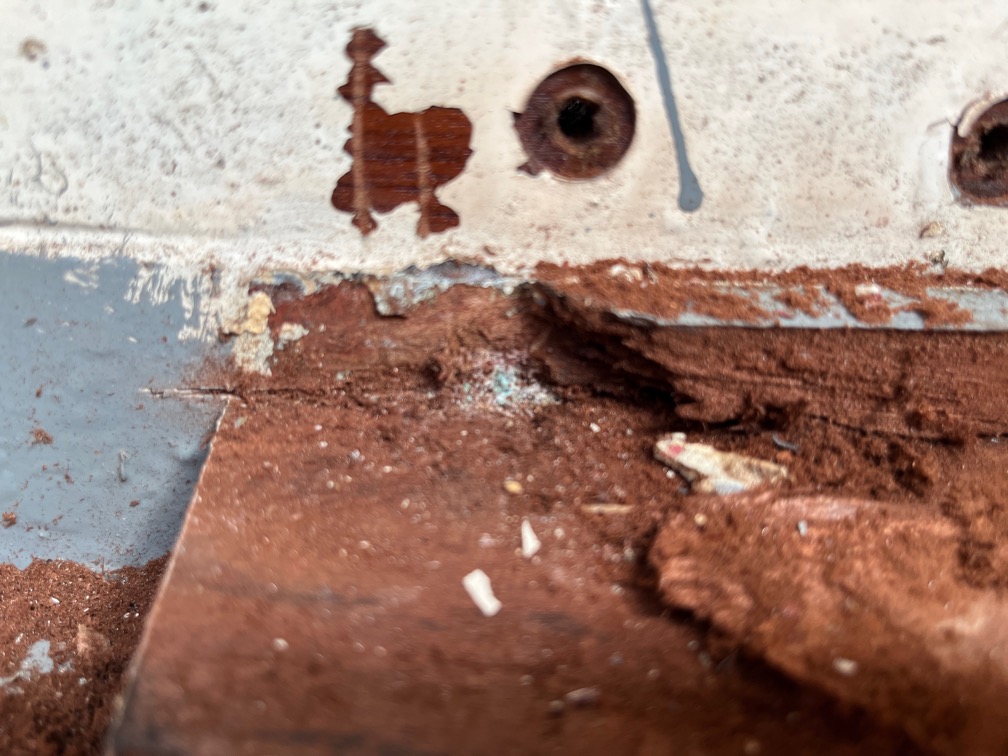
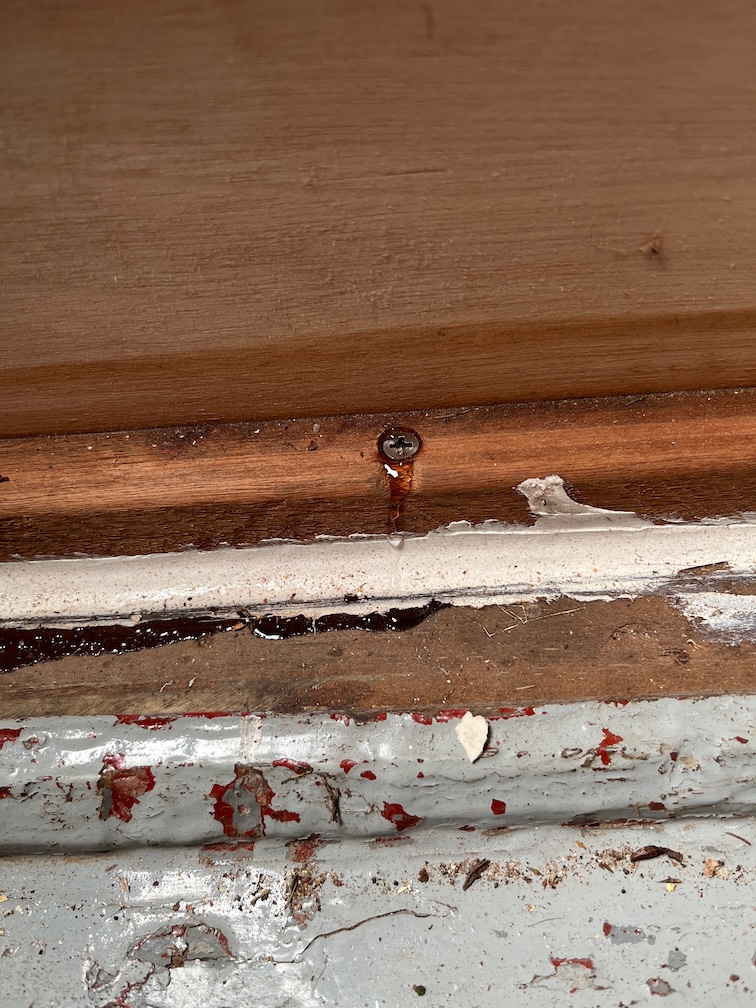
I took a scraper to the antifouling paint on the join between the hull planking and the keel and found that there is a definite gap that you can see highlighted in the image above. It does not appear to be on the other side of the keel and I will have to remove more of the antifouling along this seam to find the extent of the crack. However, there is a very good chance that this is the source of the leak.
If the crack does not extend any further, then the fix will be to open the crack slightly by cutting a chamfer on the keel and then paying this with SikaFlex. If the crack is longer, then it might require a glass fibre tape to be epoxied over the crack.
Whatever the method of the fix, the outer pad needs to be replaced and the pintle refitted. Given the various constraints it may not be possible to move the fitting up such that bolts can be used. If screws are used then they will need to be longer than the previous ones and well sealed.
The next leak to investigate is the one at the bottom of the transom.
To remind you , this is where the water is seeping onto the hull.
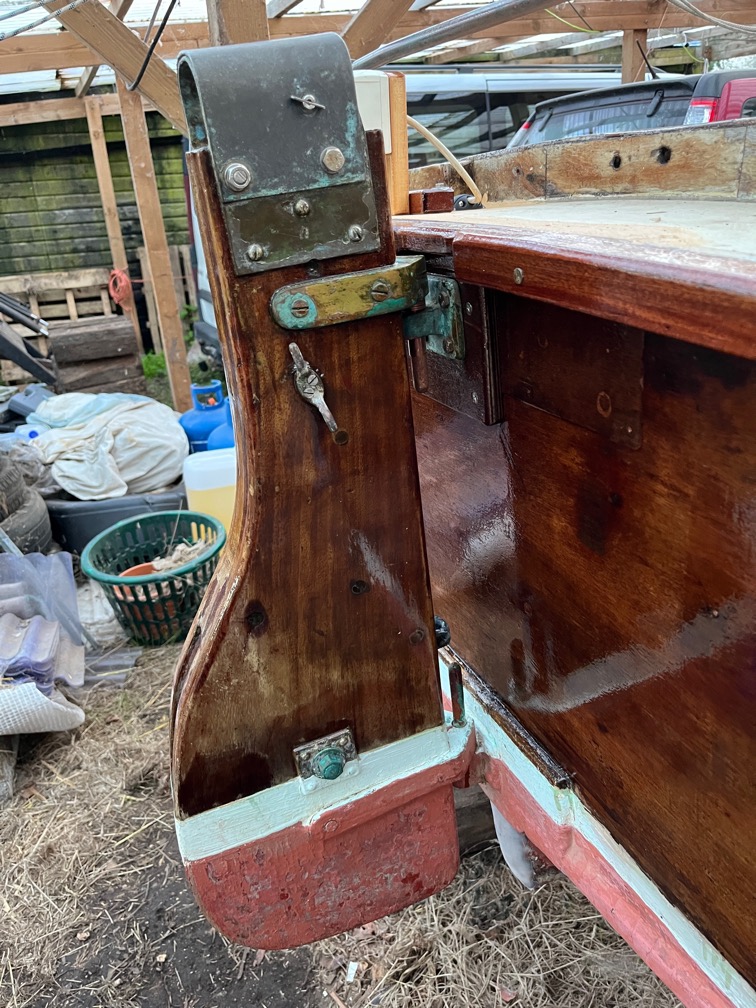
And the cause is probably something to do with this, the lower pintle. The first thing to do is to get the fixing removed so that the pintle itself can be removed from the transom. You’ll note that two lower fixings are below the water line.
On the inside, you can see that the two upper fixings are bolts, stainless steel by the looks of them and the lower two are probably screws as they cannot be seen.
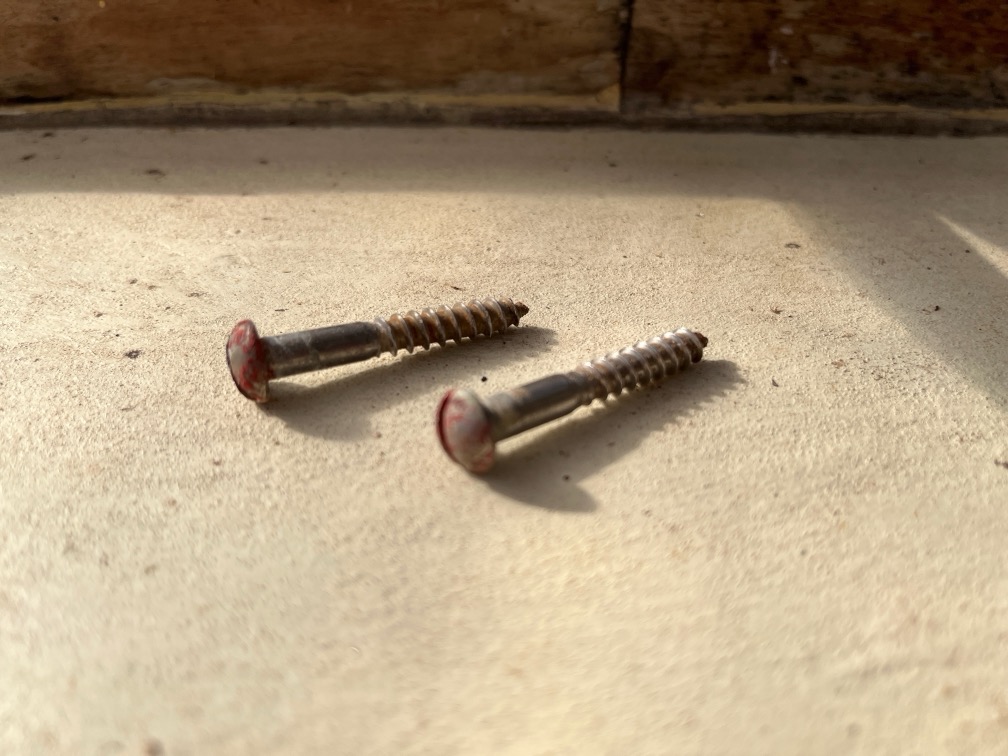
Removing the layers of antifouling paint revealed the screw heads and these were easily unscrewed. Too easily if the truth be told, they were almost loose in the holes. Definitely not a good sign, although I expect that the holes would close up a little after immersion.
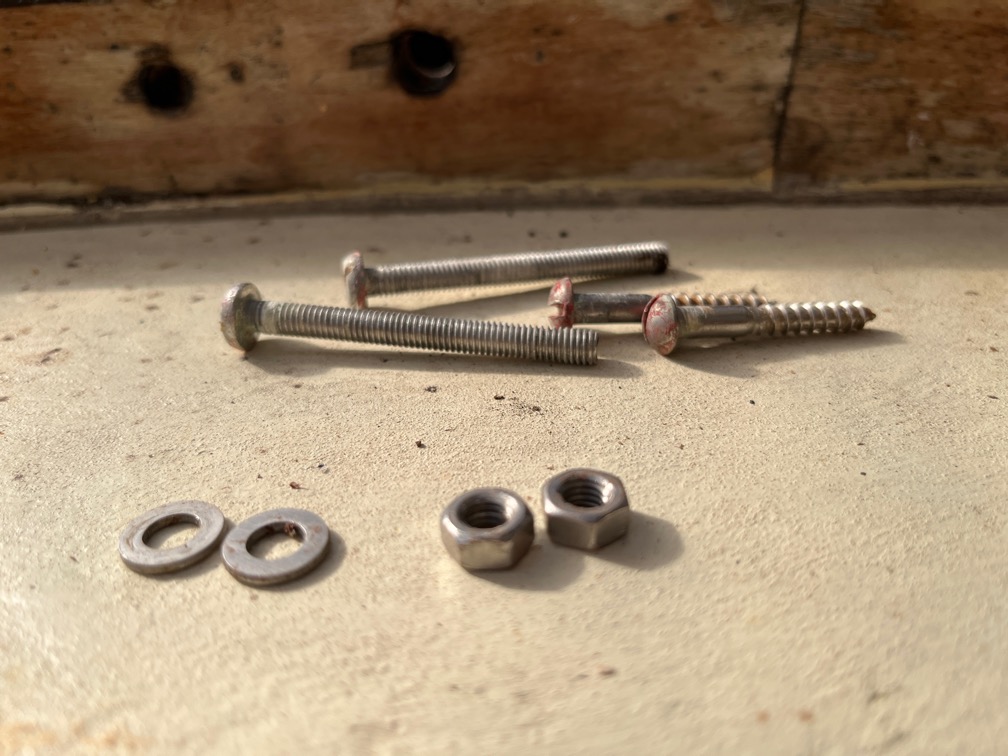
The screws were in good condition but to my eye quite a lot shorter that I would have used. Well, if I had used screws that is. Generally speaking it is a bad idea to use screws below the waterline. You rarely get a lasting good seal.
The upper two fixings came out easily and are also in good condition.
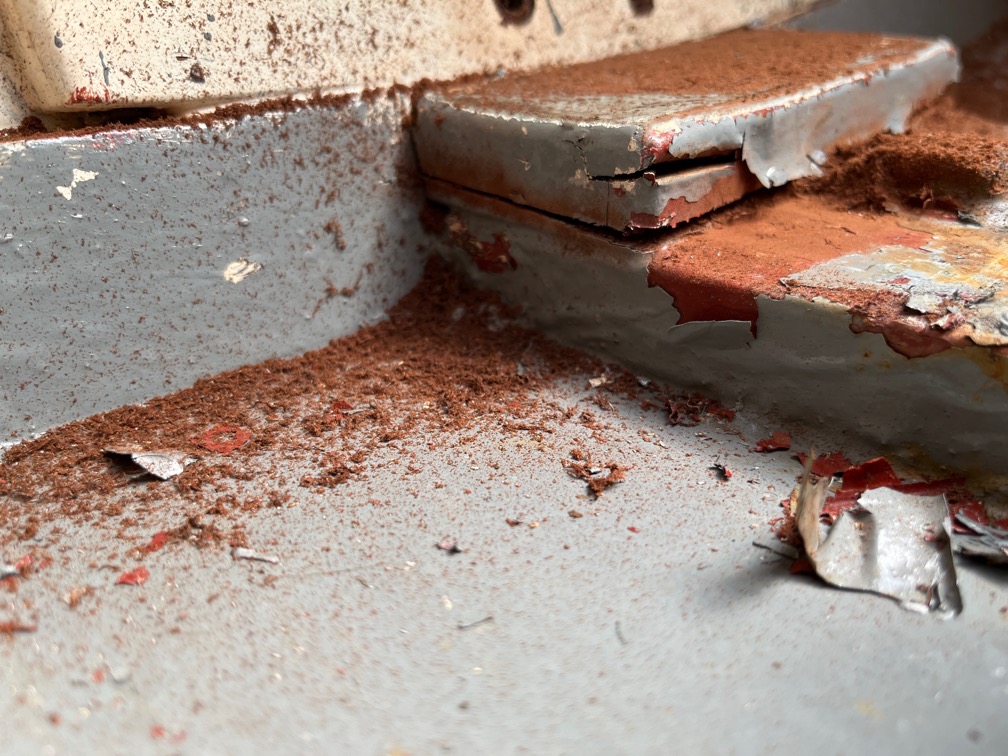
The multi-tool was then used to cut away the block on top of the keel. You’ll notice that I cut upwards at a slight angle so as not to cut into the keel itself.
Once the cut section had been removed, I carefully cut away the remaining portion and then used a chisel to clean up the top of the keel.
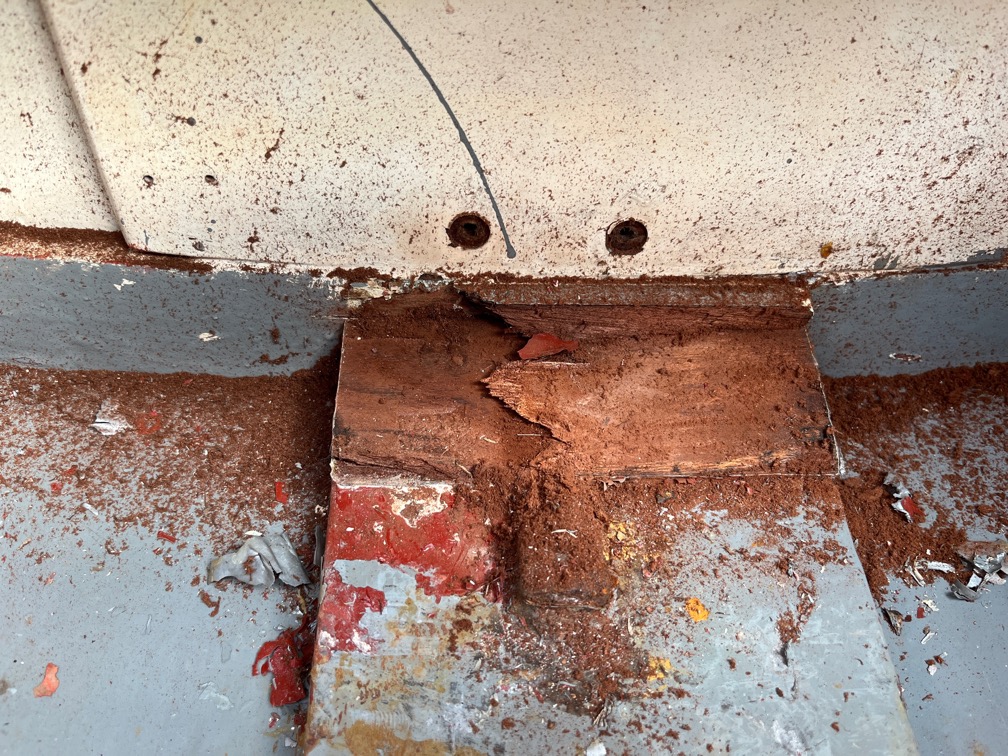
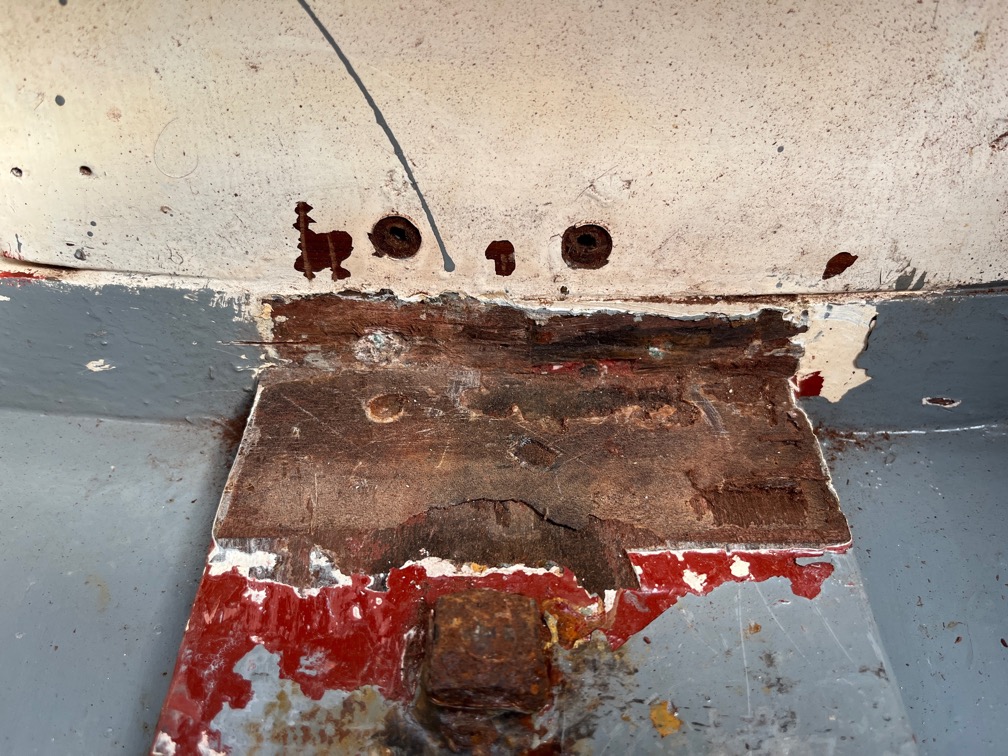
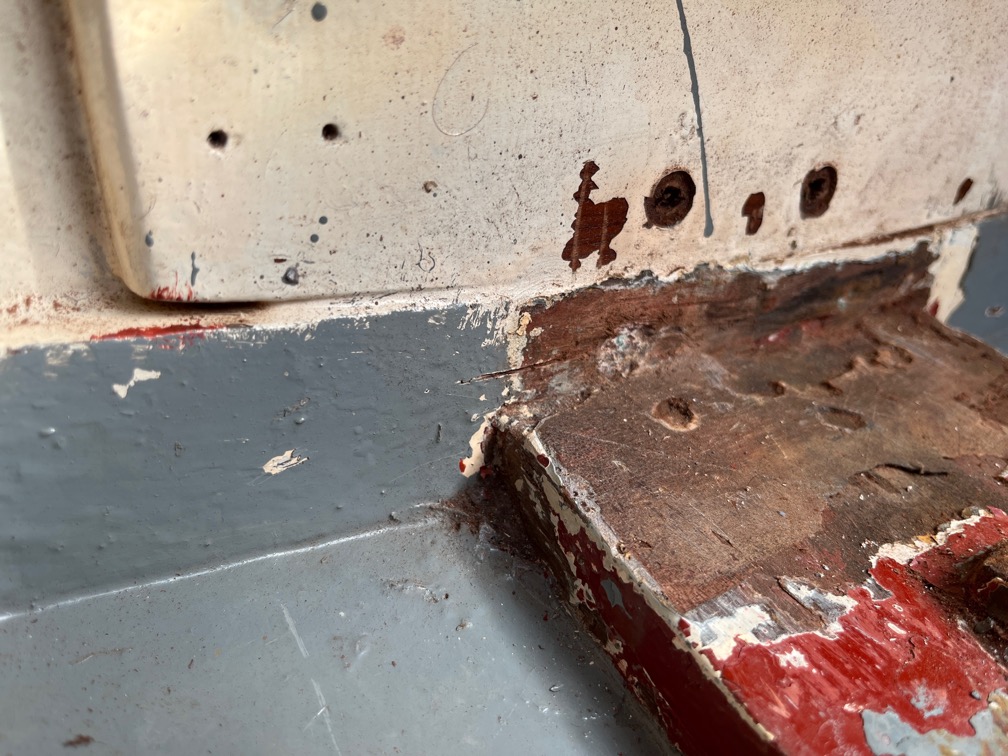
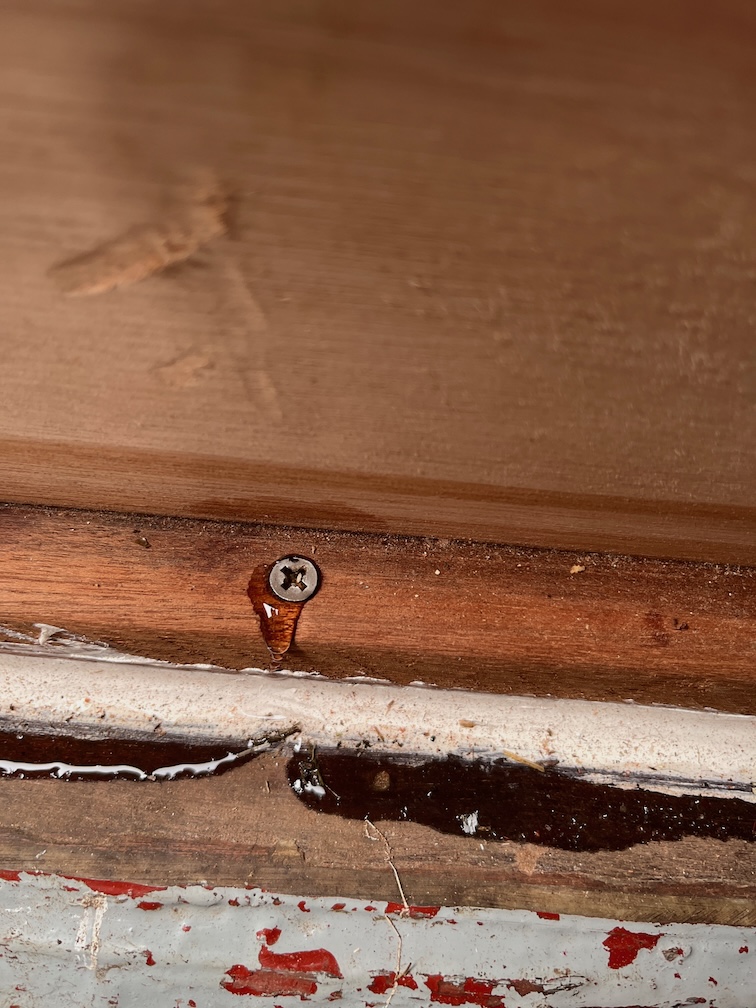
In the process of cutting away the block I noticed the remains of a brass screw coming through the transom. I presume that this was an old fixing for the pintle. I suspect that this is the main contributor to the the leak.
There was the remains of a second brass screw on the other side of the transom. This one seems to be in better condition that the first one to be found.
And this does not help. There is a channel in the wood starting by the old screw and going out to the side of the keel. Any water that made its way through the screw hole would then find its way along the channel and out from under the paint. This is exactly what I saw during the leak test.
So, how to fix this? The First thing to do is to locate the old fixings, remove them and plug the holes to make them watertight. After that I would say that the best thing would be to raise the pintle such that the lower fixings are not underwater and to use bolts here as well.
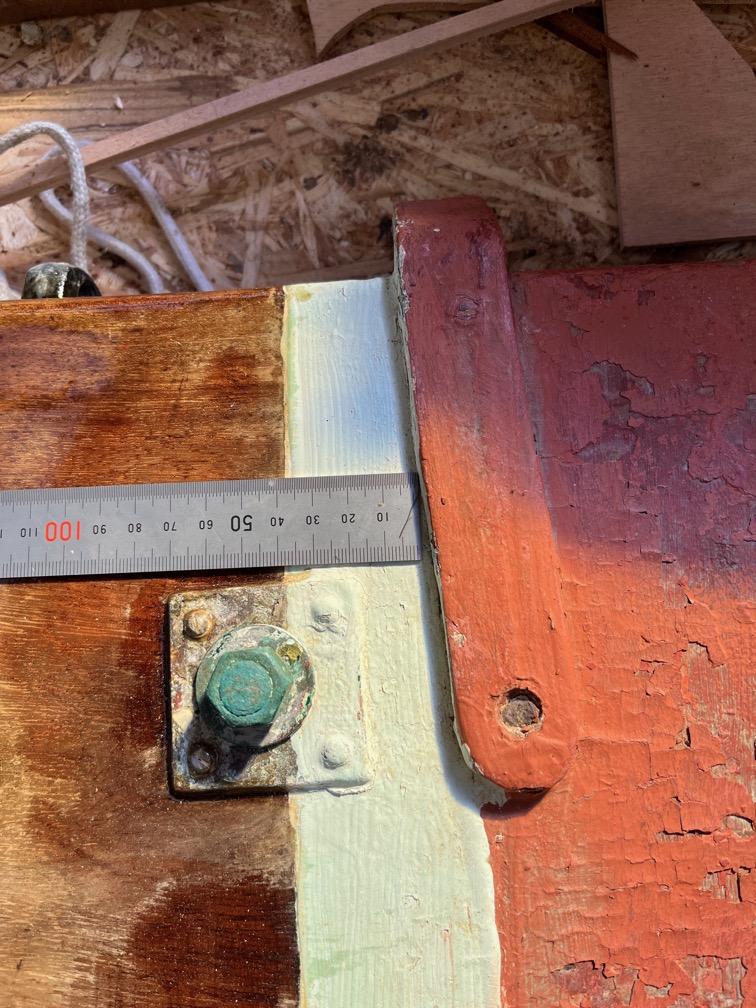
The problem with this solution is that the gudgeon on the rudder stock can only be raised by 20mm before it fouls the pivot bolt.
Now, the holes in the pintle are 38mm apart meaning that if the pintle is raised 20mm, the lower holes will be 18mm below the existing upper holes.
This may not be above the waterline, but it will be above the keel and that allows the use of bolts for the lower fixings. Bolts can be made watertight easily.
So the plan is to locate and remove the old fixings from the outside and plug those holes. You can see two old fixings above the current holes under the white paint. These probably need to be checked.
The existing upper bolt holes will also be plugged.
The gudgeon on the rudder stock needs to be raised as far as it will go and then the rudder stock can be hung on the upper fitting allowing the correct new position of the lower pintle to be marked.
The lower holes will be drilled through the transom and if necessary, a backing pad will be fitted on the inside. This will be sealed against the transom and keel to ensure a watertight joint. If necessary it will be made in the shape of an upside down ‘U’ such that it fits over the keel. Sealant will be used liberally to ensure a watertight joint between the transom, keel, hull and backing pad.
Finally, the pintle will be fitted in the new position making sure that all the bolts are watertight.
I have to confess that it was very difficult to get started on anything Shoal Waters related today. In fact, I did not start anything until after lunch. But eventually I made the effort and continued the task of the leaks in the cockpit.
Again I chose small tasks to begin with and that meant hot air gun and scraper to remove some of the paint on the starboard side of the aft block. Not a complete scrape, just enough to locate the screws.
Then it was a case of using the multi-tool, hammer and chisel to remove the runners.
Once most of the thickness of the runners was taken away, the rest broke off the keel, splitting along the glue line. These are some of the pieces that just came off, indicating that the bond was not longer good.
This screw was interesting. The left image is what remained on the port side and the right image shows the large screw that it was originally.
I suppose it was the work of about an hour to clear the runners away and then sweep up the mess. The wood of the aft block is quite wet but it does not seem to have any rot. The plan for this part of the leak repairs is to cut new runners to replace the old ones and then leave the repair so that the wood has a chance to dry out.
Then the wood will be soaked in penetrating epoxy, allowing that to cure before fitting the new runners.
The two outer runners will start at the forward end of the centerplate case and run all the way back to the aft, seen here. This means that it will not be fitted until all the other centerline leaks have been dealt with. This runner will be glued in place and screwed with just enough screws to hold it in place as it will be curved to fit the keel.
The upper runner, originally the same width as the runner that came with the hull, will be cut wider than before such that the wood overlaps the join between the two lower runners, thus providing more “leak proofing”.
None of the keel leaks around the case are a problem. The two that will probably be a little more taxing are the transom leak and the leak under the port bulkhead that forms the front of the footwell.
Something that is easy to do and requires little thought is scraping off paint. Armed with hot air gun and scrapers I set to in the cockpit well on the port side where the leaks appeared.
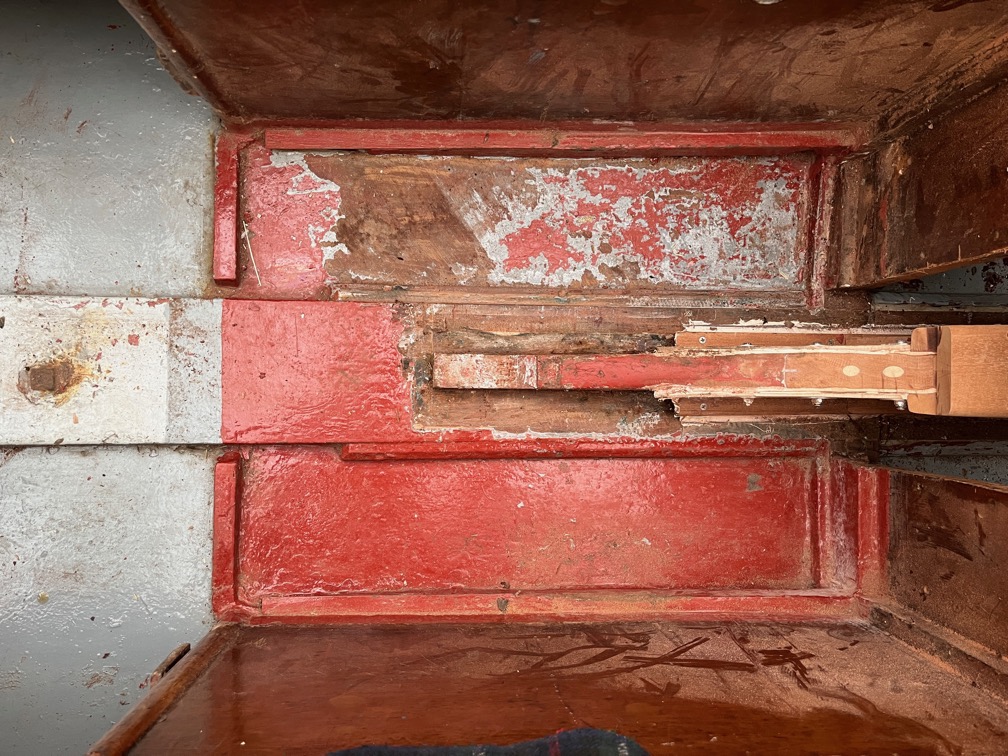
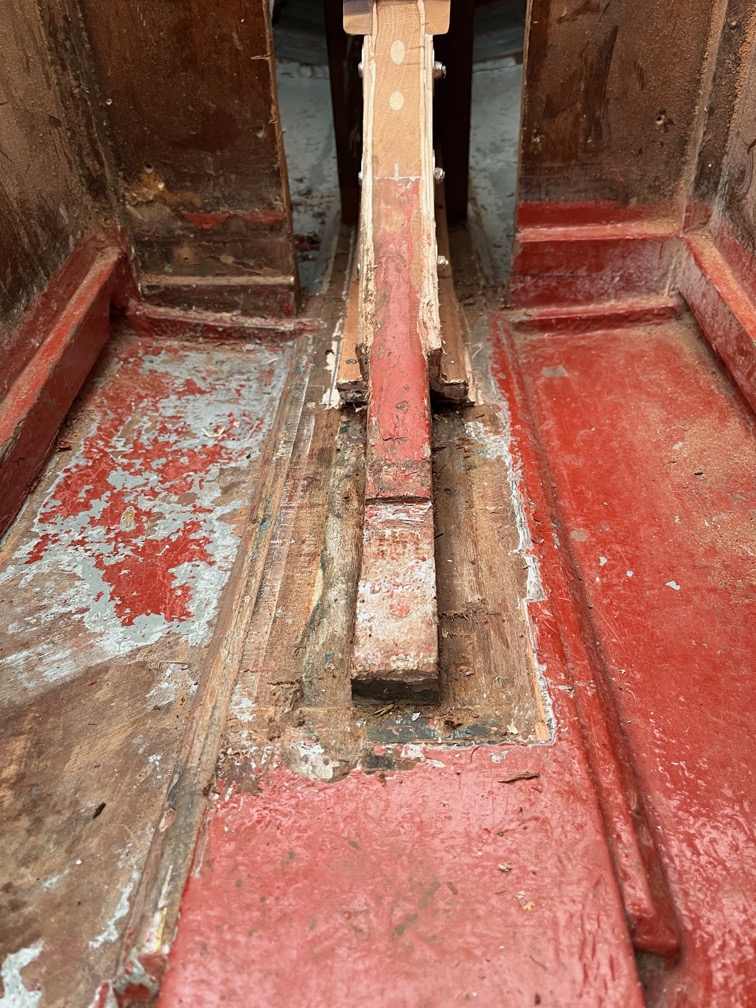
Some of the paint came off really easily and in this photo you can see the gap between the aft end of the aft centerplate block and one of the extra pieces put in by the original owner. This is the source of one of the leaks and fairly obvious.
I poked at the extra batten with the sharp point of the paint scraper and it came away easily and the wood underneath is wet. The conclusion is that the leak starts further forward where the slot in the hull begins and the crack allow water to seep along until it find a point where it can get through the point.
I’ve put two images together to show the next leak, the one highlighted by the cyan circle. This is just aft of a brass screw put in through the 45º angles face. You can see the screw in the left image and just see the indentation in the paint on the right image at about 11 o’clock on the circle. I would suspect that this is the source of the leak. I would suppose that over time the brass screw has degraded until it is no longer watertight and so the water gets it. It might be the case that after a few days in the water, the wood around the screw expands and makes it watertight again. That screw may even be at such an angle that it penetrates through the hull.
That has to come out and since this is suspect, I’ll take the entire batten out on both sides, carefully removing the brass screws in the process. The screw holes will be filled with a flexible sealant and a new batten put in place, held by SikaFlex as this remains flexible when cured.
The next area is a little more difficult since it appears to be under the battens. The whole shebang was covered in a thick layer of what looks like SikaFlex, indicating that the leak has been there for some time and attempts have been made to fix it. These battens and the bulkhead will need to be removed to investigate and I would not be surprised if there is another degraded brass screw or two through the battens, and possibly through the hull, that are no longer watertight.
So, more deconstruction required and some careful investigation of the hull that appears to be leaking.
That’s all for today, I burnt my hand on the hot air gun and need to go and attend to it.
I don’t know about you but I know myself very well and after such a day as yesterday the last thing I need is more failure. The boat was just one part of a bad day, we had to scrap the car and that’s a story all by itself.
Suffice it to say that for the next few days I shall be working on small, easy tasks that have practically no realistic possibility of failure.
The first task after propping up the boat, was to bail out the water in the bilge. In doing so I found another leak forward of the mast, shown above.
And another one on the opposite side of the keel. Both of these are easy to deal with, but without having to bail out the boat after the leak test I would not have seen these ones.
One good thing about bailing out the boat is that it has removed a lot of the dust and grime that had accumulated during the works.
The same in the cockpit foot well…
Except here where it all ended up. I’ll deal with that once it has dried.
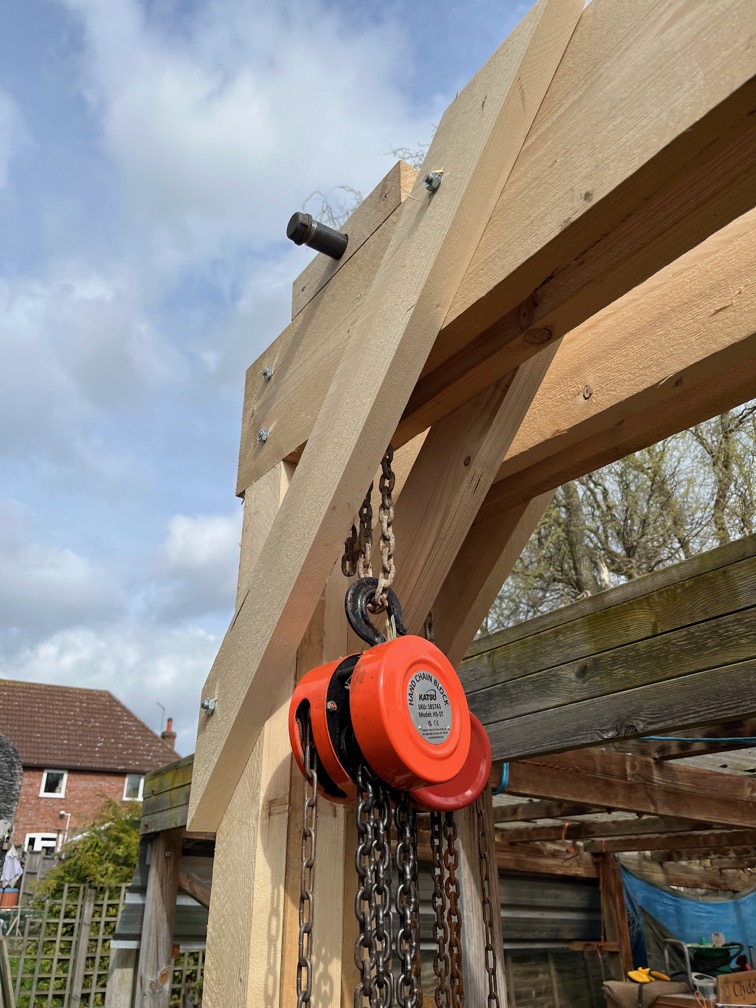
The next small task was to open out the holes in the chain hoist mounts to accept the black iron pipe that are the pins.
This was fairly easy to achieve although the wood splintered a bit as it was a bit damp from having been outside. I also cut section from the old anchor chain and used that to hang the hoists upon. These were made over long and shackled together to get the correct length for the job.
The next task was to put Shoal Waters back on the working trailer since the travelling trailer is too short to be good for working and then to level up the trailer.
I used a spirit level to get the trailer level, but I think that the boat is still slightly down on the port side. The next task, therefore, will be to adjust the side supports such that the boat is also level.
I had prepared the boat for the trip to Ely last night and this morning we drove over to the boatyard.
Ready for the trip.
The leak test failed. Several of the screws leaked…
…but only on the starboard side.
This is not a difficult fix.
And I noticed that one of the screws I have not touched is also leaking.
As I said, these are not difficult to fix.
However, there were several other leaks that are in area that I have not touched. This one, for example, is at the aft end of the centerplate case aft block, specifically long the glue line.
This one, however, is in the hull beside the keel and I will need to explore where the water is getting in. Egress does not mean ingress.
Likewise, this one is also in the hull planking right next to the keel.
This one is right at the bottom of the transom on the starboard side and I have a pretty good idea what is causing this since Naiad had a leak in the same place but on the port side.
To be honest whilst most of the leaks will be easily solved, the ones in the hull and transom may require a little more effort, but the whole thing is a little demoralising.
Still we brought the boat nae home and I will begin the investigations and repairs another day.
The pins for the cranes did not arrive yesterday, so the first thing I did this morning was to look for alternatives that will do until they do arrive.
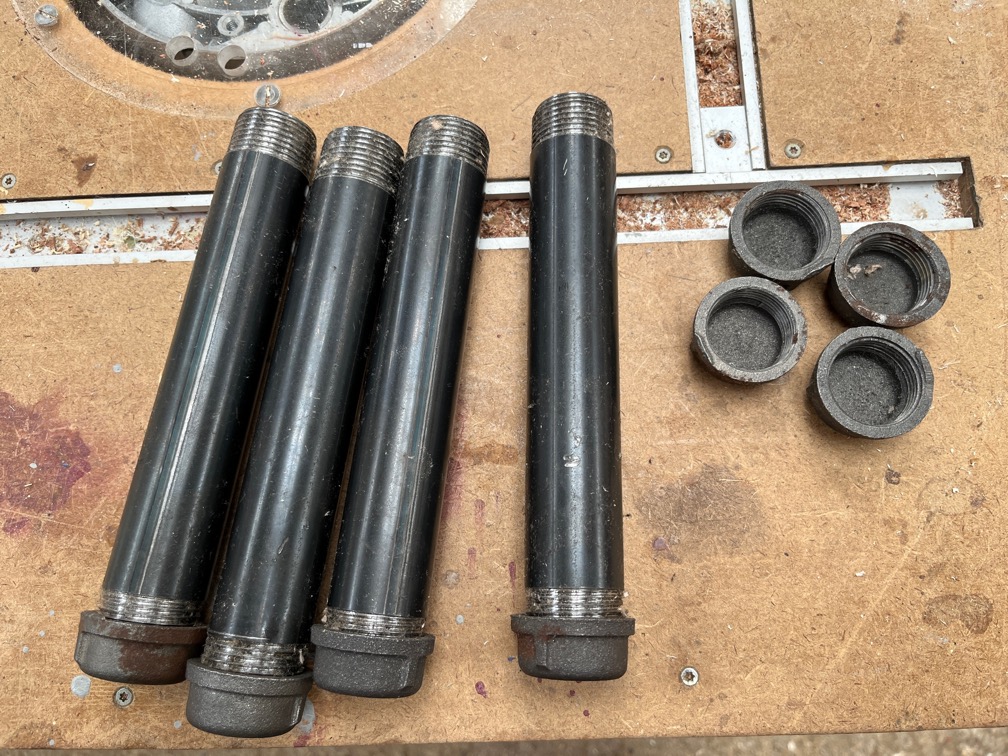
Rummaging through my sundry metal bits bin I found these. They should be good enough.
During my first break I put the pins into the mounts and hooked on the chain hoists.
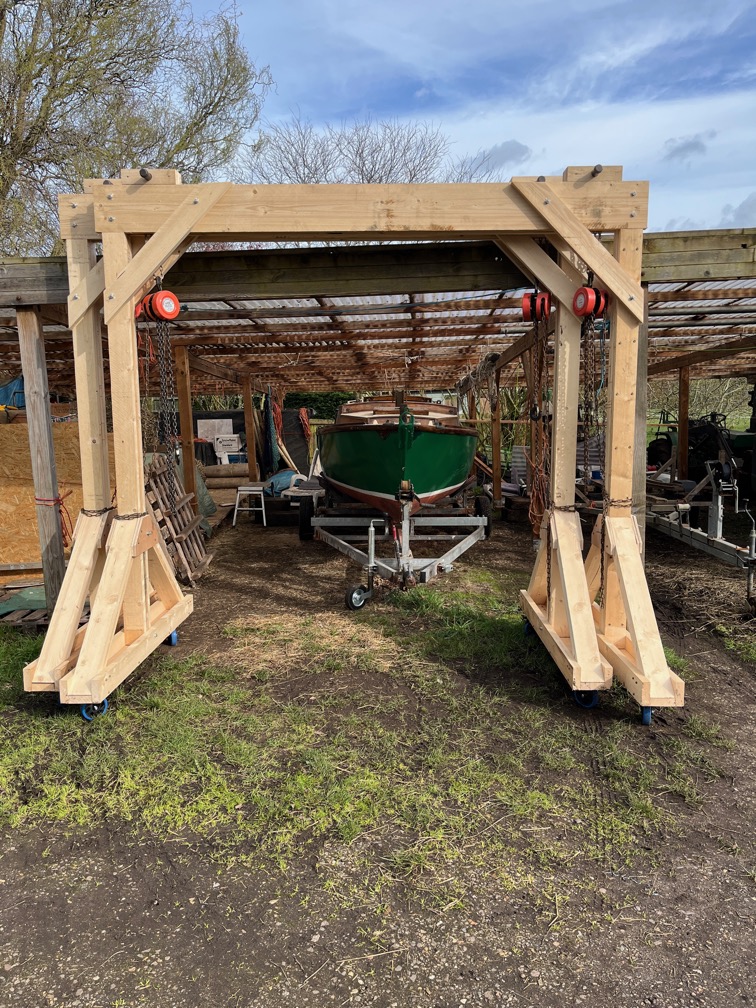
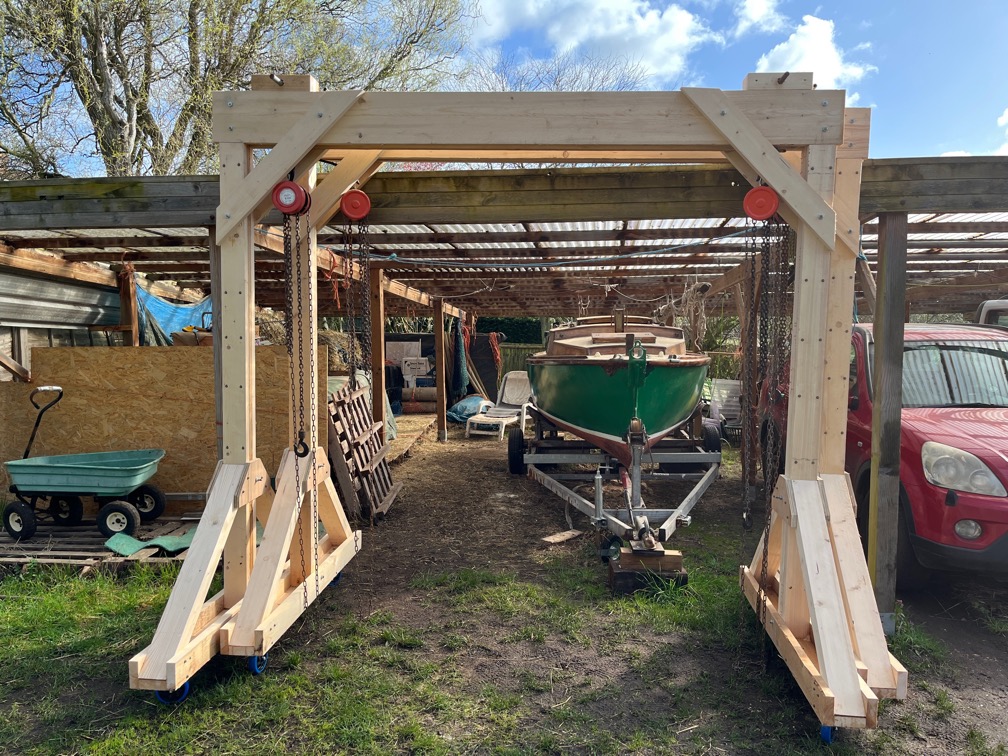
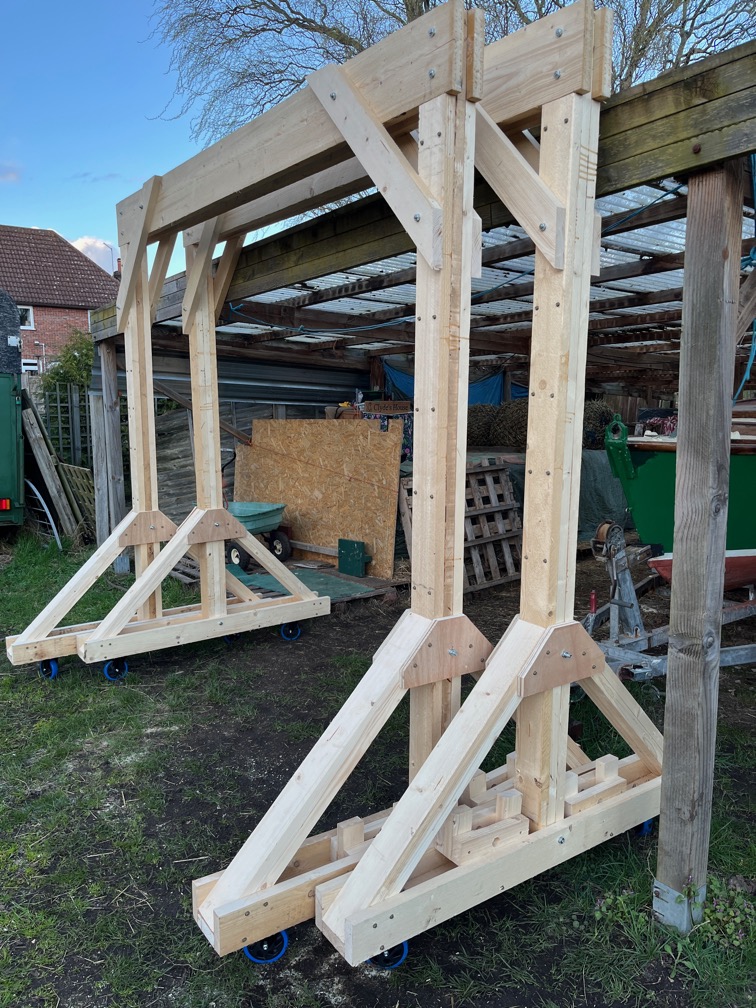
There we are, two gantry cranes completed and ready to go.
The pins arrived at lunchtime, so I will replace the alternatives with these later. These are 25mm diameter black iron pipe, threaded at both ends with caps.
However, I noticed, just by eye, that these are not 25mm in diameter, that measurement is the inside diameter. So I went and measured them and I need to open out the holes to 35mm. Wide enough for the pipe to go through but not the cap. Oh well. I’ll use the alternate pins for today and open out the holes later. I don’t have the time to do that before needing to use the cranes.
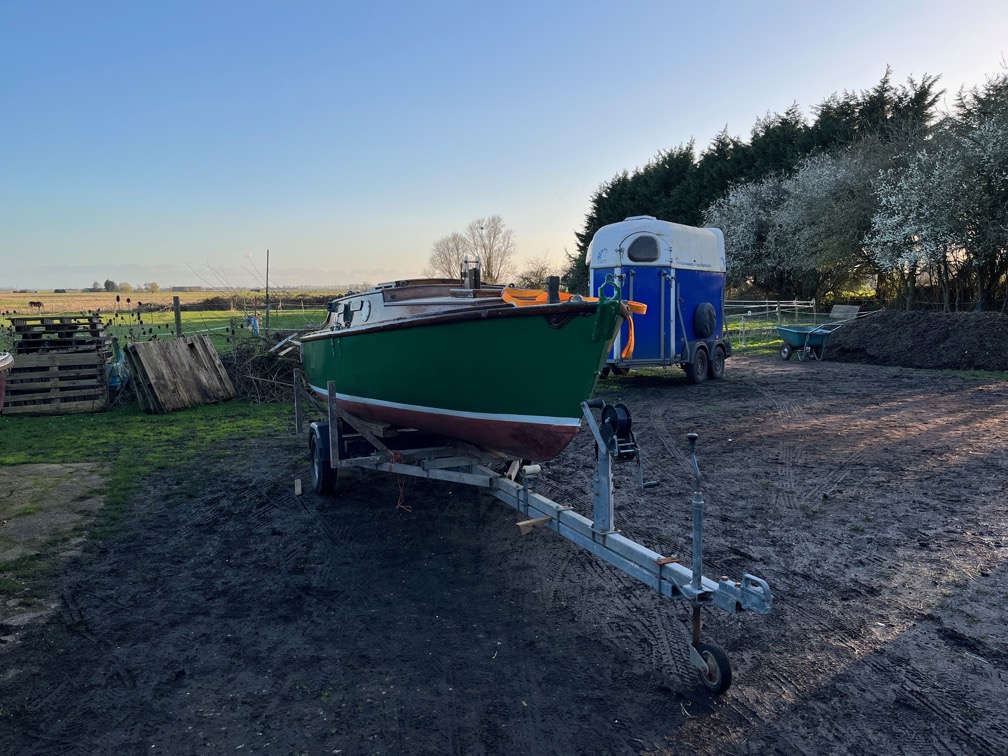
Instead I started to prepare Shoal Waters for the move to the other trailer and that meant removing all the blocks from under the trailer. Here she is now sitting just on the trailer and she is canted over to one side slightly due to the slope on the ground.
I took a moment to check the pressure in the tyres of both trailers and to add more air where necessary. I also need to check the wheel bearings for grease on the travelling trailer before putting Shoal Waters on.
The blocks that were under Shoal Waters ready to put under Naiad.
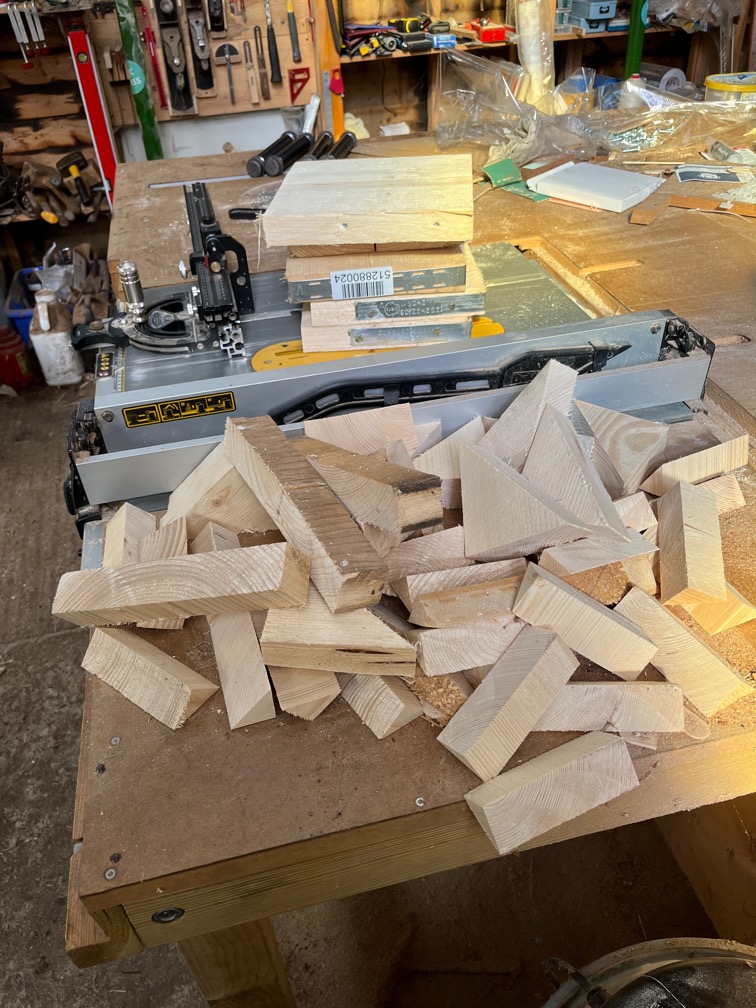
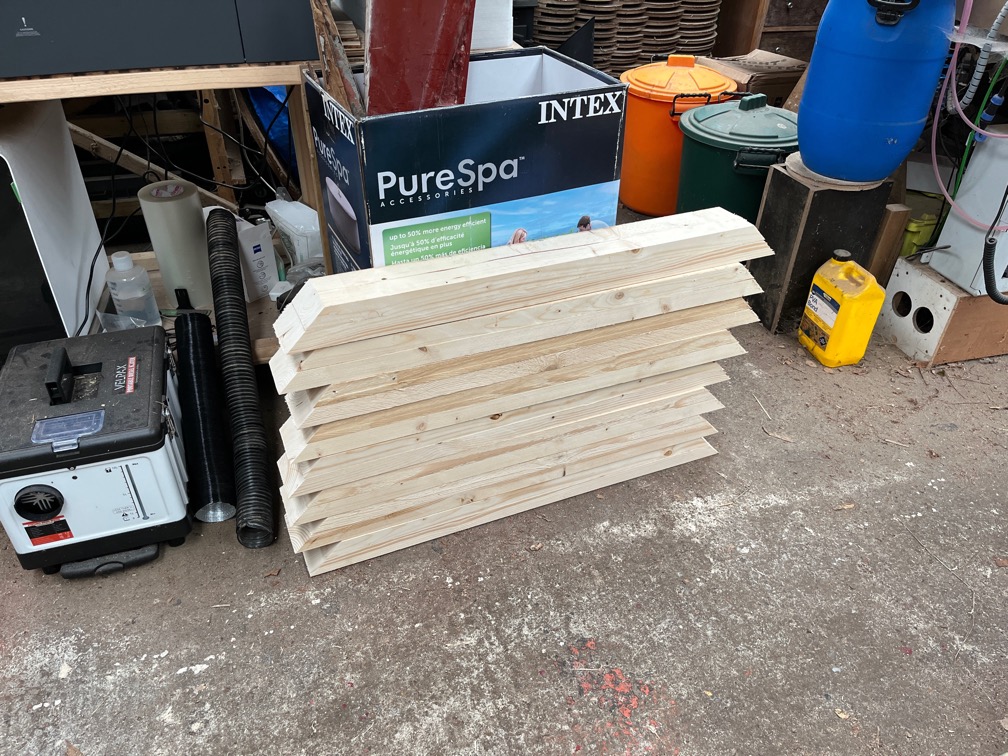
Now that the construction of the gantry cranes is completed I gathered up all the offcuts.
This is all that I have left of 12 scaffold boards. Not at all bad. I’m not sure whether to put these in the offcuts bin or the burn pile !
To get Naiad ready first required me to lower the mast since the forestay would get in the way of one of the cranes. This did not take long, it’s an easy and simple process.
Then the blocks under the trailer were removed and put aside except for the one aft of the transom since they will not be in the way there and were close to where they were needed.
After work we began the process of getting Shoal Waters onto the traveling trailer.
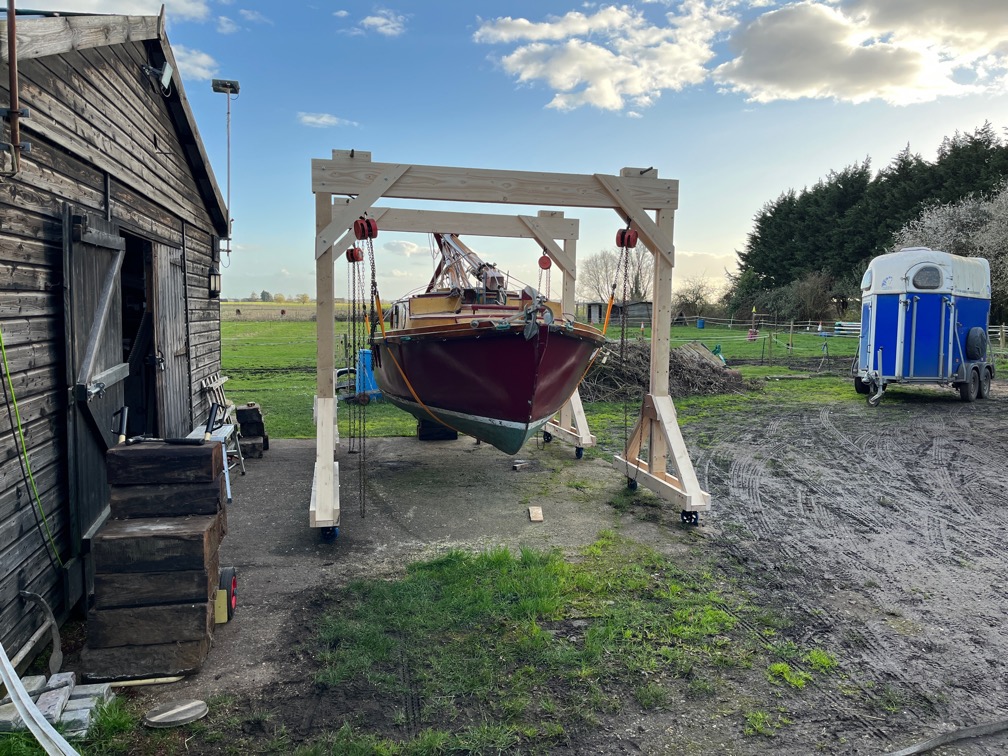
The cranes were positioned around Naiad and the strops put in place.
She was lifted off the trailer, the trailer moved out of the way…
…and blocks out under her to rest on. Having lowered her onto the blocks, the cranes were moved and Shoal Waters placed under them.
She was lifted up, the trailer moved out from under her…
…the travelling trailer put under her and she was lowered onto the trailer. The cranes were then moved well out of the way.
Shoal Waters was tied down to the trailer using ratchet straps and ropes as required. With the trailer board lashed to the stern and the correct registration plate put in, she is ready to be taken to the boatyard tomorrow.
I would have liked to have started on the construction of the second gantry this morning, but I needed to keep the drive clear of obstructions until this afternoon. Instead I started work on the chain hoist mounts.
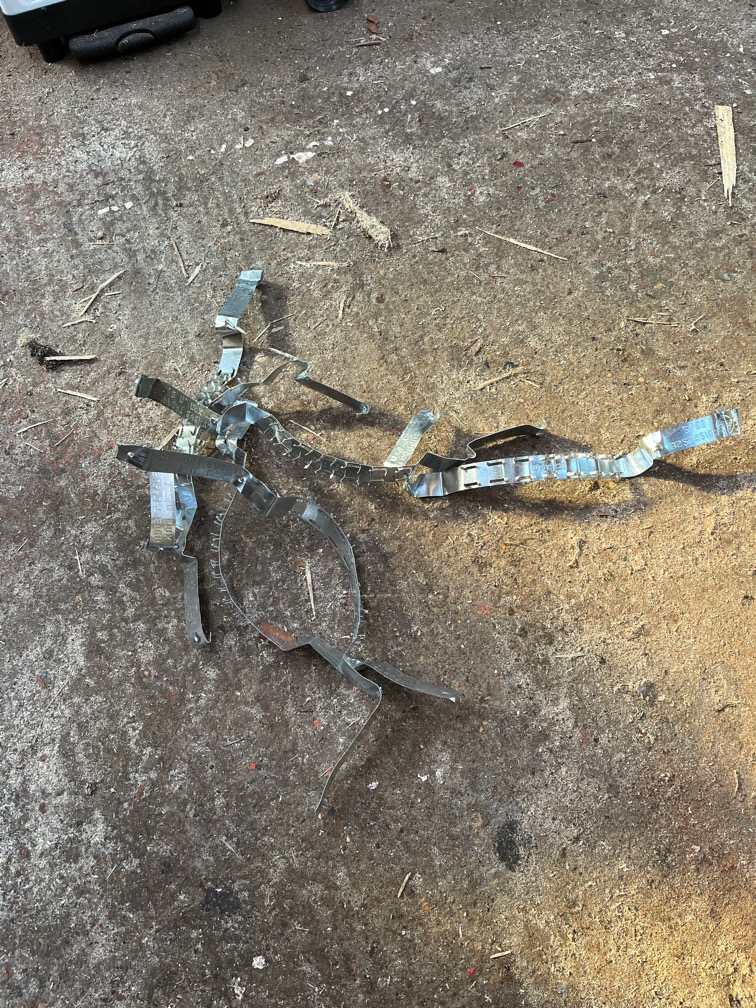
To start with, this meant removing the strapping from some of the offcuts.
A tangled mess of strapping. This stuff is no use to me, so rather than keep it, just in case, it went straight into the bin.
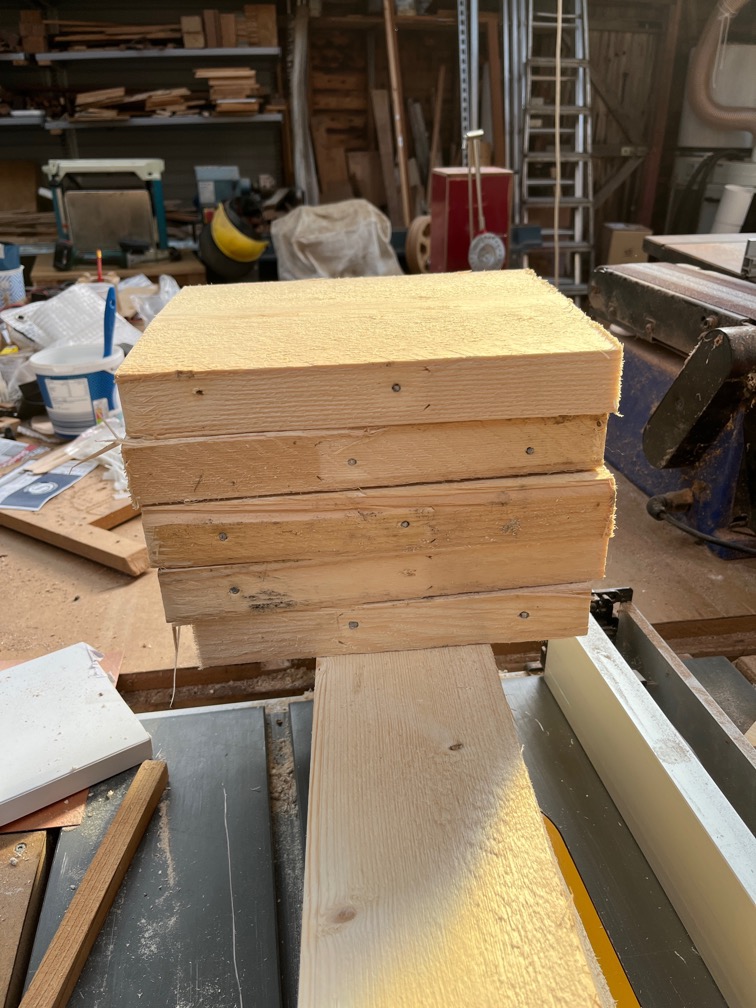
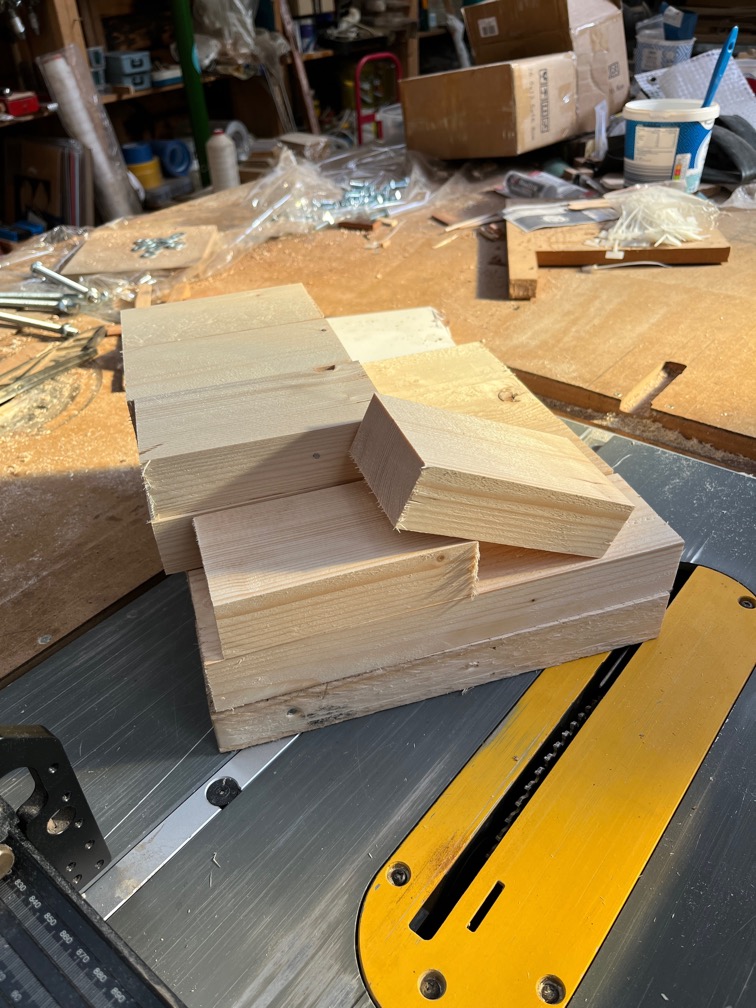
Four of the offcuts were cut into three equal width pieces, one of each three was faced slightly to make it thinner than the other two and then cut in half.
These pieces formed the mounts for the four hoists.
Time for a cup of tea.
During my next break I assembled the hoist mounts.
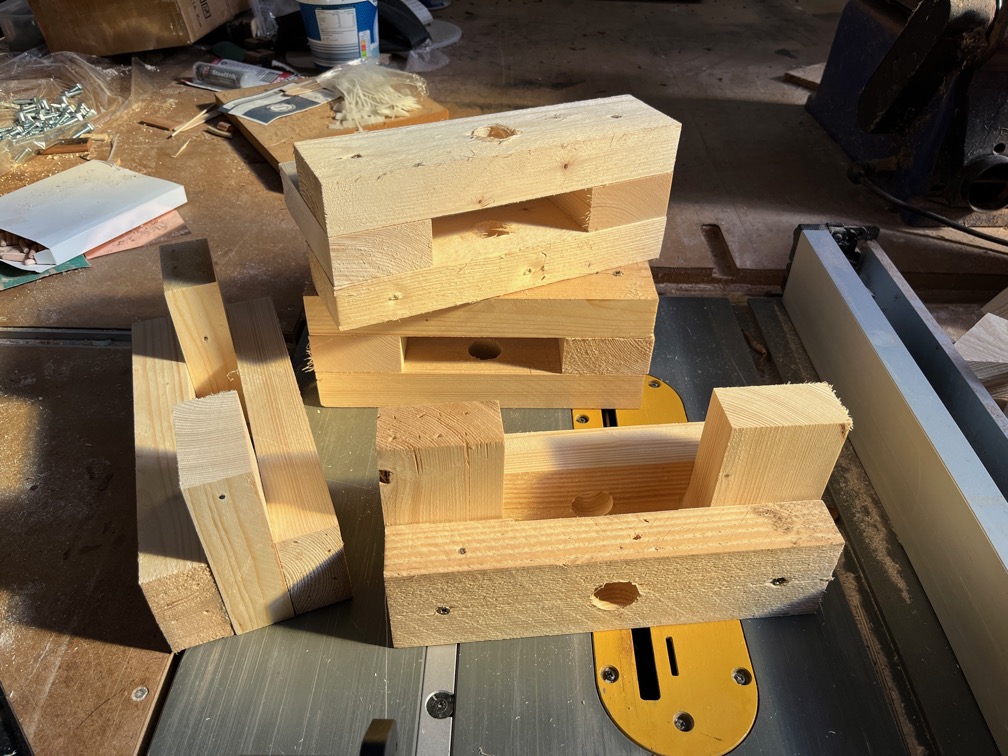
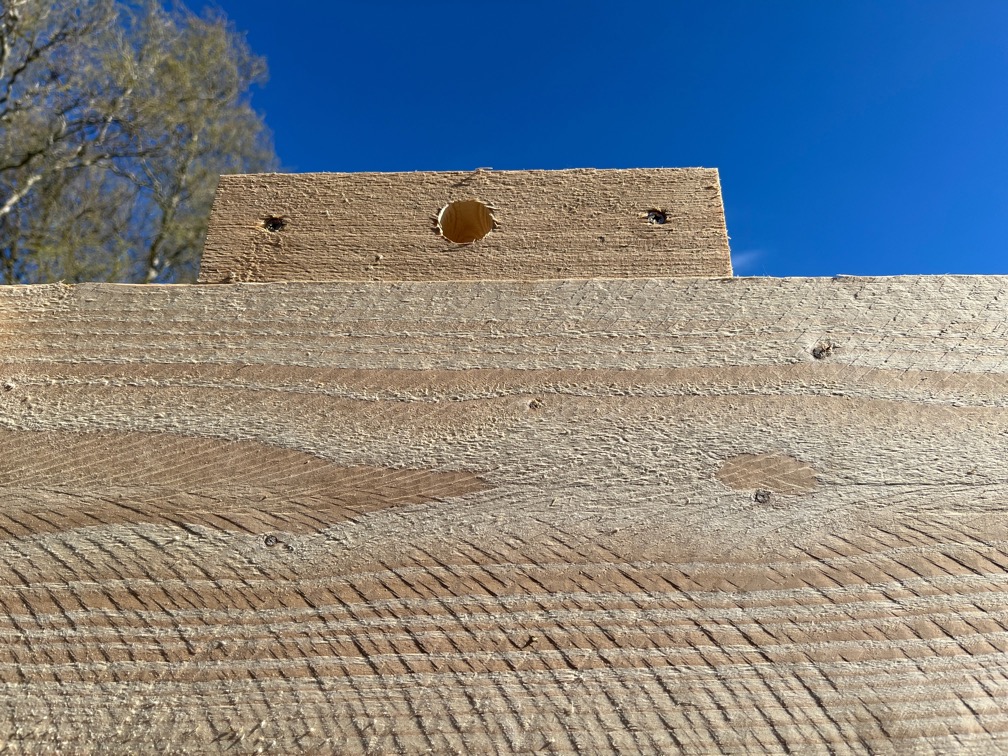
This consisted of boring a 28mm hole through the centre of the long pieces then glueing and screwing the two short pieces as locating legs between the pieces with the hole. The result is as shown.
These mount sit on top of the gantry with the locating legs of the mount down between the two cross beams. The hole is for the attachment point, due to arrive later in the afternoon.
Now all that remained was to construct the second gantry and mount the choin hoists.
Time for a cup of tea.
After work it was time to finish up the second gantry.
This did not take much time at all, as expected.
I chose to build the second gantry close to the first so that I could use the first one and a rope to haul the second upright.
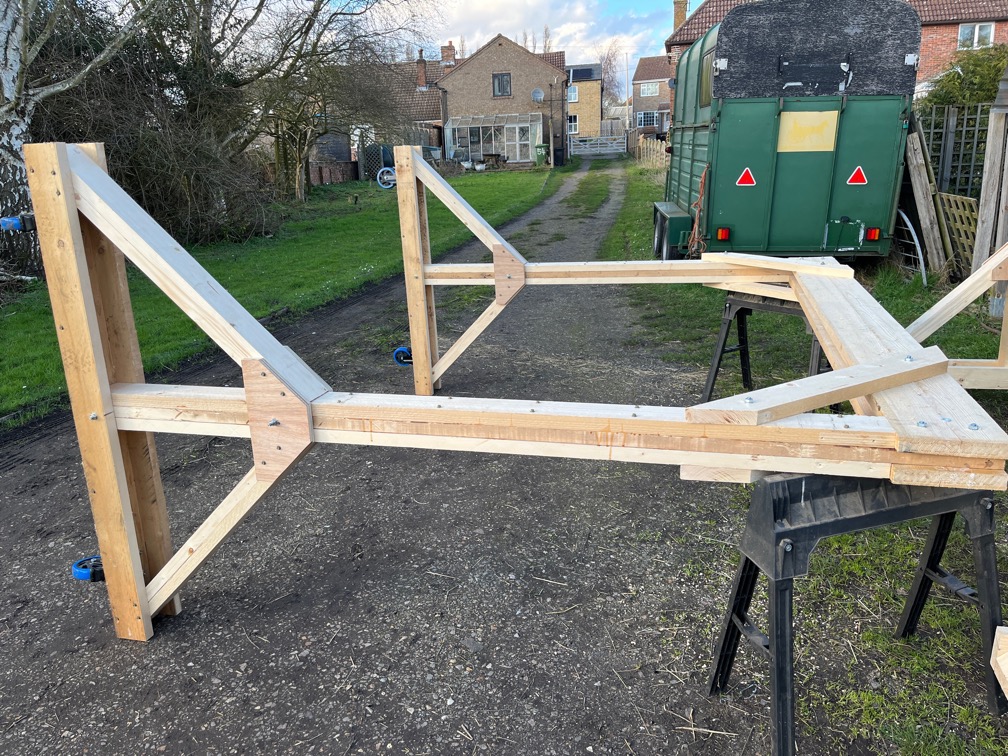
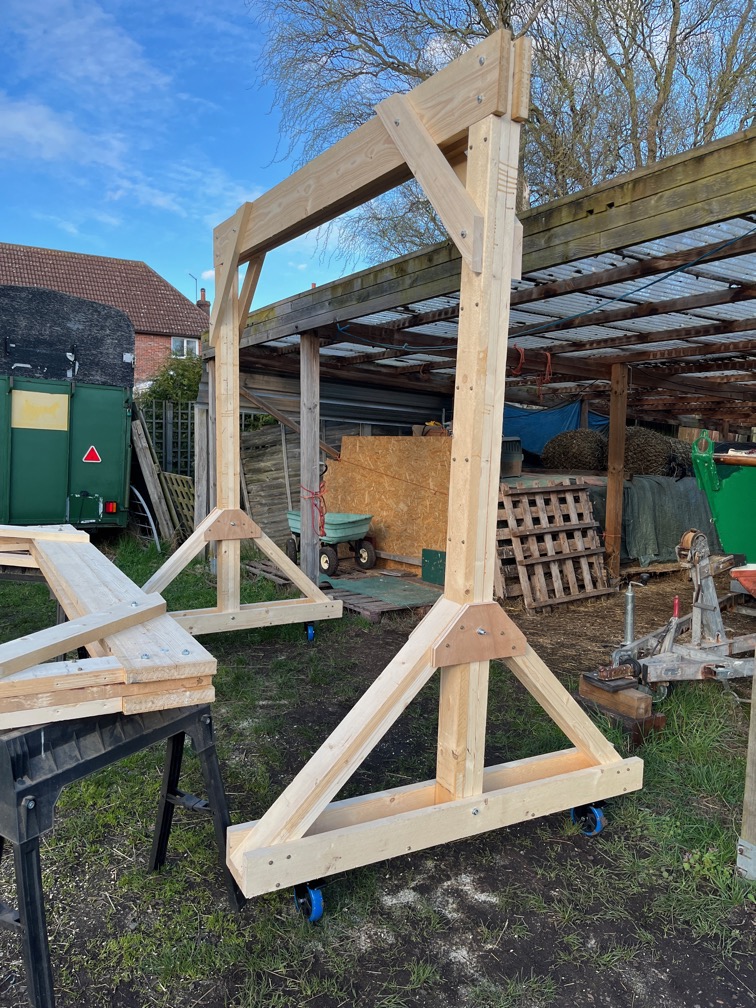
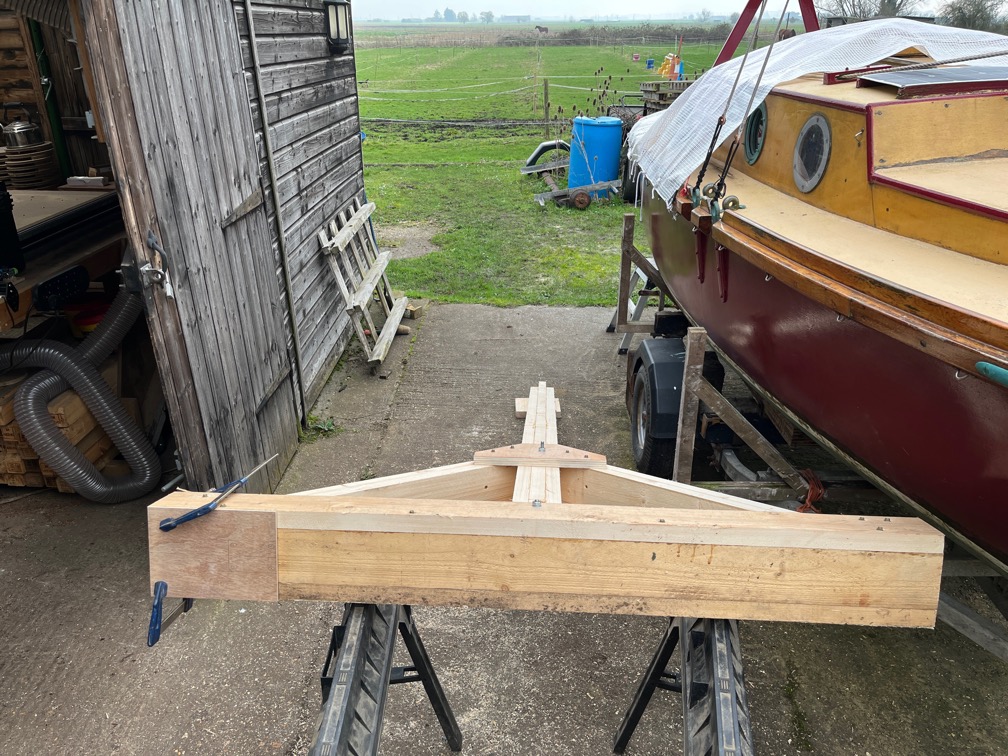
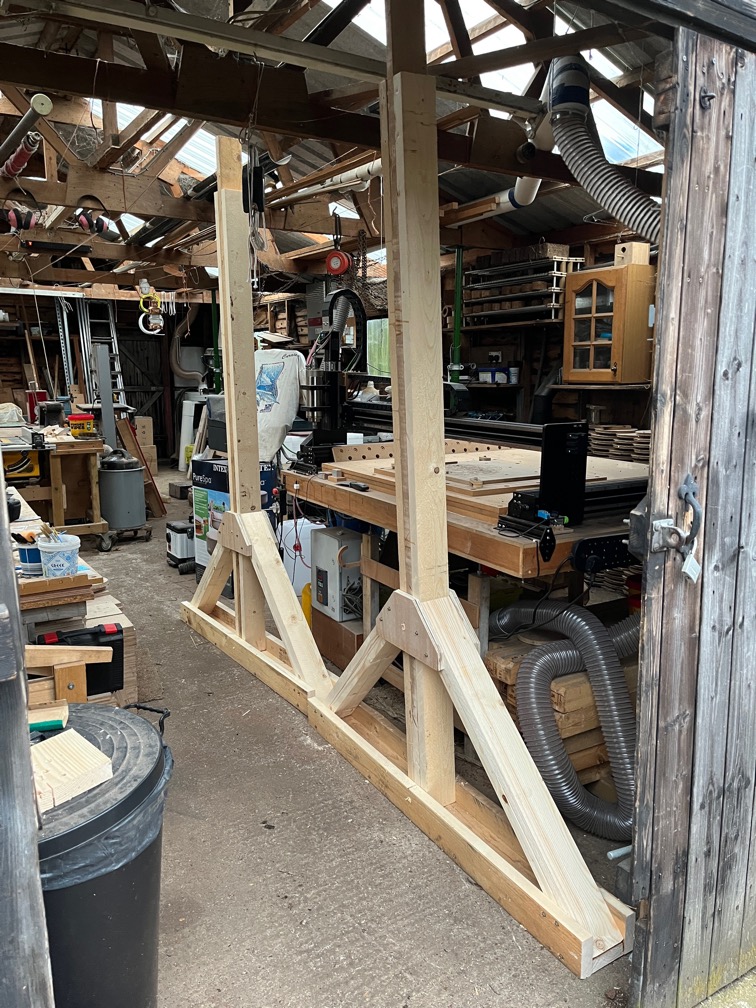
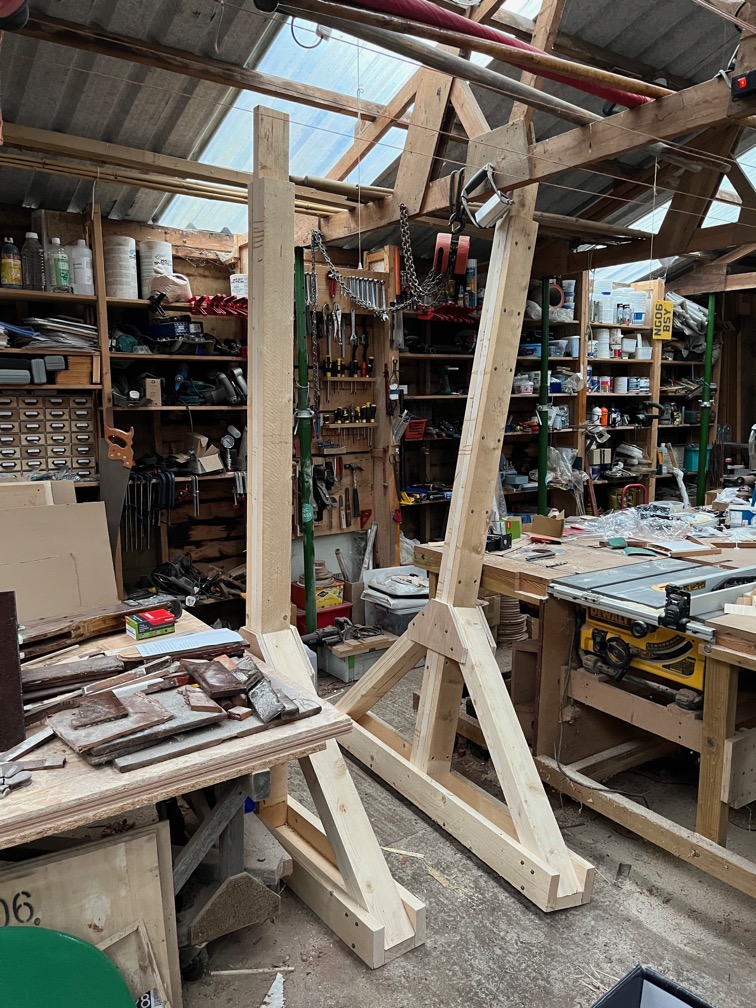
And here we are, two gantry cranes.
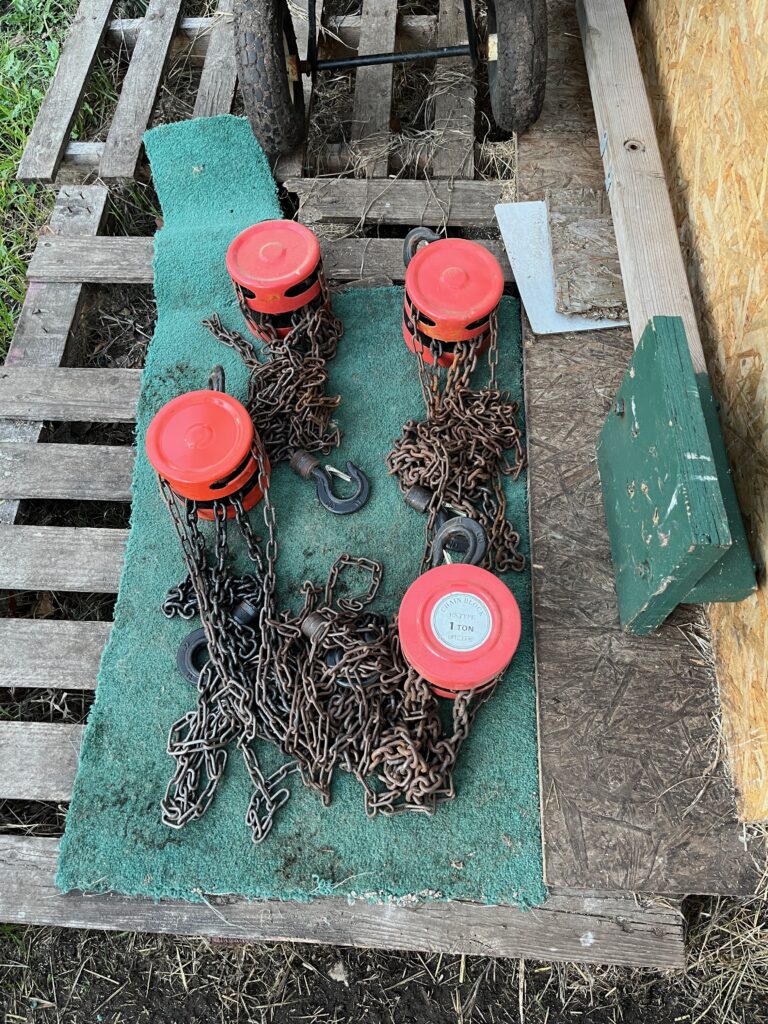
These are the four chain hoists. They have lived in the rafters for the workshop for a number of years and now it is time to make good use of them.
While I await the arrival of some metal tubes I started tidying up the boat ready for her short journey on /thursday. One of those things was to fit the gudgeon to the transom in its new, slightly higher position. Having done that I needed to check that the rudder stock still fitted. It does, tso that is another thing that can be checked off the list.
With time running out the gantry crane needs to be completed today if possible and that meant an early start. So before breakfast I hied me down to the workshop and spend the next 45 minutes cutting eight lengths of 10mm studding, deburring the ends with an external deburring tool and putting the retaining bolts into the crane legs.
The bolts were all cut the same length to save time and if the upper ones, which are longer than required, cause problems from being too long, then I shall cut them down at a more convenient time.
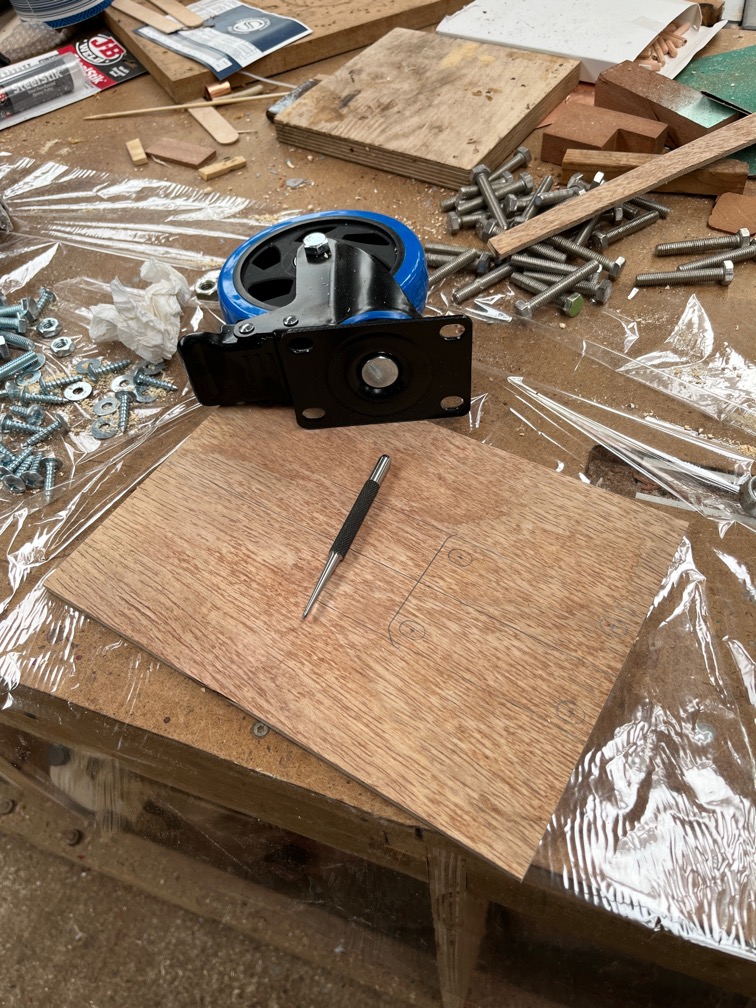
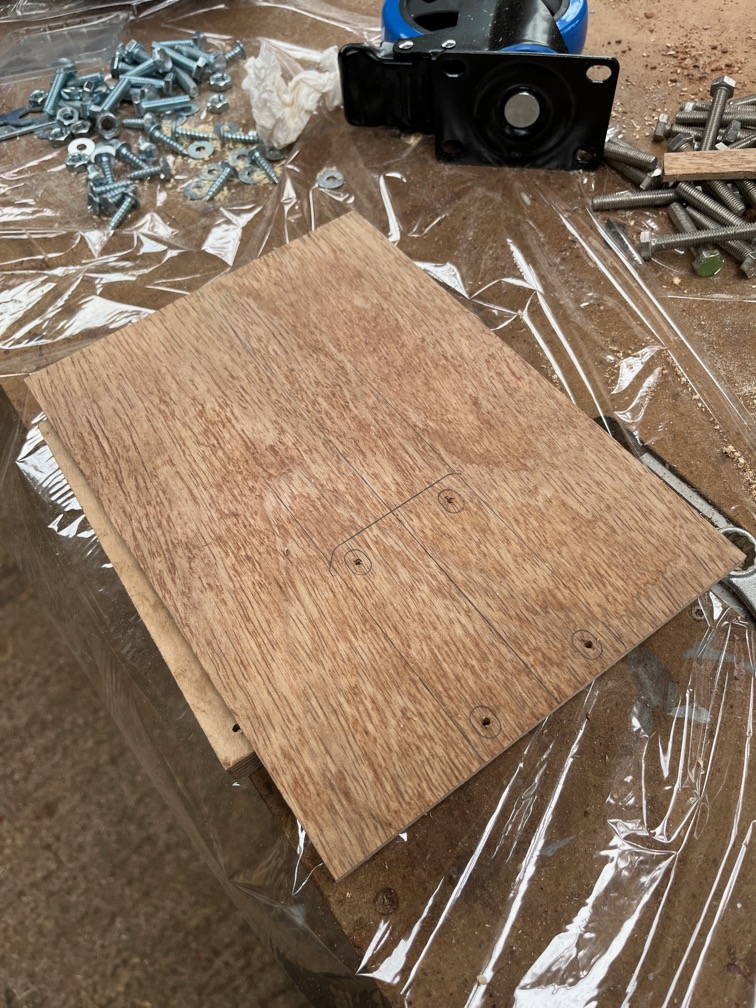
The task during my morning break was to make a drilling jig for the wheels.
This is comprised of a single sheet of plywood with four holes drilled in it. The width of the sheet is the same as the width of the underside of the feet.
And the four holes mark the position of the base of the wheels.
Easy to make and easy to use.
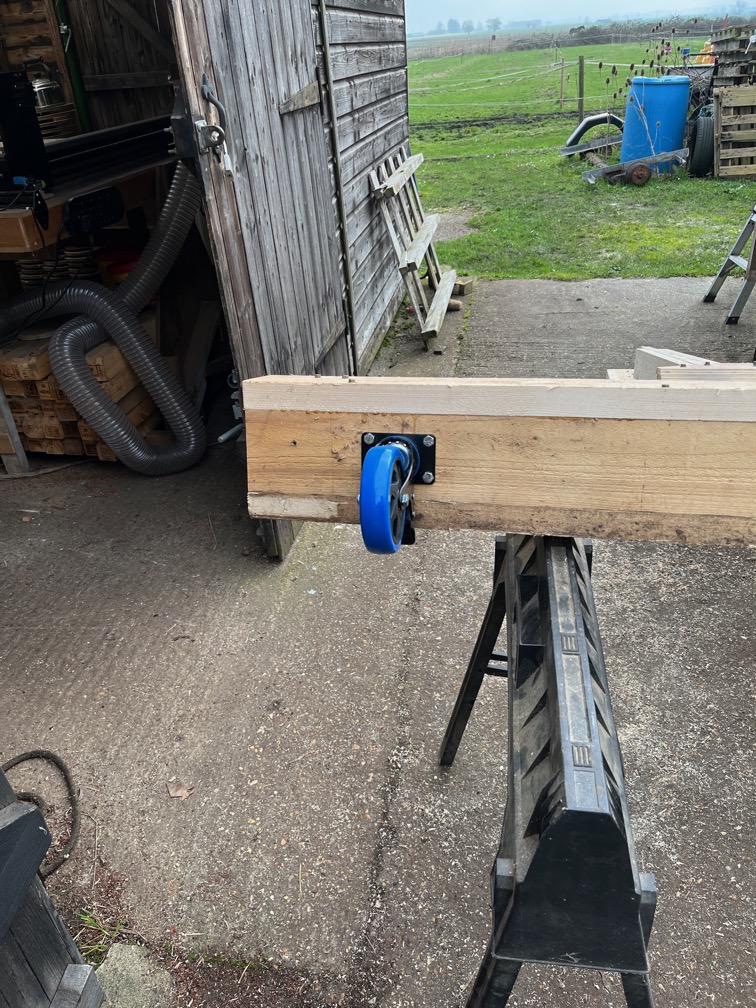
During my lunch break I started on the task of putting the wheels on to the legs. The jig was clamped to the underside of the foot with one end level with the end of the foot as show. Four small holes were drilled through the holes in the jig. The jig was removed and the 8mm drill used to widen the holes to the correct diameter.
The wheel is then bolted to the bottom of the foot.
Two complete legs had the wheels added during my lunch break. The brake on these wheels not only locks the spin of the wheel but also the rotation on the mount.
Back to work and …
Time for a cup of tea.
During my afternoon break I put the wheels on the other two legs.
A simple and easy job and quite quick as well.
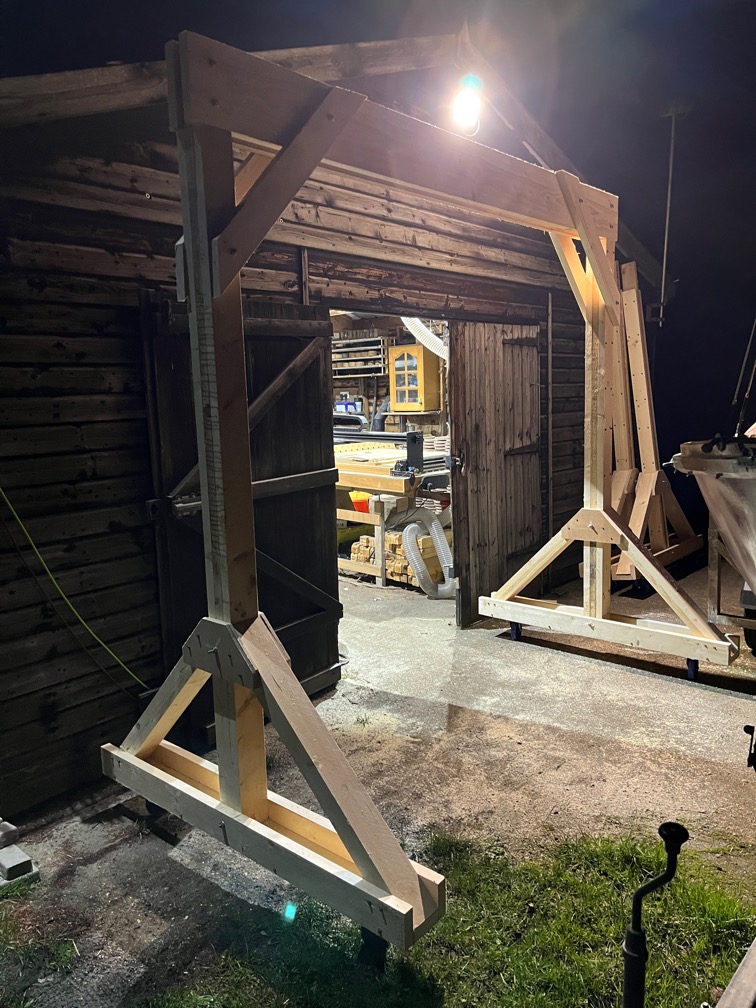
After work I set to an put the cross beams in place. This took nearly three hours and I was completing the task in the dark, hence the flood lights. The reason it took so long was because all the things that had to be made, the bolts, braces and so on I made for both gantries. This means that the second one will take a lot less time.
The next part of the gantry cranes part is to make the various components from the timber that was cut yesterday.
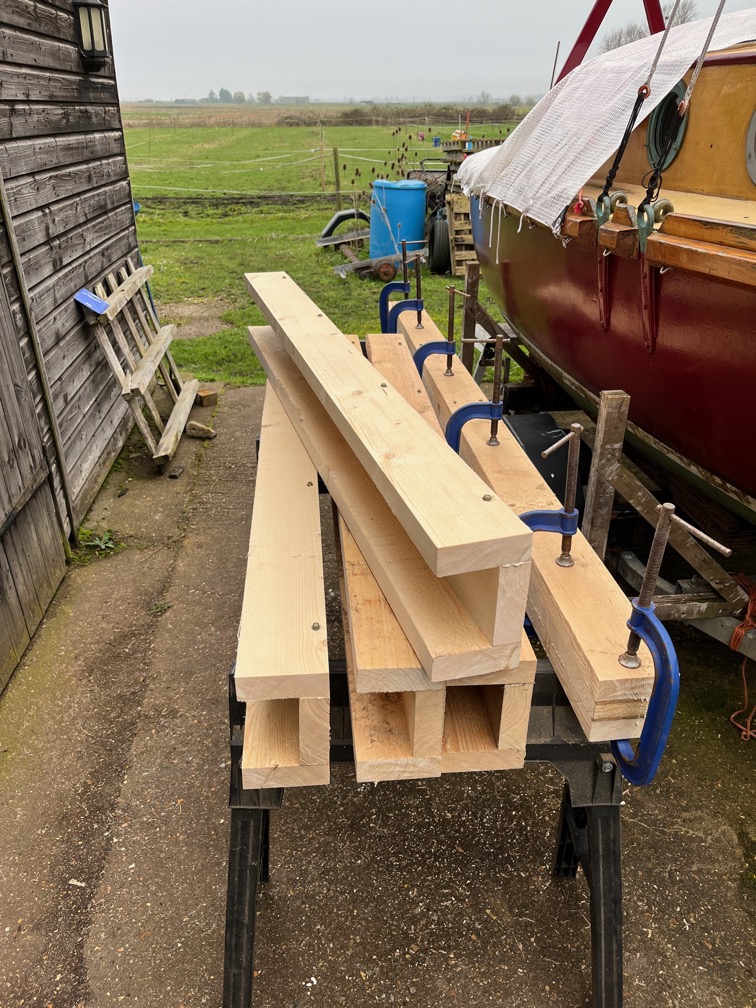
I started with the leg braces. These were glued and screwed together to form eight braces and put to one side.
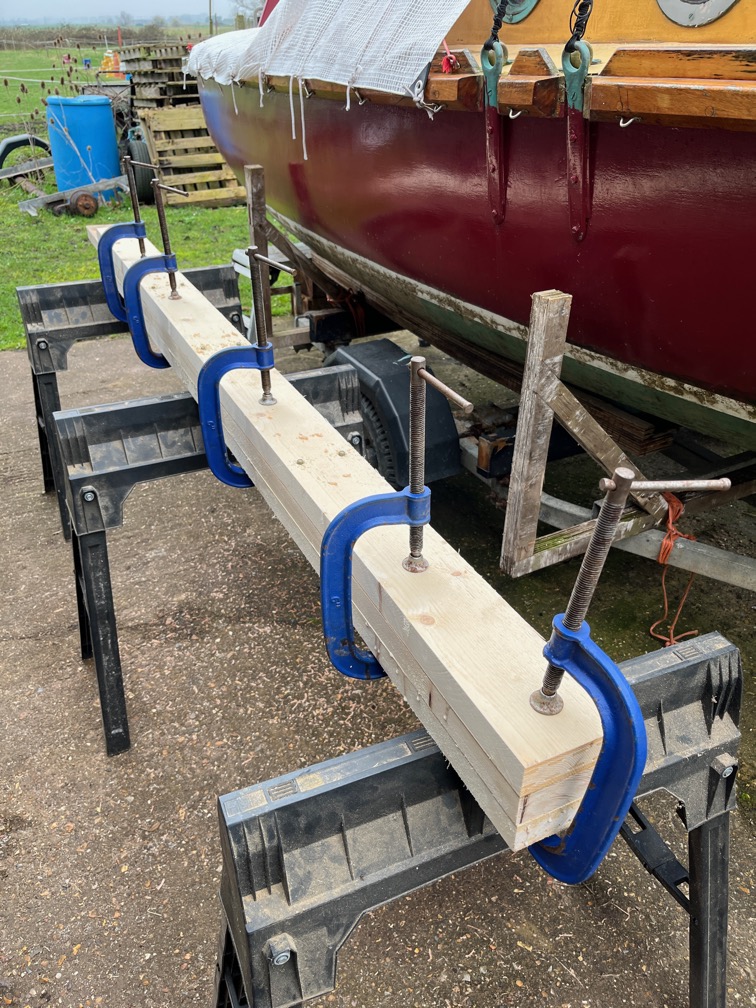
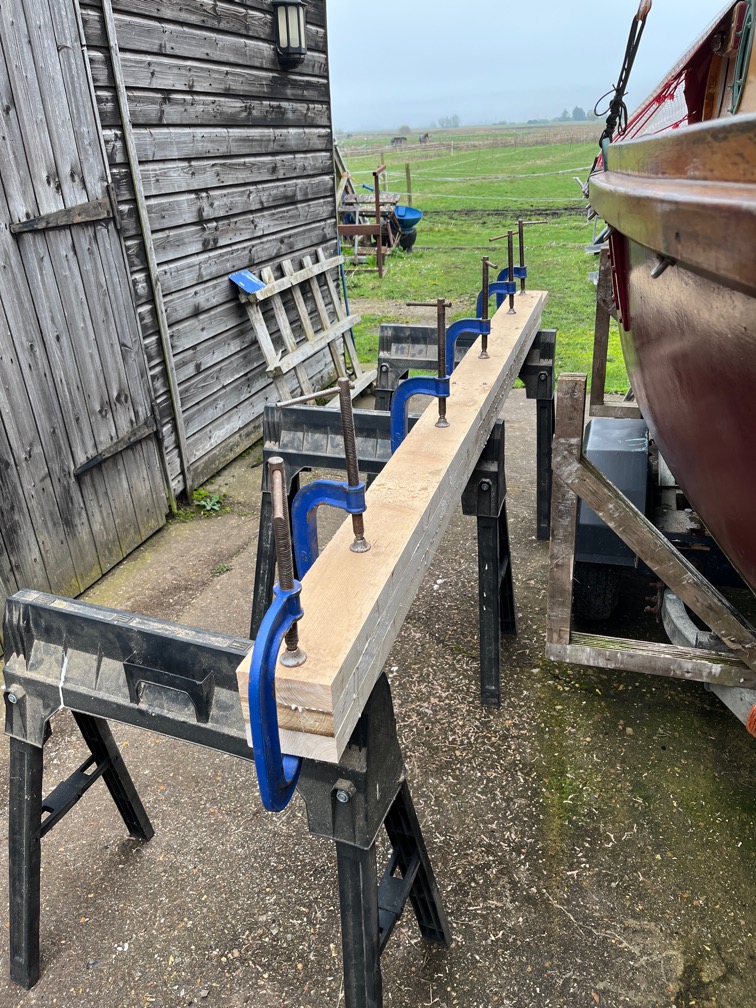
Next were the legs. I used three saw horses on level ground to ensure that I had enough flat space to construct the four legs.
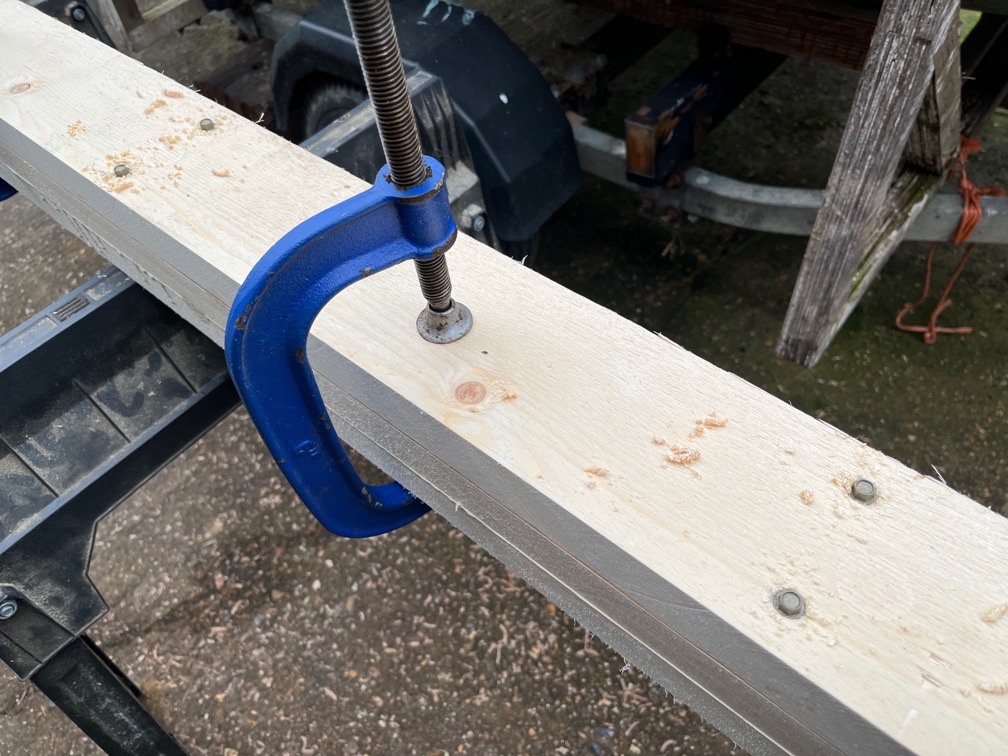
The legs were also glued and screwed but I used 100mm long timber screws. Four of these need to be screwed in flush with the surface so that I can dismantle them form the feet for storage.
Even though I used screws, cramps were added in between the screws to hold the glueing surface together.
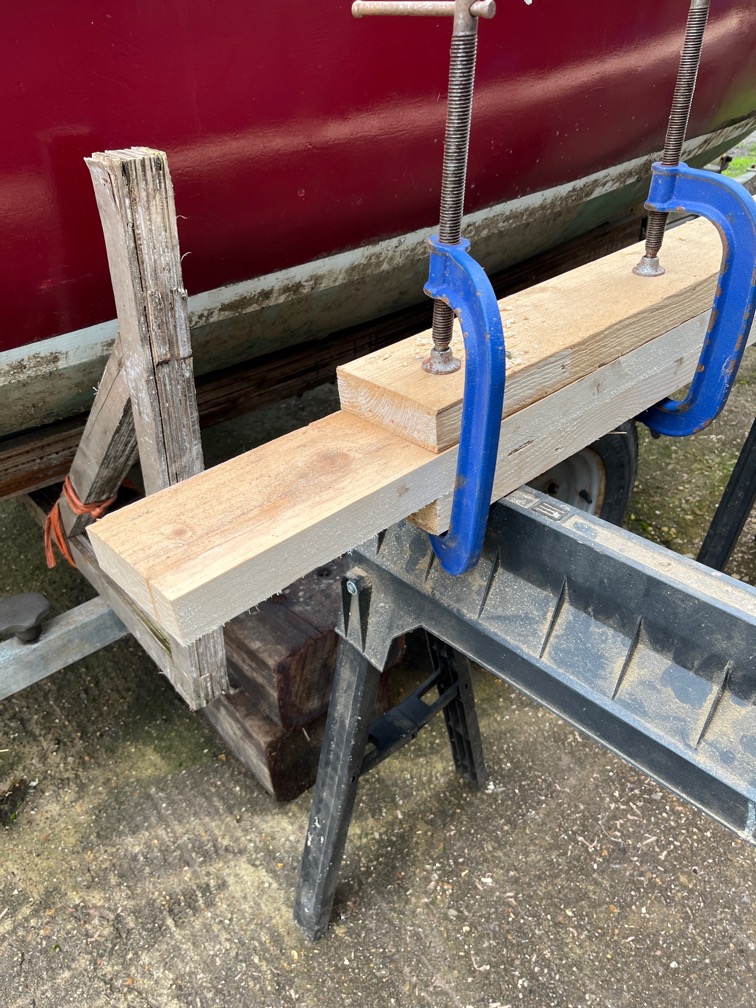
The top of the leg is stepped as shown so that the two cross beams can sit on the step for added rigidity.
The last component are the feet. Again, glued and screwed using the timber screws.
Now I wait a while until the glue has grabbed the wood sufficiently before assembling each leg.
Time for a cup of tea.
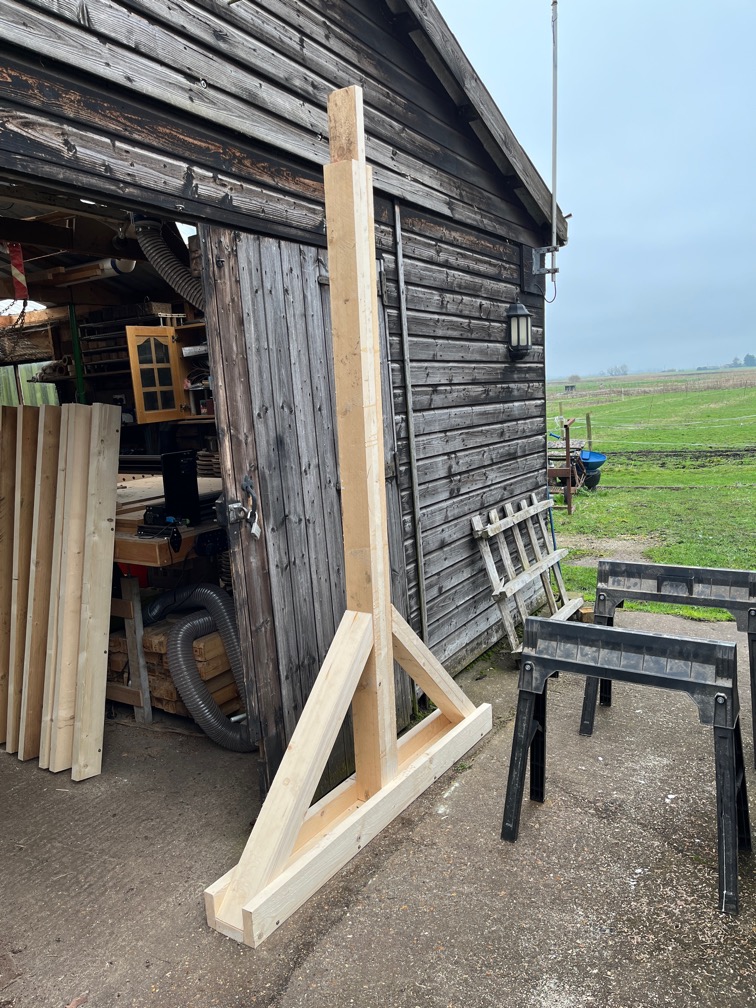
The first leg took quite a while to construct, mainly because it was the first one.
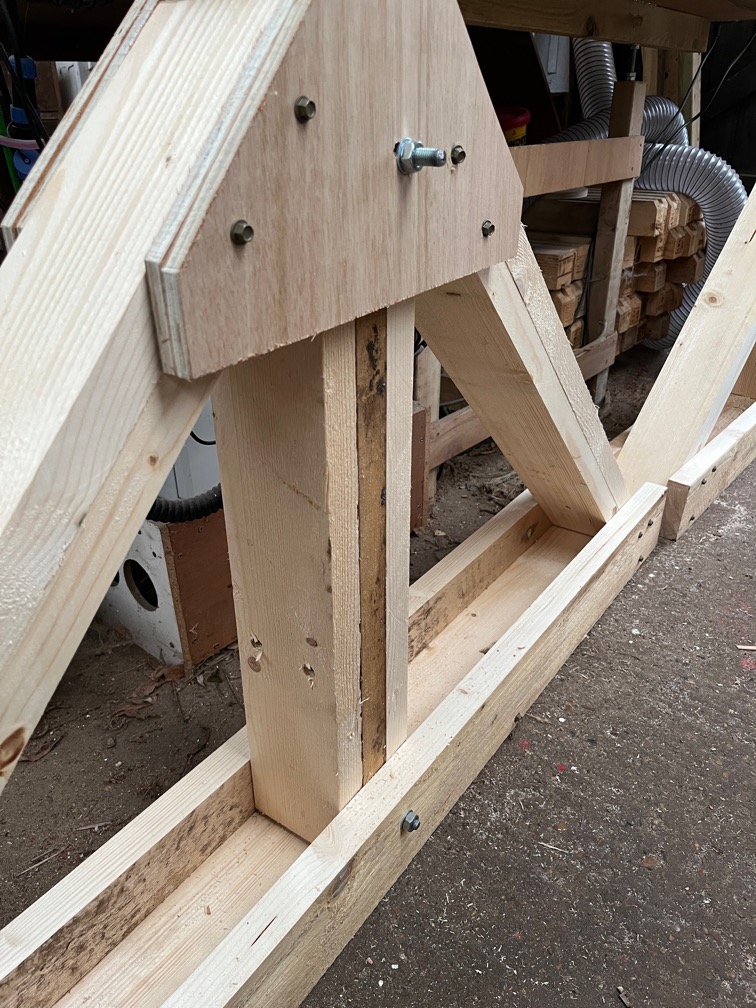
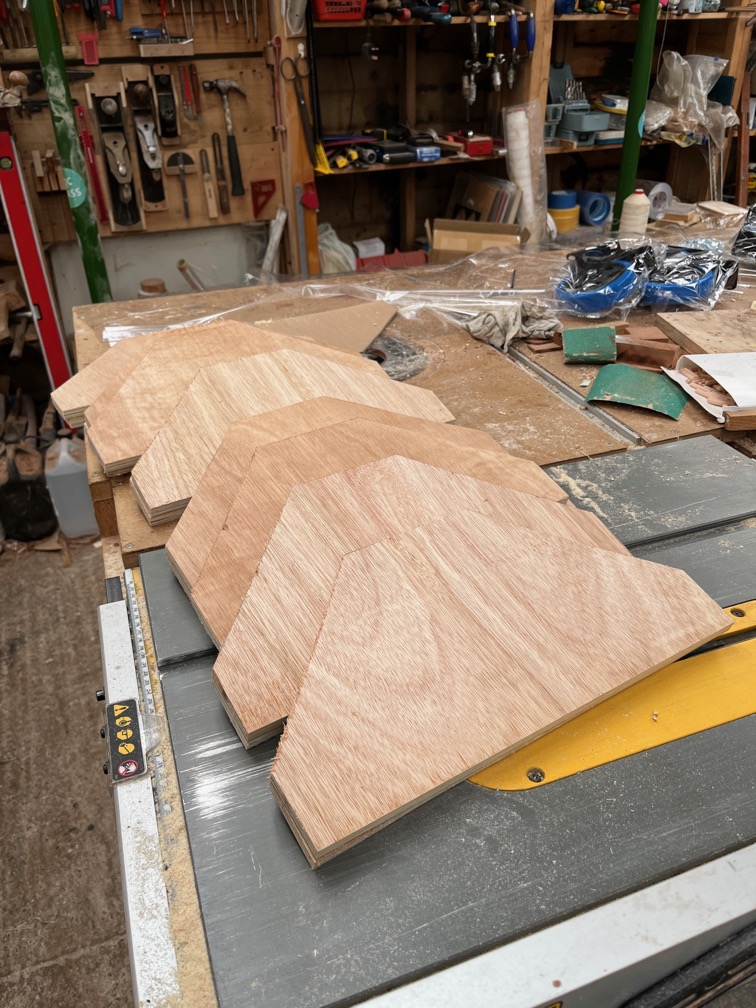
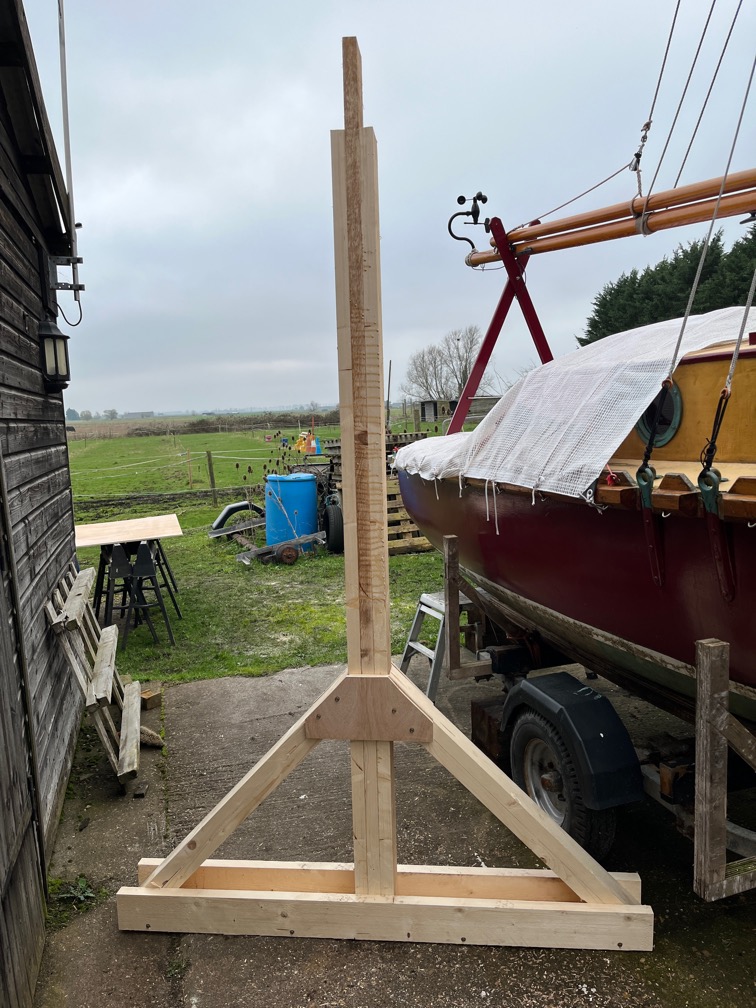
This the main parts of the leg fitted together and I need to make a bridge piece that covers the joint between the leg upright and the braces.
I made one then used that to mark out the rest.
This is how it fits on the leg.
After lunch I made a start on the other three legs and, as expected, I built the three in the same time that it took to build the first.
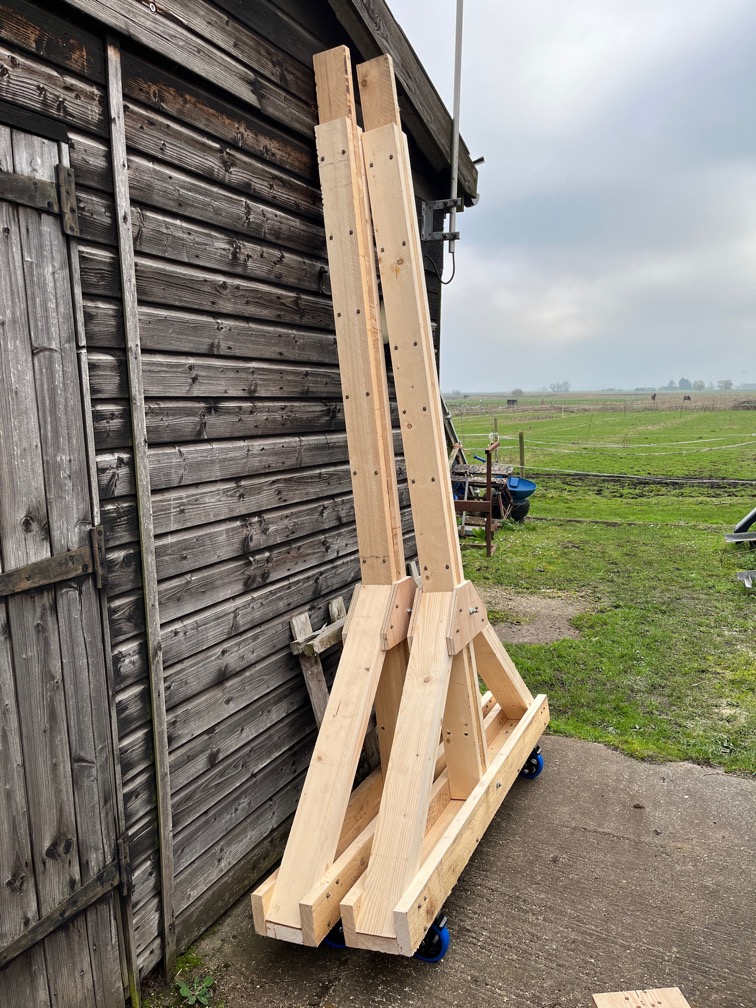
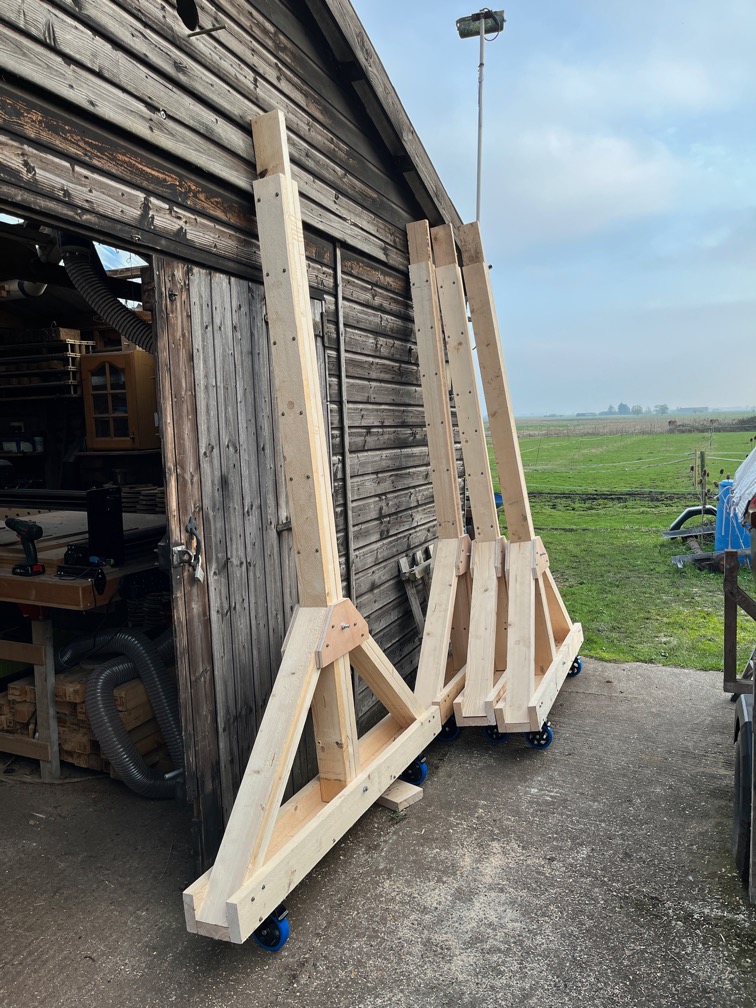
The weather forecast suggests that it is going to be foggy and misty tonight so I pulled the legs into the workshop.
This took a bit of doing because they are taller that the rafters and also heavy.
To complete the legs I have to put on the wheels, cut and fit the retaining bolts for the uprights. Once those tasks are done the cross beams will need to be fitted along with the top bracers.