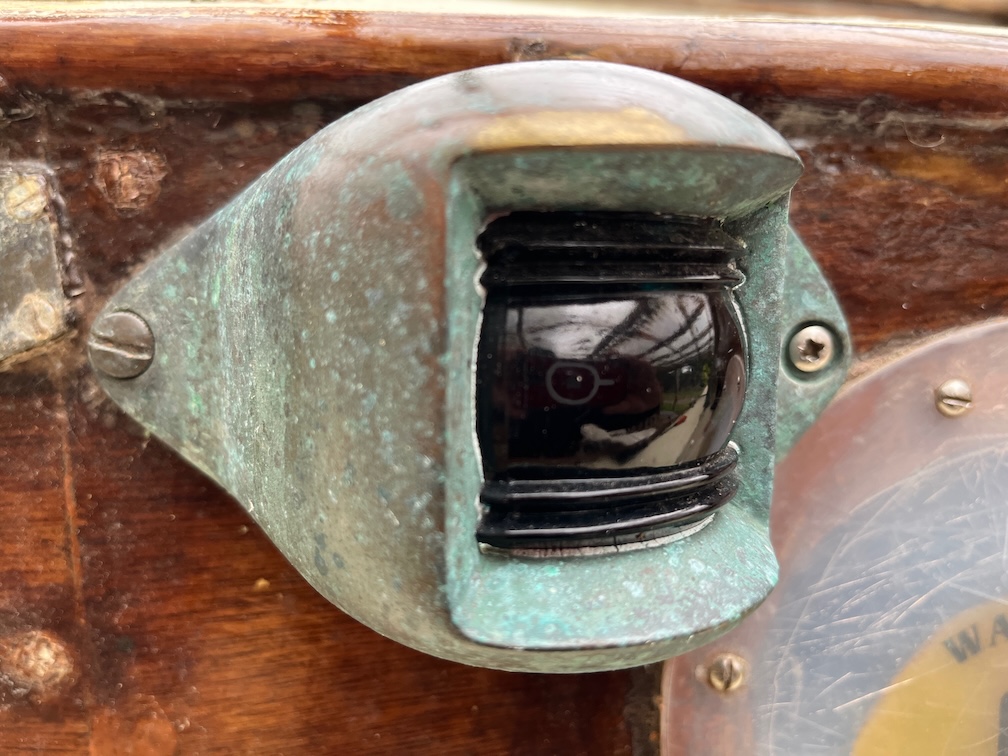
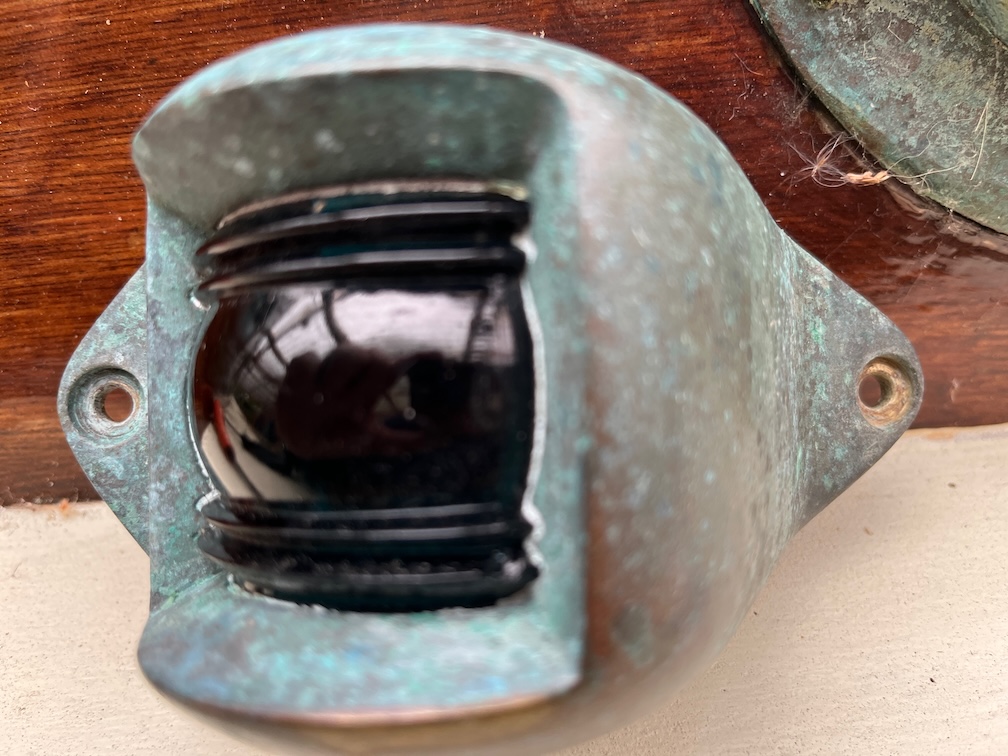
One of the reasons for working on the nav lights these last few days was to answer two questions.
Firstly, If a reflector was fitted inside the nav light would that affect the light cone emitted from the light and if so, by how much?
Secondly, how much brighter would a reflector make?
There was an additional question of whether the LED replacement bulbs affected the cone of light emitted as compared to the original incandescent bulb. This one was largely academic since I’m certainly going to use LED bulbs, but it will be interesting to see if there is a difference.
I asked on the Dinghy Cruising Association website for possible ways to add a reflector to an antique nav light and the two best options seemed to be scrunched up aluminium foil and an acrylic based mirror cut to shape.
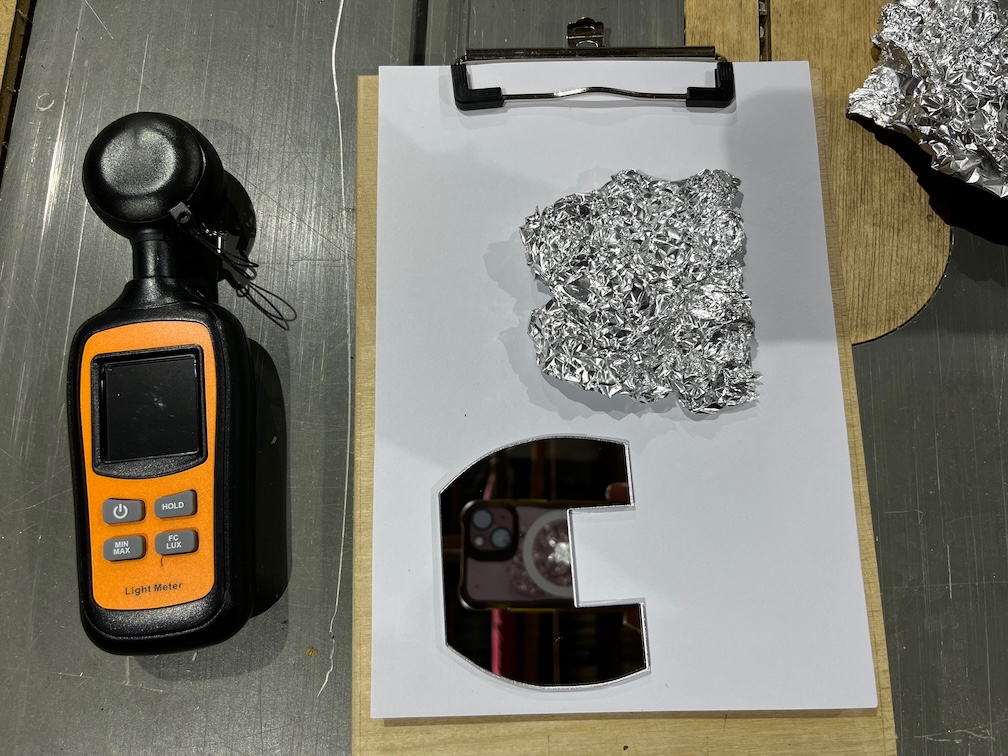
Once darkness had fallen I went back out to Shoal Waters armed with a torch, a piece of scrunched up foil, a carefully cut mirror and a light meter.
I then spend half an hour or so taking a series of measurements of the light output of the starboard nav light. Firstly without any reflector, then the foil and finally the mirror. I placed a wooden block on the side deck and used that to ensure that the position of the light meter was the same for each measurement.
Not surprisingly, the readings for the light without the reflector was the lowest, as I expected, but the question was which of the reflectors was better. The foil didn’t reflect as much light as the mirror, but because of the scrunched up nature, the foil spread the reflections around a lot more than the mirror. Also, not surprisingly, the mirror reflected the most light but this was not as widely spread as the foil.
The foil was 8% brighter on average whilst the mirror was 25% brighter on average than the light without any reflector.
So which is better? It depends. The foil is 8% brighter across a broader spread but the mirror reflects a lot more light.
As any maker will tell you, we spend more time making jigs than making projects, or so it seems at times. Take the new brass thumb screws I bought for the navigation lights. There were two small problems with them. The first is that they are brass. Nothing I can do about that as those are the only ones that fit. The second issue is that they are flat on the head, no slot for a screwdriver. Now that is something I can do something about.
The first, and most obvious answer, is to cut a slot with a hacksaw, but if you’ve ever tried doing this you will know that the result is usually less than optimal.
Enter a jig.
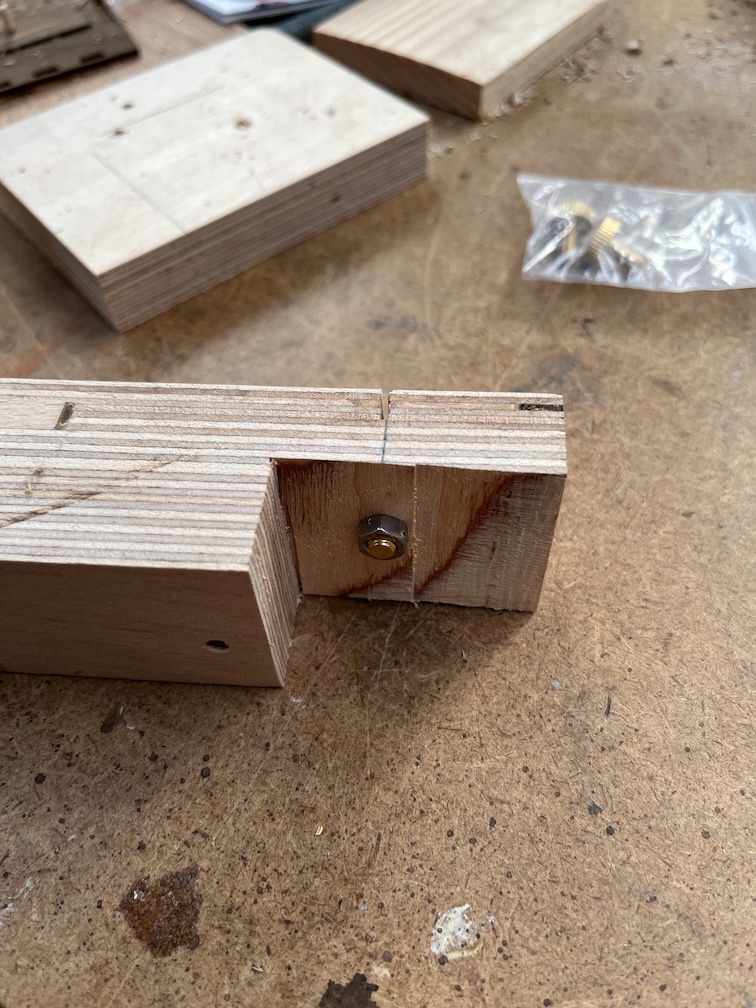
I cut a 5.5mm holes through a piece of scrap plywood and then a 12mm hole halfway through centred on the smaller hole. I marked a centreline and use the bandsaw to cut a slot in the wood through the centre of the larger hole. The thumbscrew was put into the jig and fixed in place with a nut on the bottom.
Like this.
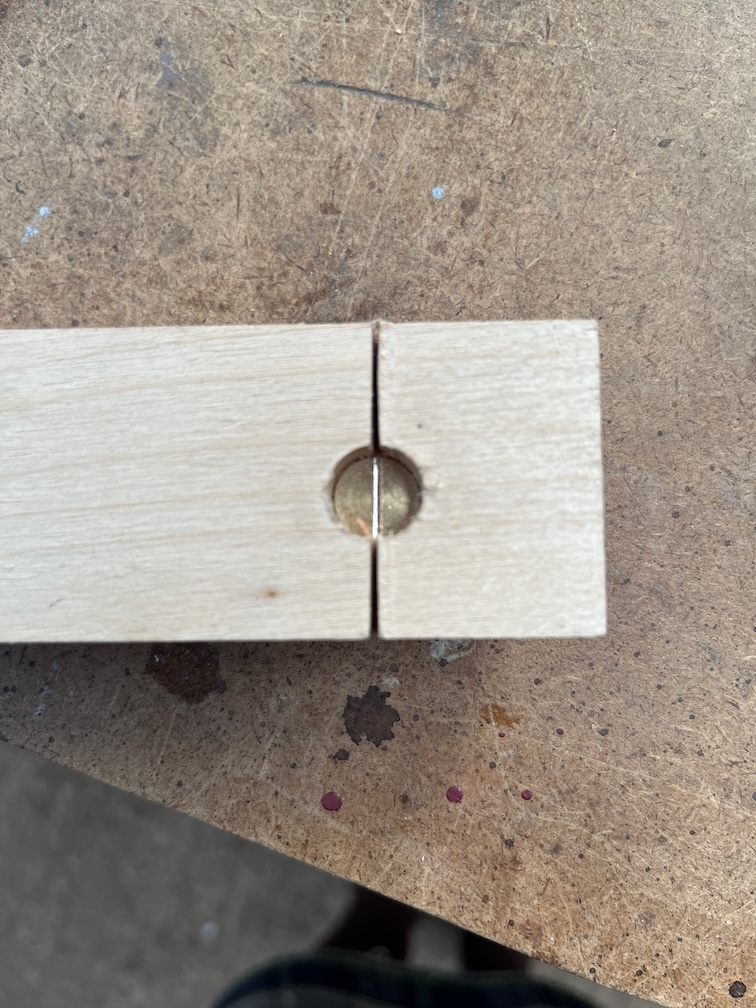
I then used the bandsaw again to cut a small slot in the thumb screw, just to get the slot started and to stop the hacksaw blade from wandering.
Over to the bench vice next and with the jig clamped in place, I used the jigsaw to carefully cut the slot to the required depth using the cut in the plywood as a guide.
The result is a nearly perfect slot in the top of the thumbscrews. Marvellous.
The newly slotted thumb screw in place. Apart from the obvious newness of the brass, it looks pretty good. I’d say that was a good use of my lunch break.
Having had another cup of tea and a sit down, I decided that since the screws had arrived I would continue the work on the nav lights.
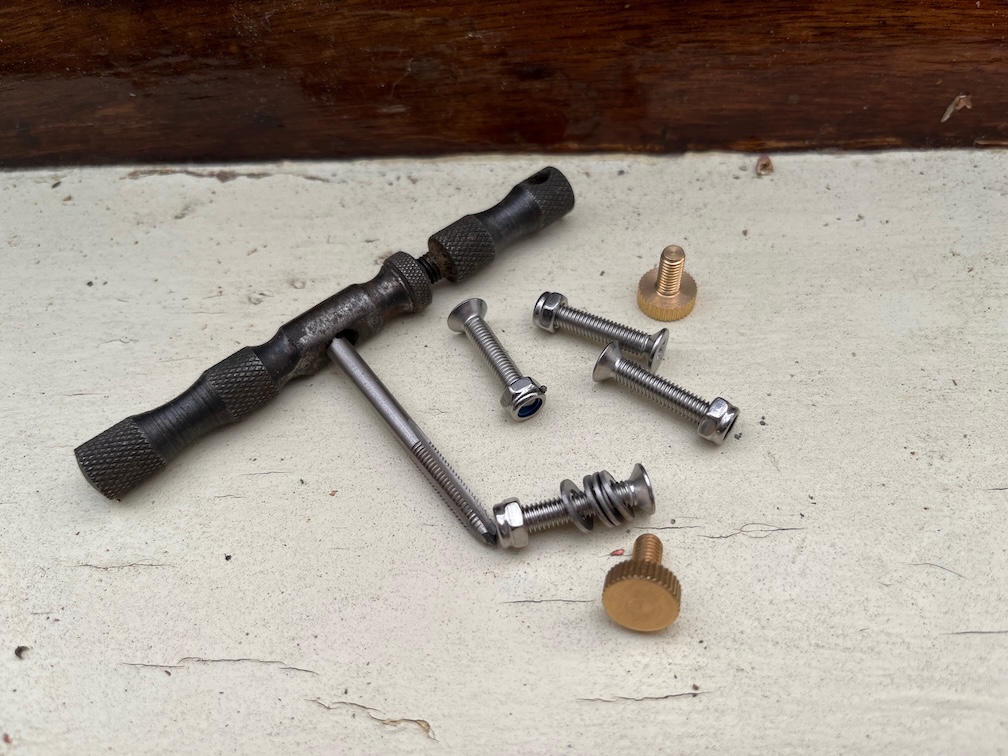
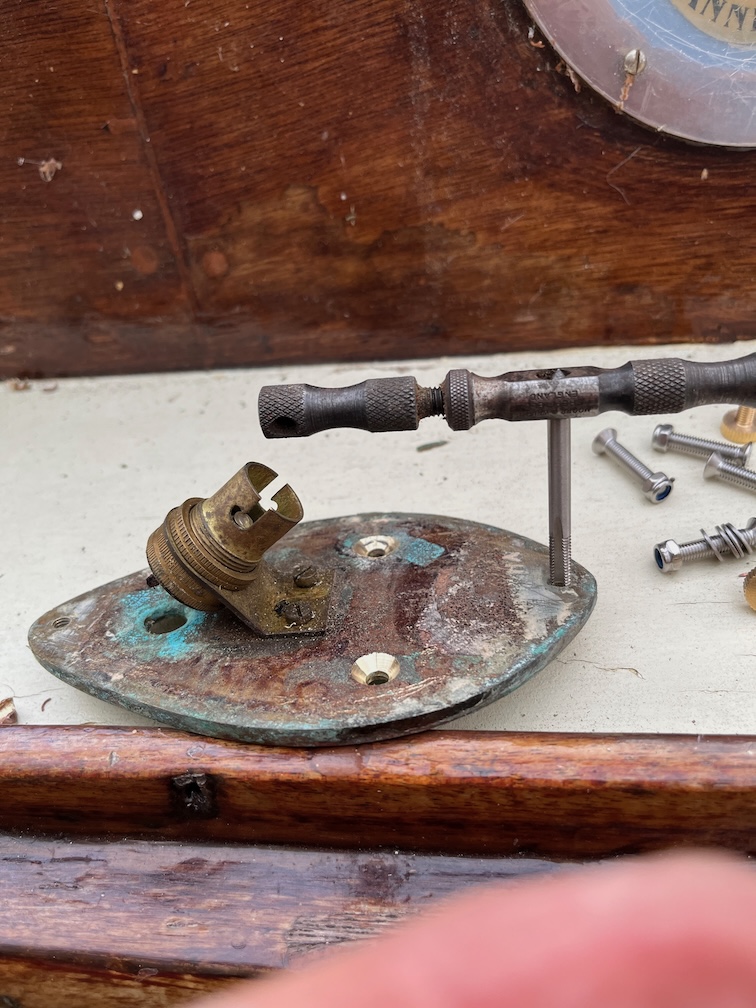
The new brass thumb screws are metric, M5 to be exact, whereas the older ones, probably over 50 years old, are imperial. No idea what they are but they are smaller than M5 and the new thumb screws are too large to fit in the original holes. This means that I need to tap the existing holes to take an M5 thread. I gathered the parts together and set to.
The imperial hole was wide enough to use the M5 tap directly and did not need to be drilled out. The new thread didn’t take long to make, the initial thread or two always being the hardest to get right.
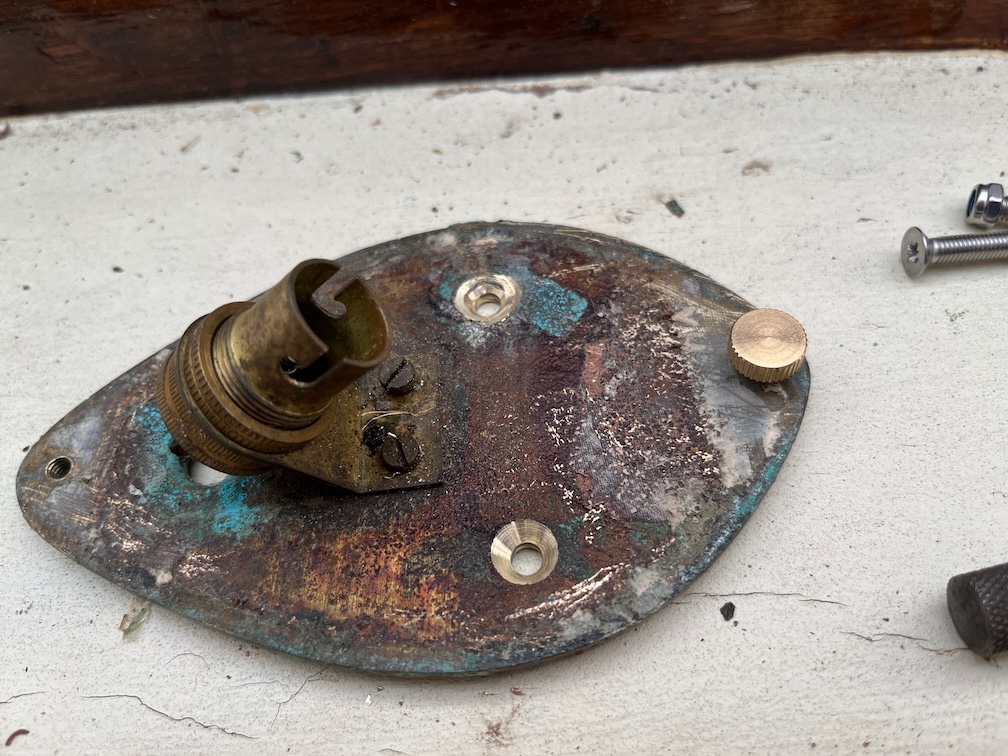
The new thumb screw was inserted to make sure that it fit, and, as you can see, it did.
Next the new countersunk machine screws were used to attach the base plate back to the cabin side. I used normal nuts to do this as the work is not completed as yet. I’ll need to take the plate off and on again a few times before the final fitting and at that time I shall use self-locking nuts. Still, for now, this is looking good.
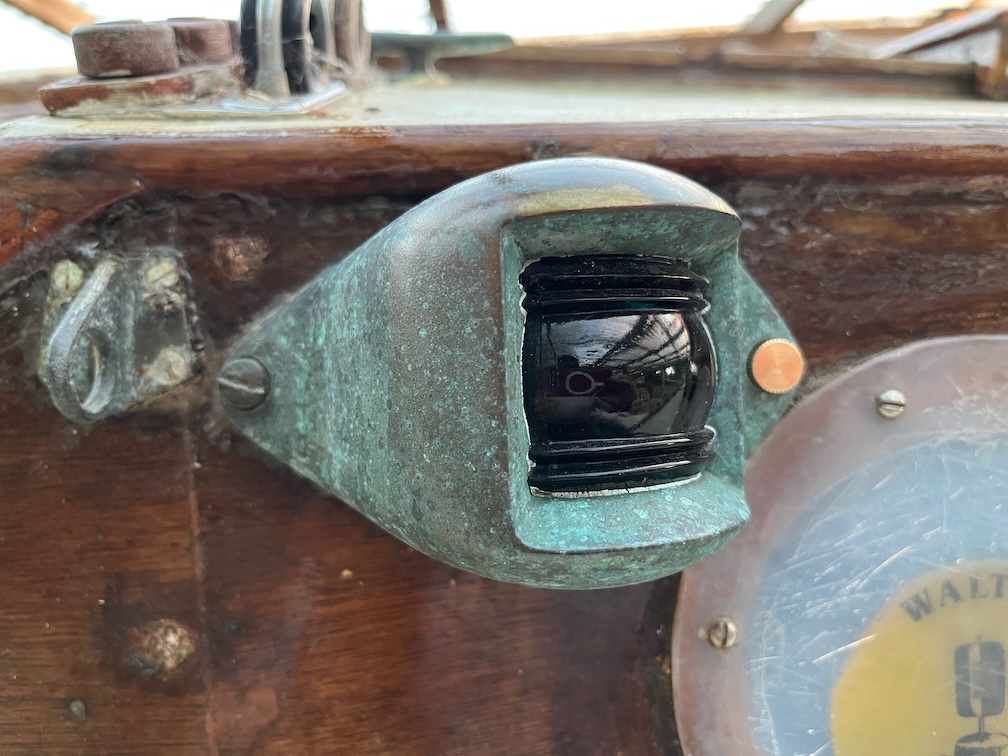
Finally, the outer housing was screwed in place. Looks pretty good. With this successfully completed I carried out the same process on the other side.
The brass thumb screws will need to have a slot made in the head to allow it to be tightened with a screwdriver as the head is a very tight fit into the recess in the housing, but this was expected. I’ll use two of the spares to make the slots, either using the CNC router or a hacksaw.
All in all, a very productive day and although the tasks I have done today are quite small ones, I feel as though I am making progress.
Having had a cup of tea and a sit down, I decided to tackle the locker hinges and the old gas bottle box.
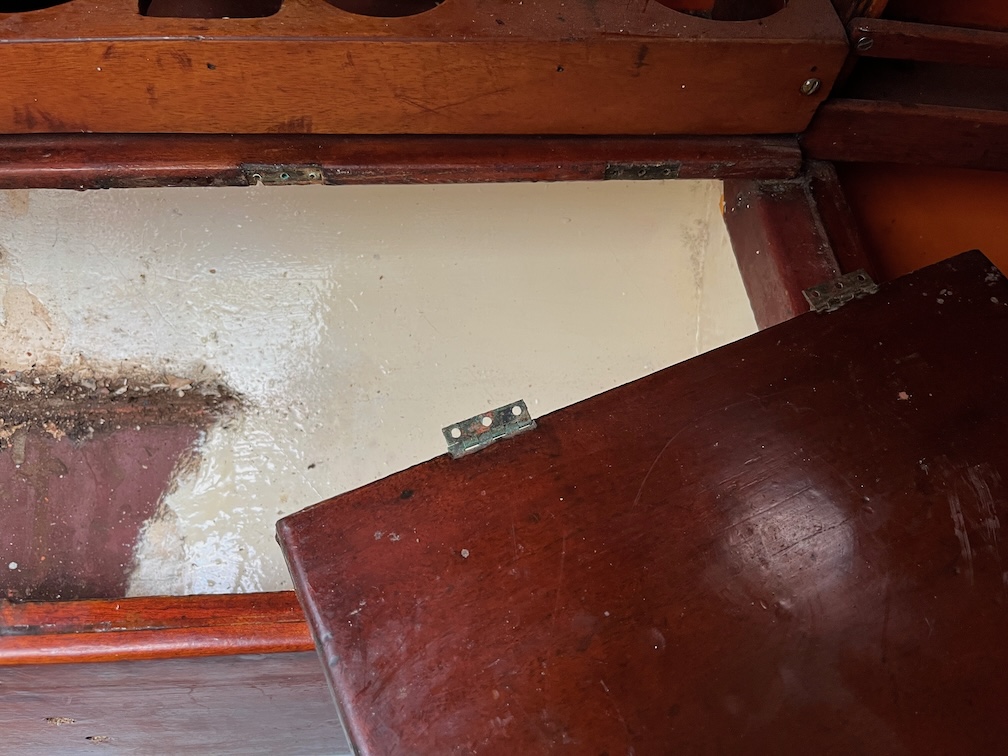
As it turned out, three of the six screws to be removed came out easily, the screws being in quite good condition despite being brass. The other three, those on the aft-most hinge, snapped as they were unscrewed, but the locker lid came off easily even so.
Emboldened by that success I turned my attention to the six screws holding the box to the side panel.
These came out fairly easily but only after being persuaded. In this case that meant putting a screwdriver into the slot and then hitting the end of the screwdriver with a hammer. Not too hard, but hard enough to break any seal between the screw itself and the wood. That’s the theory, at least. In this case it worked.
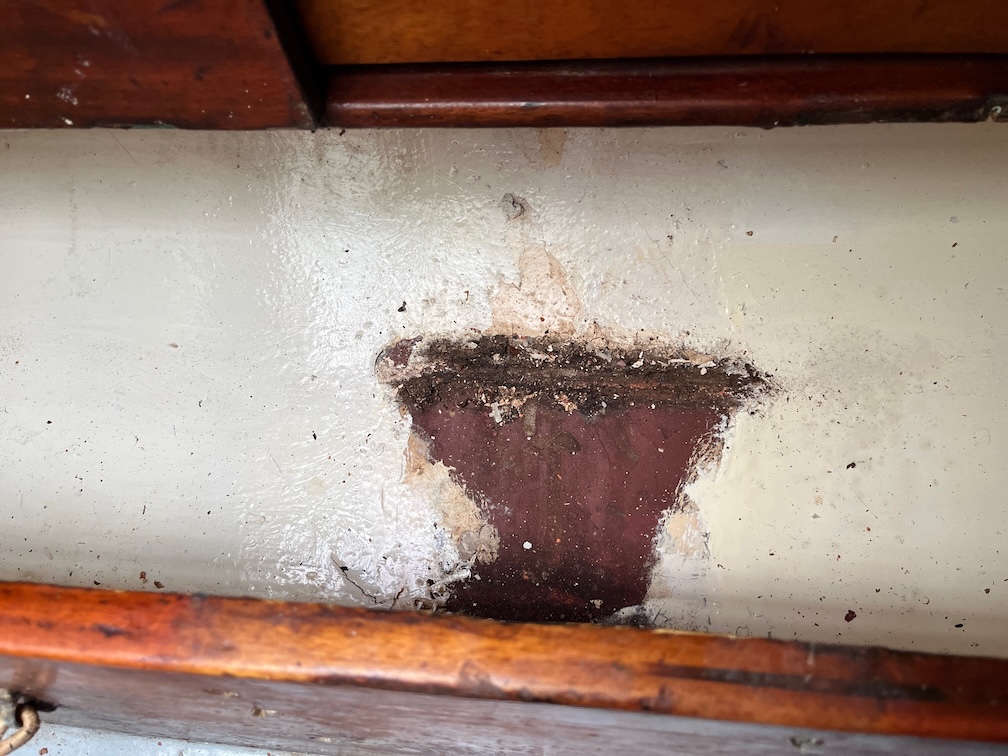
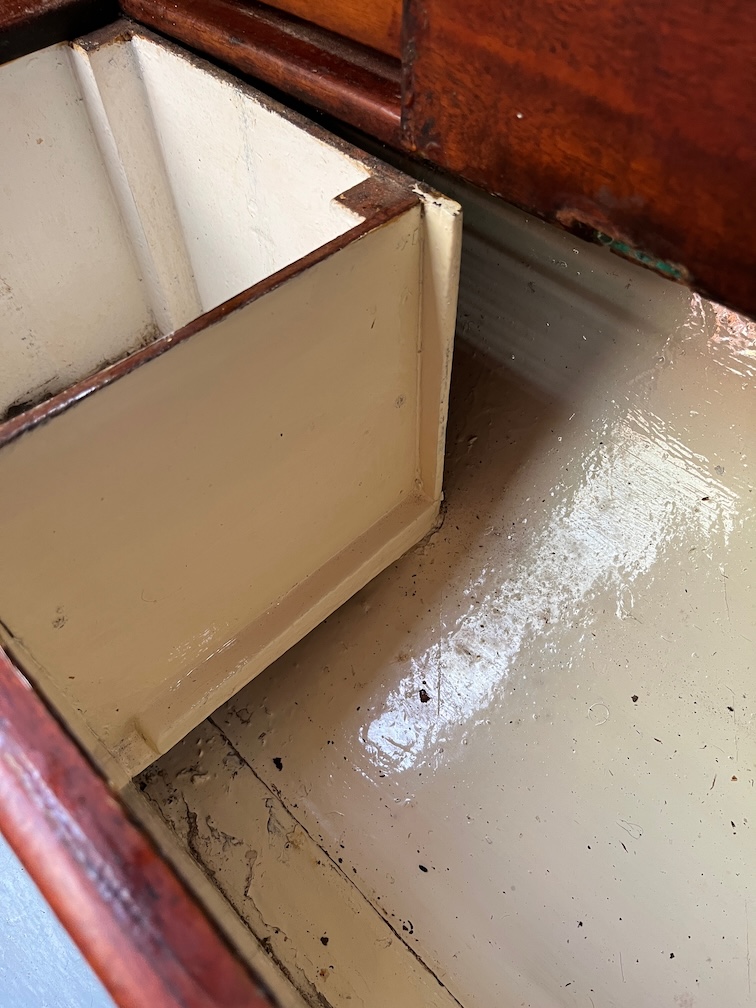
After the box was removed, you can see that the white paint on the hull was done after the box had been installed. It was fairly clean in the lockers, which was nice to see.
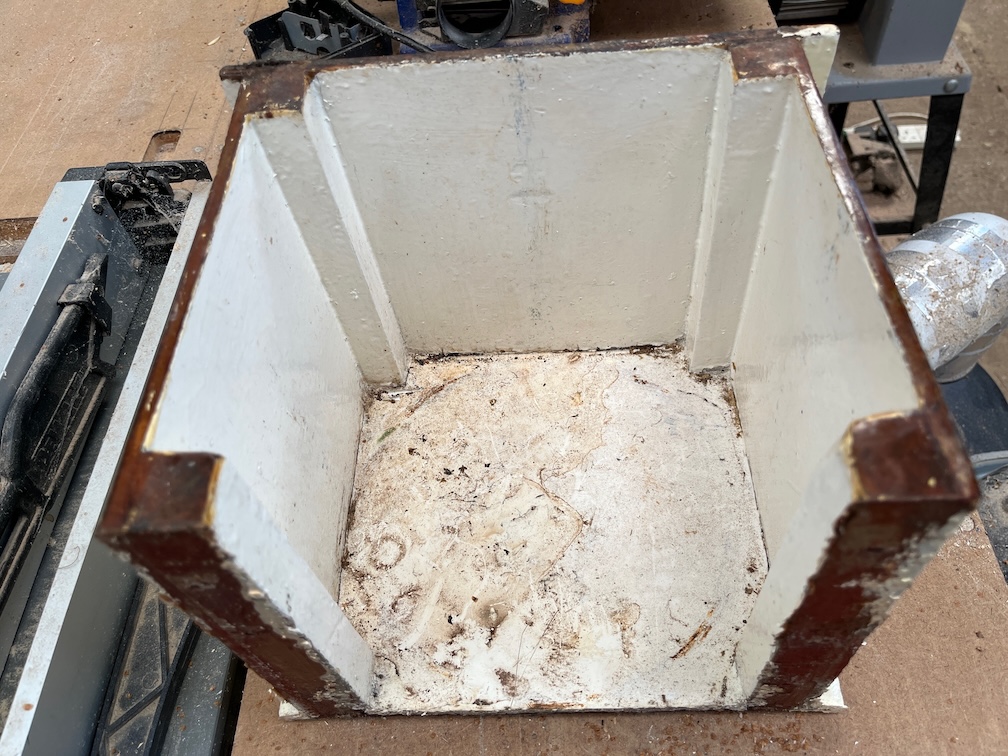
The box itself was taken into the workshop with the intent of reusing the wood, but all the brass screws have distigrated so I’ll have to put some thought into getting those out without damaging the wood too much.
The stove in Shoal Waters was, for many years, a single burner screwed into a Camping Gaz cylinder. The burner could be replaced by a radiant heater to heat the cabin when cold.
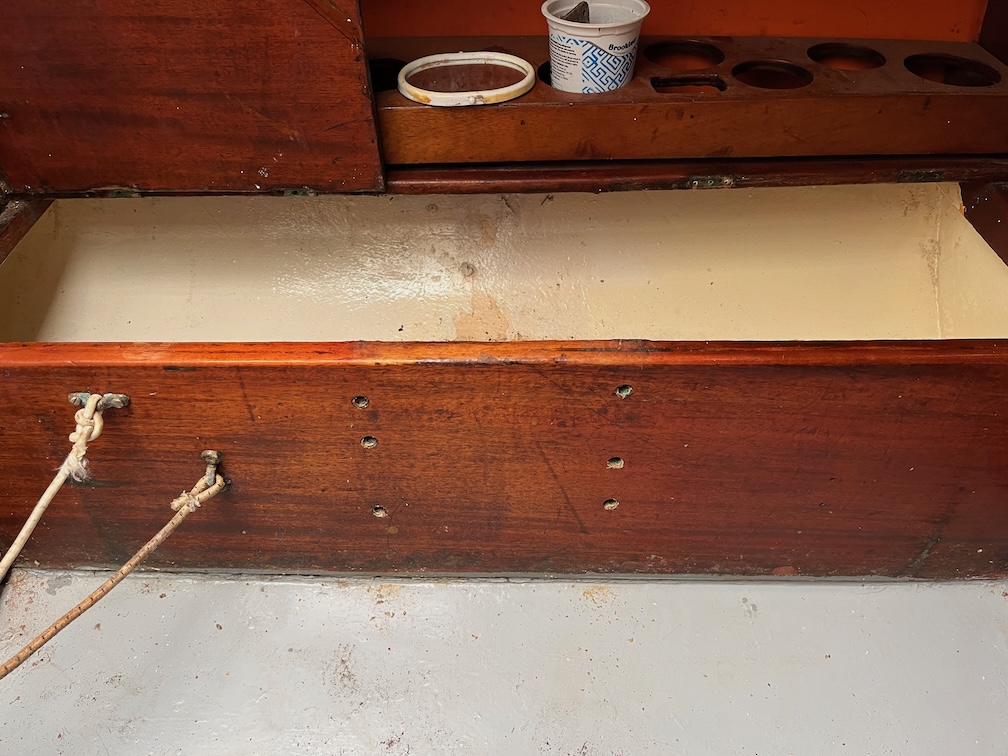
The stove can be seen in the above photo, the cylinder housed in a well between two lockers on the port side of the cabin as is traditional.
To use the radiant heater the stove part was unscrewed, the cylinder moved to sit on the cabin floor between the lockers and the centreboard case and held in place with a bungee. The heater was then screwed onto the cylinder.
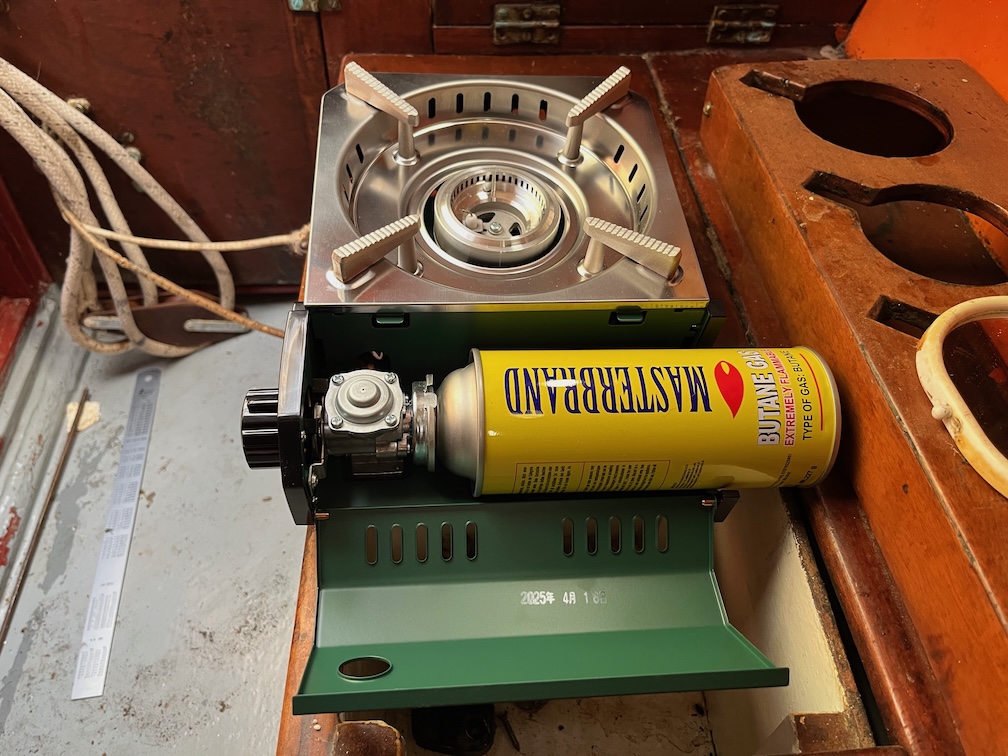
Now, none of these parts were on Shoal Waters when purchased and I’m not going to replace the stove with an exact replacement. Instead I’m going to use a burner that takes the modern 200g canisters since this will allow me to store the spares outside of the cabin. However, the space available for such a burner is quite small and the size I use for camping is too large.
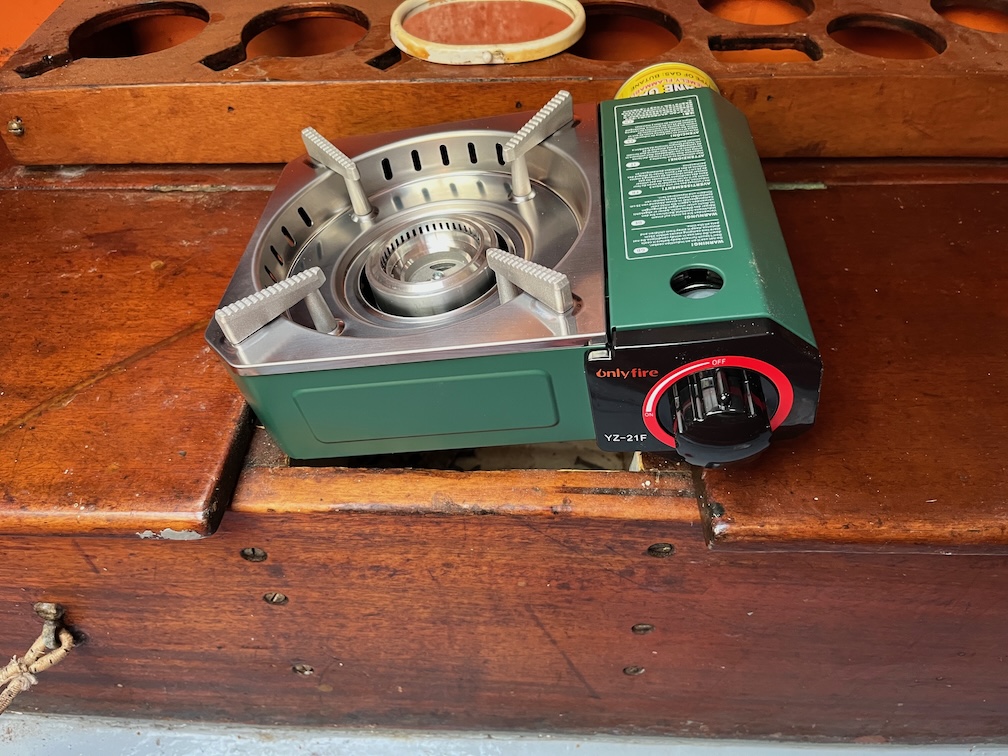
Not to worry, a quick internet search found a much smaller unit.
The difference between this and the larger, more common variant, is that there is no lever mechanism to pull the canister into place. Instead it is held in place by a magnet.
Now, my intention is to make a box to hold the stove that is just a little bit deeper than the stove plus canister, so that the canister cannot move away from the magnet which might happen in a bumpy sea.
The stove is also a bit wider that the space that held the old gas cylinder and that will mean rearranging the lockers slightly.
The stove plus canister is also a bit deeper that the locker, as you can see here.
However, the gas cylinder locker is a simple box screwed to the side wall, so making it wider and deeper will not be too much of a chore. The hardest part will be removing the lid of the locker forward of the burner to cut a section off to make space for the wider burner box.
I started looking at the navigation lights as I need something small to be getting on with since I have hurt my right foot. When I get tired I make mistakes and last week the mistake involved the foot and a solid metal support meeting at a high enough relative velocity to break open the wound remaining from the surgery a few months ago. So, no kneeling down on the inside of the boat trying to work on the centreboard case. I’ll have to wait until I can comfortably flex the foot before continuing with that.
One of the things I’ve done as part of the refurbishment is to buy LED replacement bulbs for the lights to cut down on battery drain.
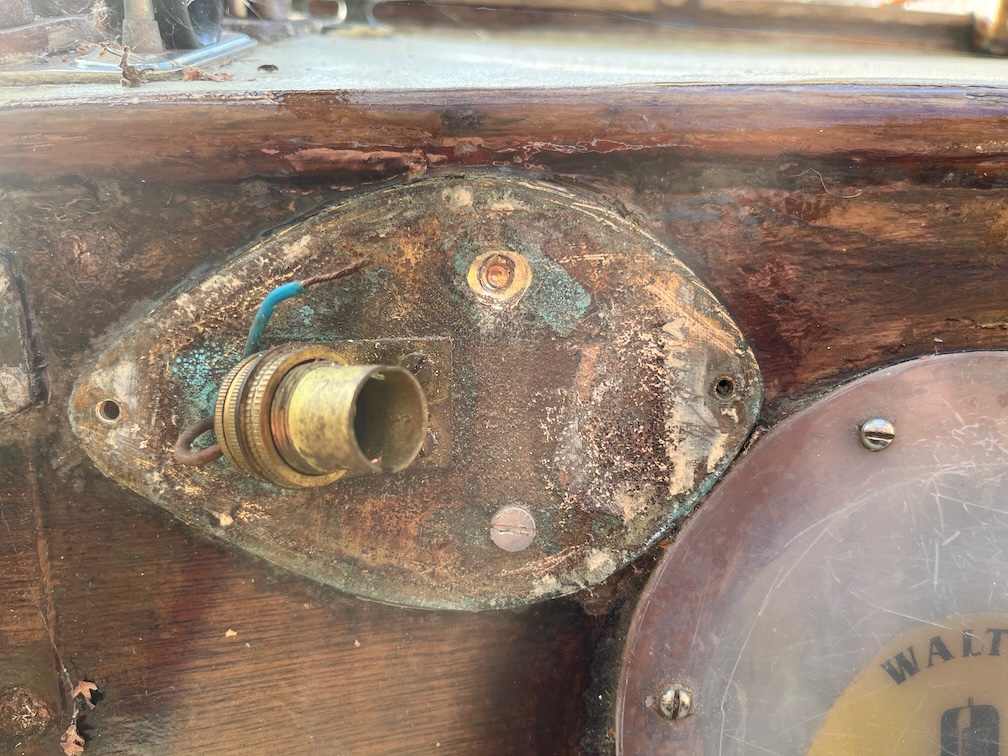
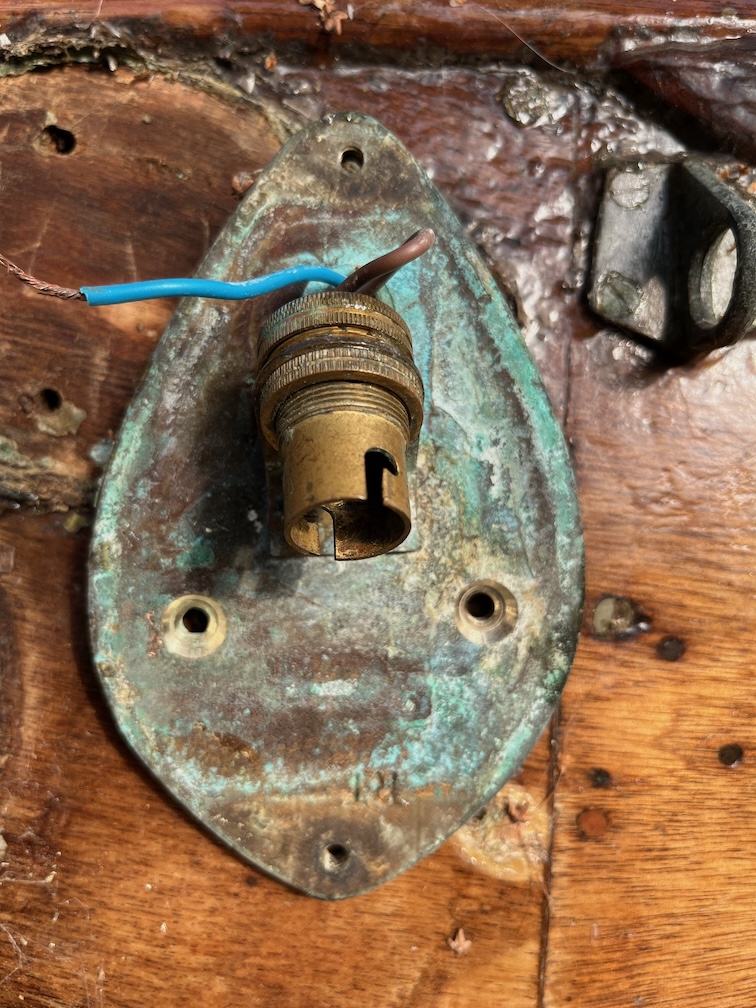
This is the original bulb, fairly standard.
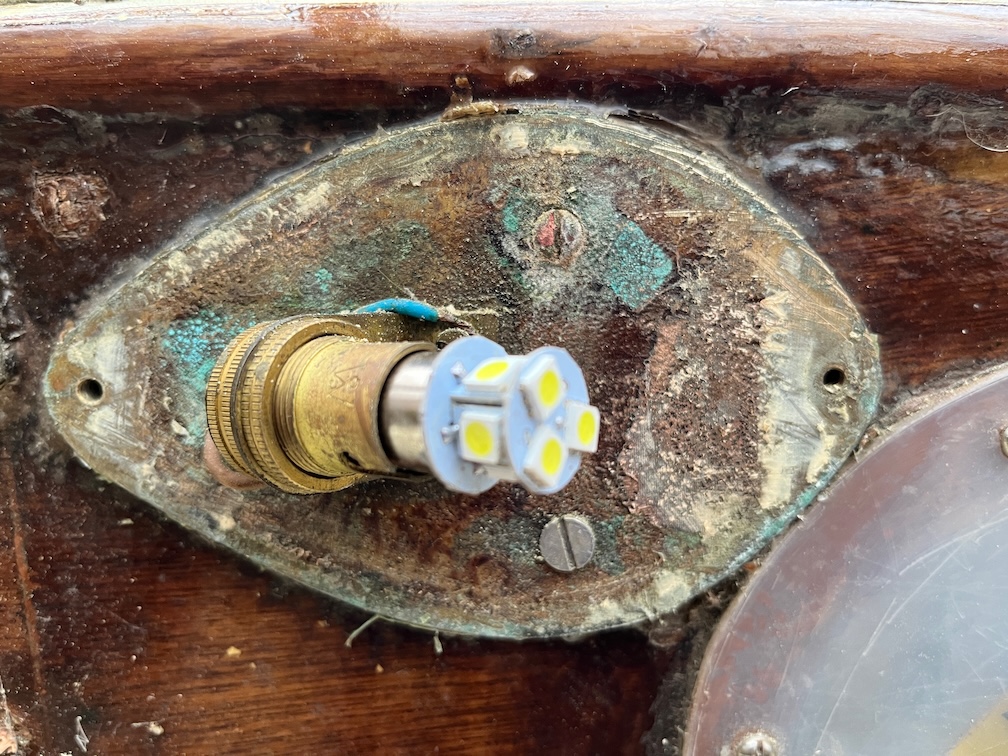
And this is the new LED bulb. It occured to me that the back of the light, as you can clearly see from the photo, is not at all reflective and thus the nav lights will be dimmer than they could be. I asked on the Dinghy Cruising Club Forum, of which I am a member, for suggestions and these boiled down to two main options. Crumpled aluminium foil and a plastic mirror cut to shape, both of which are possibilities for the tools I have.
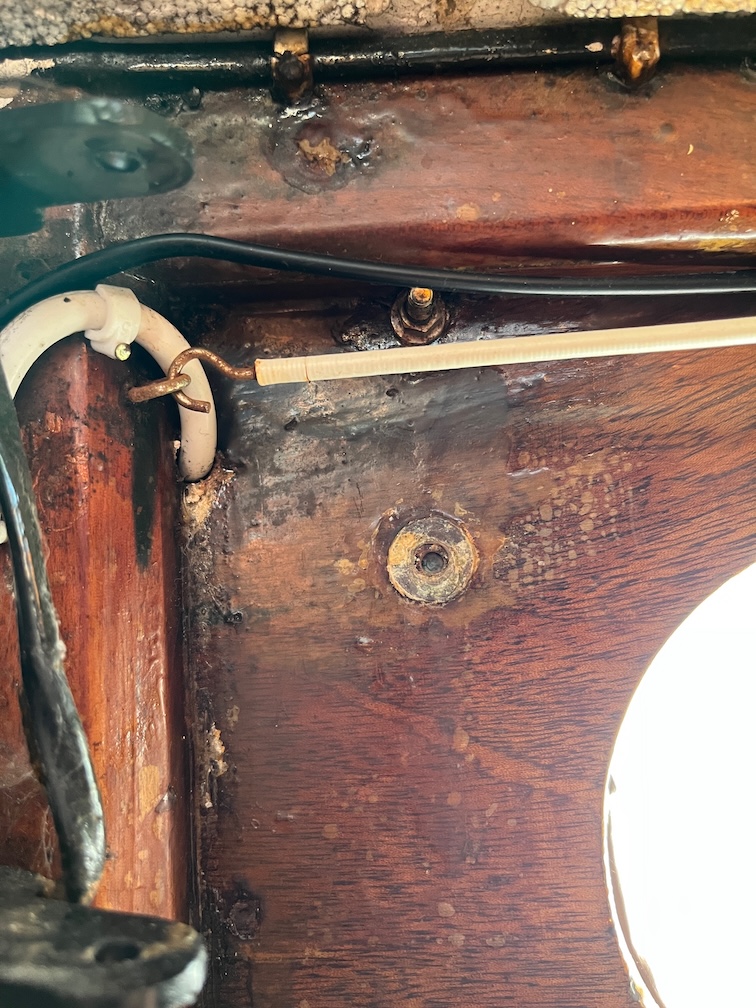
However, before I test out these options, I really need to do something about the fixings. The two bolts holding the base plate to the cabin side need to be removed. One is brass, well it was and is now copper, and the other is stainless. This is the same on both sides. Not sure why but they need to be taken out. The ex-brass one to be replaced and the stainless one removed to allow the base plate to be countersunk such that the head of the machine screw does not protrude.
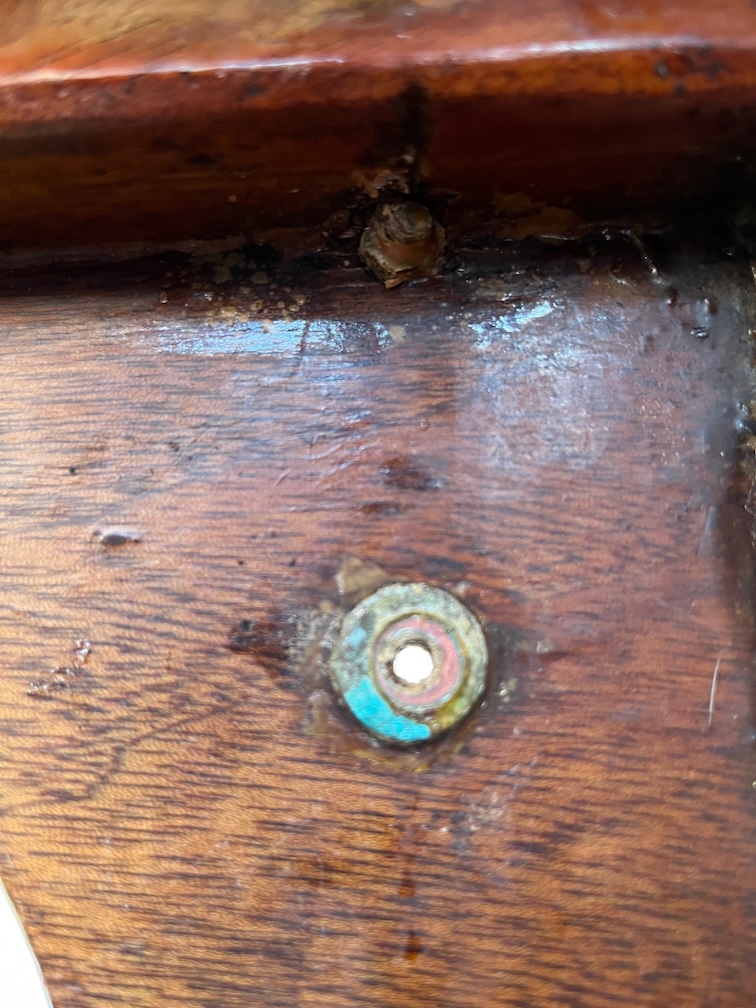
The head of the brass bolt was drilled with a shallow hole and then countersunk as can be seen here. A small diameter drill bit was used to drill a hole right along the length of the bolt and then opened up using successively larger diameter bits until the entire bolt was removed.
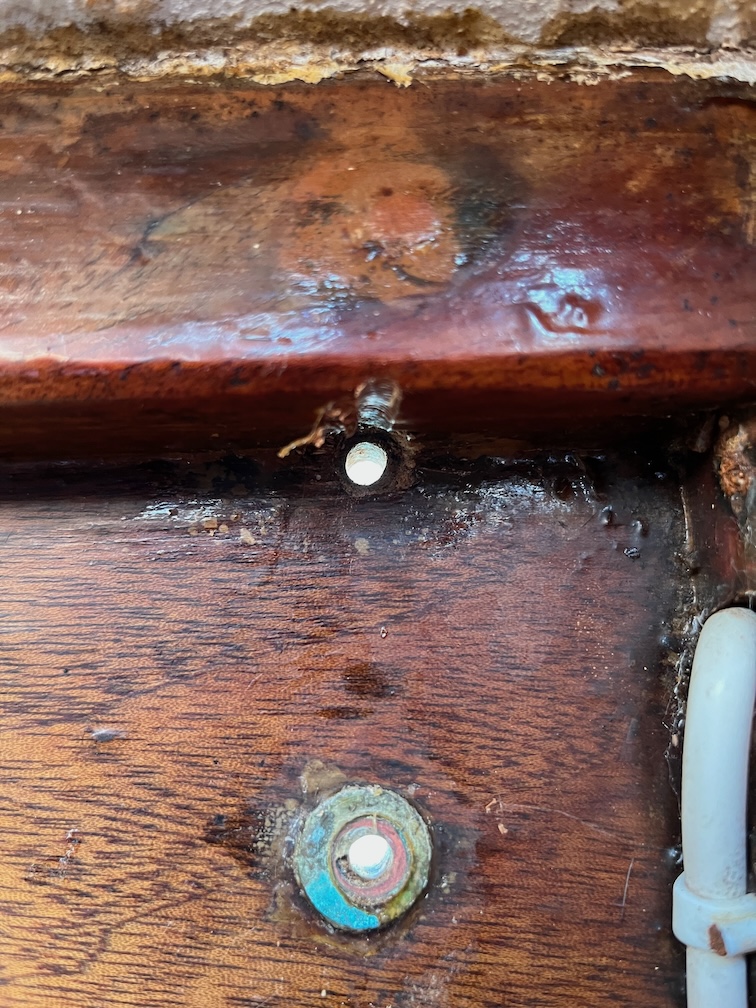
In this photo you can see that the lower, stainless steel bolt has been removed and the upper brass bolt remains.
It didn’t take long to remove the upper bolt, just a steady hand to prevent the drill bits from breaking.
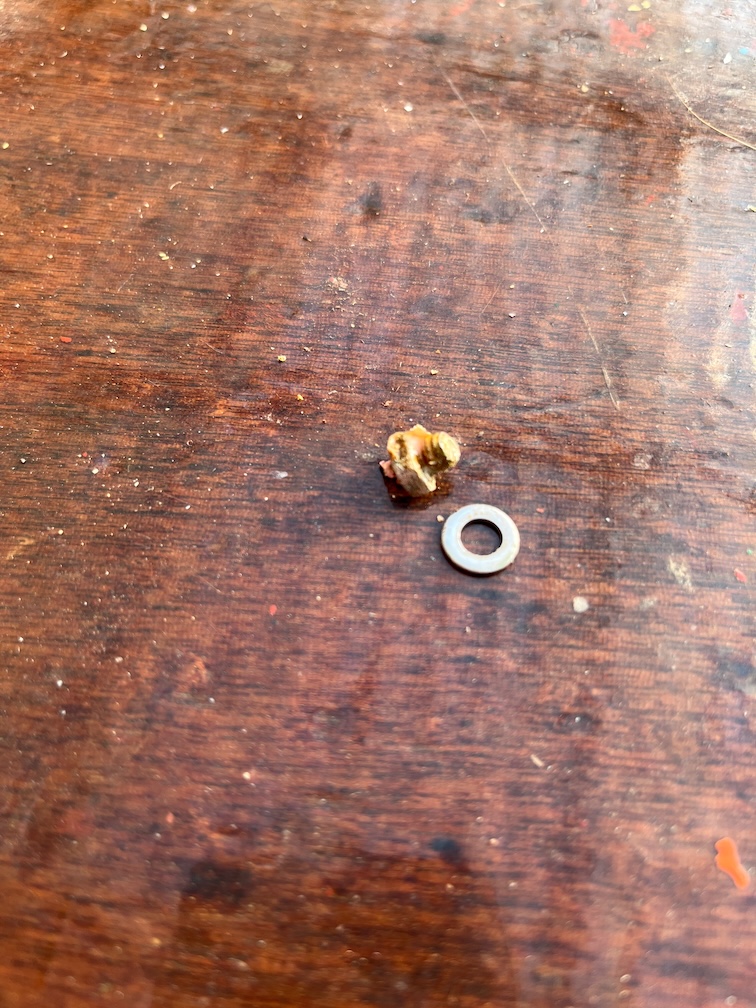
Here is the remains of the bolt, the nut and washer.
The nav light on the opposite side was done in the same fashion except on this side, the lower bolt was the brass one and the upper one stainless steel.
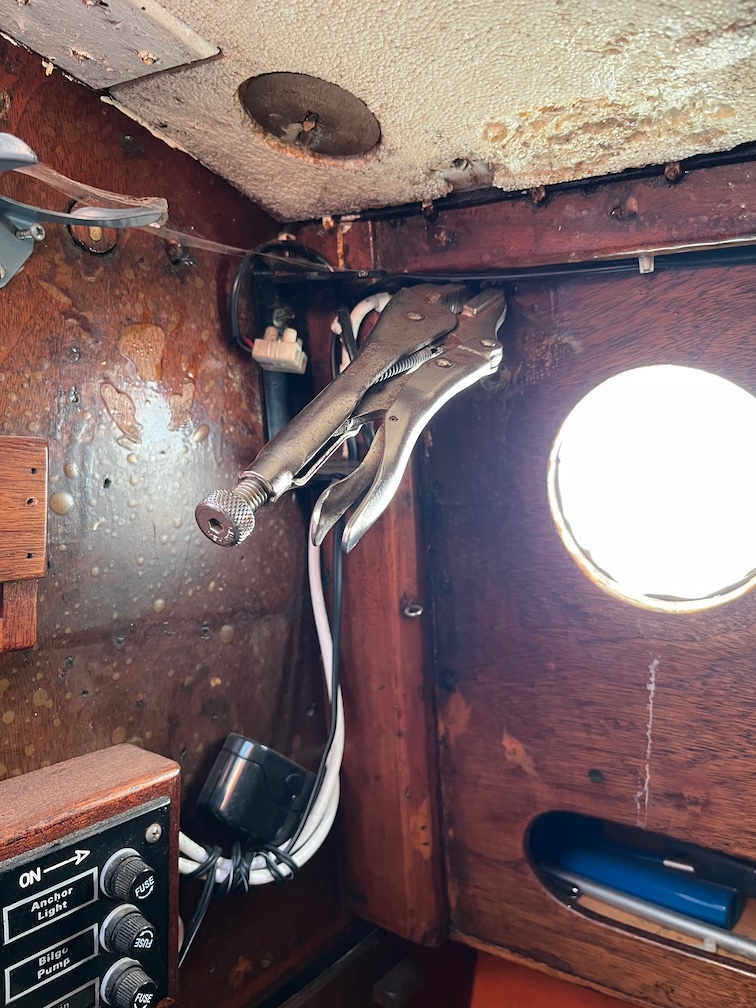
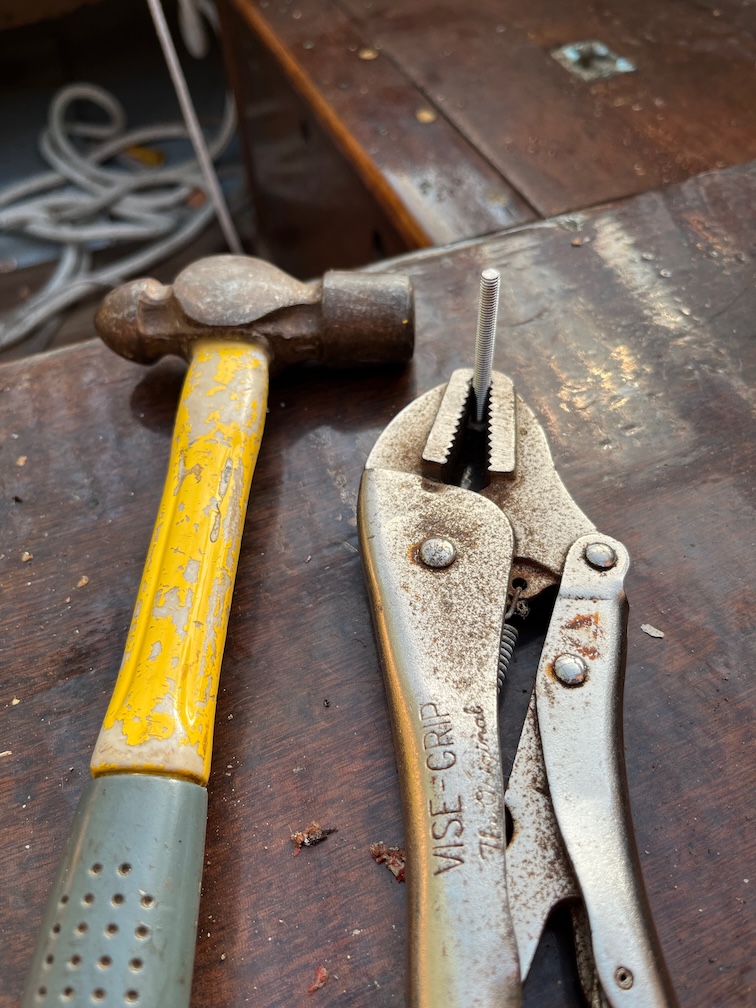
I used vice-grips on the inside to hold the nut whilst I unscrewed the bolt from outside for the stainless bolt, but the other one had to be knocked out. I did this on the first side as well but forgot to take photos.
The brass bolt and nut had degraded into copper and at some time in the past it has been knocked off, as can be seen in the photo, just leaving a short length of the bolt in the wood of the cabin side.
I used a bolt as a drift and gently hammered out the remaining bolt from the inside. The vice-grips are to stop me from hitting my hand which probably would have happened if I had held the bolt and tried to hit it.
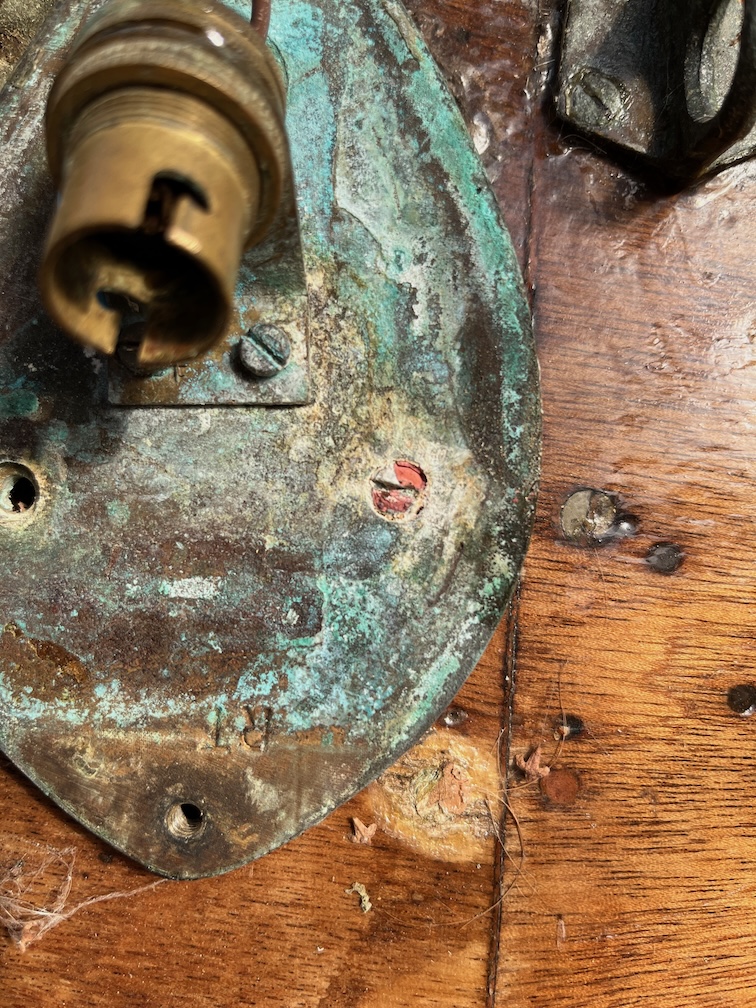
In the end, the bolt stayed in the base plate which itself came loose from the cabin side. Still, the copper bolt was easily remove with a gentle tap on the reverse with the hammer.
The two holes were then countersunk as you can see. I gently drilled the countersink, taking off a little at a time and offering up a machine screw of the correct size each time to check that I didn’t remove too much of the base plate. The other side was similarly countersunk, but you don’t need to see a photo of that as it’s more or less the same as this one.
So far, so good. I only had one machine screw of the correct size so the next thing to do was to order more. With that done I turned my attention to the outer casing fixings.
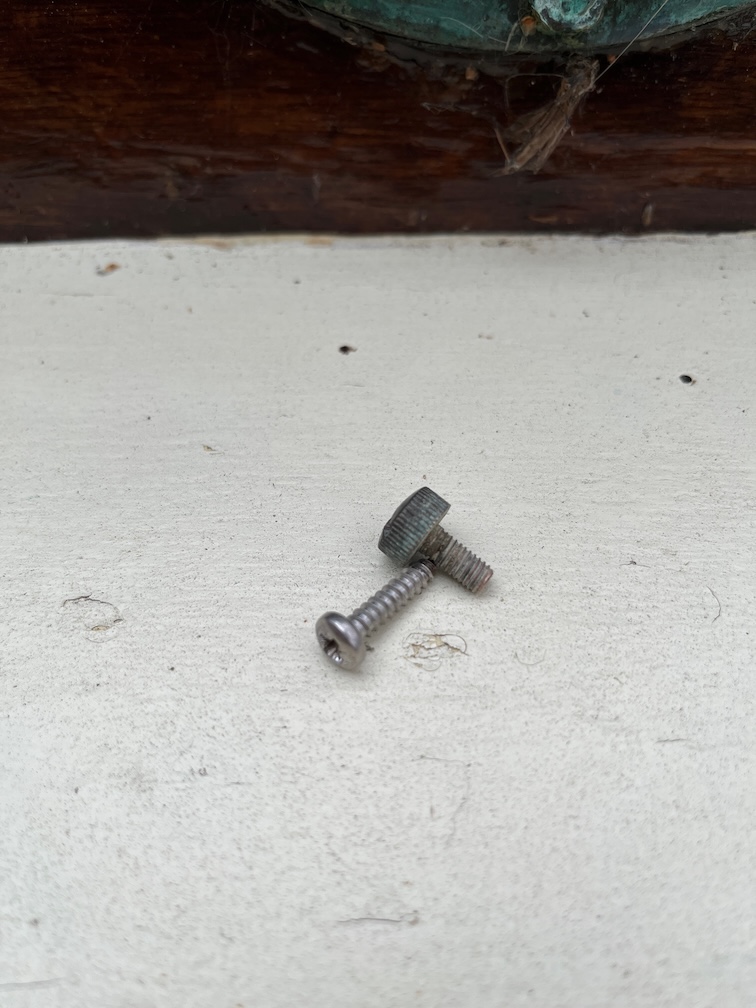
From the photo above you can see that one of the fixings is a knurled bolt, presumably original, whilst the other is a stainless steel wood screw that goes through both holes in the light and into the side of the cabin and this is the case for both nav lights. I presume that the lights had two of the knurled bolts each and that over time two had been lost and were replaced with the screws.
Time to fix that.
These are the fixings. The screw will be replaced but I could only find brass knurled bolts that will fit.
The problem is the recesses in the casing. The heads of the knurled bolts measures 11.2mm in diameter and although I can find stainless steel knurled bolts, only the brass ones have a head that will fit into the recess. Even then it might be tight as those have a head diameter of 12mm, so it’s going to be close. Also, I think that the nav lights are bronze, not brass and I’d really like to have bronze replacements. However, those would have to be custom made and that would be exceedingly expensive. This is also why I was looking at stainless ones.
Never mind, brass ones are on order and I’ll liberally coat them with some thing when I reassemble the lights to slow down the leaching of the zinc from the brass over time. The pack also contains 5 bolts so I’ll have replacements until I can find bronze or stainless replacements.