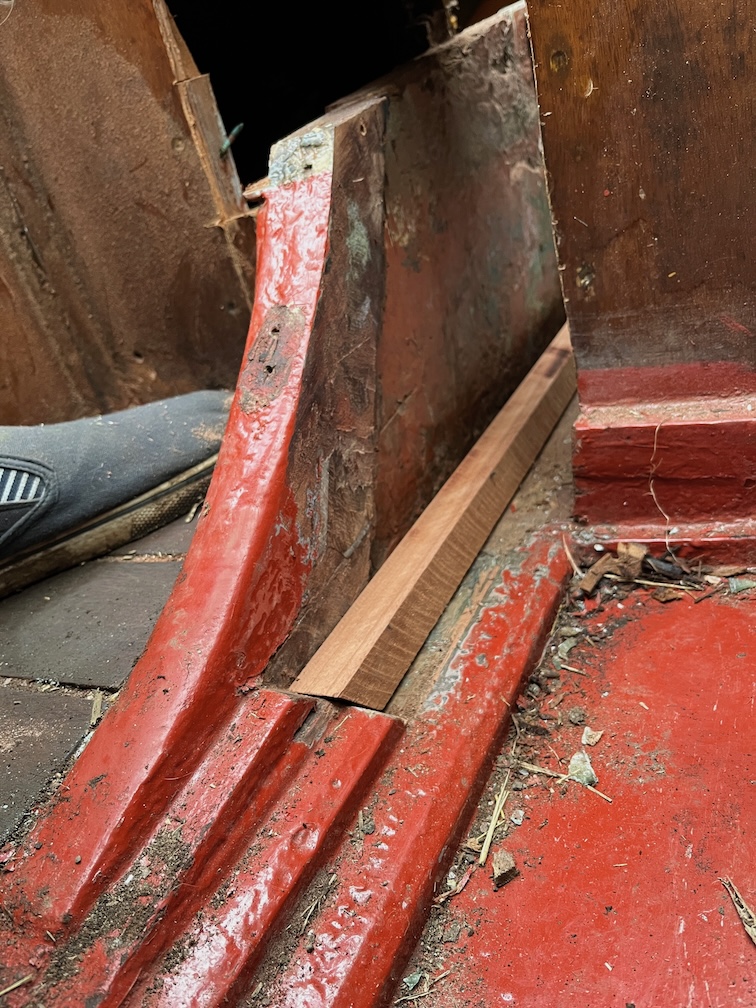
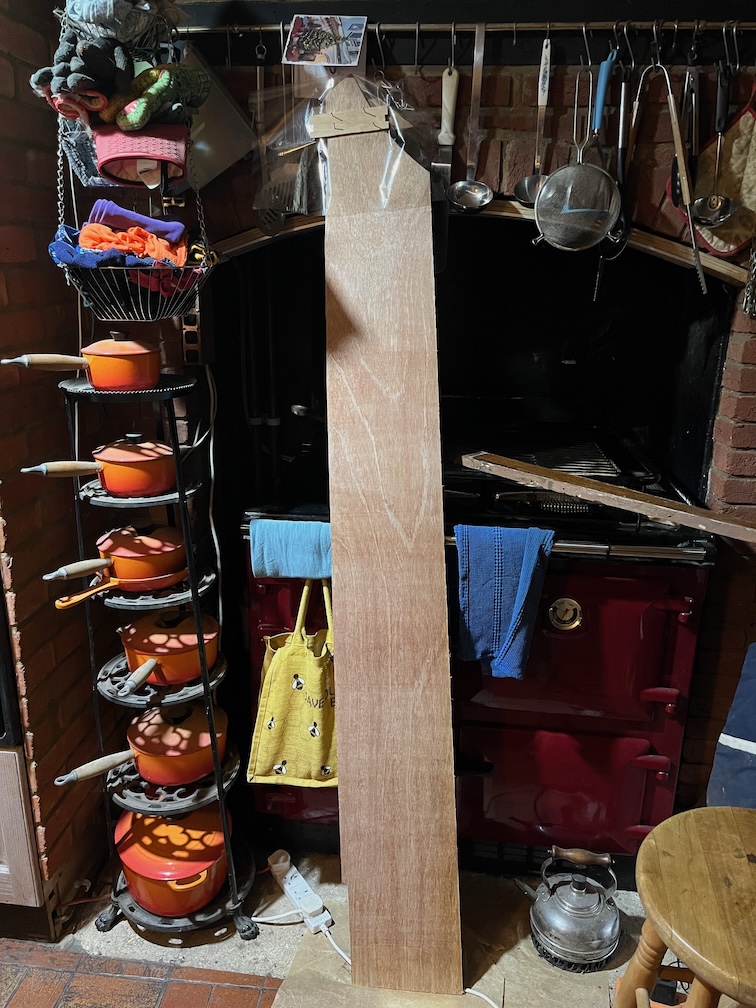
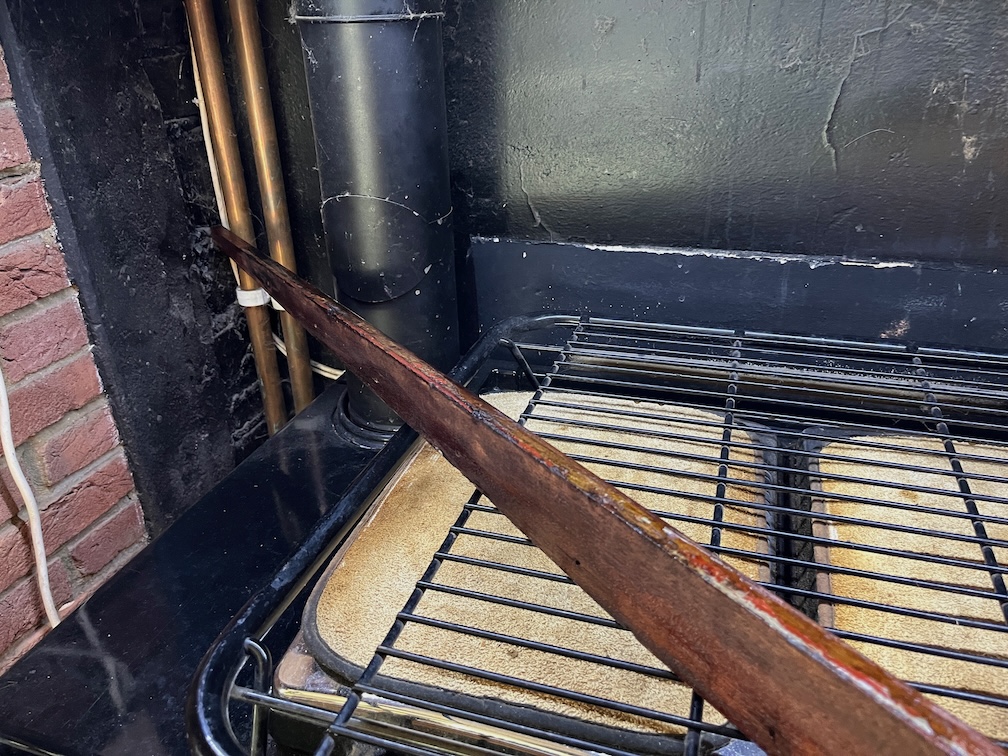
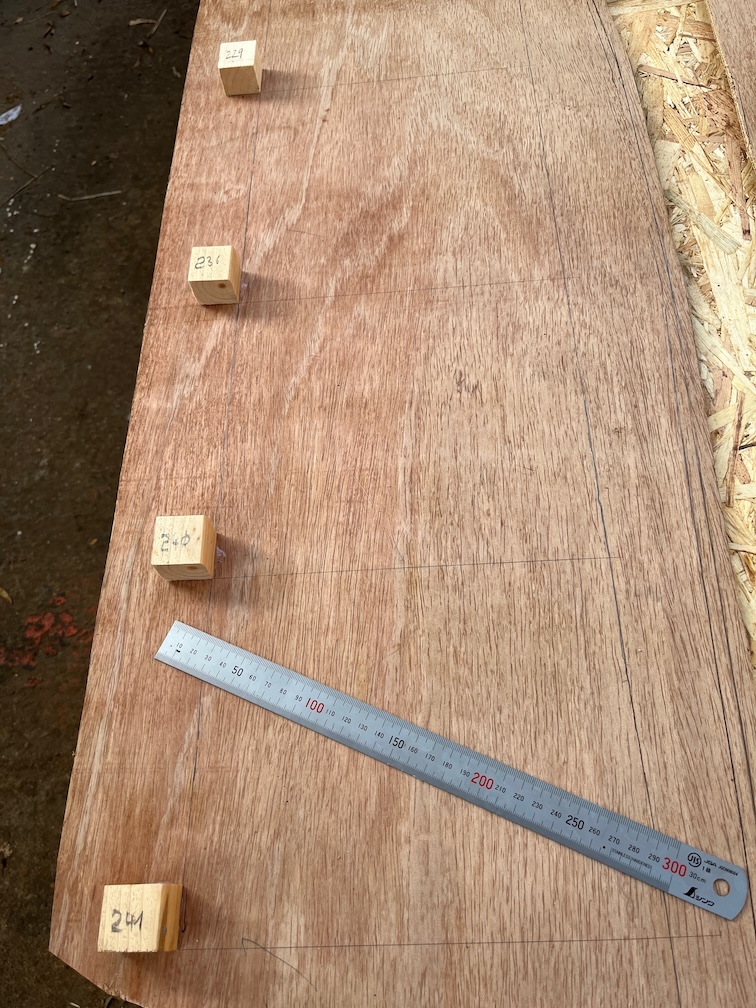
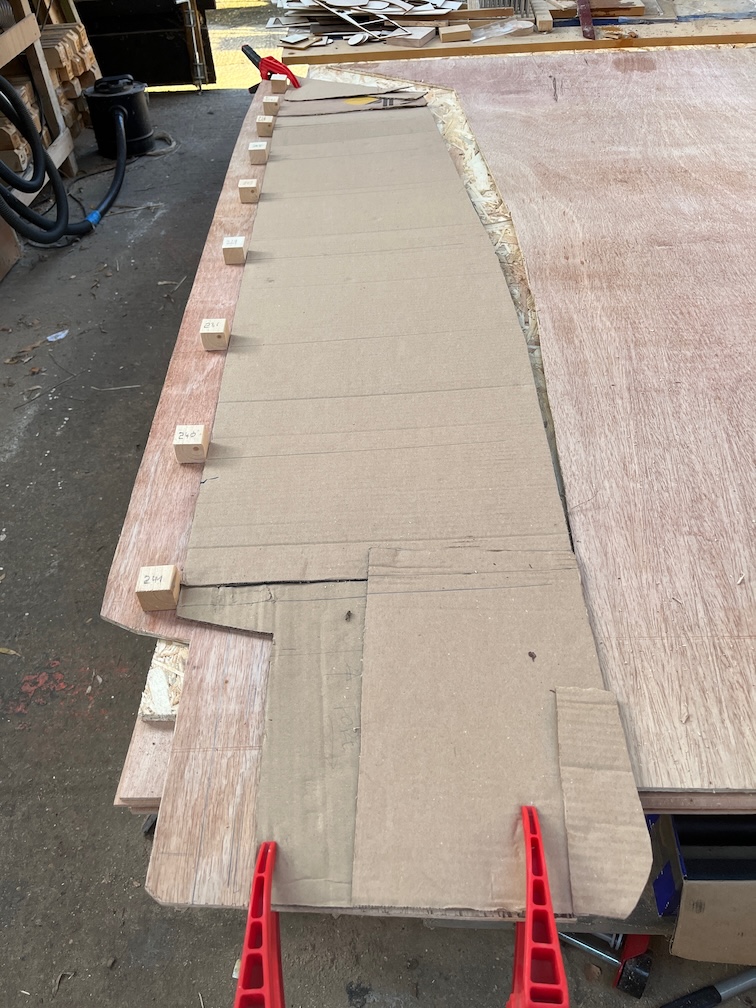
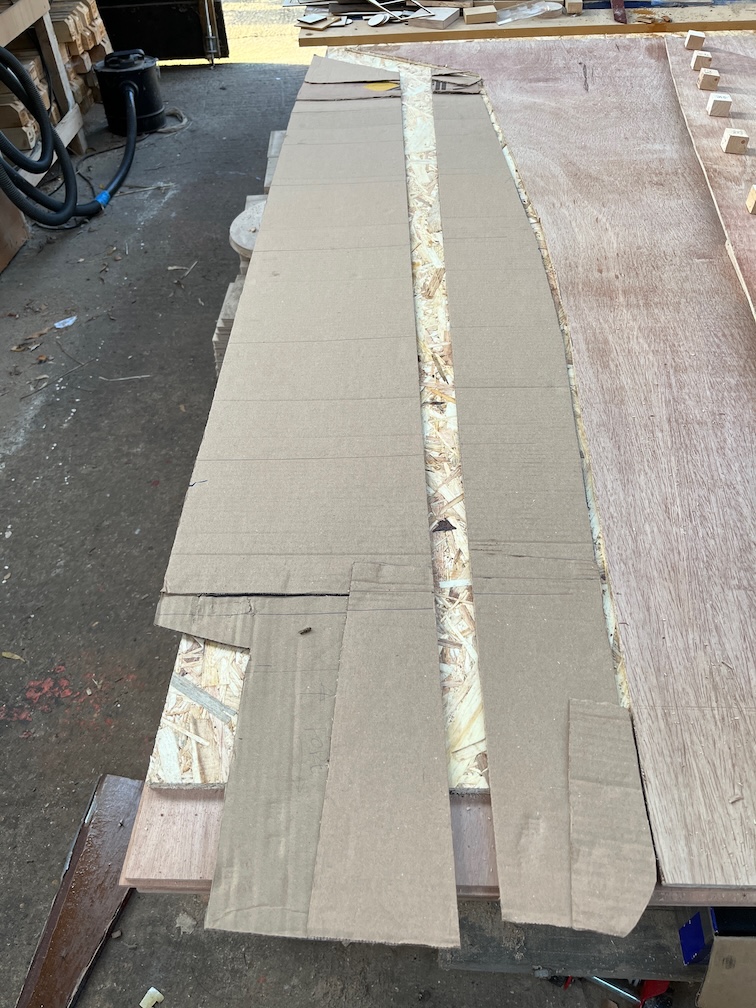
2025-12-29 – Case Side V

Work has continued on the centerplate case sides over the past days, I’ve just not posted anything about it, until today.

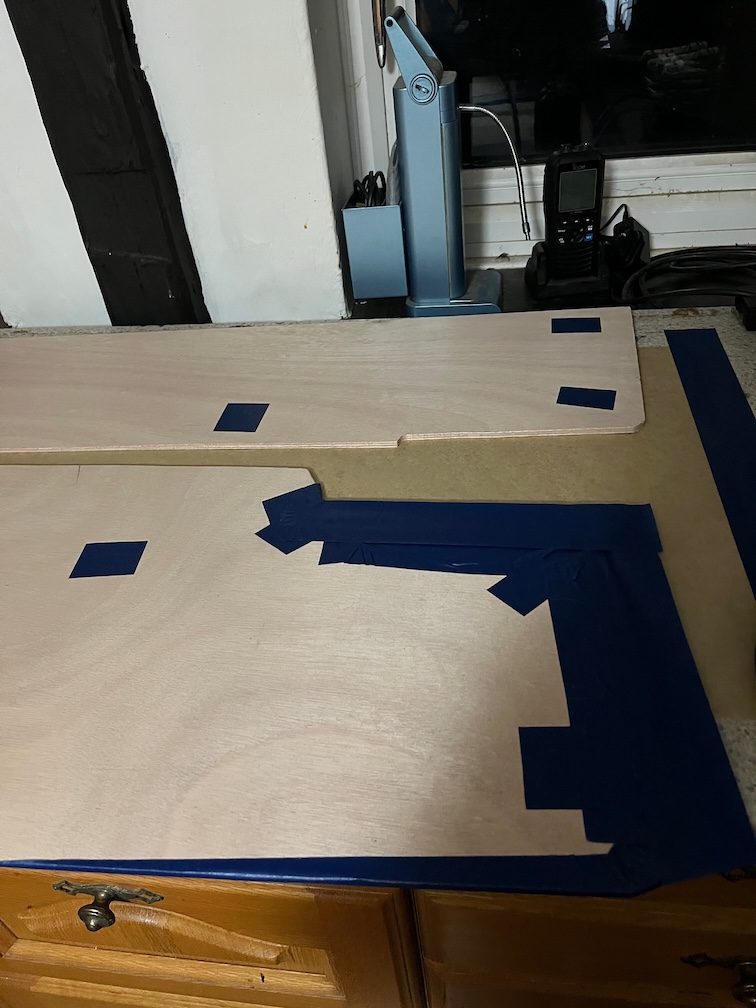
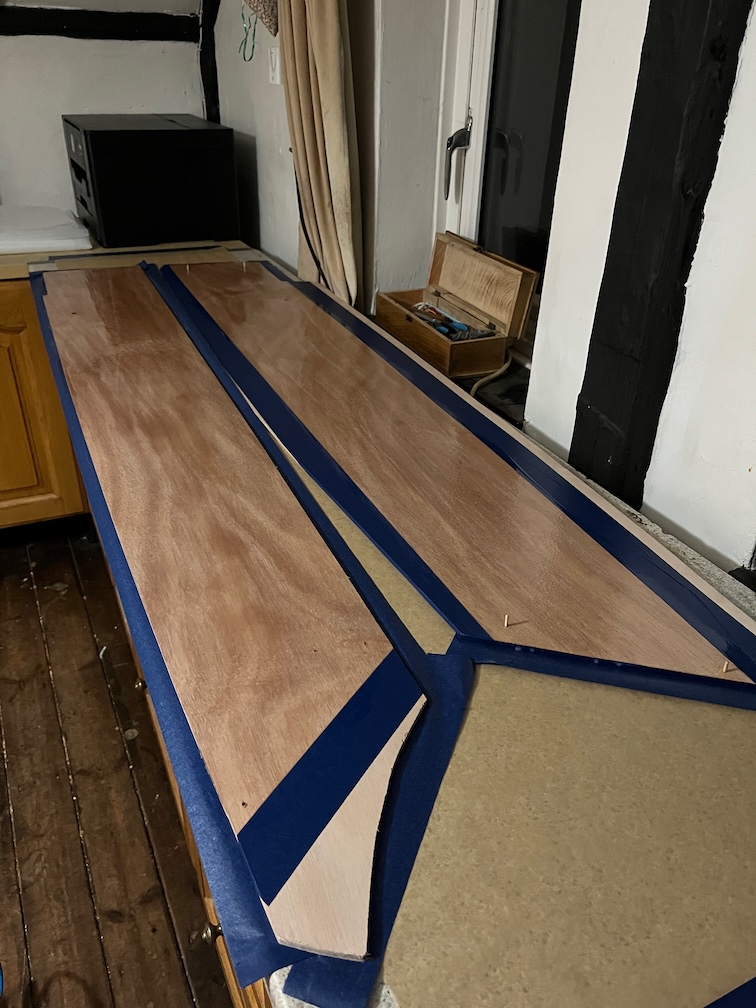
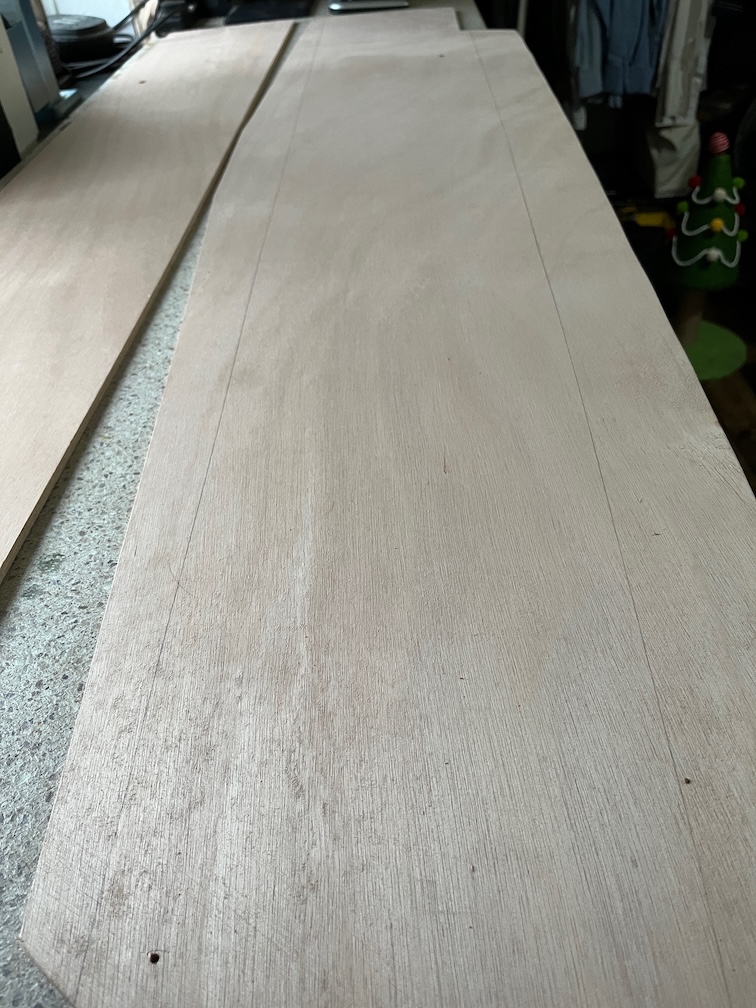
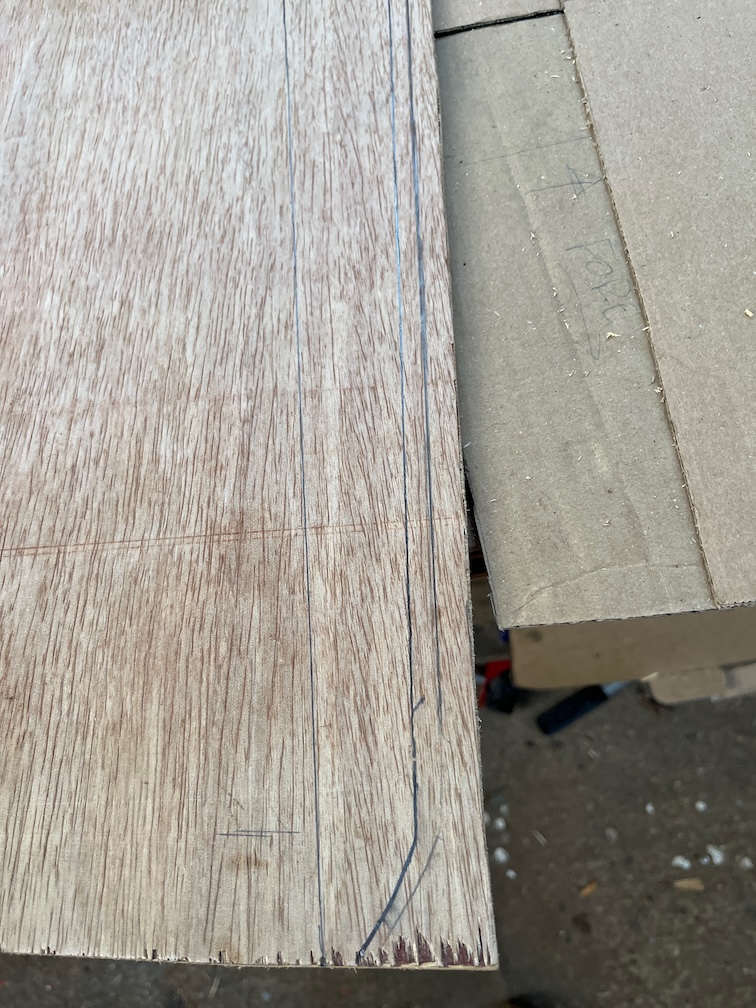
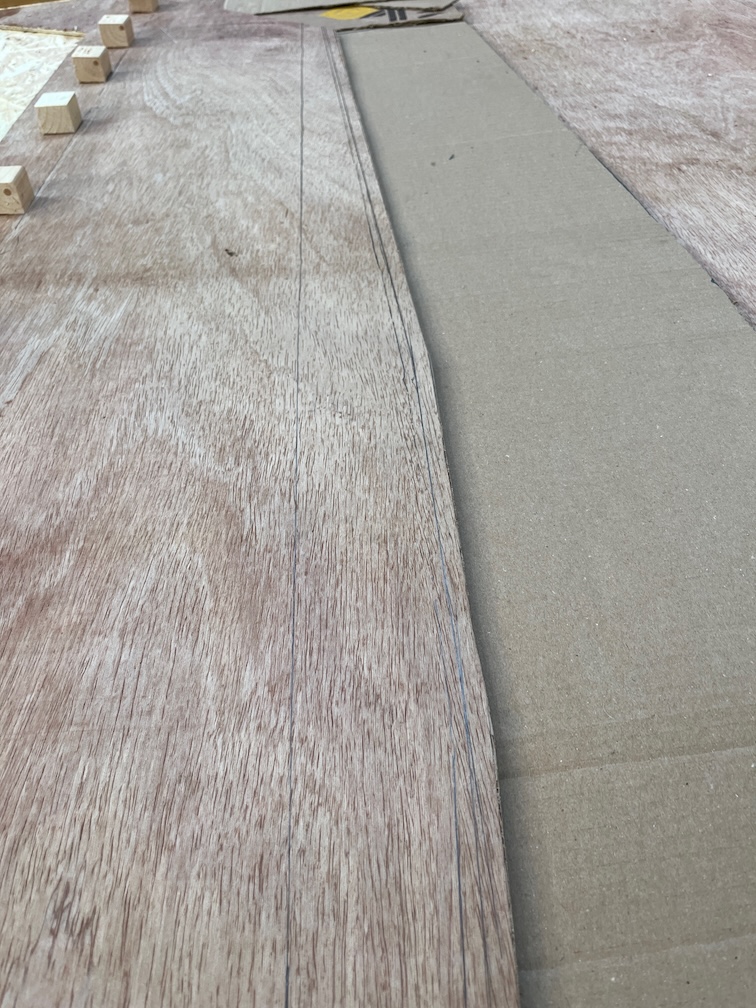
The port side now coated with neat epoxy and much less messy without so much tape.
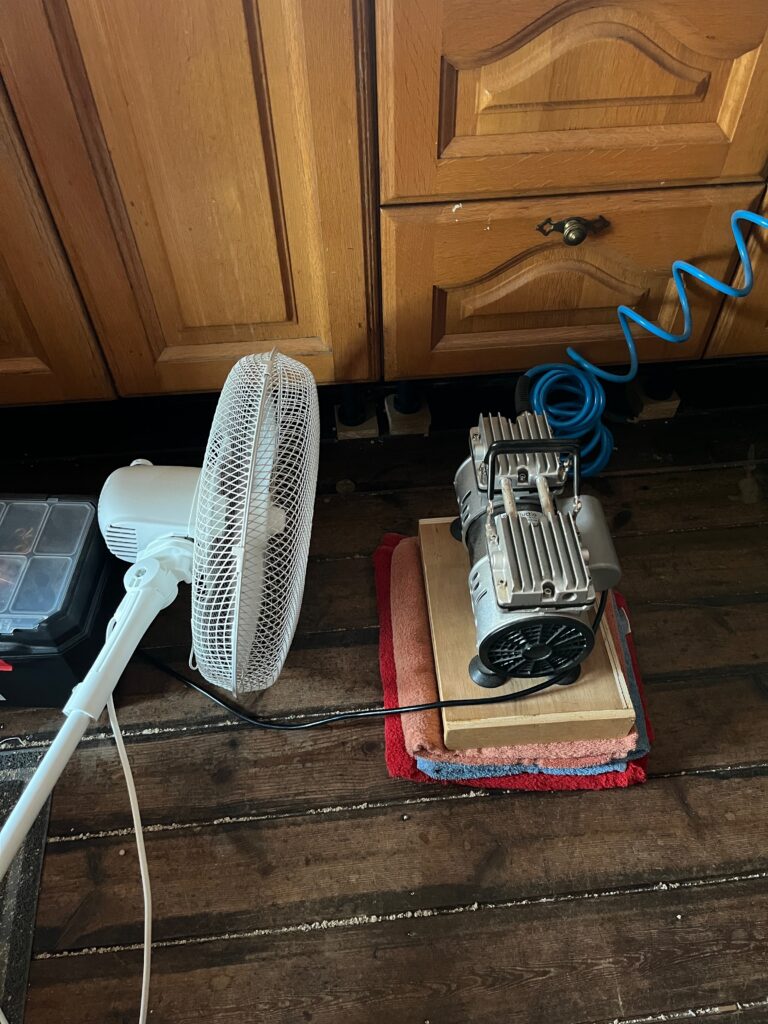
During the vacuuming part of the process, however, the pump started to overheat after an hour and I noticed that it had managed to pull a greater vacuum than before indicating that the seals were better but the pump was working harder as a result. So I resorted to some cooling. After a couple of hours, however, the pump was still too hot, so I ran it for 30 minutes then let it cool for 30 minutes with the fan still going.

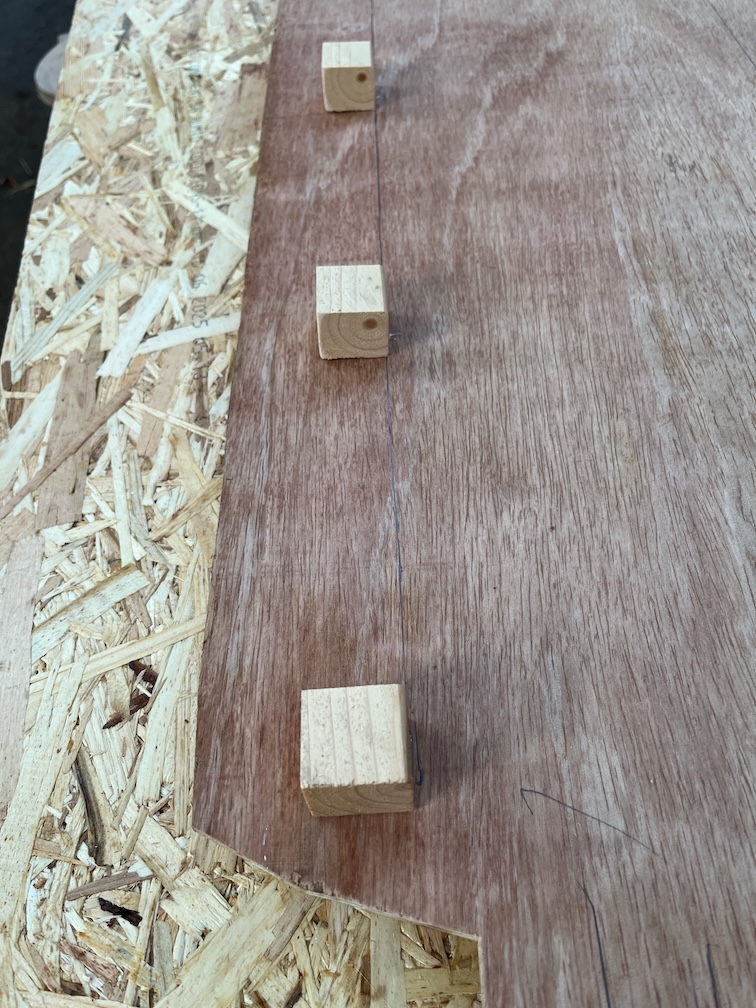
Just to prevent the top laminate from lifting during the cooling phase, I put some lead weights on the top. Each of those is 2kg so plenty of downward pressure. Not that I expected the laminate to lift, but there’s not reason not to put the weights on, just to be sure.
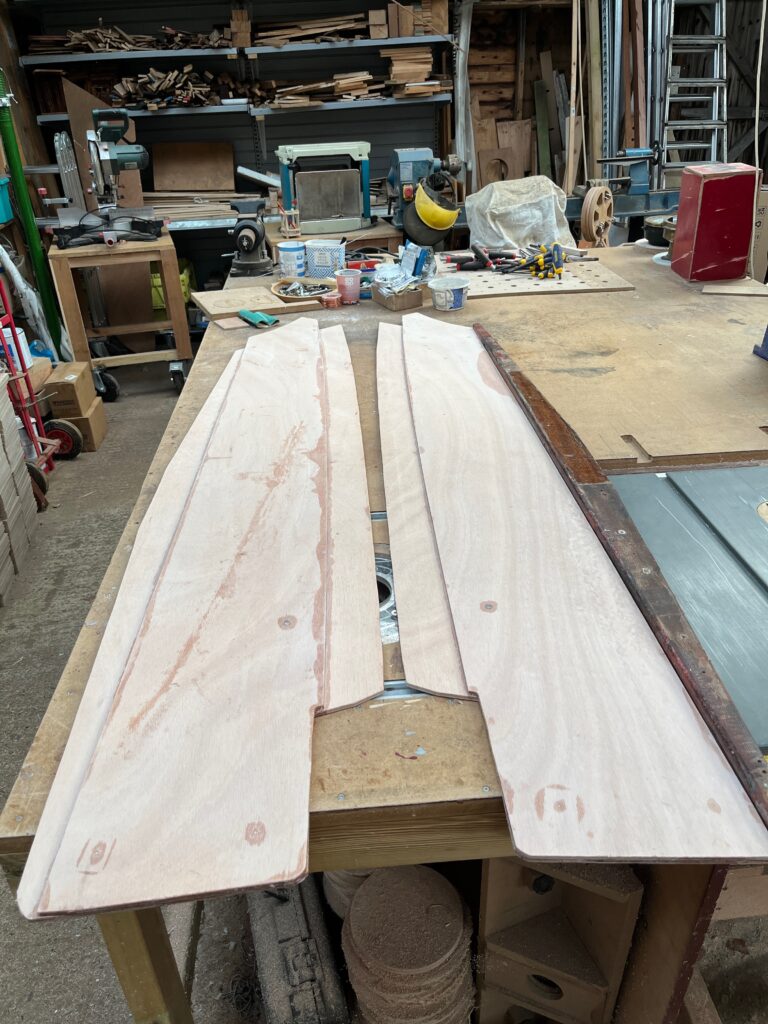
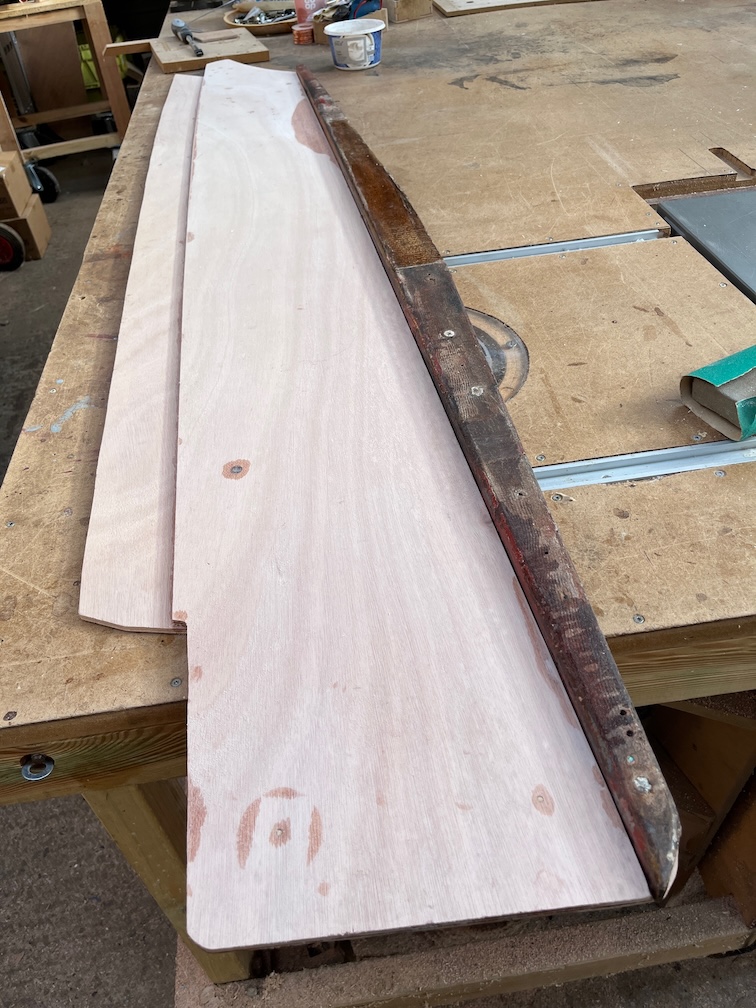
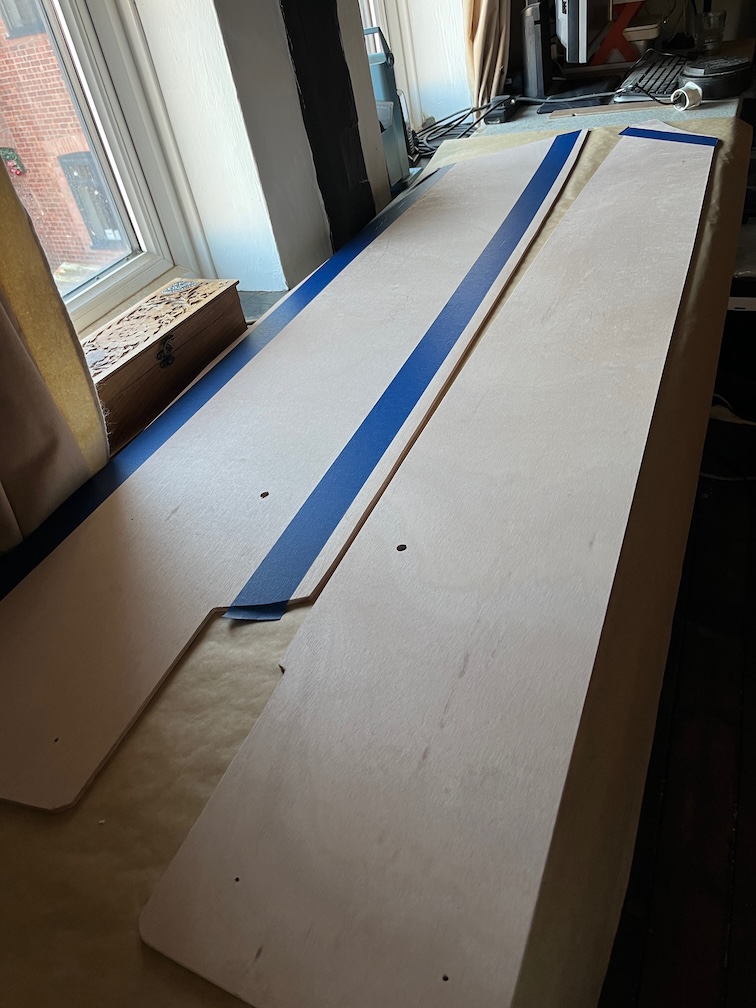
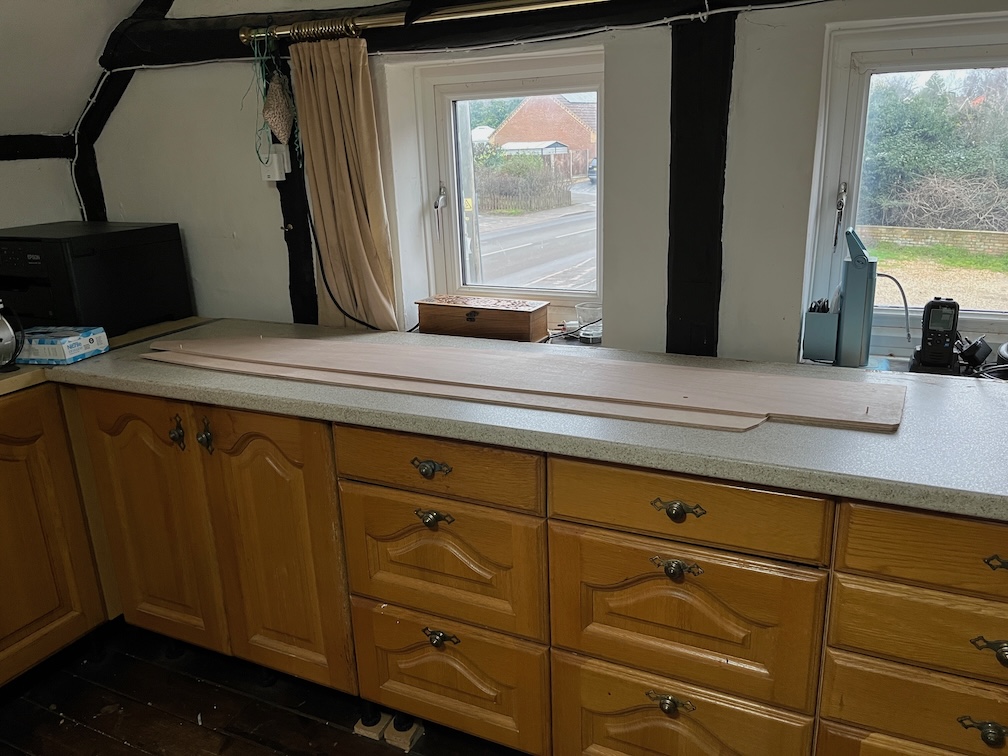
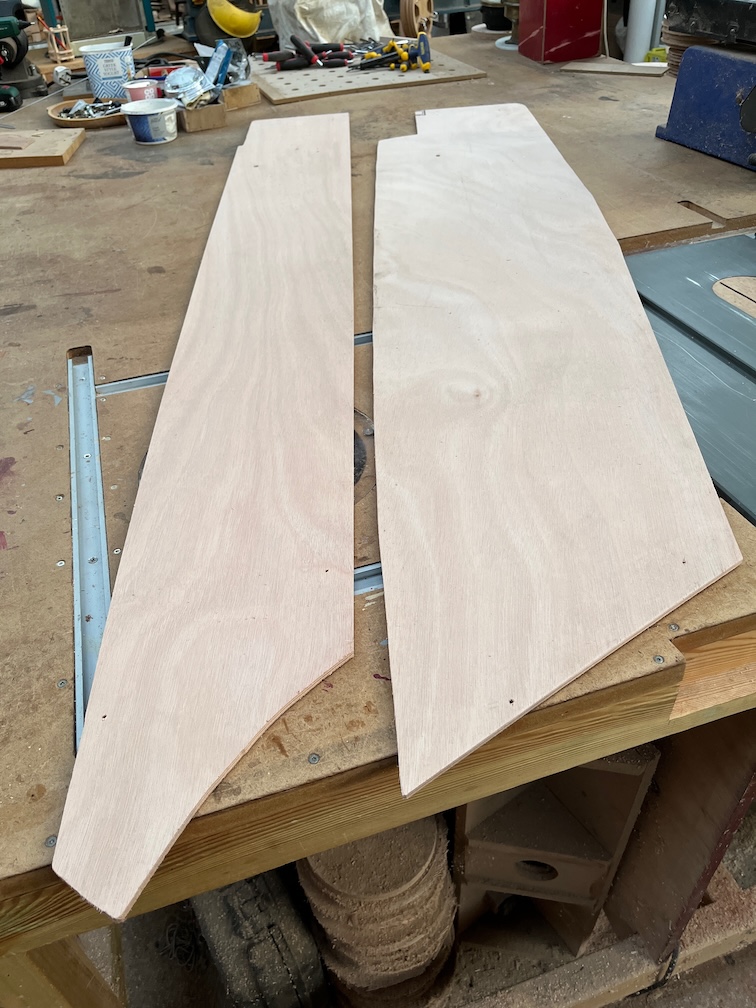
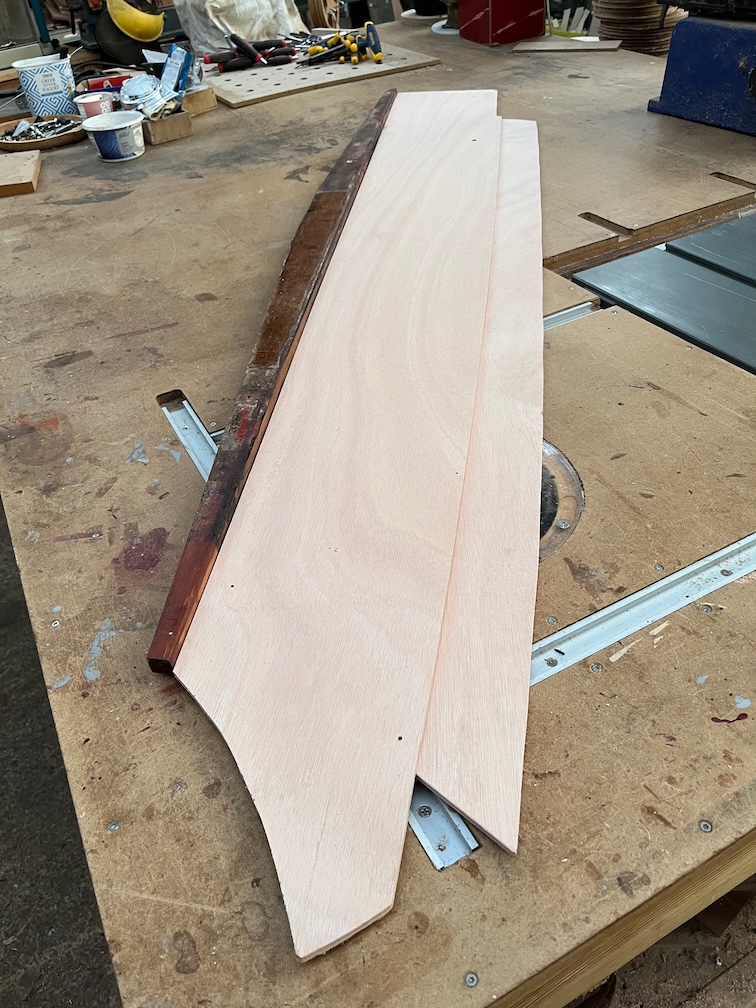
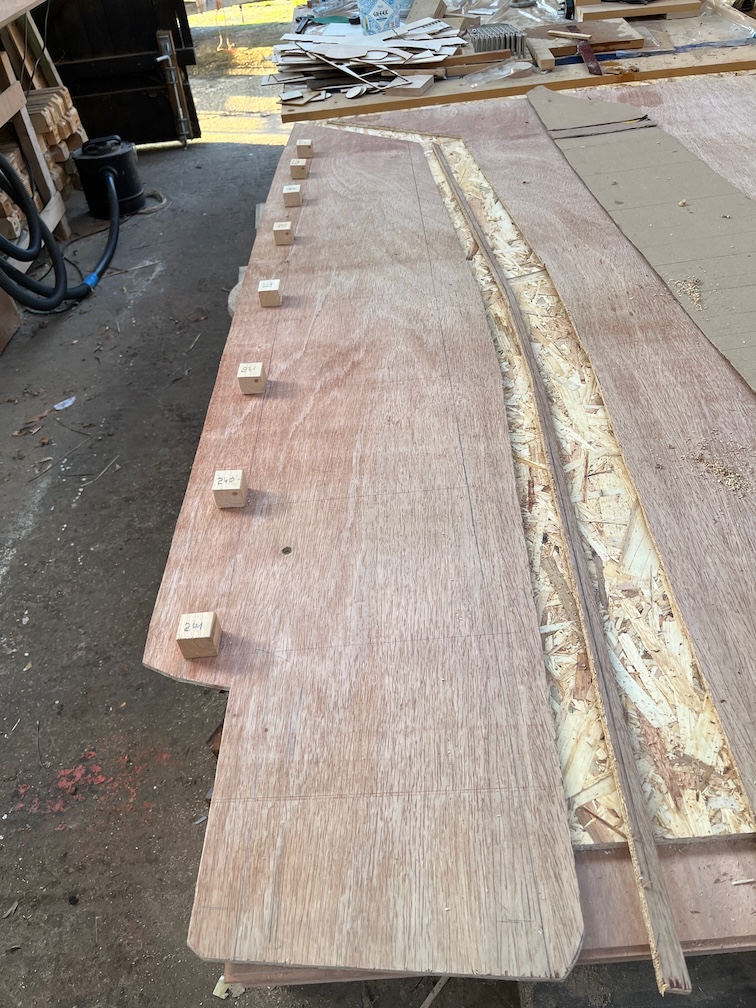
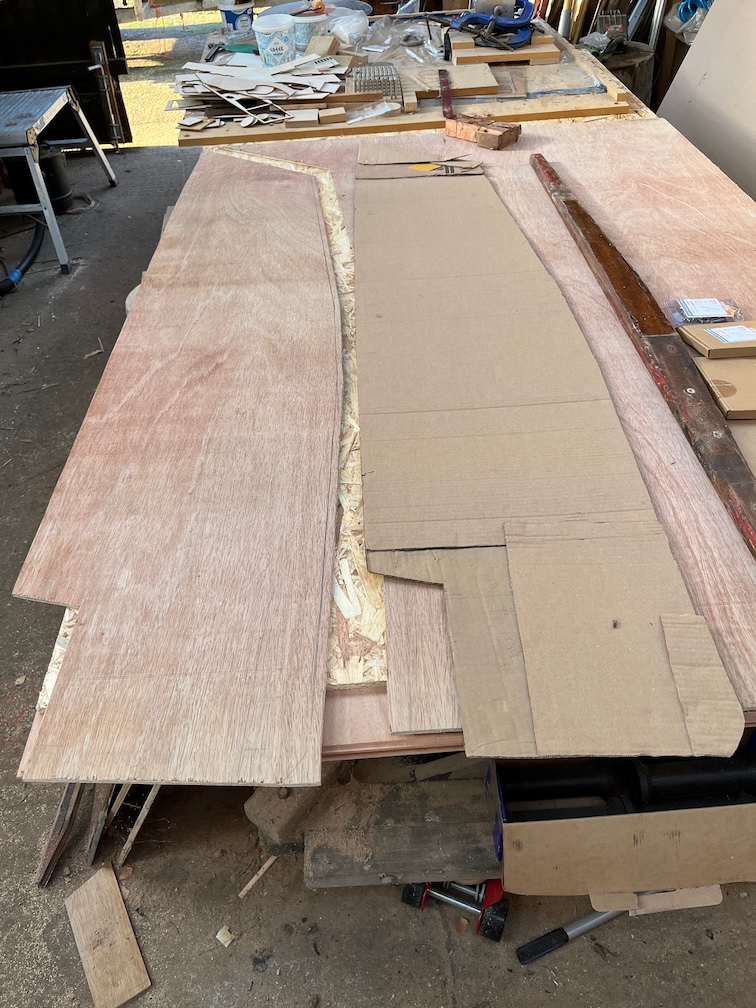
Now I have the two sides laminated up and you can see that one is the mirror of the other. After cleaning up the squeeze out I put the port side aside for the moment since I need to remove the old side from the boat before I can continue with that piece.
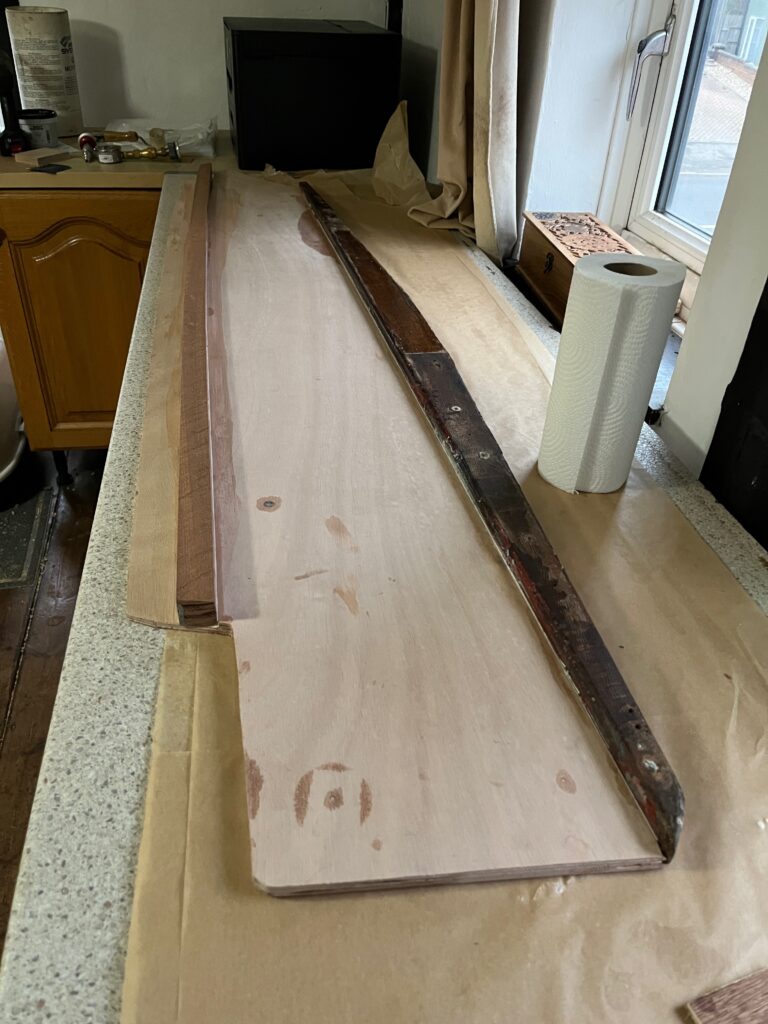
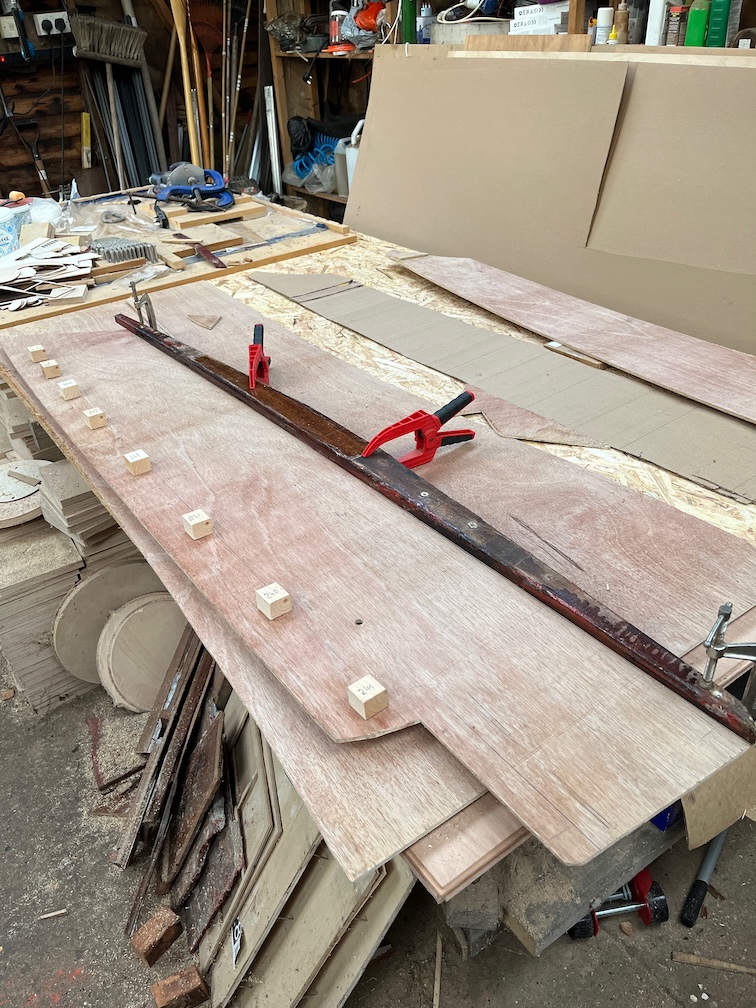
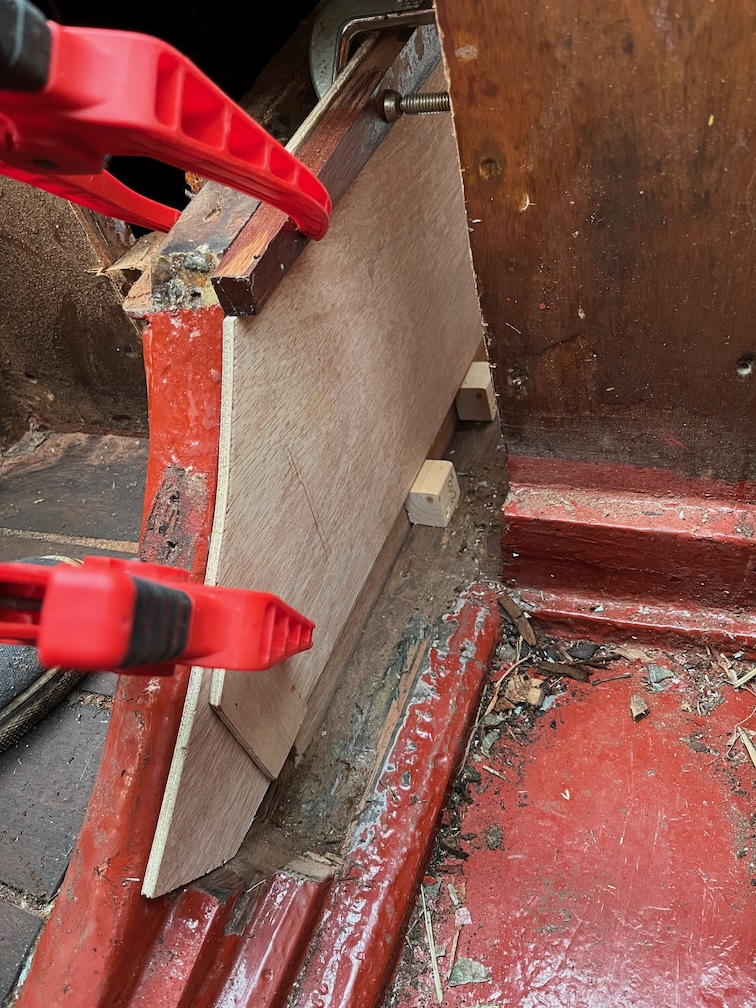
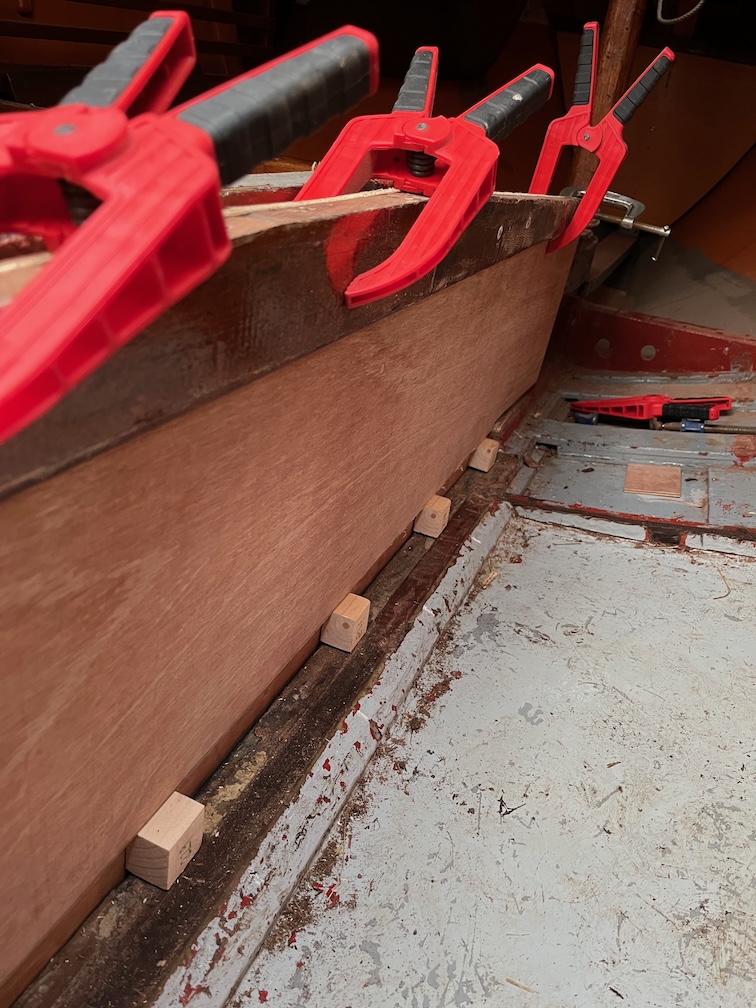
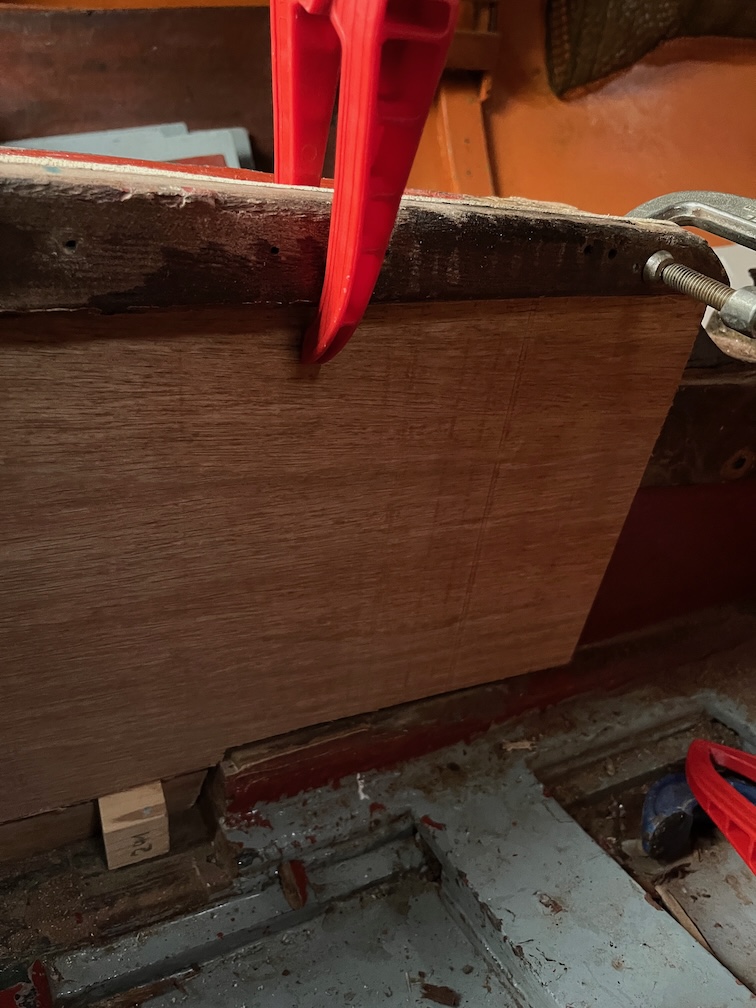
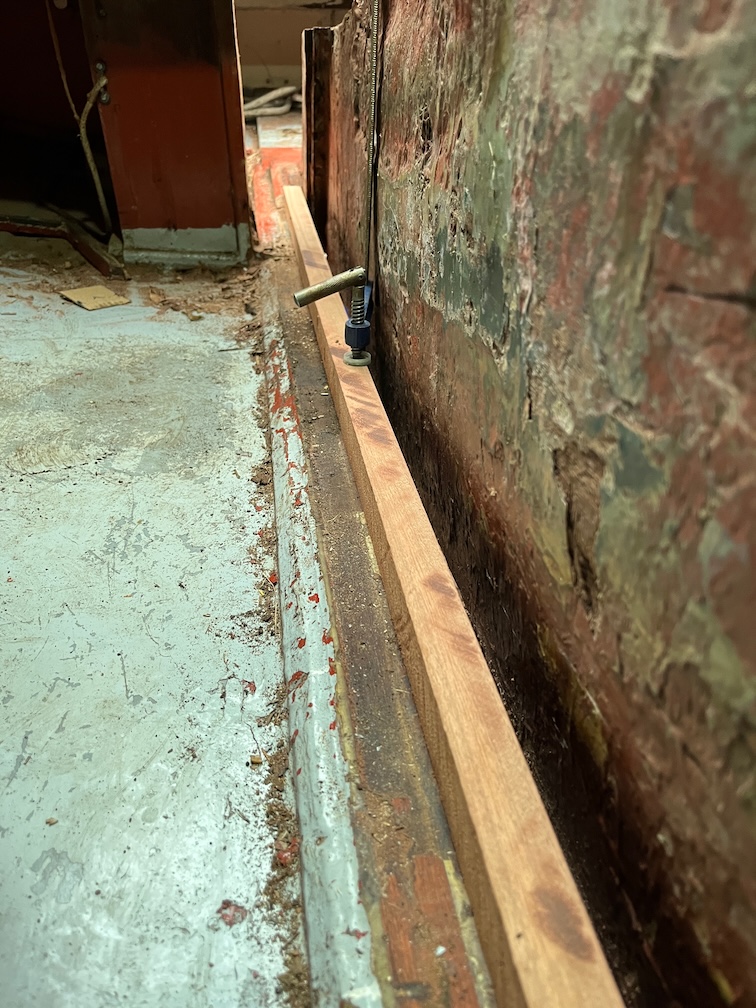
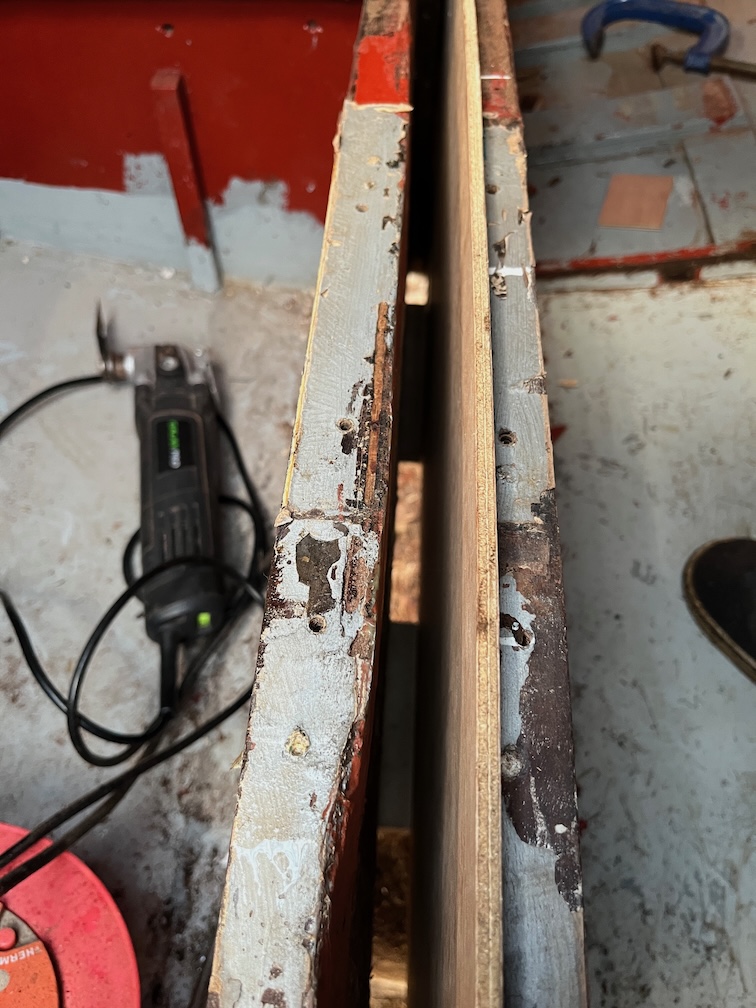
But there’s nothing stopping me from working on the starboard side. I clamped the runners in place then dry fitted the side to the space. I had to trim a few sections but once it fit snugly I glued and screwed the top and bottom runners in place and took the workpiece inside to speed up the glue drying.
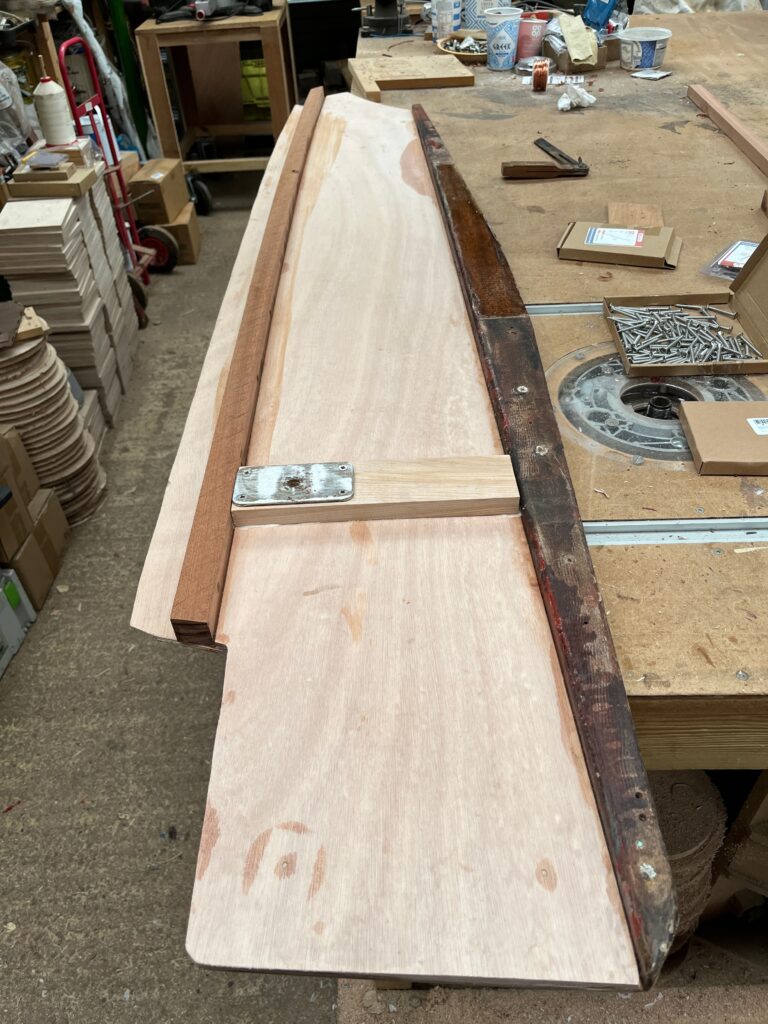
Once the glue had dried I made the reinforcement at the pivot bolt hole and this was also glued and screwed in place.

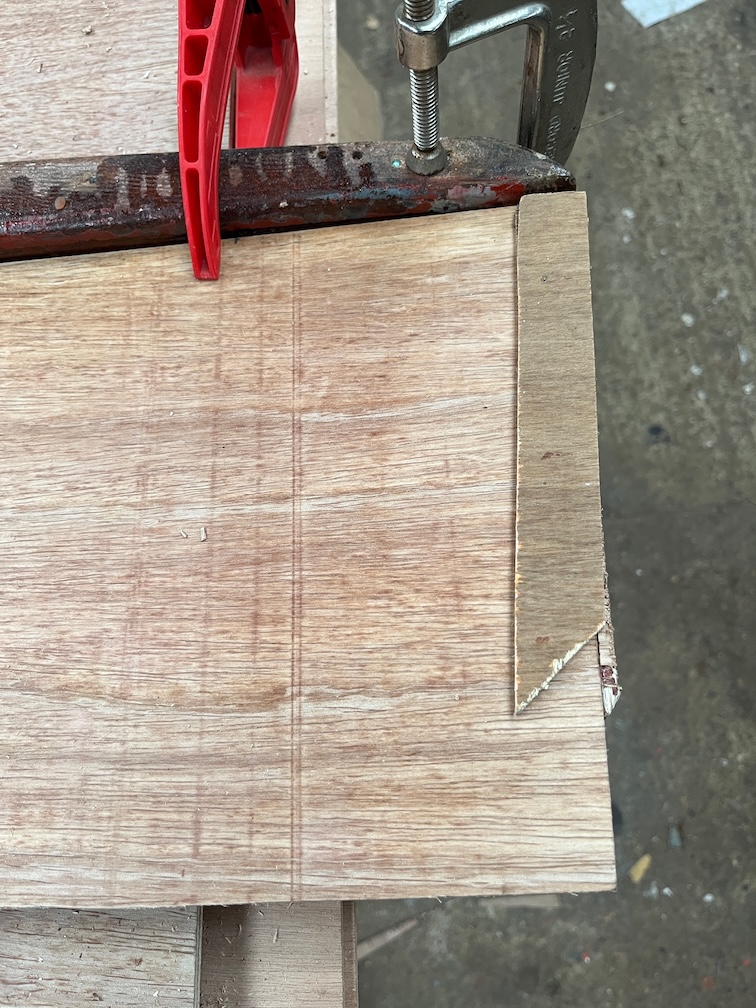
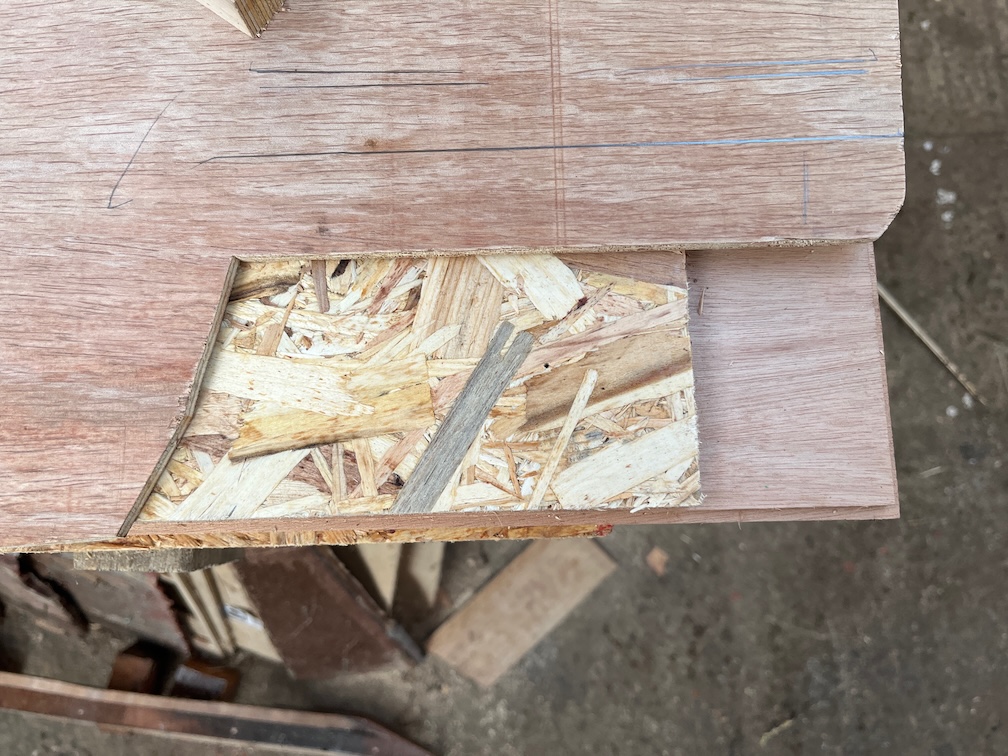
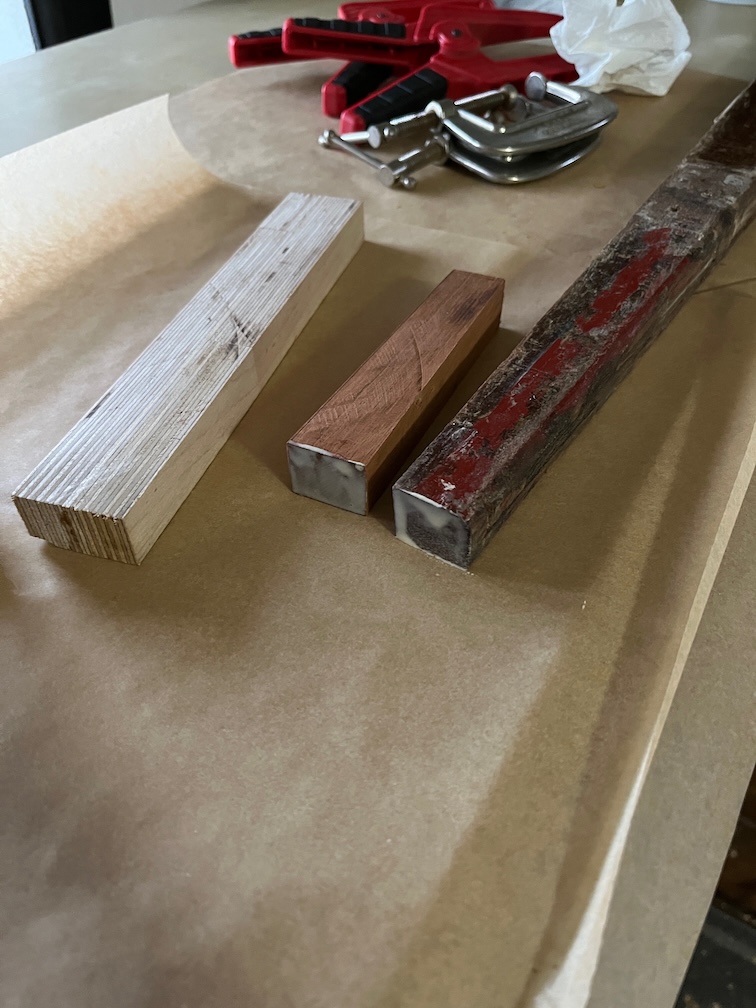
Then the diagonal brace was constructed. At least, I presume that it is a brace, I can’t think of any other reason for it except aesthetics. The original case side was just one layer of 8mm plywood so a brace may have been needed. Whatever the reason I decided that I would replace it anyway.
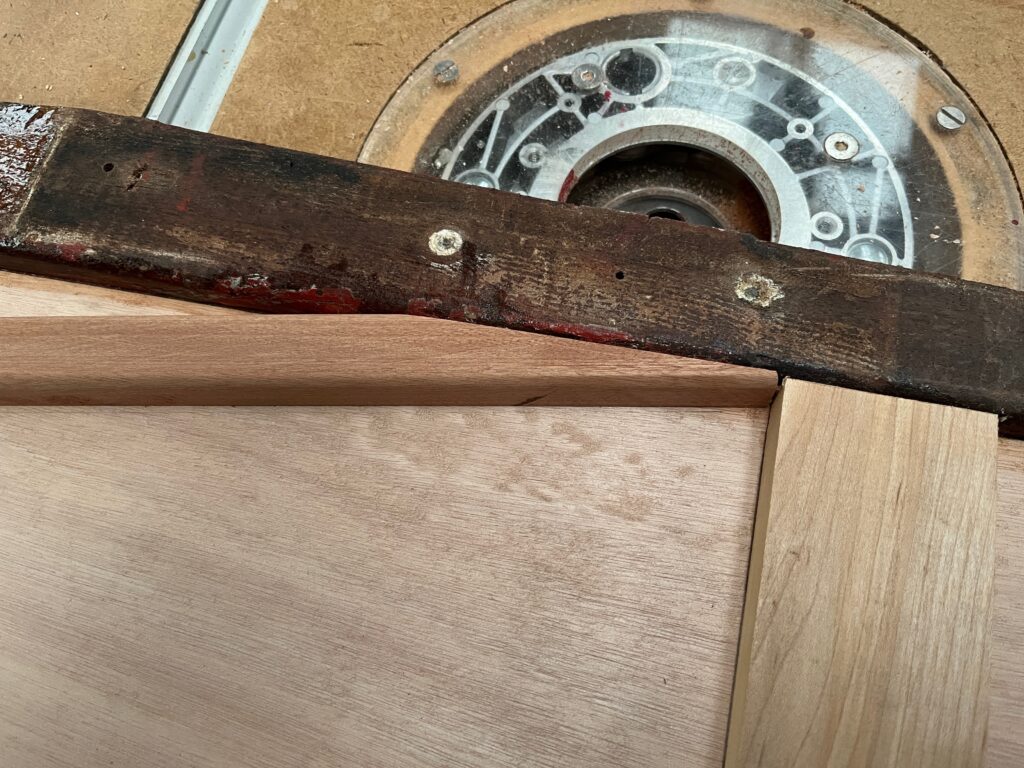
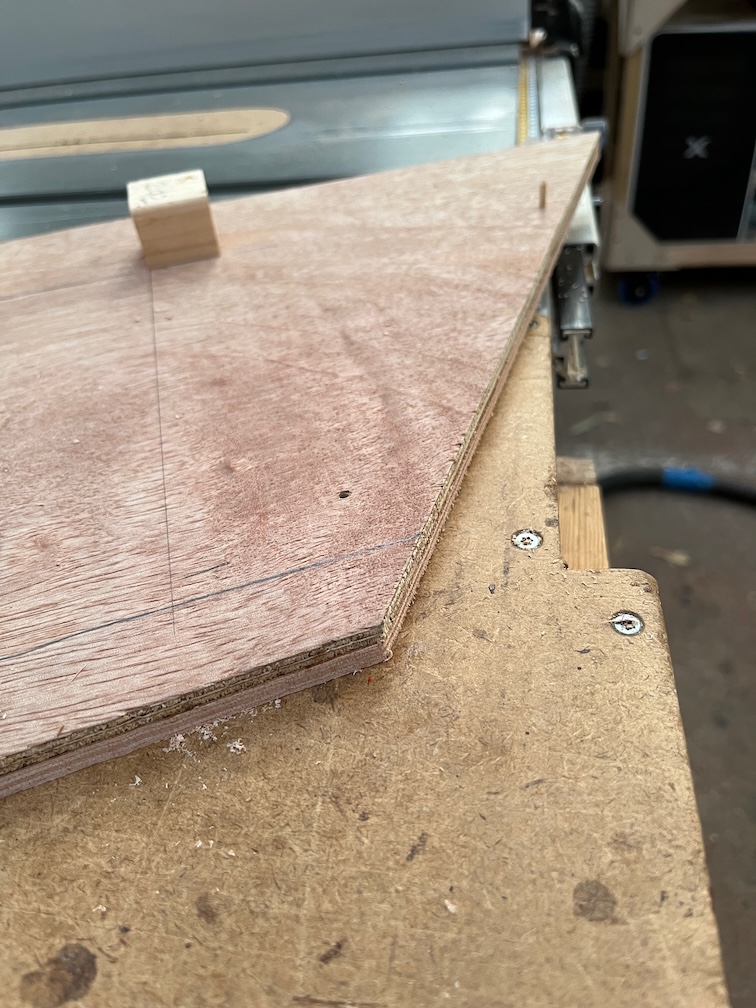
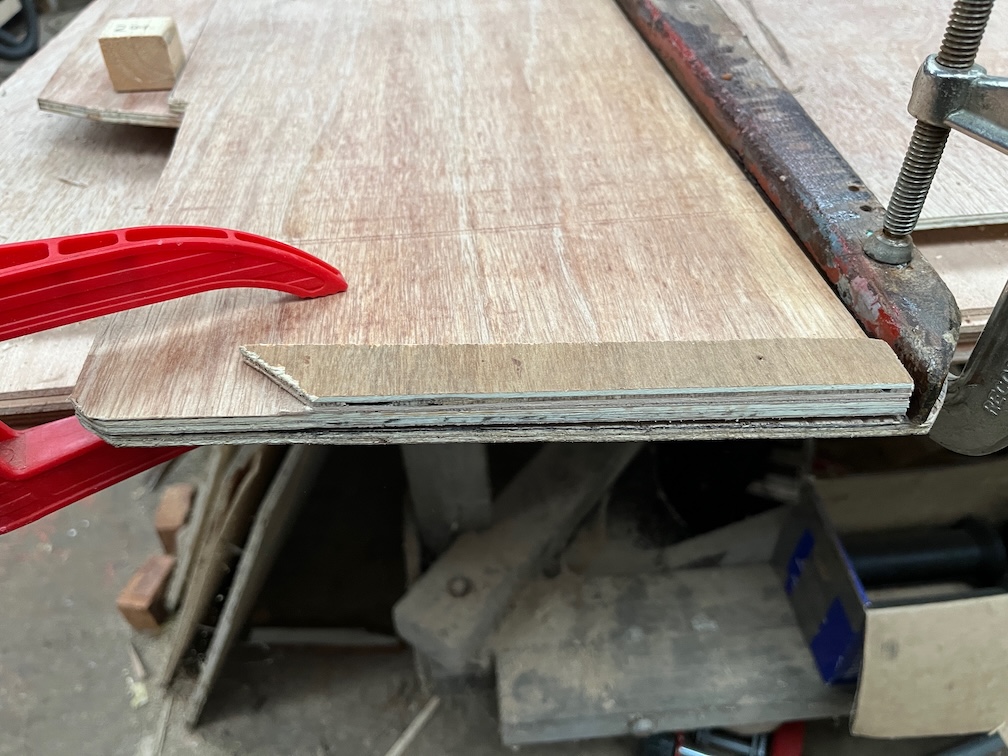
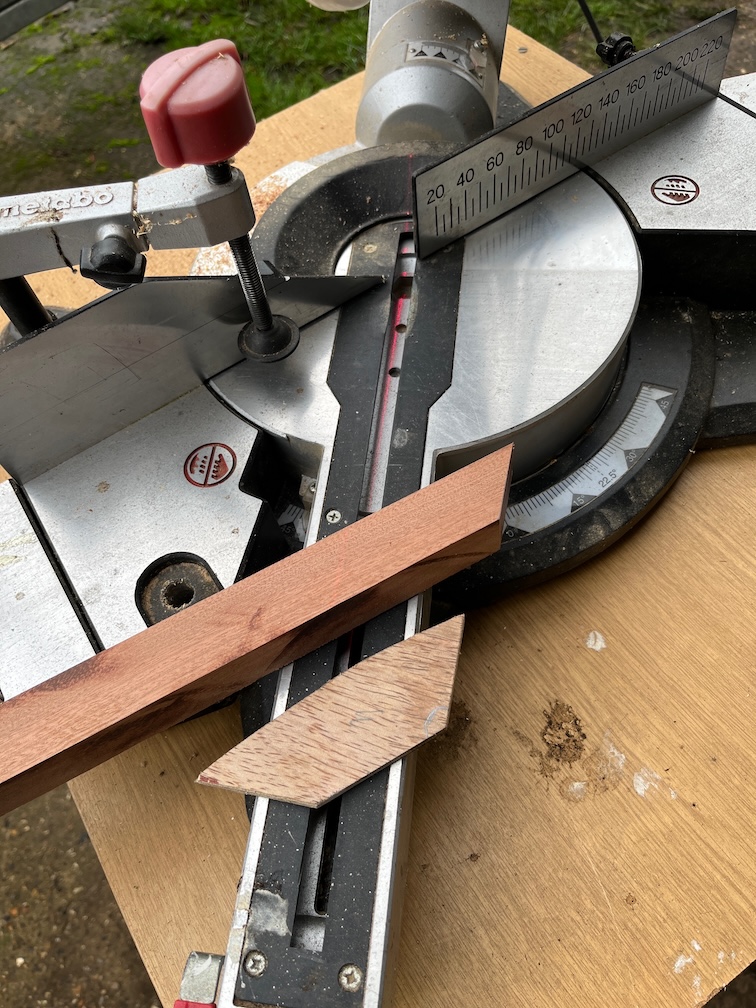
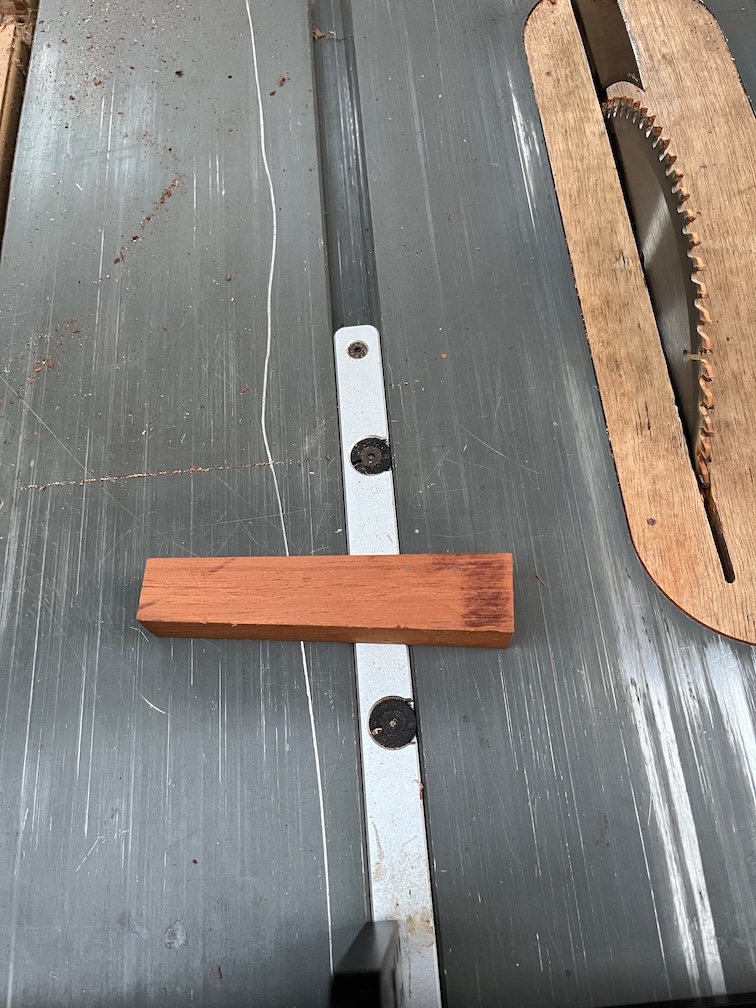
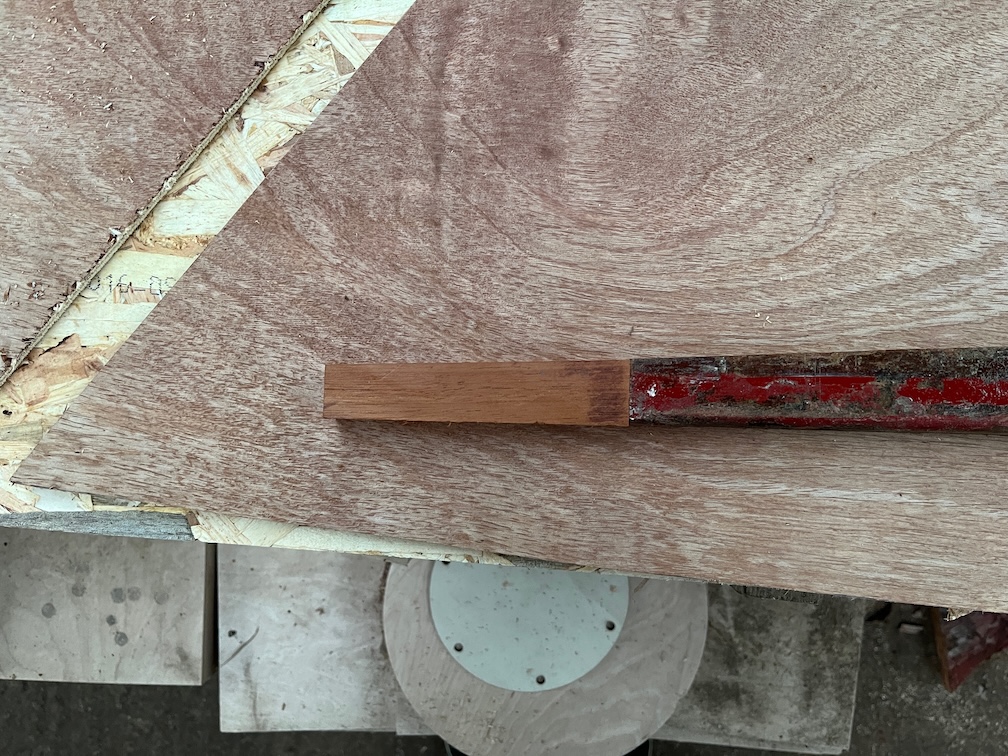
This was a little tricky since the angle of the cut required at the top of the brace is not the same as the one at the bottom. I knocked up a simple scarfing table saw jig for this.
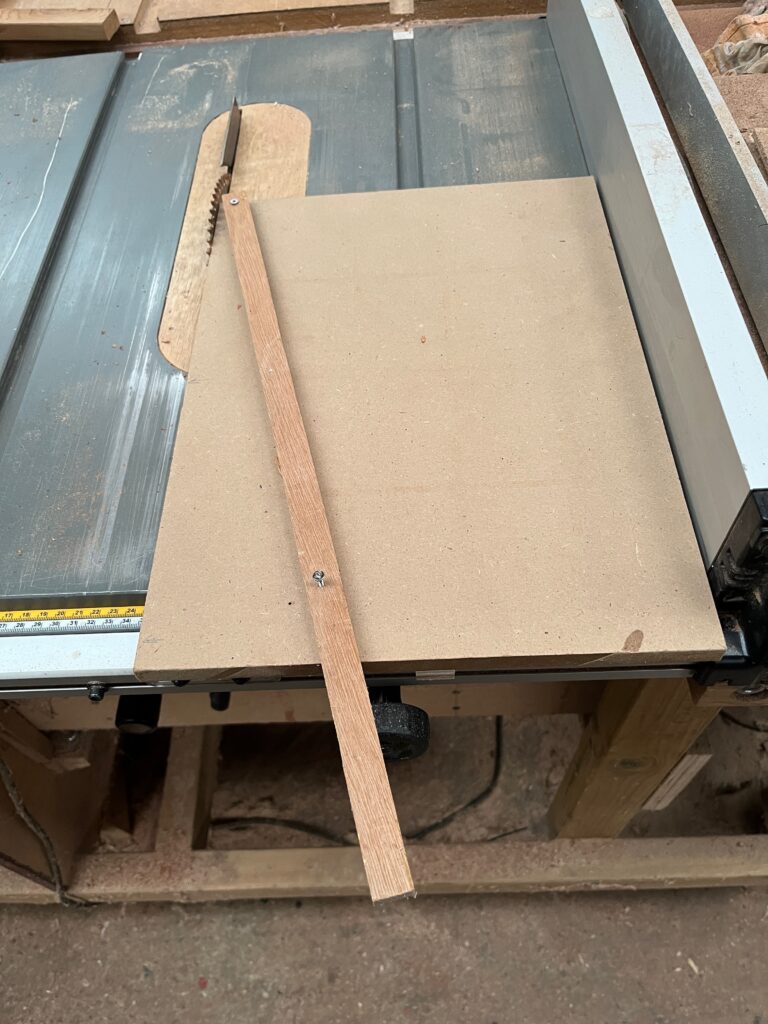
Nothing fancy but it does the job well enough.
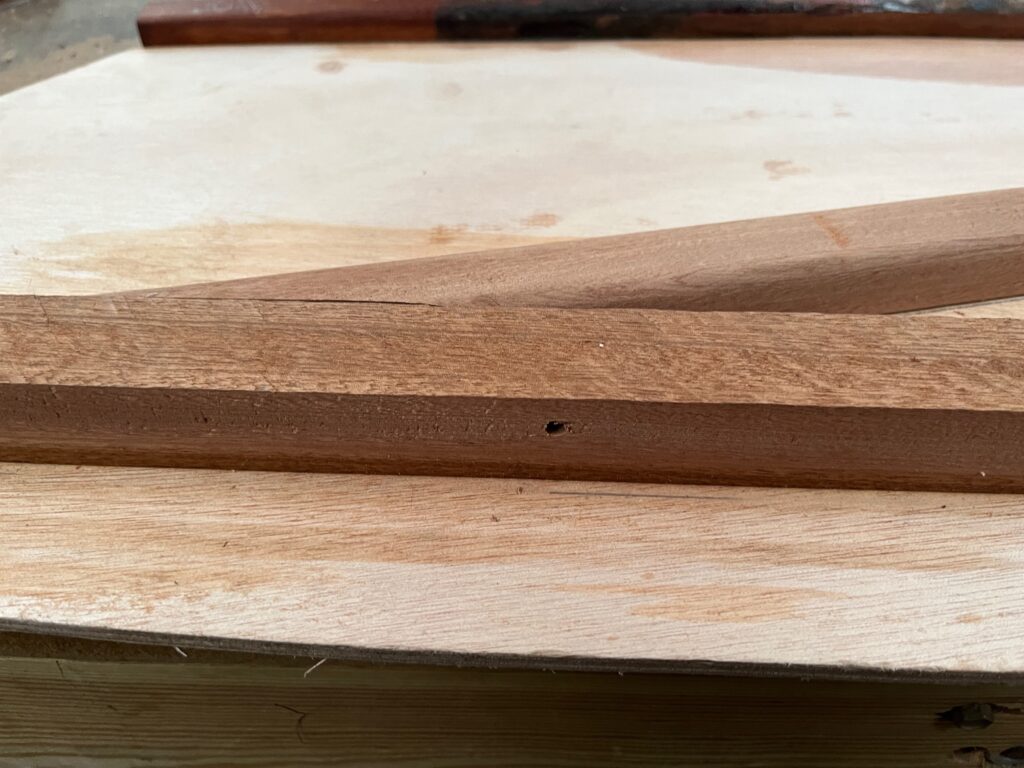
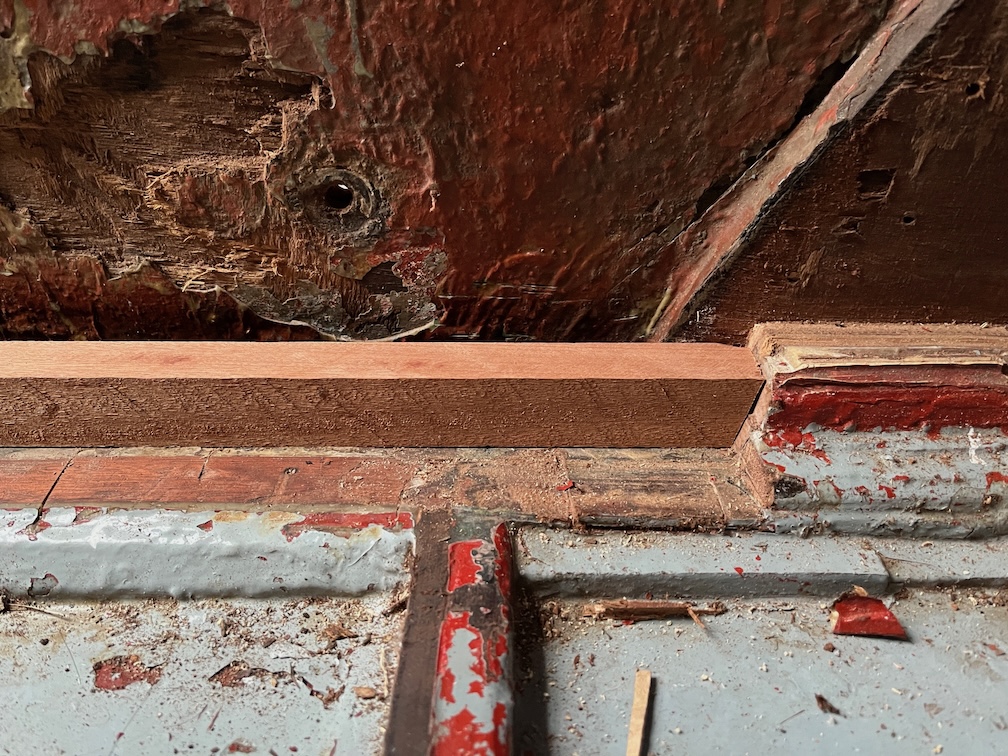
The problem at the lower end is that whatever I do, it impinges on one of the screws that holds the bottom runner to the keel. So once the glue has dried I shall drill up through the screw hole and then drill a hole in the brace that is wide enough to allow me to put the screw in and tighten it up. I will plug the hole once the screw is tightened as it will be a water trap otherwise.
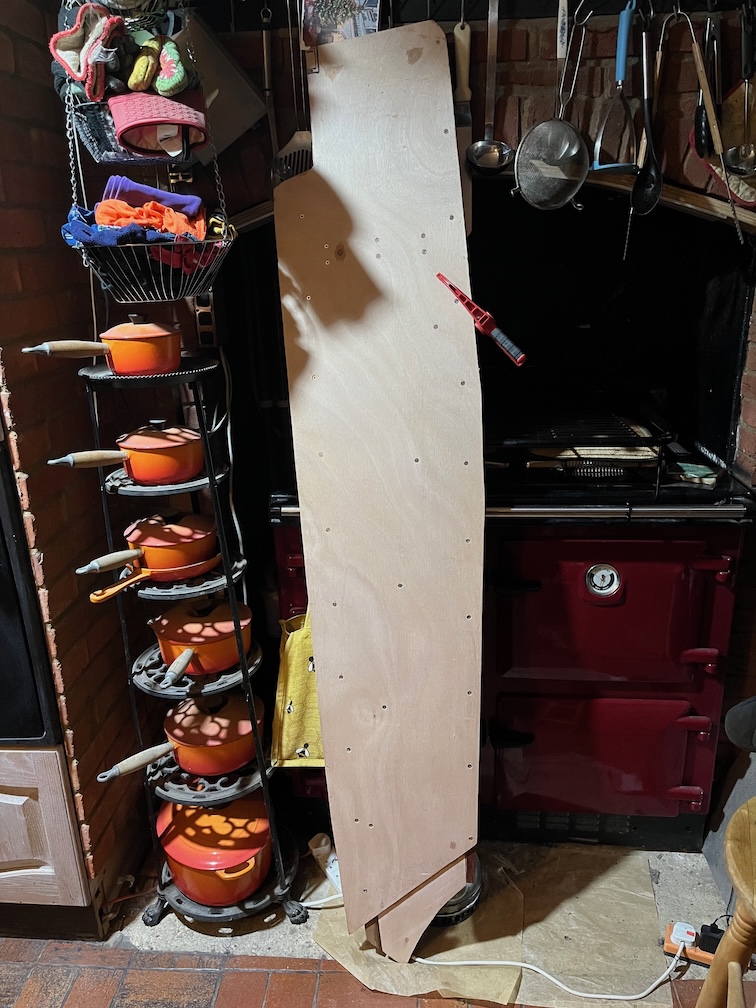
Then it was back to the Rayburn to warm the workpiece up. At this point I had to order some more No.8 1″ 316 stainless screws as I’d only bought a pack of 50 previously, and I’ve used 32 on this side alone.

There won’t be any more going in from this side, but there will be some more from the outside and into the end block, but those require screws of a different length, as do the screws into the keel which are longer still. However, I’ll have to do the same for the port side once I start on that.

Once the glue has dried I’ll run a round-over bit in the trim router around some of the edges, just to give a better edge for paint. Right angle edges tend to shed paint quite quickly.

But for today, I think that it is time to pack up. It has been a very successful few days with the few mistakes made being minor.

Time for a cup of tea.

2025-12-25 – Case Side IV

To be honest, I hadn’t intended to do any work on Shoal Waters today, after all, it is Christmas, but in the end I have been so enthused about the project that I just could not resist. I took the case side down to the workshop for some work.

You see, I made two mistakes with the vacuum bag clamping. Firstly, I used far too much tape and secondly, I really should have stopped the vacuum an hour or two into the process and removed as much of the squeeze out as I could.

I managed to remove most of the tape by hand, and fingernails, but the parts of the tape that had epoxy on just needed something a little sharper.

Here is what I mean about the blue tape. It is right in the corner and under epoxy.

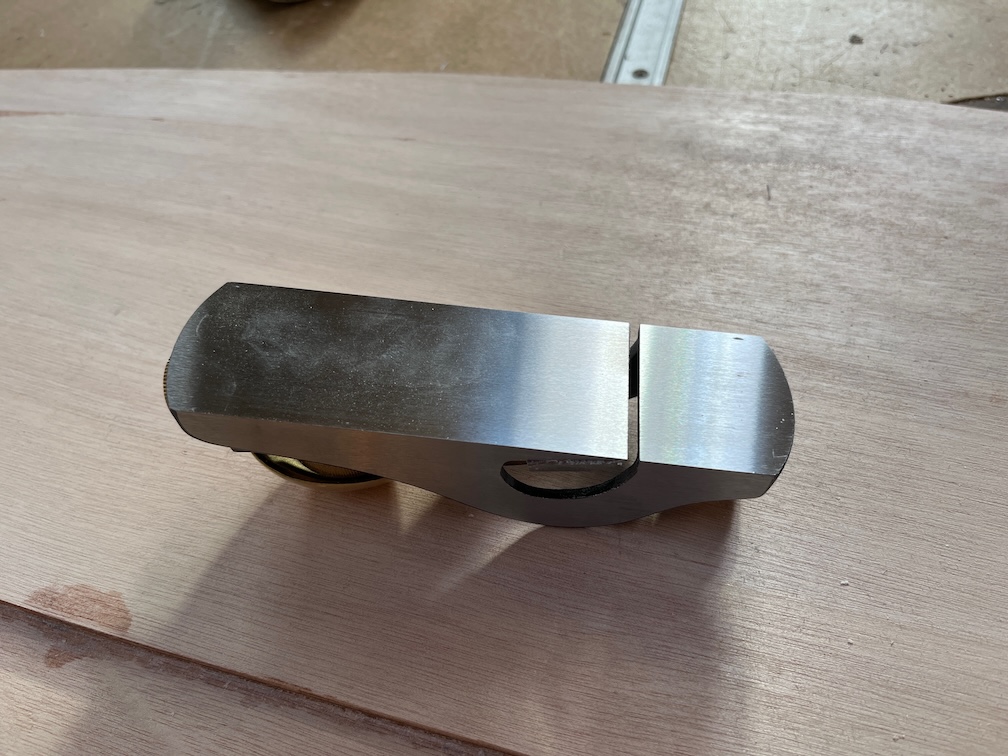
And this is the unremoved squeeze out after the tape has been removed elsewhere. I cleaned as much of this up with a sharp chisel, being very careful as it is a cold day again and then I used one of the special planes I have. So special, in fact, that I keep them in the workroom and not outside so that they do not rust.

One of them is different from standard planes in that the blade extends with across the width of the plae.

Like this.

Using this plane I am able to get all the way into corners provided that they are ninety degrees or more. Anything less than this requires using a chisel for all the excess removal.

The result, as you can see here, is a much better joint and no blue tape. There is still just a little epoxy left in the very corner as I did not want to risk planing away any of the plywood. I will chamfer the edge of the runners a little to allow for this before assembly.

Even without this chamfer the top runner is quite a close fit, almost good enough. But there is a slight gap, so I added the chamfer and when the time for the assembly comes, I’ll make sure that there is plenty of sealant in the joint.

One thing that I did not think about is the pivot bolt hole which you will notice is full of epoxy. This is a good thing as I was planning to do that later in the build anyway. Well, not filling the hole completely, but sealing the edges of the hole with epoxy to prevent any water ingress. All that I need to do now is to drill out the hole and the plywood should be already sealed.

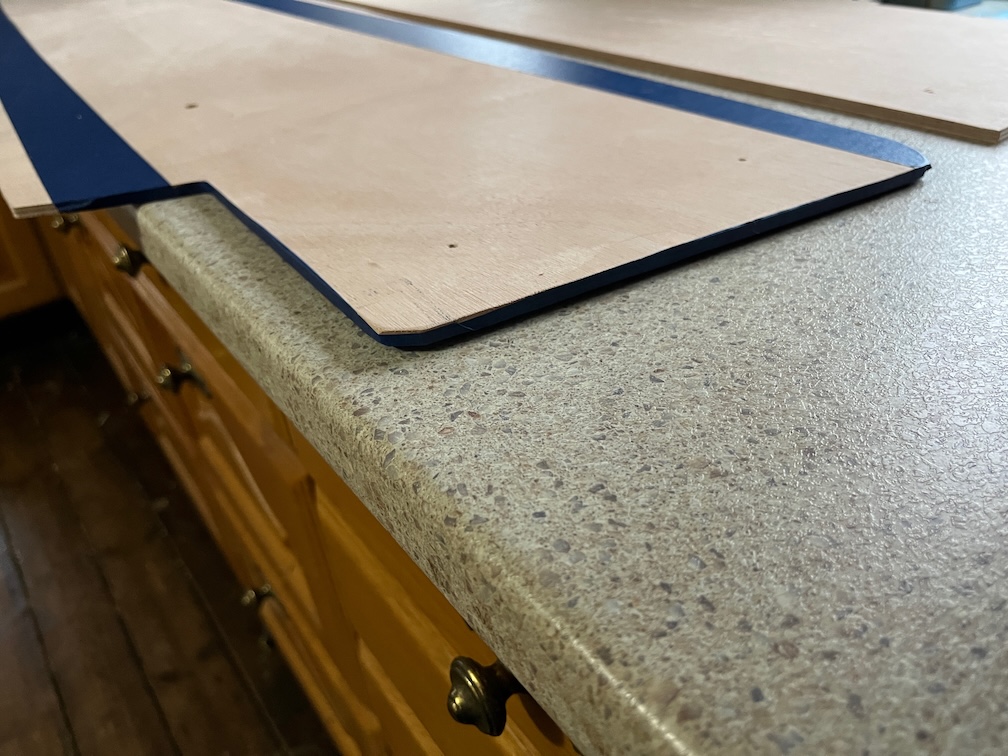
Finally, for the day, I taped up the port side components of the centerplate case that I cut out yesterday.

Much less tape than yesterday and only on those parts of the plywood that need it.

Time for a cup of tea.
2025-12-24 – Case Side III

Epoxy day, or one of them at least. Having got up, fed the cats, most important, and done my ablutions, it was time to get started.

Firstly, I needed to tape over the holes in the work pieces, something that I forgot about yesterday. that didn’t take long.

I mixed up eight pumps of resin and hardener and used the mechanical stirrer to mix it up for around two minutes. This new arrangement is much easier than stirring my hand using a mixing stick.

I poured half on one piece and the rest on the other as soon as it was mixed since keeping the epoxy in the mixing cup too long will cause it to kick off and start solidifying, sometimes with enough heat to melt the plastic. Yes, I’ve had that happen in the past. It’s very messy!!

Using a plastic spreader I coated each piece with the epoxy and used a brush to make sure that the plywood was evenly covered.

I put the four registration pins into what will be the bottom piece when clamped and made sure that the holes in the other piece were clear of epoxy. That’s it for now.

It is quite cold again today and we don’t have heating in the workroom as it isn’t used much, so I dragged one of out portable Butane gas heaters in to the room and set that going. That should raise the temperature enough to shorten the cure time.

For now it’s time to make breakfast and..

…have a cup of tea.

This is how it sounds and what it looks like. A little intrusive, but not too much. Mind you, the cats hate it!

After 5 hours of continuous use, the vacuum pump was getting a little too hot for comfort, so I turned it off, removed the plastic and inspected the epoxy. It has kicked off but is not hard. It is, however, sufficiently cured for there to be little chance of the two laminates coming apart, but just to be on the safe side I put some weights on the top. Each of those is 2 kg, which should do the trick.

I’ll leave it like that until the epoxy has hardened properly and then look at taking the tape off and cleaning up the squeeze-out.

Time for a cup of tea.
2025-12-23 – Case Side II

The first task of the day is to prepare the work area in the workroom for the epoxy work and, like yesterday, the means clearing things up.

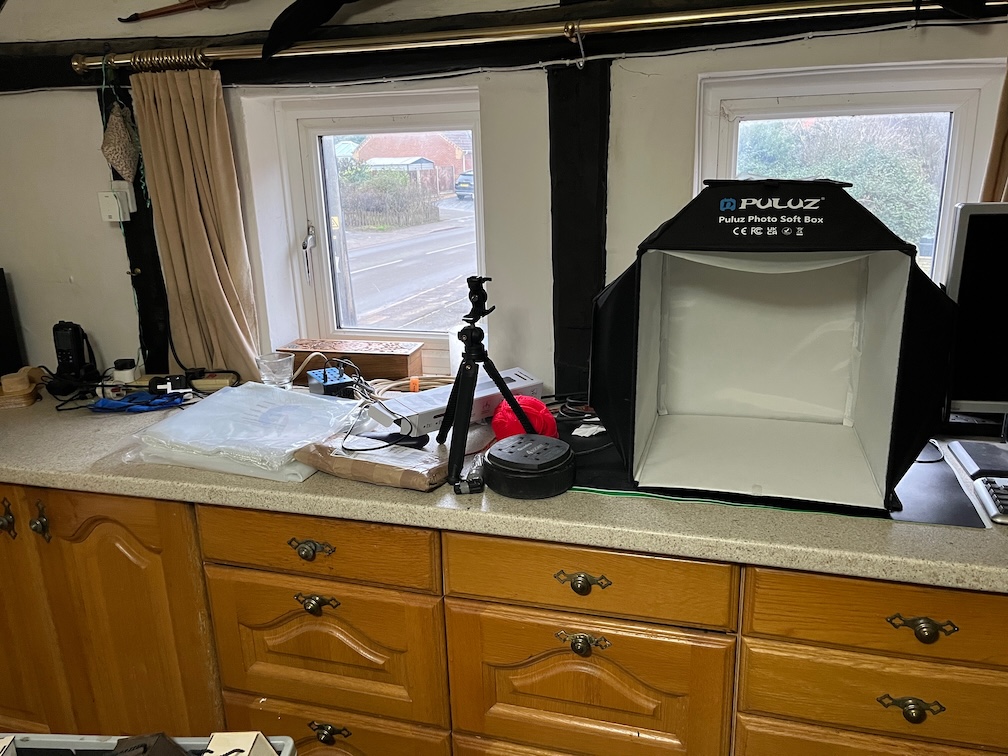
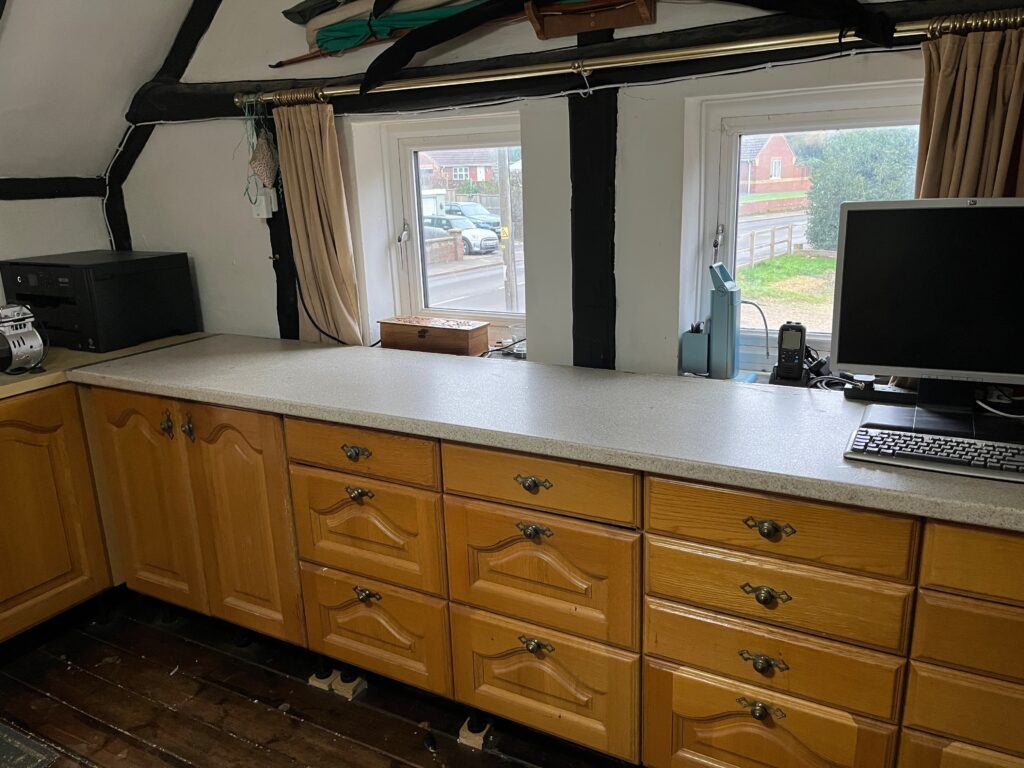
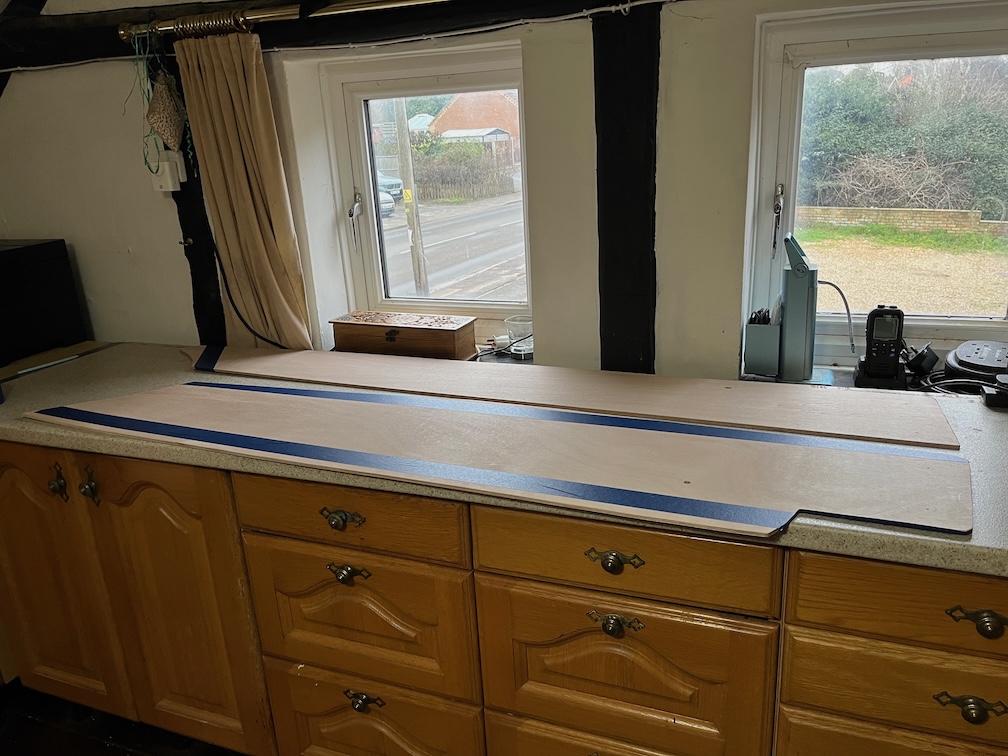
This is the surface I’ll be using for the epoxy work over the next few days and I’ve chosen it for a number of reasons. Firstly, it’s indoors and the temperature is above the minimum of 16 Celsius quoted by the manufacturer. Secondly, it is pretty flat. Not completely. but good enough for this purpose. Thirdly, being a kitchen work surface it is not porous. The only other large, flat surfaces I have are MDF and plywood, neither of which is suitable for vacuum bag clamping unless the entire thing is encased in the plastic sheet.. Fourthly, it is in the work room which, as the name suggests, is set aside for working.

Now, to be on the safe side, I did clear a small area on the worksurface, you can just see it on the left of the photo, and used it to test the vacuum bagging. A piece of the plastic sheet was fixed to the surface using butyl tape, a vacuum gauge and the pump connection added and the pump turned on. This pump is rated to draw down to -0.9 bar and the gauge read -0.85 bar which is more than good enough. I will have to find a way to cut down the noise the pump makes as putting it on the workbench or the floor directly rattles the whole house. I’ll try a folded towel and see if that makes a difference. The pump will be on continuously for about 8 hours, so it needs to be as unobtrusive as possibly.

So, clearing up time it is.

The result is very good. I really ought to keep it in this condition all the time but you know how it is. Any spare space is used for something.

Having thrown away or found a home for just about everything, I washed the surface thoroughly using hot water and washing up liquid, being careful to rinse the surface very well before drying it. I probably used about eight rinsing sessions with clean water each time to make sure that all the detergent was removed.

I brought up the plywood that has spent the last 27 hours leaning against the Rayburn and are now dry and laid them out on the surface and pegged them together.

The first epoxy work will be to laminate these two pieces together and that requires two epoxy coats. The first, a coating layer of neat epoxy applied to both mating faces and the second, a coat thickened with a small amount of microfibers, applied to one surface when the coating layer has become tacky. At that point the vacuum bag will be used to clamp the two layers together until the epoxy has cured sufficiently to allow the clamping to be removed.

So, first order of business is to mark the limits of the epoxy.

Nice and easy.

Next blue painter’s tape was put on the plywood on the outside of the lines to stop any excess from coating the plywood where not needed.

I also taped up the edges where I am likely to get epoxy on the edge.

Why do this? Why not just let it coat the edges? After all, all the edges will be epoxy coated eventually.

The answer to this is amine blush, a waxy by product of the curing process that coats the surface of the epoxy and needs ro be removed before painting or varnishing. The normal way to avoid this is to use peel ply, and I will be using this when working on the inner side of the case, but for the edges at this time it is difficult and very messy to use. Leaving this to the end makes it much easier to do.

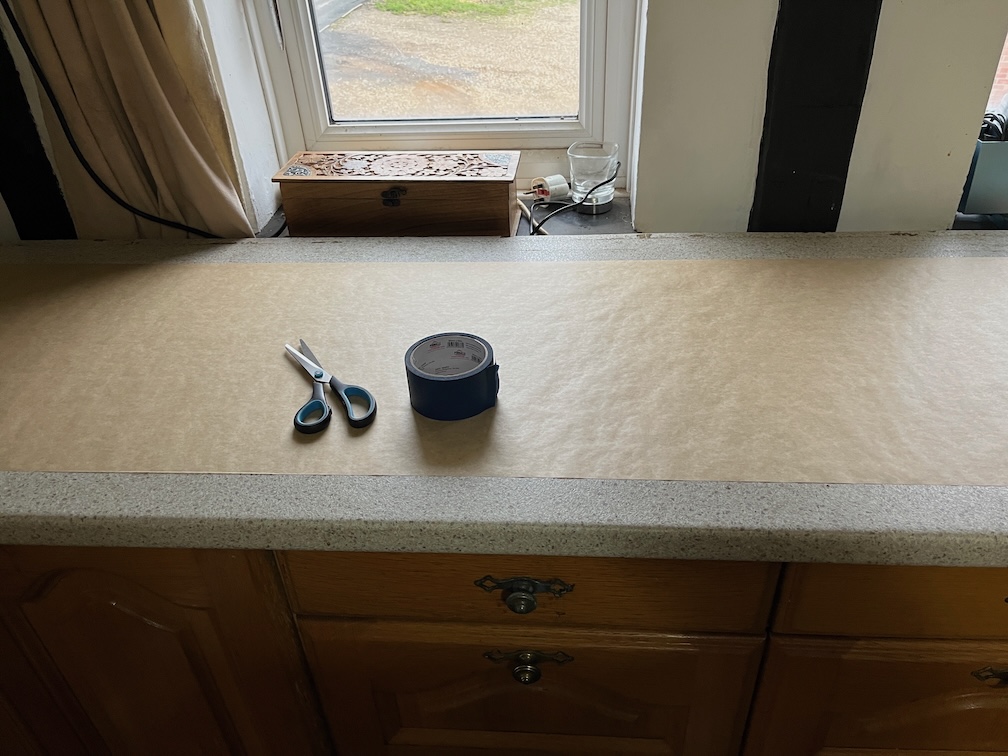
Speaking of mess, I put down some baking paper for the first part of the epoxy work…

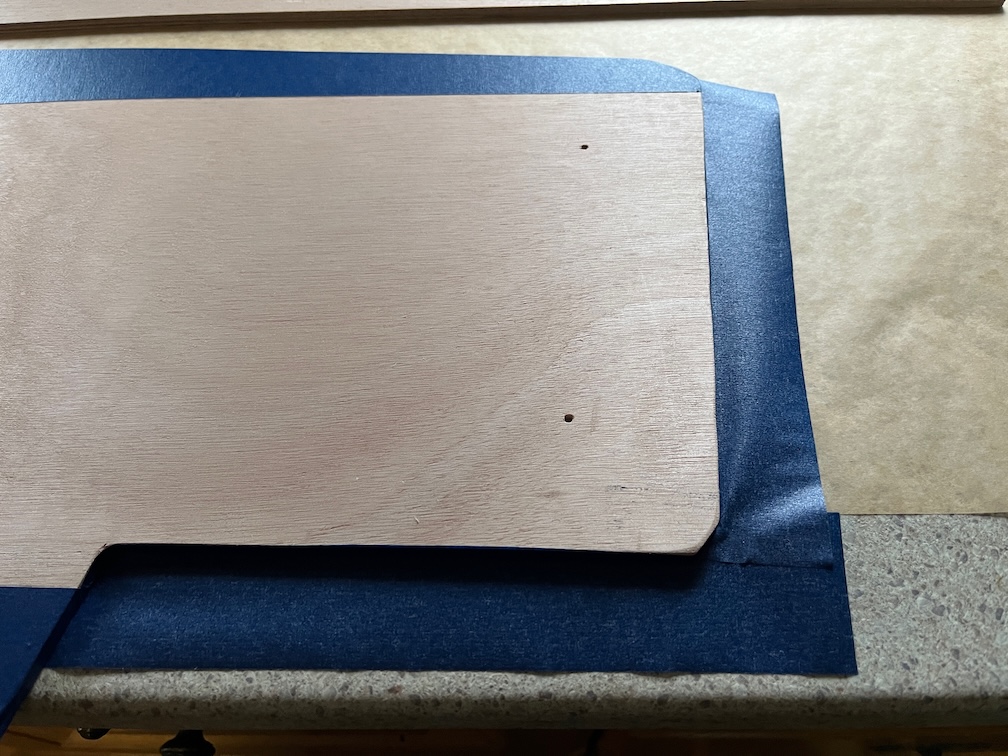
…and added some more painter’s tape as a catch tray on the larger of the two pieces.

According to several other makers, one pump each of resin and hardener will cover one square foot of area. Now the area to be covered is 7,425 square cm which is just under 8 square feet, so I’ll need 8 pumps for the coating layers and 4 pumps for the laminating layer.

So far so good.

At this point I’ll have to stop on the epoxy work due to timing issues. The coating will take around thirty minutes, possibly less, but the time to go tacky will be around three hours. Say thirty minutes to set up the vacuum bag and another thirty minutes to mix up and apply the laminating layer. Finally, it will take around eight hours with the pump going before being able to turn it off. In total twelve and a half hours. Now I don’t want the pump to be going after about 6pm, it’s noisy, so I need to start the process at around 05:30.

Guess who’s going to be up very early tomorrow morning !

Time for a cup of tea.
Having had a bit of a break it was time to continue on although, I have to say that it was quite cold outside so I didn’t do much !

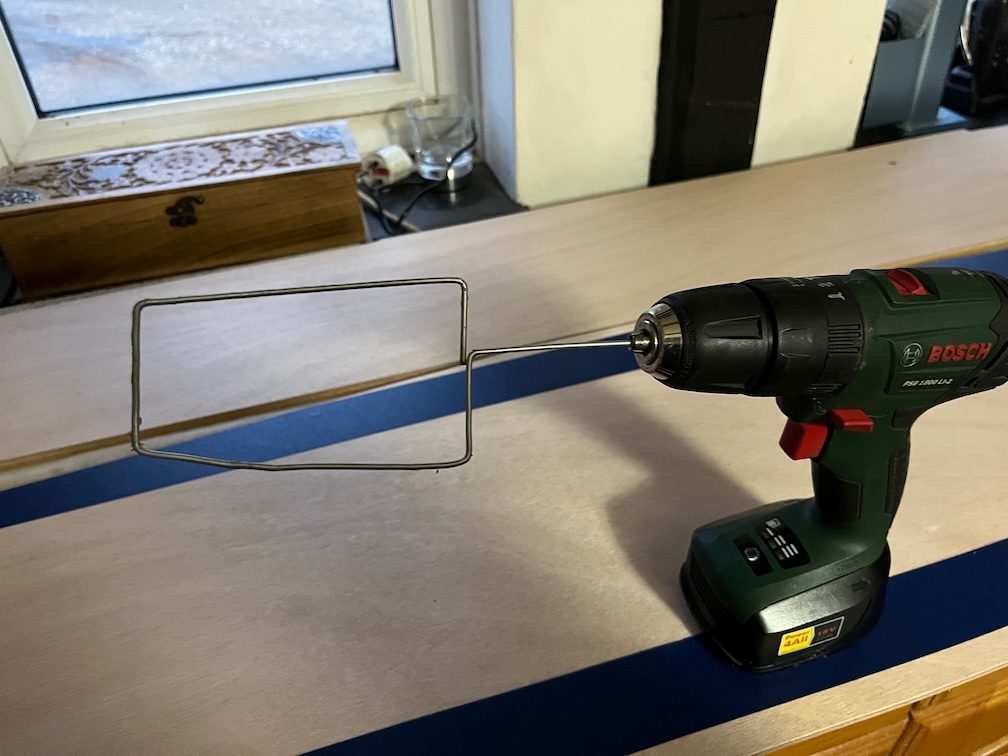
I saw this on https://www.youtube.com/@Nomadboatbuilding, a boat builder on YouTube, which he uses for stirring epoxy. This is usually a tedious process as you have to stir the mixture for around 2 minutes. This allows you to just hold the thing in place for the required time and it does all the work for you. Nomad Boat Builder also uses this in a drill press where he sets it going and goes and does something else for the two minutes and doesn’t even have to hold it.

I have a collection of wire coat hangers in the workshop just for things like this and after a few minutes I had an epoxy stirring thing. You just have to remember to use the slow setting on the drill !!

I also marked and drilled the locating holes for the other side pieces and I’ll cut those out once the epoxy work has been done indoors.

Time for a cup of tea.
2025-12-22 – Case Side I

Today is the day I start to cut out and construct the starboard side of the centerplate case. So, bright and early I hied me down to the workshop to make a start, only to realise that before I can cut a single piece of marine plywood, I have to clear up.

A lot !

This is the state of the work table and what you can’t see under that lot is the router and I’ll need that soon. That looks like chaos but it isn’t as random as it may seem.

This is the plywood cutting table and you can see the mess that has on it at the top of the photo. Again, if looks chaotic but there is some organisation in the mess. Still, it all has to be removed from the table for two reasons. Firstly, the marine plywood is under the shuttering ply that you can see on the top and secondly, I need at least 6′ of cleared space to cut the pieces and the entire table is just 8′ long.

So I spent the rest of the morning doing a massive cleanup of those two tables. The junk, rubbish and such like got binned, some wooden scraps were put on the fire. That was a mistake since they were damp and the workshop filled with smoke. I had to open all three doors to allow the very light breeze to blow that away.

Then the remainder was sorted into boat bits, non-boat bit and tools. Then, starting with the tools, a home as found for all of them except the thirty or so T-bar hex keys I have. those were put out of the way for now, I’ll have to make some sort of rack for those. Mind you, I’ve been saying that for the last two years.

The non-boat bits were found a home and the boat bits were divided into Shoal Waters’ bits, Naiad’s bits and other and then sorted out. I also went through the pile of wood removed from Shoal Waters and put the usable chunks somewhere as I will be wanting to use those for making other parts for the boat later on.

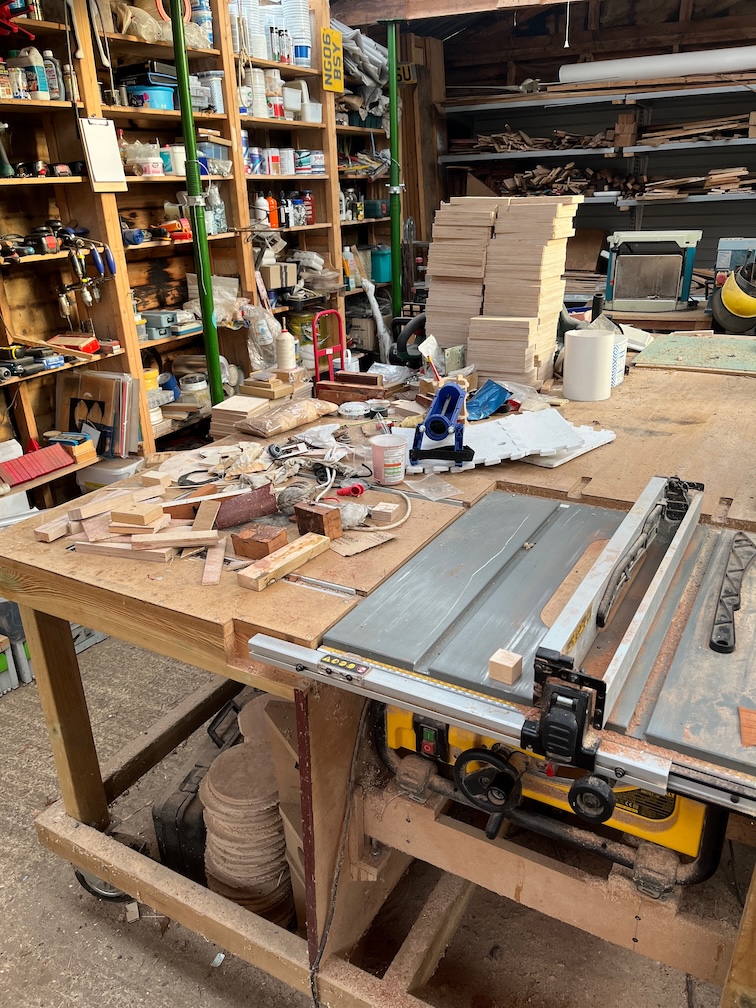
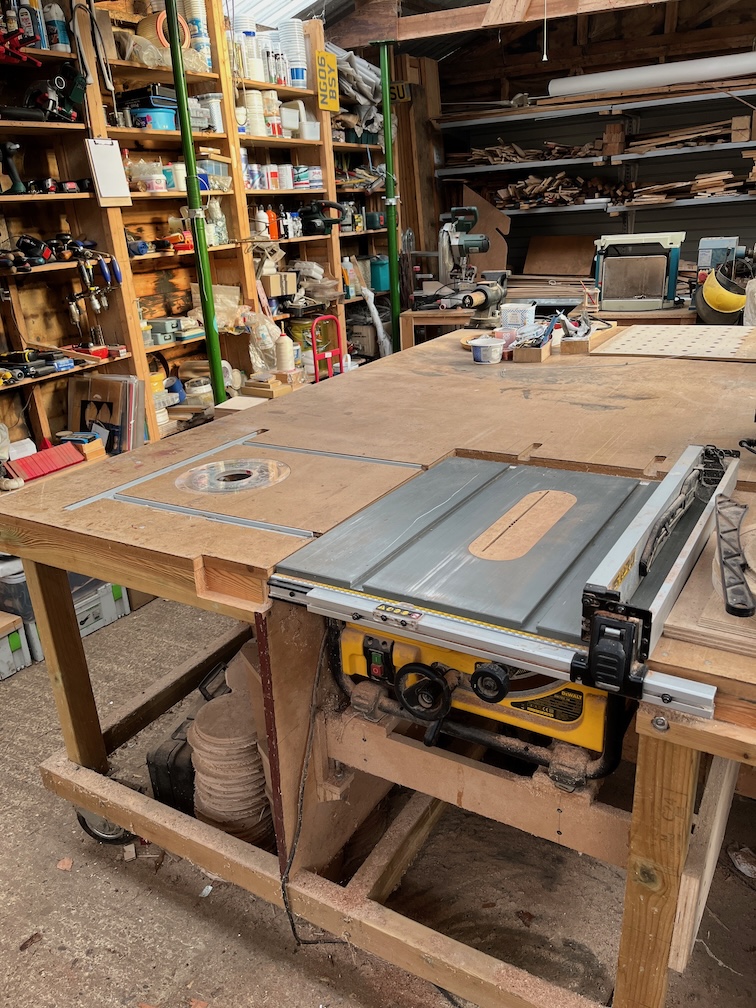
And here is the result. A fairly clean and uncluttered table, you can even see the router.

And the plywood cutting table, also clean and uncluttered with a piece of 6 mm marine plywood on top, ready to go.

However, by this point my throat was dry and dusty from sweeping up the dust and sawdust, so…

Time for a cup of tea.
Some time later…

Having taken a break and had some lunch, it was time to start cutting the inner and outer sides for the centerplate case.

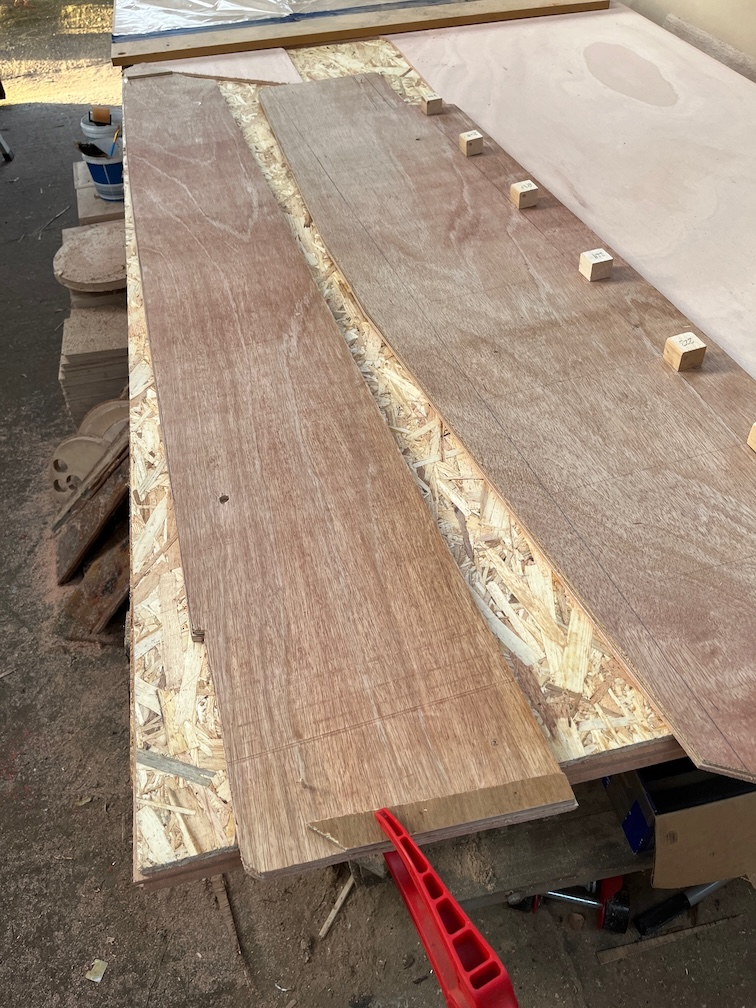
I arranged the two templates on the marine ply making sure that they didn’t take up more than half the width of the sheet. I drilled the locating holes in the marine ply so that I can locate the two pieces later on. Then I drew around each template.

This is the result. I used a utility knife to score along the pencil lines where the lines cross the grain to prevent tear out.

The pieces were cut out using a jigsaw and I tried to keep just on the outside of the pencil lines. The two pieces came out quite well. I used 120 grit sandpaper to tidy up the edges.

Once that was done I put the templates onto the marine ply using the locating holes to get them in the correct position.

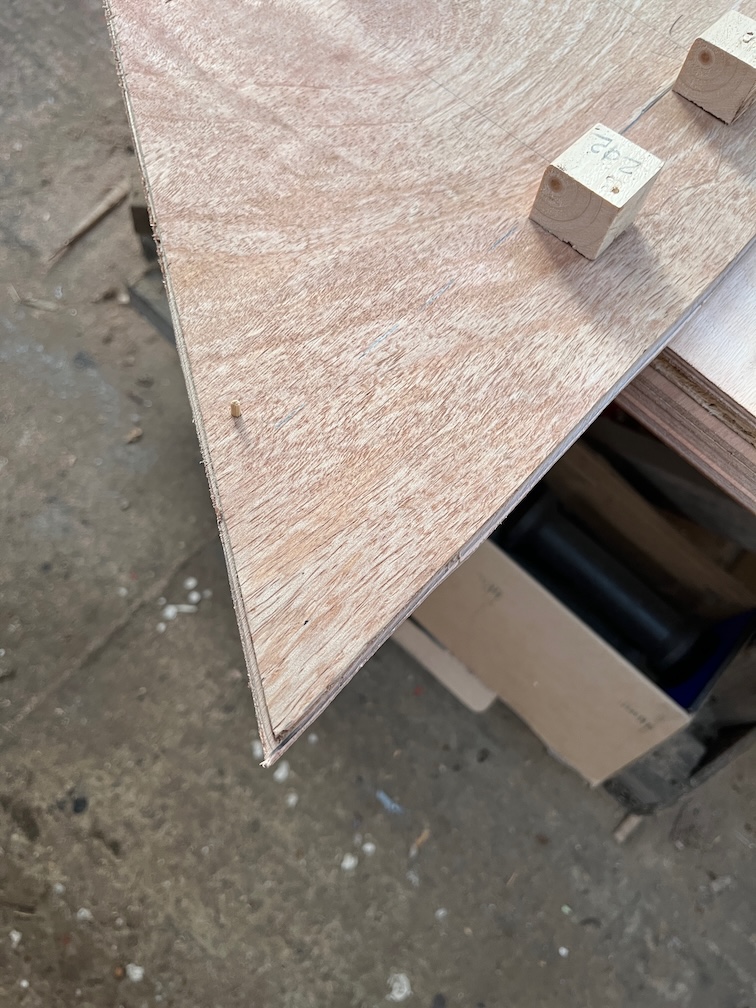
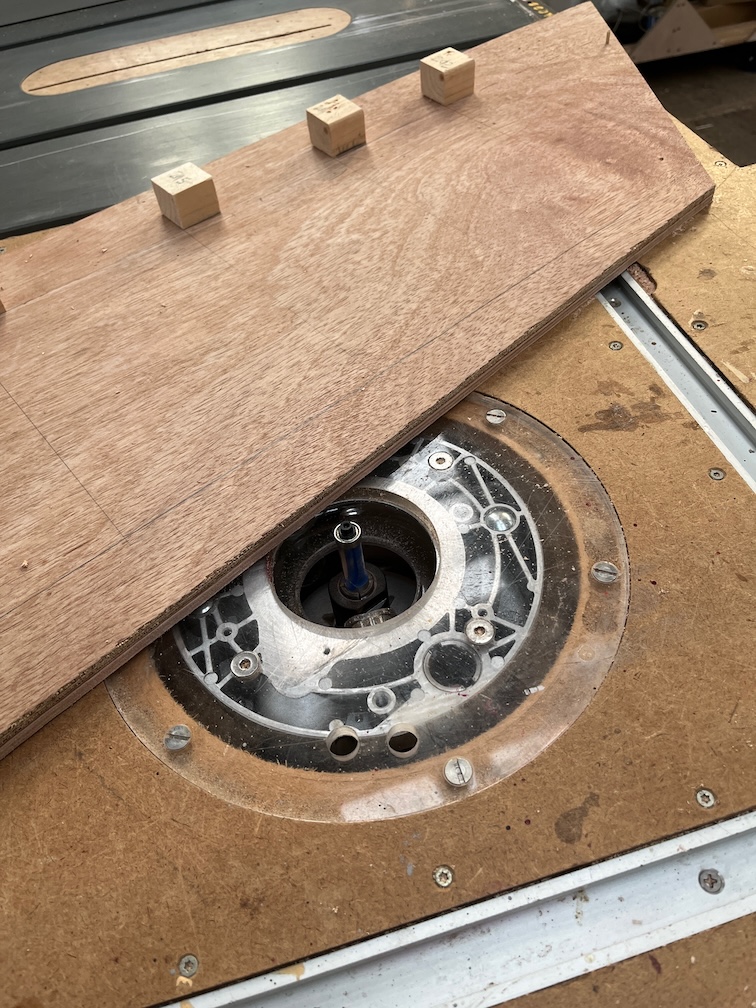
You can see the the marine plywood protrudes a little past the template. I used a splodge of hot glue at either end to ensure that the pieces stayed together and then it was over to the router.

I used a top following trim router bit to cut the marine ply to the exact size of hte templates. An easy job now that the work table is cleared.

Another view of the template on top of the marine ply after being trimmed.

I didn’t use much hot glue deliberately so the pieces came apart easily without destroying the expensive marine ply nor the cheap template.

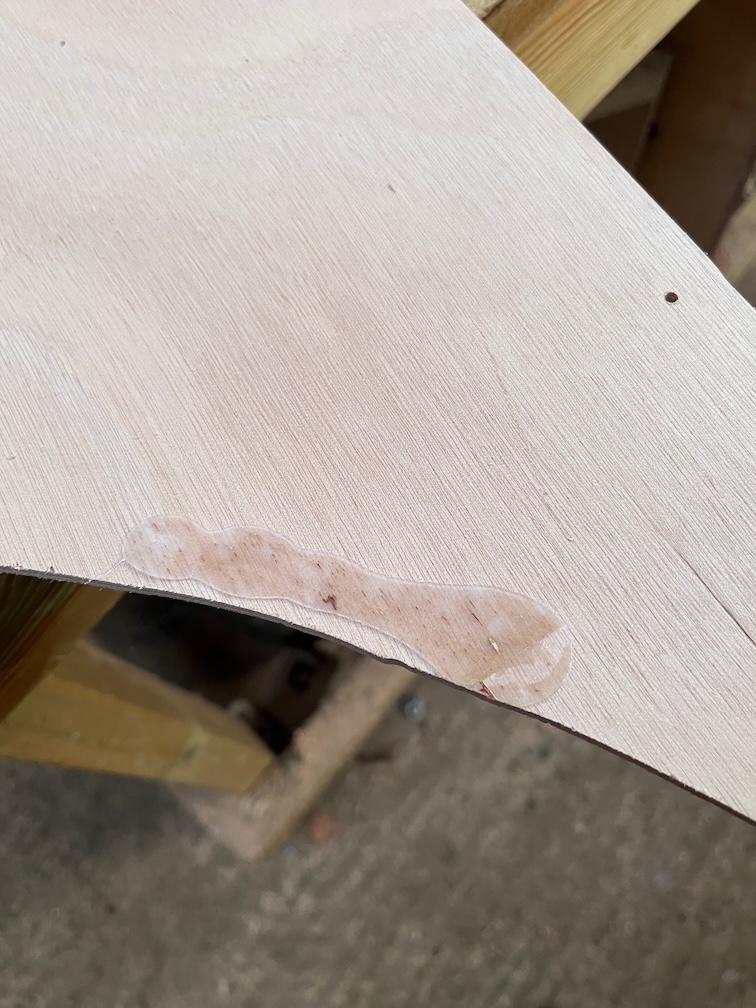
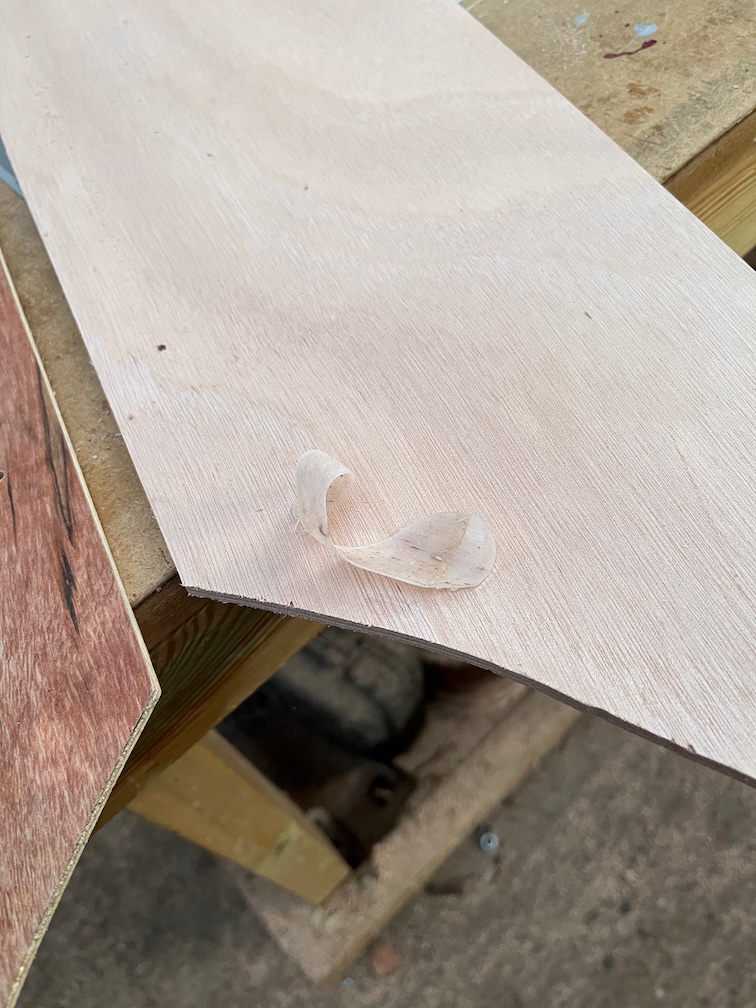
It Is quite satisfying to peel the hot glue off the wood in one piece.

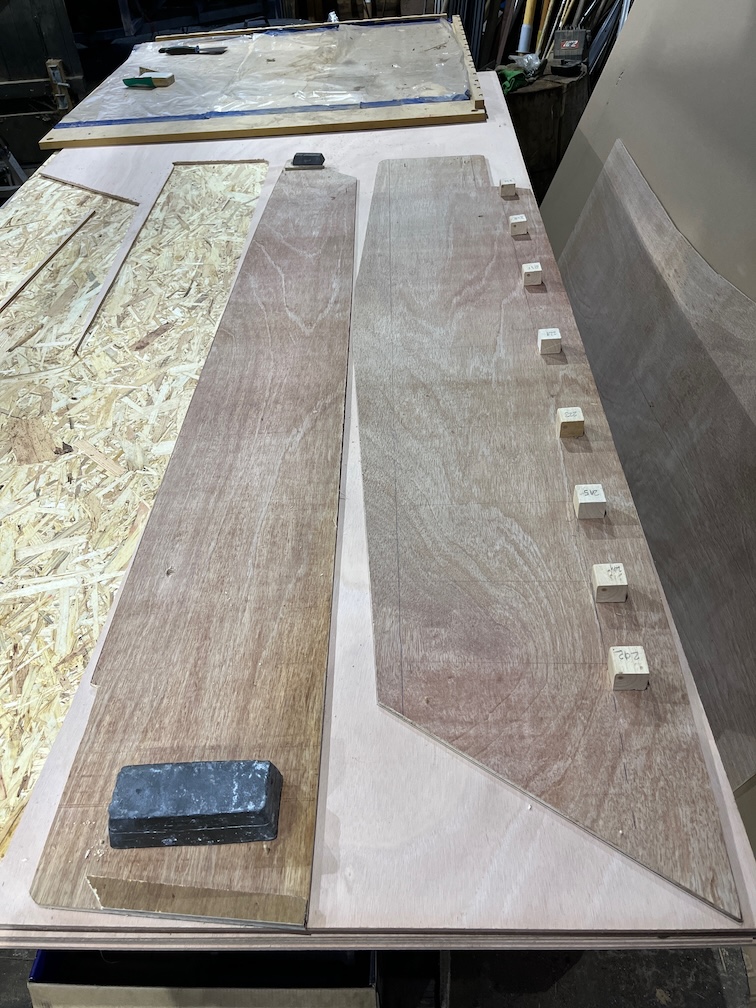
So, there we are. The inner and outer case laminates for the starboard side of the centerplate case ready to be epoxied together.

I put the two pieces together using the locating holes to get them in the correct position and put the top runner in place, just to see what it looked like.

What is quite amazing is that the time from laying the templates on the marine plywood to taking this photo of the two completed laminates is just one hour, and the result is pretty much perfect. I don’t need to offer these up to the boat to know that they will fit. I will, but I don’t need to. The templates fitted and so will these.

The other nice thing about making templates is that you know that the templates are temporary and made of cheap plywood, so if you make a mistake, no big deal. You patch it and carry on. And when it comes time to make the other side, well the templates are ready to be used for that as well.

The next step in the process is to epoxy these two pieces together and for that I’ll be working in the house where the temperature is more suited to epoxy work.

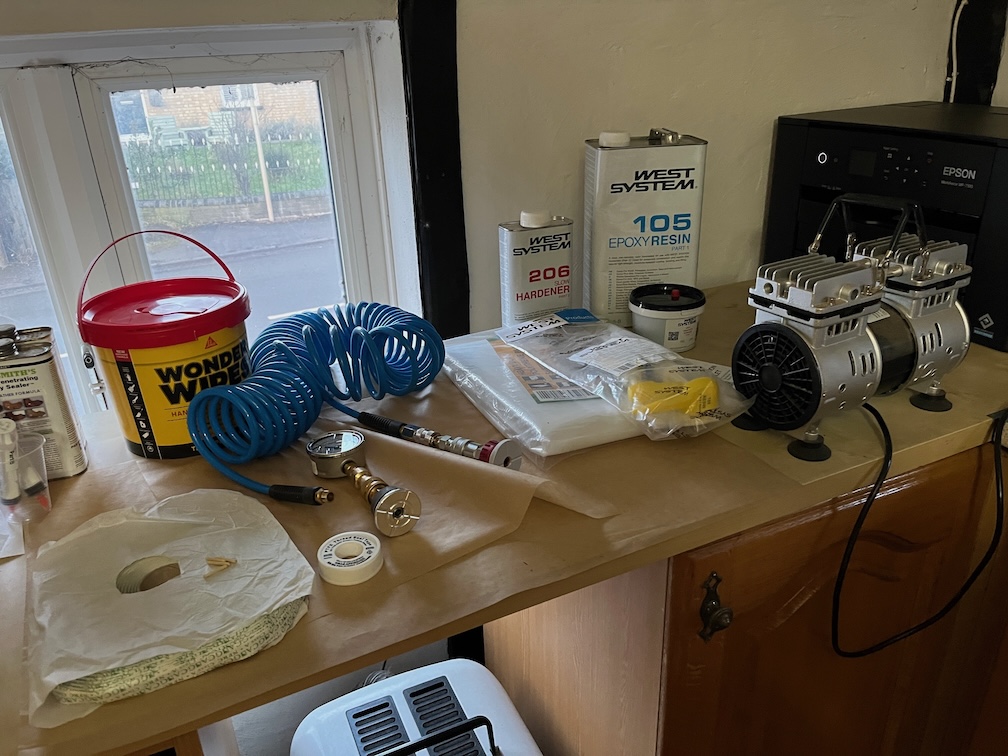
Here are most of the pieces for the vacuum bagging. Vacuum pump, epoxy and pumps, hose and fittings, vacuum gauge, butyl tape, teflon tape, heavy duty plastic sheet and Wonder Wipes. I still have to find suitable netting for the breather layer and a sturdy flat piece of wood that is flat, long enough and wide enough on which to place the laminates, but for today, I’m done.

Time for a cup of tea.
2025-12-21 – Case Template VI

Even though the temperature is several degrees warmer than yesterday, I didn’t make an early start because, well, it’s Sunday.

The first task of the day is to complete the outer plywood template and to that end I took the top runner and the template, that had been curing and drying indoors, down to the workshop.

The top runner was clamped to the inner template in the correct position such that the outer template can be adjusted to fit between the runner and the block.

This is the result after several adjustments using the belt sander being careful only to take off small increments at a time. I discovered that contrary to my previous thought that the bottom of the top runner is not straight but curves down slightly at either end. By slightly I mean about 1 mm at the front and 3 mm at the back. Still, this is 6 mm cheap plywood and it doesn’t take much work with the belt sander to remove the excess.

The aft end of the outer template will probably need to be adjusted since I gauged the correct line by eye at this point as the bottom runner hasn’t been made yet.

As you can see here, the outer template looks as though it meets the correct line but I won’t know for sure until the bottom runner is in place.

With the two templates clamped together it was an easy job to slide the case side into place and I was able to see how it looks. It was a trifle awkward with all the cramps hanging off the side, but once inside the cabin the side fitted well into the space.

The very front end will need a little more work at the bottom, but I think I’ll not worry about that for the template and cut the real pieces oversize at that end and then adjust the real plywood to make a tight fit.

I did add a small extension to the front end of the outer template and I’ll cut that back to match the inner template once the glue has fully cured. Cyanoacrylate glue (or CA glue also known as SuperGlue) this time, so it didn’t take long.

This is the result of a little more work with the belt sander and this completes the outer template.

Time to move onto the next part, but first…

Time for a cup of tea.
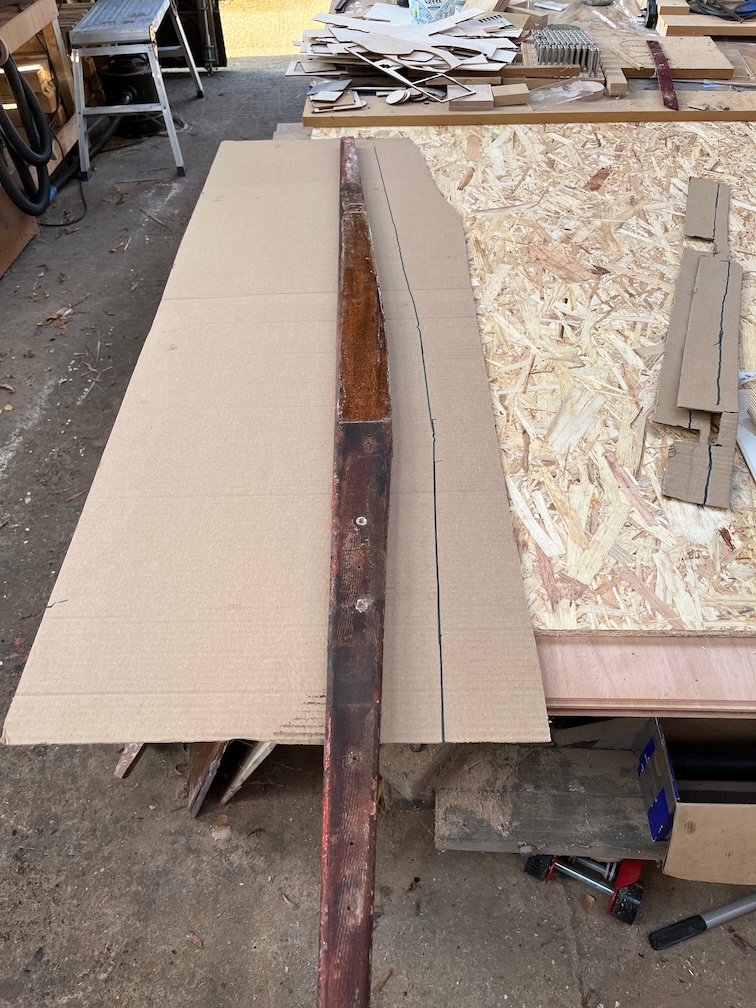
The next task on the list is to make the bottom runner. This is 25 mm wide, 30 mm high and about 1.6m long. It will be screwed and glued to the outside of the case and screwed down against the keel. When it is fitted it will have adhesive on the bottom so as to make a good waterproof seal with the keel.

I bought a plank of Sapele that is 2500mm long, 150 mm wide and 38 mm thick and the bottom runners for both sides will be cut from this.

The cutting of the runners was straightforward, but both ends needed to be cut at an angle to match the runners already in place.

I cut a plywood template first and the used the mitre saw to cut the runner. all easy stuff. This is the aft end and the first end cut.

The forward end was a little more complicated to cut since the keel has a curve in and I had to kneel on the runner to press it to the keel in order to get the correct angle. Once again it was a case of little by little until the fit was as good as I was going to get.

I clamped the runner to the keel with an F-cramp to check the fit.

And all seemed to be well. You can see that there is a slight gap between the runner and the keel here but it was a little too difficult to get another cramp in here, so I didn’t bother.

So, after some time of destruction and template making, the construction of the centerplate case replacement sides has begun. I had a very late lunch at this point and decided that this was a good plate to stop the case work for today. The next part is cutting out the side pieces from the marine plywood and I want to be awake and rested for that.

But if I can find a couple of small jobs to do then I might do those this afternoon, but don’t bank on it !

Time for a cup of tea.
2025-12-20 – Case Template Va

The evening was cold and condensation was forming over just about everything and I remembered that I had left the main hatch on Shoal Waters and Naiad open as well as leaving Naiad’s cockpit cover off to dry. So, I went down to the boats and closed hatches and took the now sodden cover into the workshop.

Whilst I was there I thought that I would get thing ready for tomorrow and glue a small piece of plywood to the piece from which I was going to cut the outer template, it being about 100 mm too short. This would mean that I had a long enough piece of plywood from which to cut the template tomorrow.

Now, the top edge of the cardboard template is straight so it made sense to put this edge on the straight edge of the plywood and cut a piece wide enough to shape the piece tomorrow. So I drew along the curved edge, positioned the plywood and set to with the jigsaw and just cut out the curved bit anyway.

Then I measured up the piece to glue on, glued it on and put two pieces of gash plywood over the butt joint to hold it, took it indoors and propped it up against the Rayburn to warm up.

I hadn’t intended to cut this piece out, but I did it anyway.

Here’s the outer plywood template warming up.

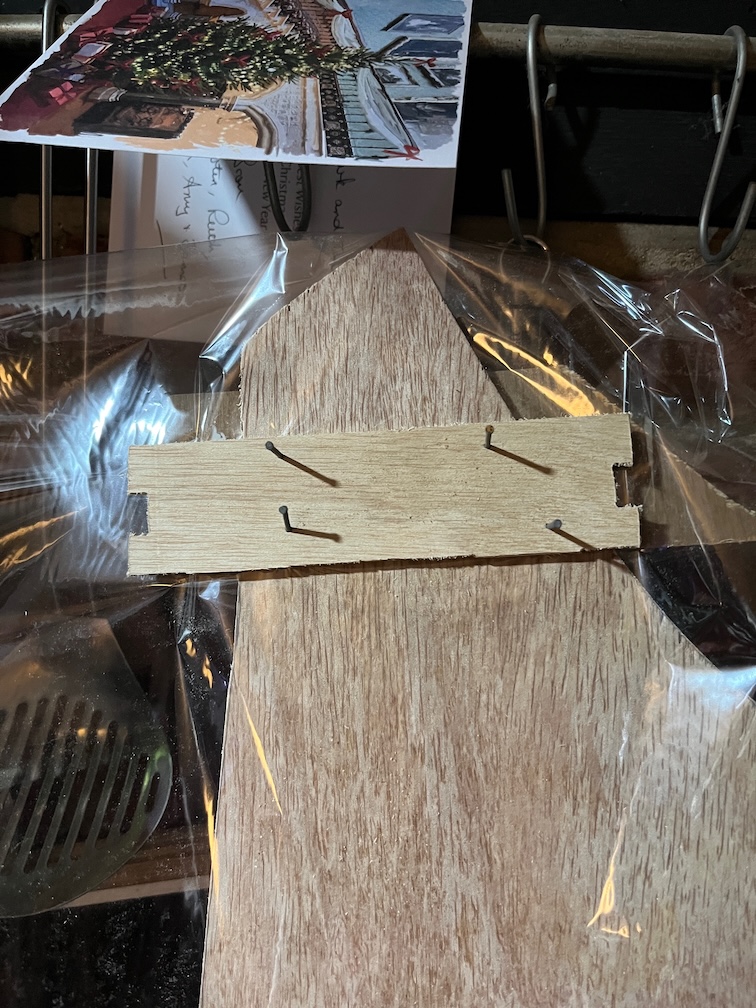
And a close up of the but joint with the two pieces of plywood nailed over the joint to hold it in position whilst the glue dries. The plastic film is to prevent the gash pieces from being glued to the template.

Took all of 30 minutes !

Time for a cup of tea.
2025-12-20 – Case Template V

The aim of the work on Shoal Waters today is to get as much of the plywood template for the centerplate case side finished. It was a cold morning today, so I delayed getting started until about 09:30, not because it warmed up any but rather because I hate working in the cold!

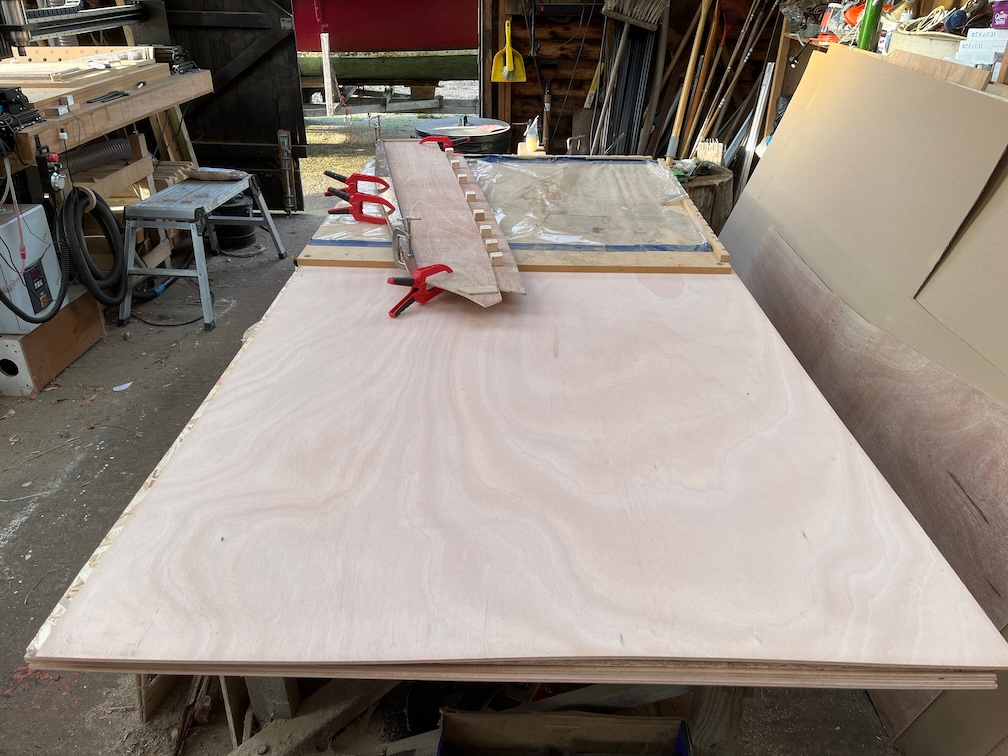
First on the list was the shaping of the top runner extension and as you can see from the above photo, it came out quite well. I could have used a small hand plane for this, but I’m not that good with a plane so I used the belt sander to do the work. Much less chance of me messing it up that way.

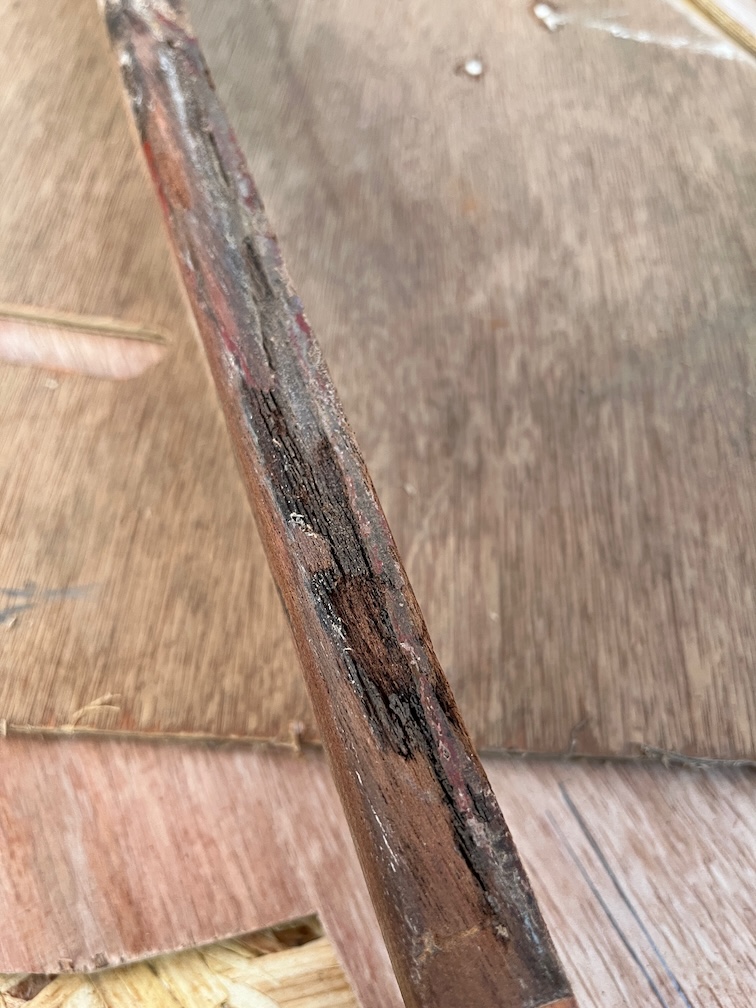
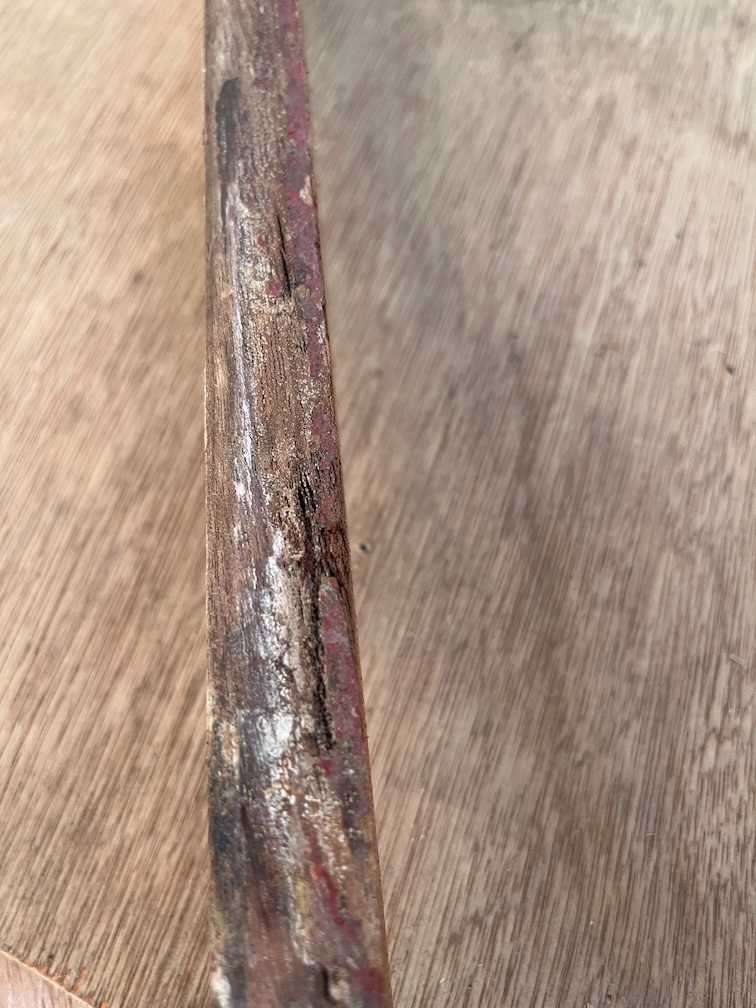
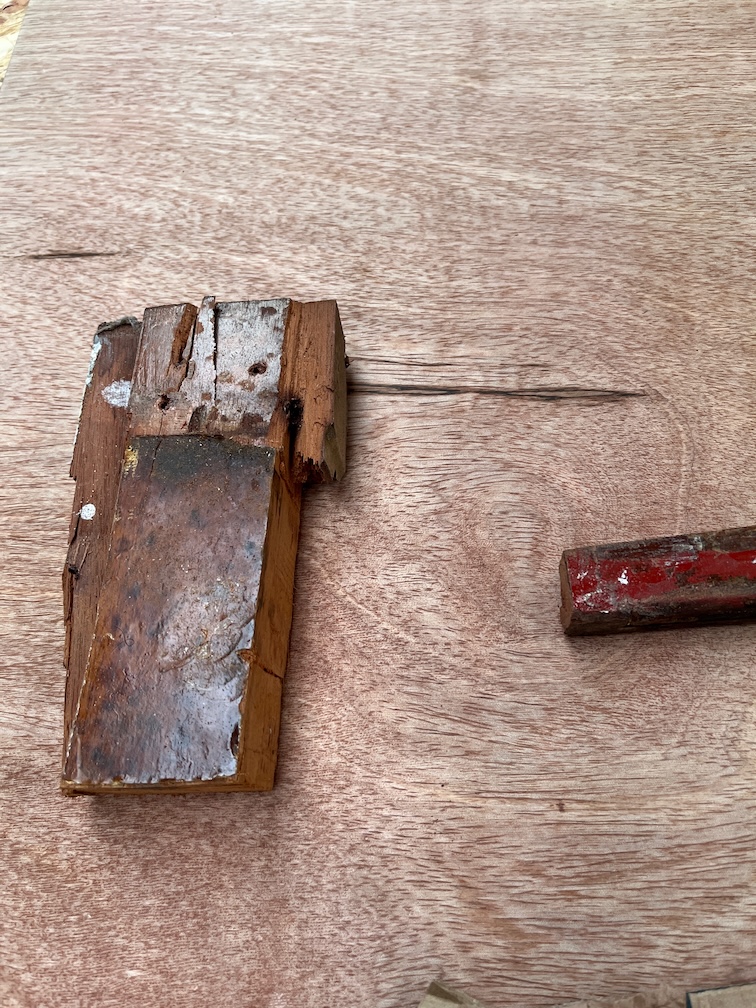
However, as I was sanding the new piece I noticed that the old piece had some rot. You can see it here. It’s not that deep and seems to be where the wood has not been painted or varnished so the water has been allowed to penetrate and stay. This is the bottom of the runner.

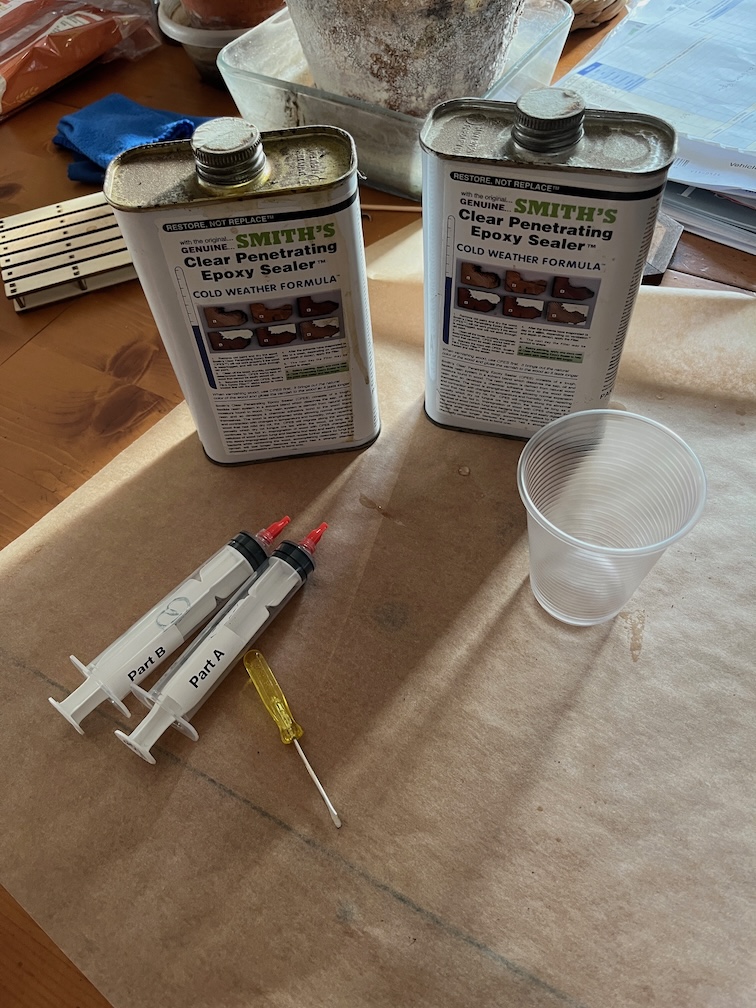
There are several other spots along the underside of the runner showing signs of rot so once I have completed the tasks that require the runner I’ll take in indoors and soak the rotten parts with the Clear Penetrating Epoxy Sealer, or CPES, that was formulated specifically for this kind of situation. I took the tins of the epoxy inside straight away as the temperature need to be higher than 10 Celsius, even for the cold weather formula, and it’s a lot lower than that outside today.

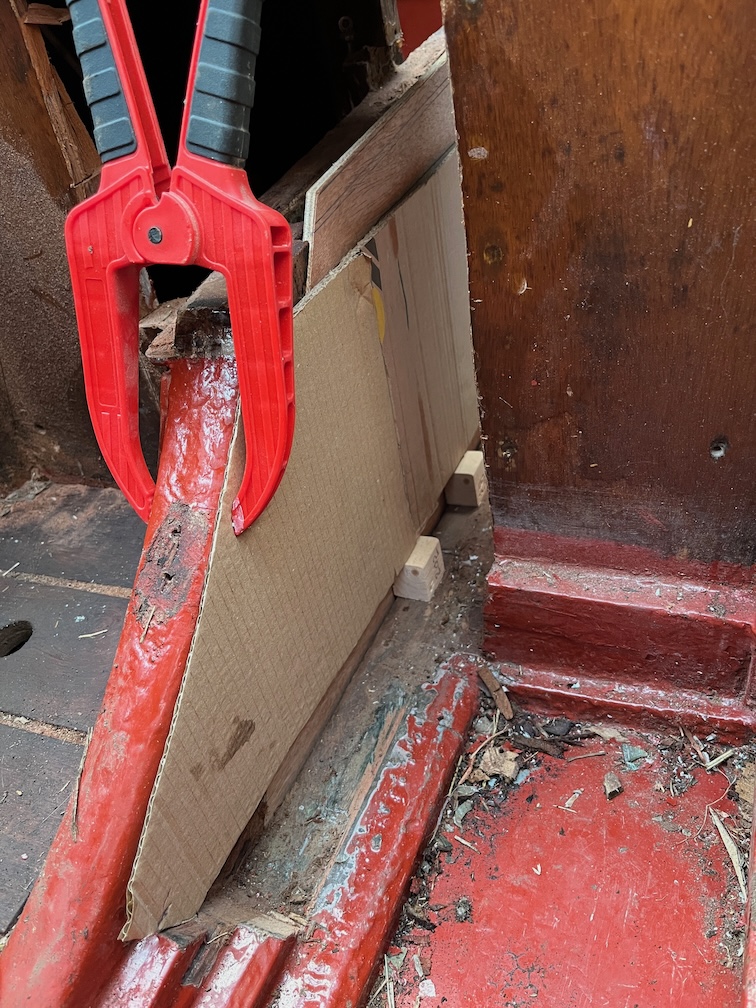
The template was put into position with some block on the inside of the slot to stop the template from falling down and the top runner clamped into position. You can see the extension looking out from the inside.

From the outside and above you can see that it extends just a little past the end of the aft block giving me a little wiggle room. This will be shaped to the original form once the case is ready to be installed.

Notice that there is a gap between the template and the block of about 2mm. The original plywood seems to have been 8mm thick and although I could have bought that for the replacement, the inside of the case will be coated with neat epoxy, then a layer of 300g glass mat, then another layer of epoxy and finally a layer of epoxy containing graphite powder. All this is likely to be around 2mm thick so that gap should disappear with the finished case side.

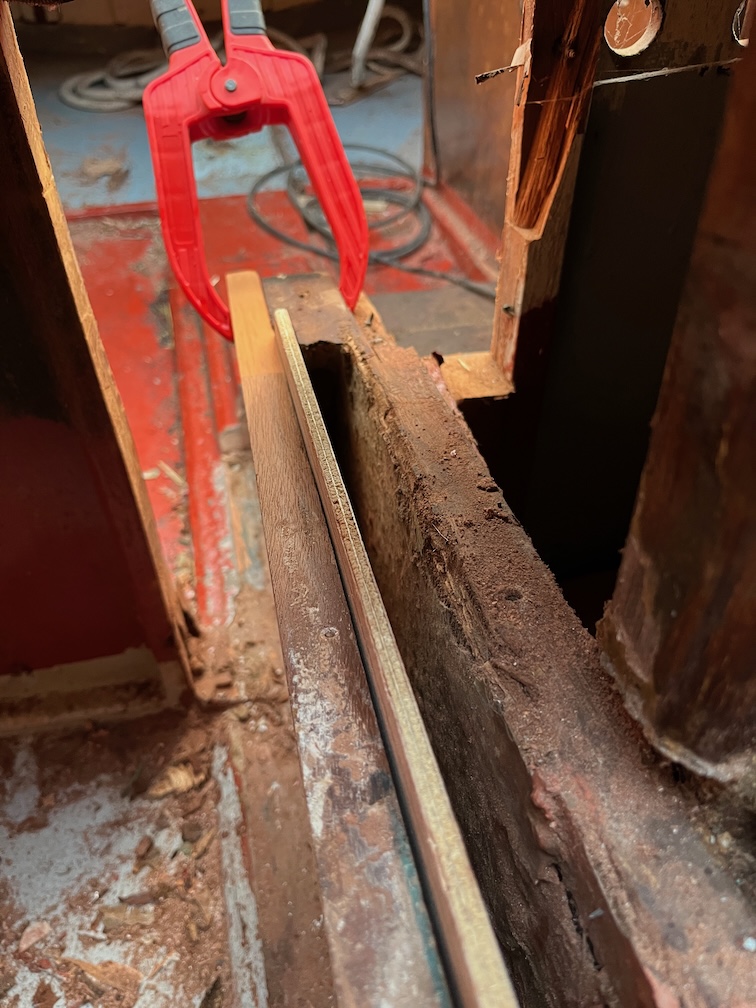
The inside blocks served their purpose well but I did find that the sides of the slot are not parallel and it is wider at the center than at the ends. Not a problem, just that when I cut the blocks to wedge the case side in place after gluing, I need to remember that the slot width varies and cut the blocks accordingly.

With the top runner now clamped in the correct position I was able to mark the top and bottom of the runner into the template. The template will be cut back to the top line and the bottom line will be used for making the outer template.

The two lines can be seen here with the “real” top line being the left line close to the top, not the right hand one.

Several small blocks were cut to match the width and height of the bottom runner, the dimensions of which I took from the runner in Naiad. One block was used to pencil in the line that will be the bottom of the outer template by putting the pencil on the top of the block, both against the plywood and running the block along the keel timber.

The blocks were subsequently fixed to the template with hot glue. Glue was applied to the correct face of the block, the block was placed on the keel and the glued face pressed against the template.

No errors so far and a good place to stop for lunch.

After lunch and a cup of tea, and since I was inside in the warm, I decided that they next task would be the rot in the top runner.

I use two syringes to measure small quantities of the epoxy components and you can see that I’ve labelled them to avoid having the syringes epoxied shut by getting them the wrong way around.

I mixed up 20 ml of CPES, more than enough for this job, but better too much than too little, and flooded the rotted wood with the mixture. Once the rotten areas stopped absorbing the epoxy I applied the remainder to any bare wood so as not to waste the epoxy. this stuff isn’t cheap. The runner was carefully placed on the Rayburn. At this temperature the epoxy should be tacky in an hour and cured in 24.

Now for the cardboard template for the outer layer of the centerplate side. That’s a mouthful !

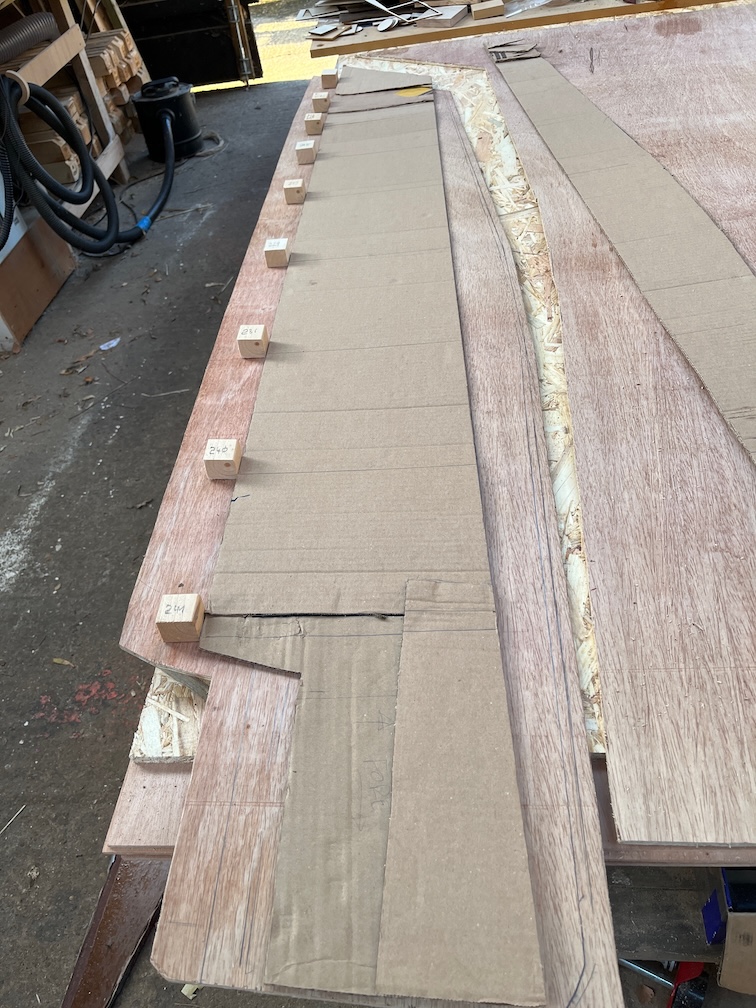
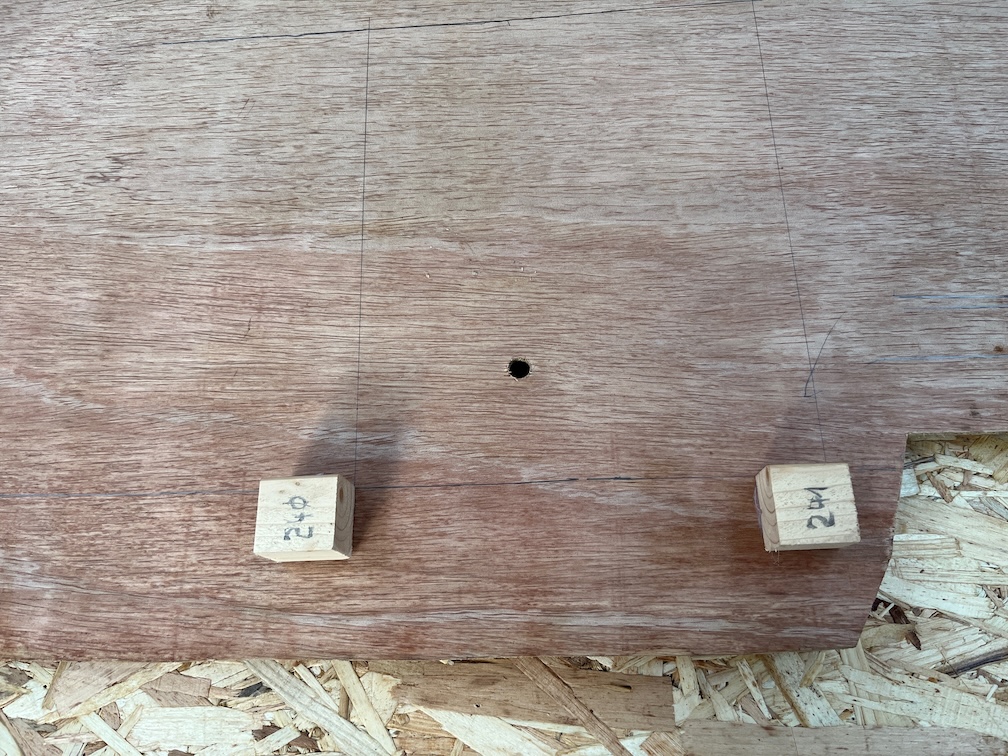
I drew straight lines on the plywood template at each block up to the line that marked the bottom of the top runner, measured the distance from the block to that line and write the value on the block.

I reused the cardboard inner template since it already has the bottom curve and I’m not going to need it for anything else. Having clamped this into position I drew straight lines from the blocks, measured up the values marked on the block and made a mark on the cardboard. Repeat for all the blocks.

Join up the marks and cut along the line.

So far so good. No mistakes yet.

Now offer it up to the plywood template and check that the top edge matches the line drawn on the plywood. It did, so press on.

Now I need an extension cardboard piece to match the aft block. First cut this to the line of the keel.

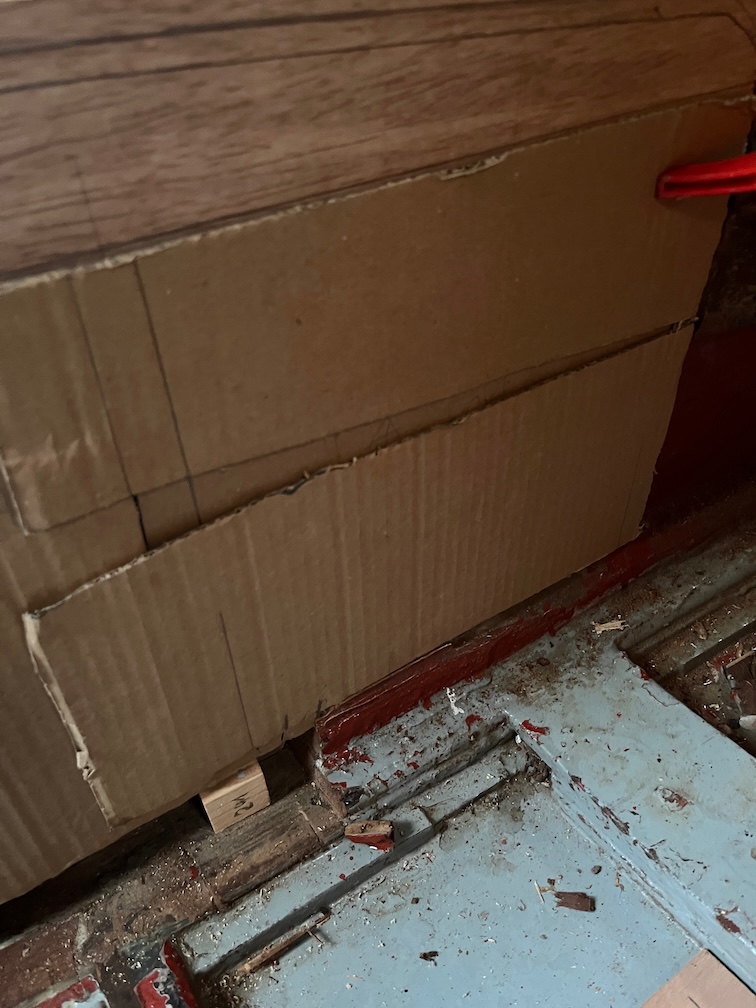
Then use the bottom runner blocks to mark where the bottom should be and cut away the excess and glue it to the rest of the outer template.

Still no mistakes.

Now for the other end.This just needed a piece to fill in as shown above, nothing difficult about this part.

Still no mistakes. I’m beginning to get that “waiting for the other shoe to drop” feeling.

While the plywood template is clamped in position I pushed a pencil through the pivot bolt hole in the other case side to mark the correct position on the starboard side and drilled a 10 mm hole in the template. Having done this there is no reason to leave the port side of the case in place and I can remove it in due course.

Not really looking forward to it, well not the tricky end bits, but there’s nothing to stop me from doing this task now.

Finally, for this sprint, I cut the top of the plywood template off to the marked line.

Still no errors but I cannot do any more on this as the next bit needs the top runner and the epoxy on that isn’t cured yet.

so…

Time for a cup of tea.
2025-12-19 – Case Template IV

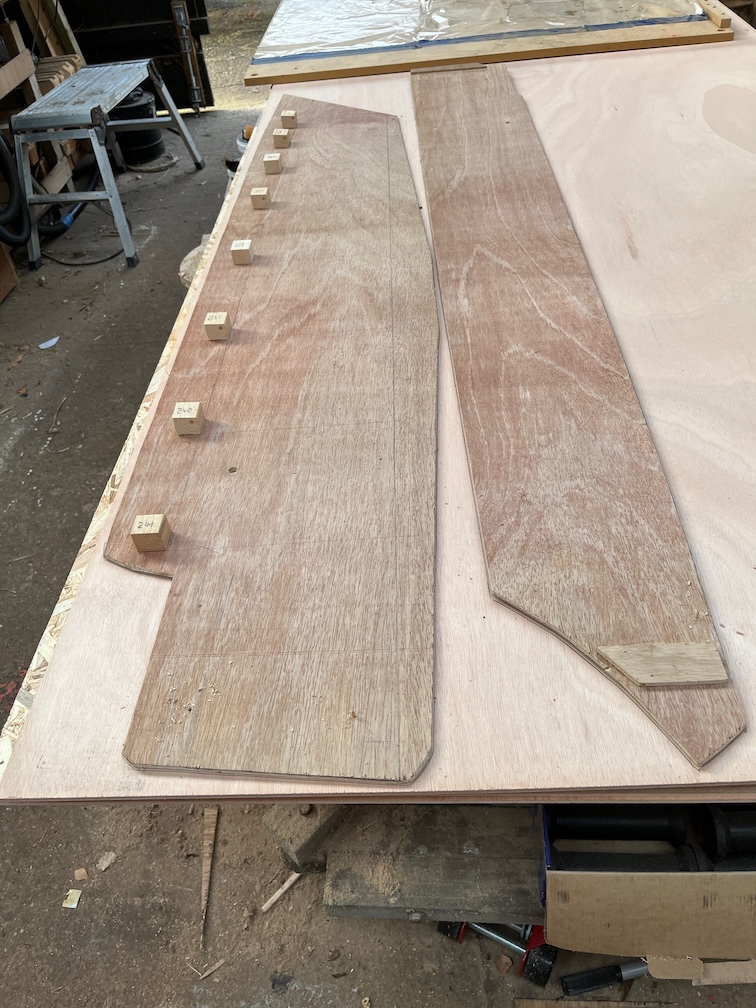
The main task for today is to cut out the plywood template for the inner case side. All but the bottom of the template are straight lines and are thus easy to deal with but the curved bottom is a little more difficult to cut. I cut all the easy straight edges which then left me with a fairly long piece of plywood that I cut on the bandsaw.

This is the result. But this is not the finish of the plywood template, just the first stage of a number of stages.

I’ve cut the top edge about 10mm too large since I’m not entirely sure where the top will be and won’t know until the top runner has been extended replacing the part that had to be cut off as it was screwed to the aft block from the inside the case and thus inaccessible. Once the extension of the top batten is done I’ll be able to clamp the runner in the correct place for and aft and that will give me the top line on the template and I’ll be able to mark and cut the template to the correct shape.

Then it was a case to offer up the template, see where it doesn’t fit, mark the adjustments, take the template back into the workshop, make the adjustments, rinse and repeat until the template fits.

This is made more difficult as the template is a little floppy and keeps on falling off the keel slot lip. Still, only the front end of the template needed to be adjusted due to my not being able to get a clean edge with a chisel because of the access restrictions.

Time for a cup of tea.
Some time later…

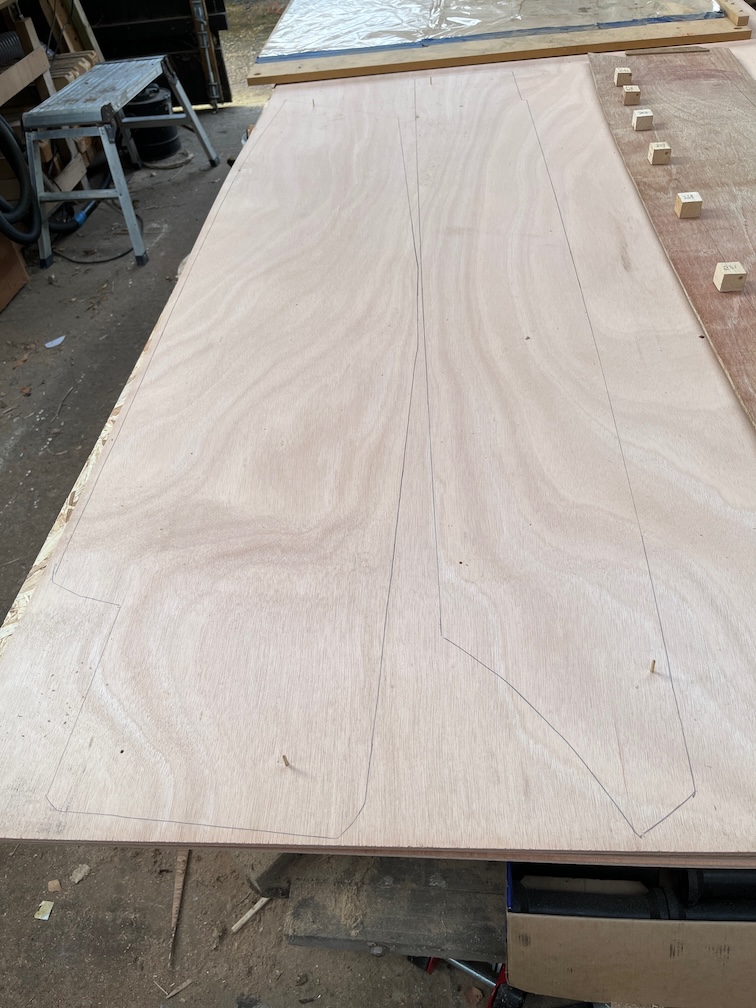
The edges of the top runner on each side of the case are not parallel, so my next task was to find a piece of old Shoal Waters Mahogany from which to cut the piece that will extend the top runner back to its original length. This wasn’t as easy as it sounds as most of the offcuts had saw cut, nails, old screws and splits and sometimes all at once.

After about an hour of careful measurement, marking, cutting and shaping I had a suitably shaped piece for the extension.

This is where it needs to go and once I have glued the pieces together I’ll round over the corners on the outside of the extended bit to match the old part.

The pieces, glue and cramps were brought inside as it is now late afternoon and the temperature is dropping now that the sun is setting.

In order to give the glue the best change to cure the higher temperature indoors is needed. Here you can see that I have applied the glue to ends but not yet put them together. This is because the parts of the piece to be glued are end grain and if you just glue them together directly, the joint is not very good as the grain wicks away the glue. The recommended procedure is to apply a thin layer of glue to each surface and then wait 10-15 minutes for the glue to be absorbed into the grain. Then apply some more glue to each surface and clamp the two surfaces together firmly.

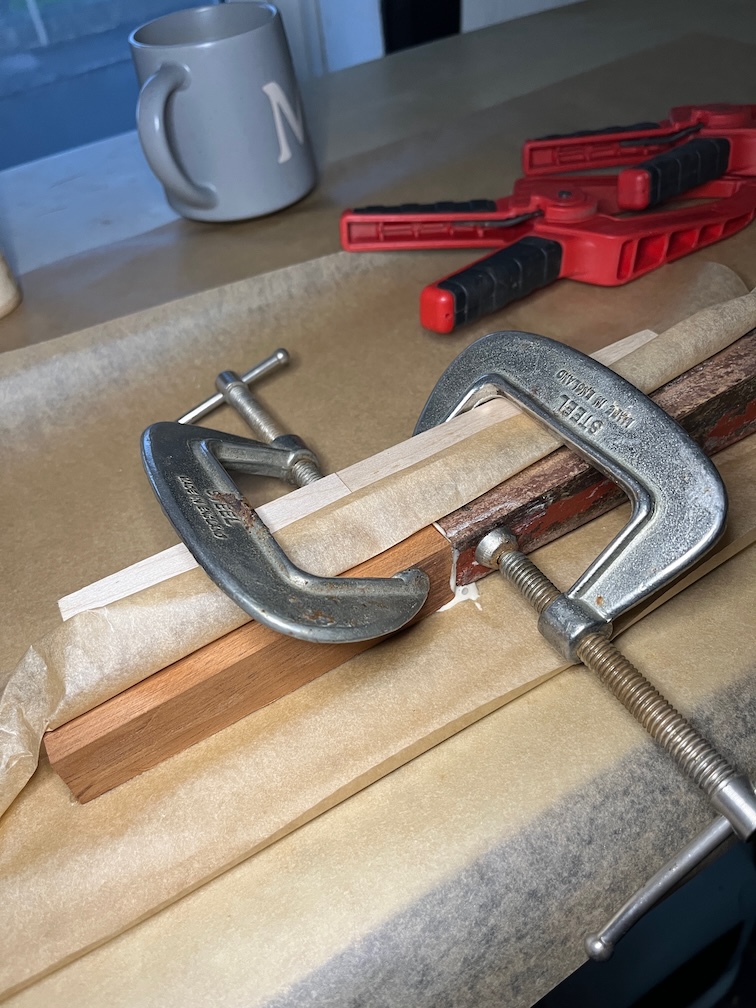
Fifteen minutes or so later the joint has been assembled and clamped. There is a straight edge clamped to one side of the joint to hold the pieces in the correct position and baking paper used to stop the glue from sticking the straight edge to the work piece.

I’ll leave this for a few hours, remove the cramps and then move the workpiece close to the Rayburn for the night.

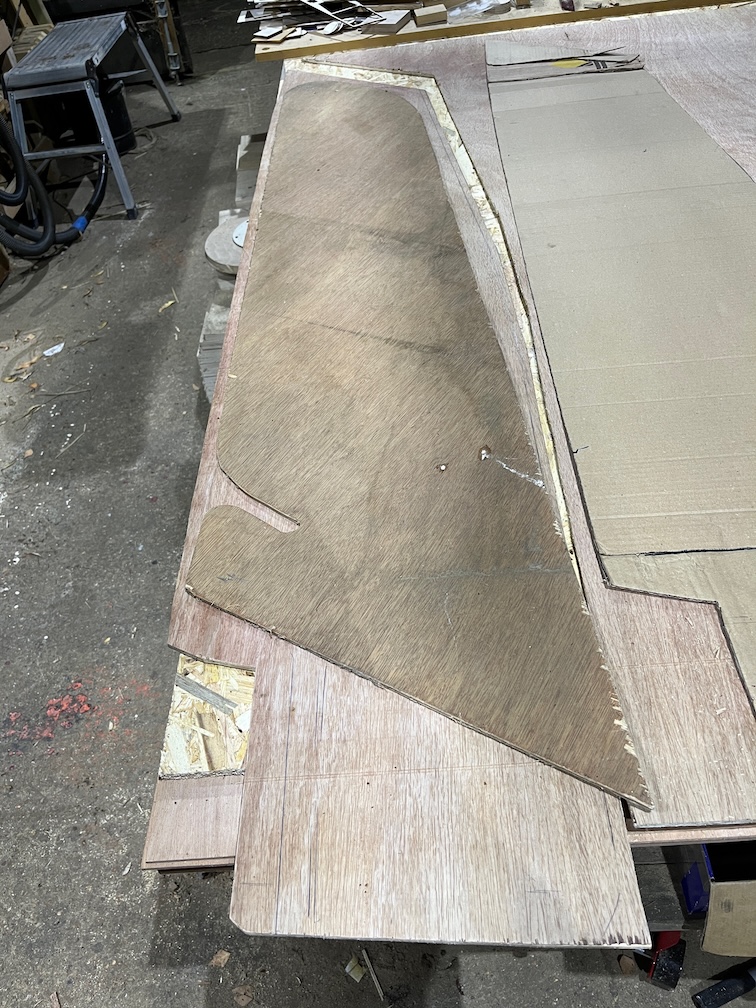
The old case side came out in pieces, so it is very interesting to see just how big the side of the centerplate case is when it is in one piece. This is not the end of the story as the outer layer of the case side extends further aft by about 200mm, so the complete side will be quite long. This is not that surprising when you consider that Shoal Waters’ centerplate is 5′ long or 1,524mm. Naiad’s plate is longer still.

Shoal Waters’ plate compared to the template I made of Naiad’s plate. Not sure why they are different. I wonder if Shoal Waters’ plate was cut down or originally that size?

Putting Naiad’s plate onto the case template in approximately the correct position shows that the case is only just large enough for the plate.

The next tasks on the list to complete the plywood templates are:

  • Shape the extension of the top runner and use it to mark the correct top edge of the inner template.
  • Make some spacers and hot glue them to the template such that they are inside the slot.
  • Clamp the template in place.
  • Cut some short pieces the same width and height as the bottom runner and fix to inner template (hot glue then screw).
  • Mark the location of the pivot bolt hole.
  • Drill the pivot bolt hole and check that the hole is correct.
  • Cut a cardboard template for the outer piece of the case side.
  • Cut a plywood template from the cardboard template.
  • Clamp the inner template in position and adjust the outer template to fit.
  • Drill the pivot bolt hole through the outer template.

Sounds like quite a lot, but , if nothing goes wrong, I should be able to complete that lot in a day. We will see.

Time for a cup of tea.
2025-12-16 – Case Template III

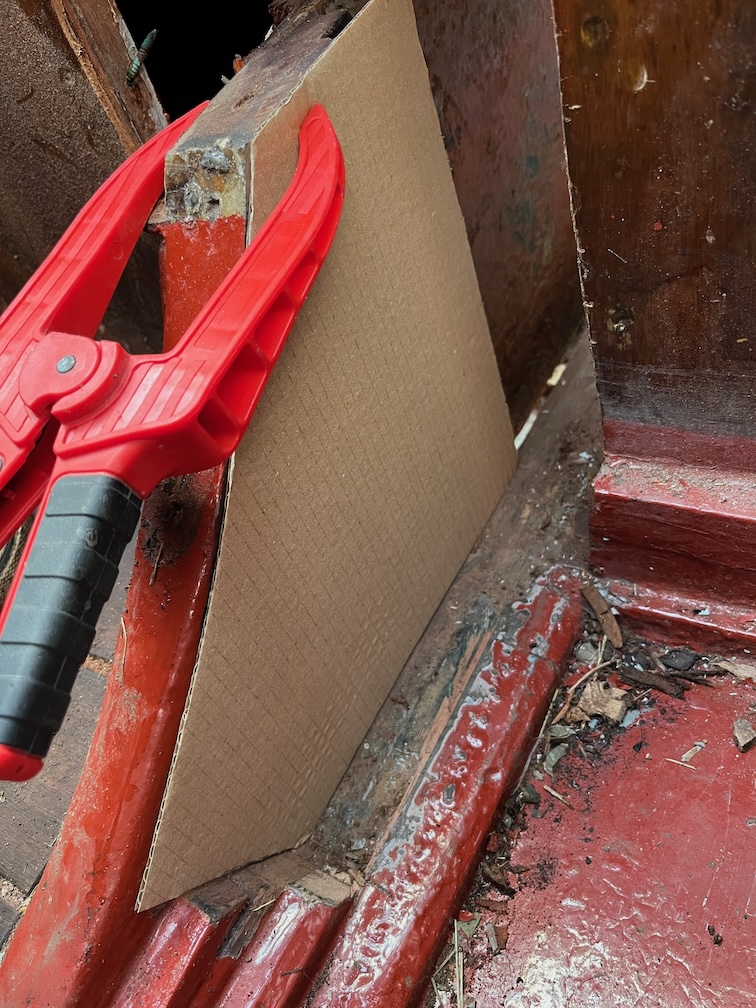
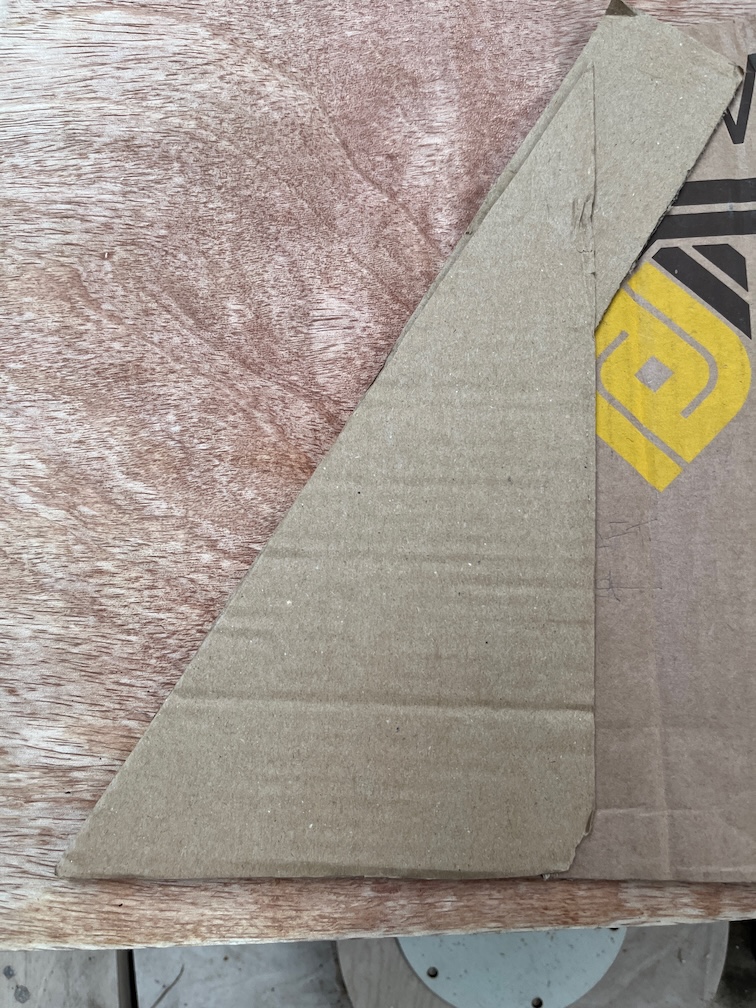
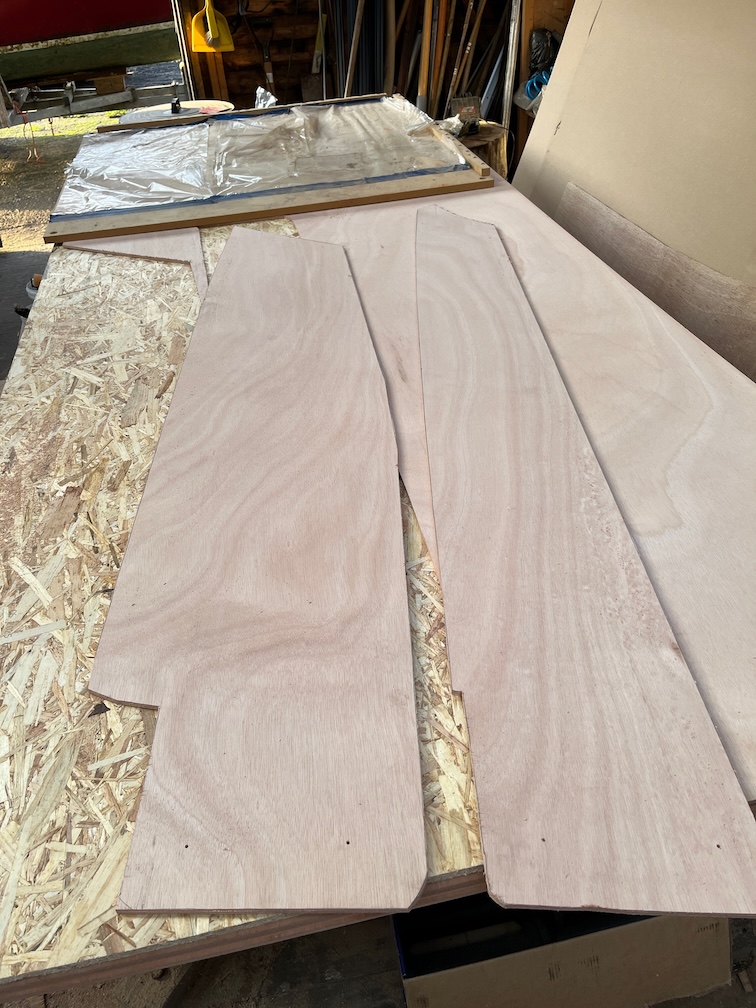
It is a dreary, wet and slightly cold day today, not at all conducive to doing anything outside. On the good side, there is no wind ! Still, I dragged myself out to the boat during a tea break and carried out a couple of quick tasks. The first was to cut out a new cardboard template piece and glue it to the bigger template.
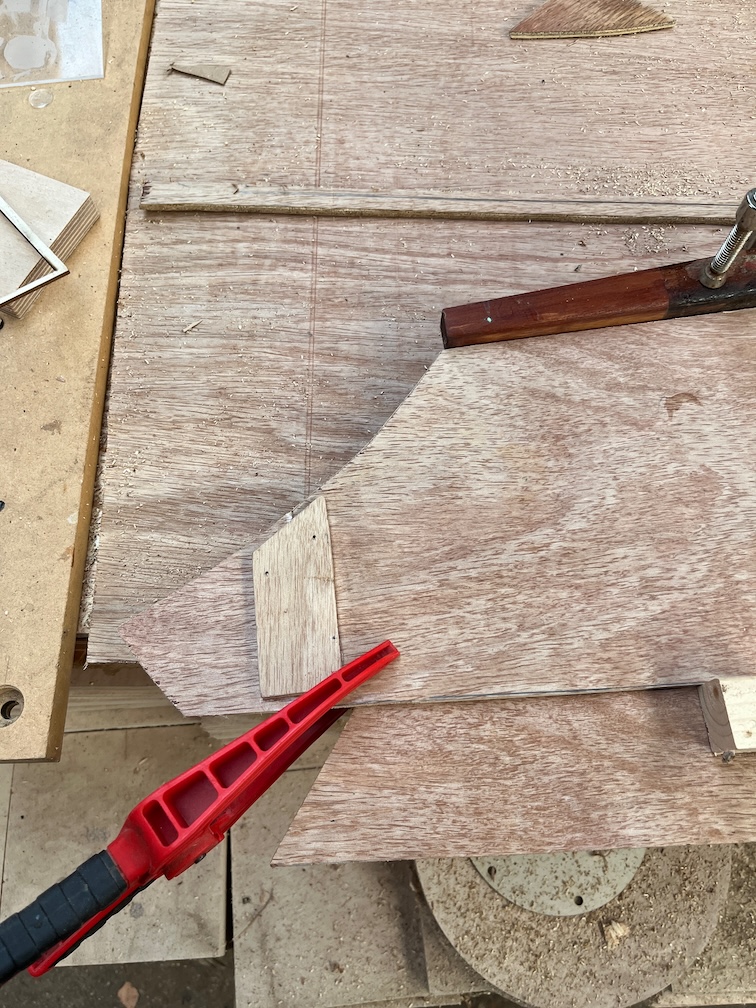
Here is the result and as you can see, the template now ends in the expected point.

The second task was to select a chunk of removed Mahogany to use to “repair” the top batten that had to be cut short in order to remove it. This chunk will be used for both sides of the new case.

To be fair, this was not a task that I expected to do today, although it is on my list of tasks, but I tripped over the block of wood during today’s first task which reminded me that it needed to be done.

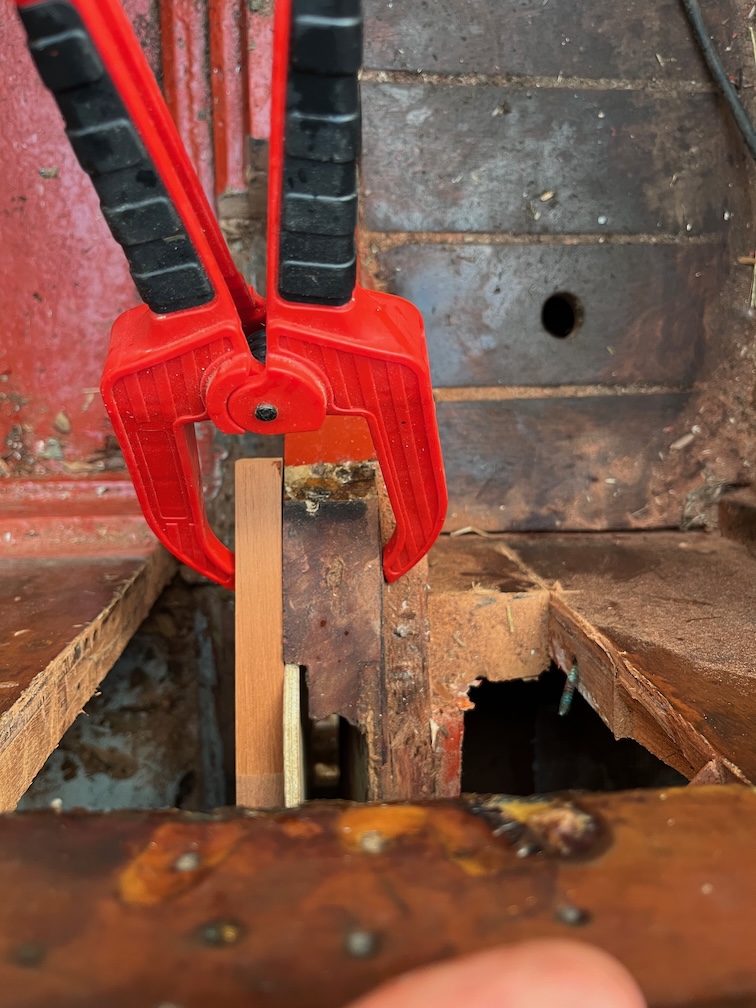
The third task was to slip a piece of 6mm marine plywood into the slot in the keel and see how much of the bottom lip protrudes. The lip seems to be about 7mm, although it is not easy to measure and thus it does stick out past the 6mm plywood. However, this is good news as I intend to coat the inside of the case with neat epoxy, then 300g biaxial fibreglass cloth, then another layer of neat epoxy and finally a layer of epoxy mixed with graphite powder. I may even apply a coat or two of antifoul after that, I’m not sure about that yet.

All this extra coating on the inside of the case will probably pad it out so that the lip no longer protrudes. This is good news since it means that I do not have to worry about the case sides being too thick, which would be the case if the lip were just 6mm wide.

Time for a cup of tea.