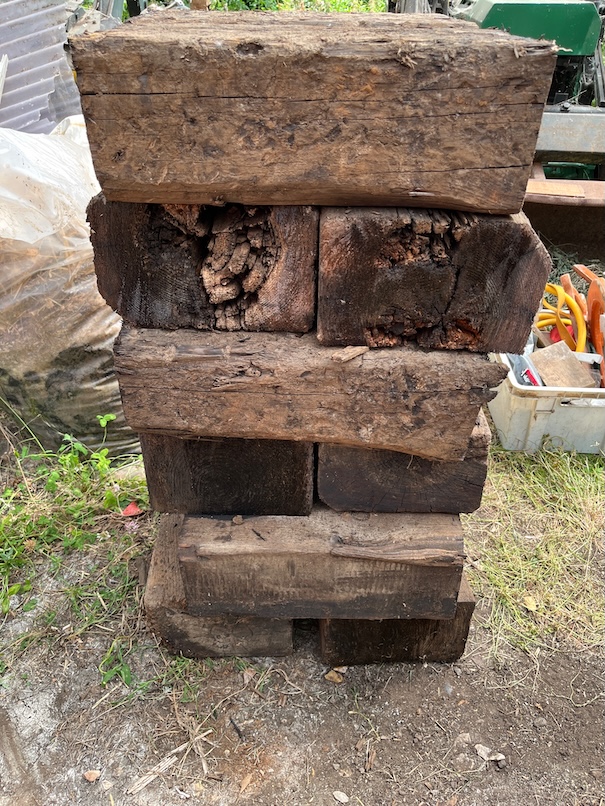
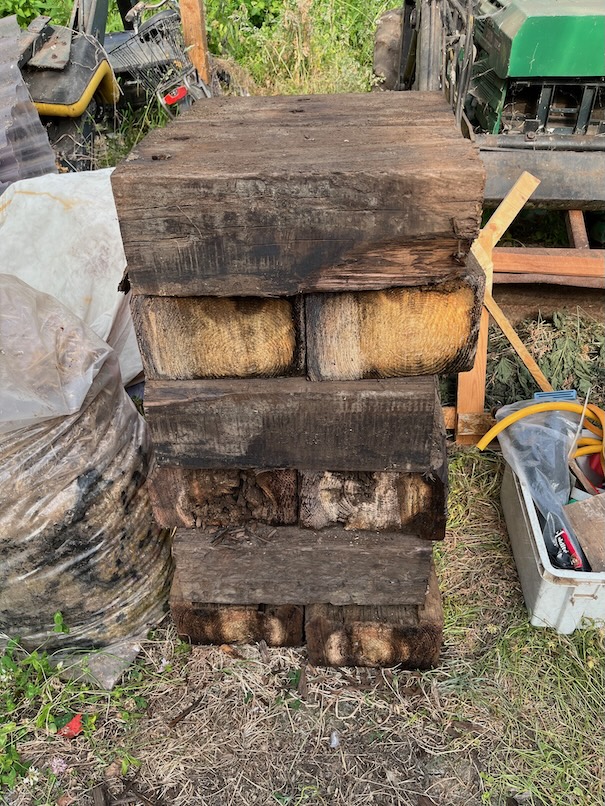
The following day I set too with paint brush and wood preserver to coat all the cut ends of the block in an attempt to slow the cracking of the blocks due to them drying out.
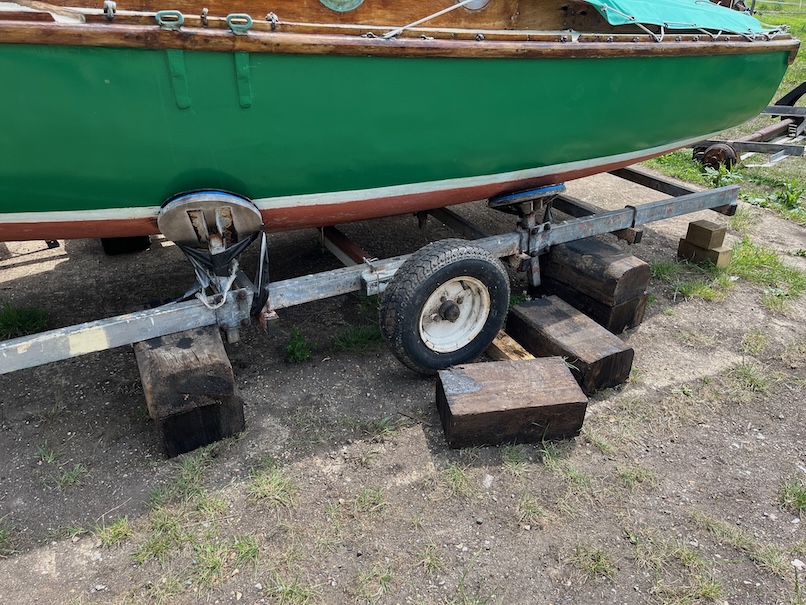
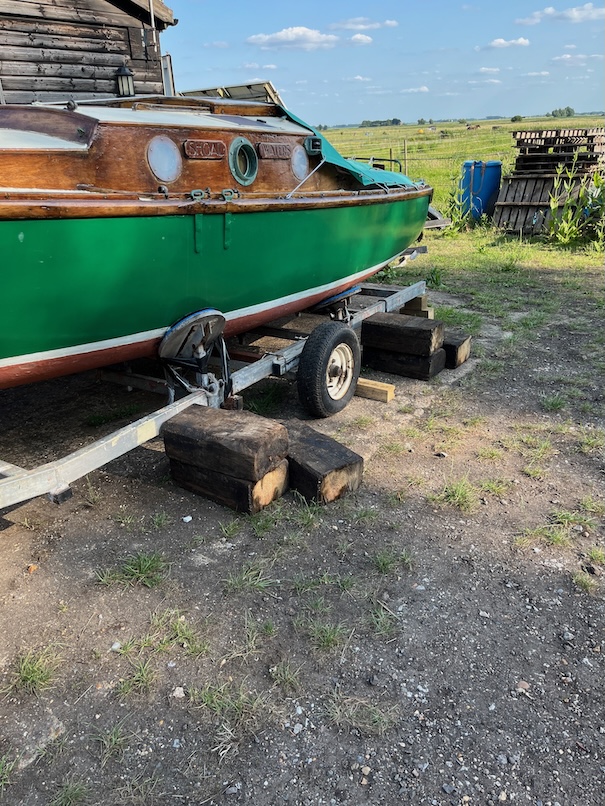
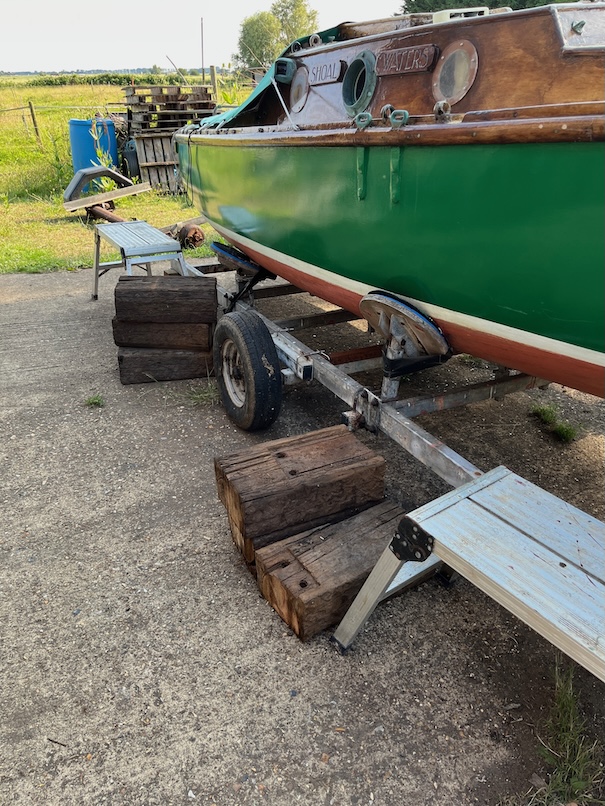
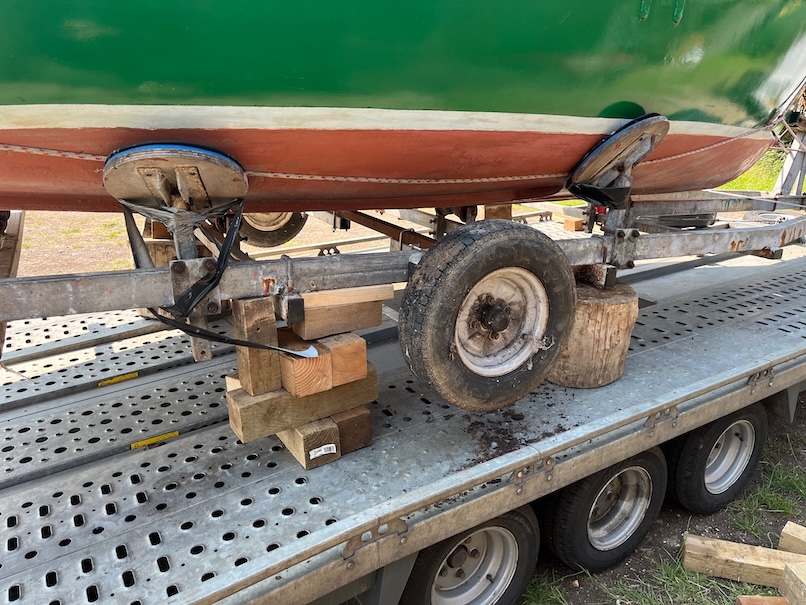
I jacked up the trailer one side at a time and blocked it up such that the tyres were off the ground.
So far so good and the whole thing is really stable allowing me to work on moving the axle without fear of the whole thing collapsing on me as I work.
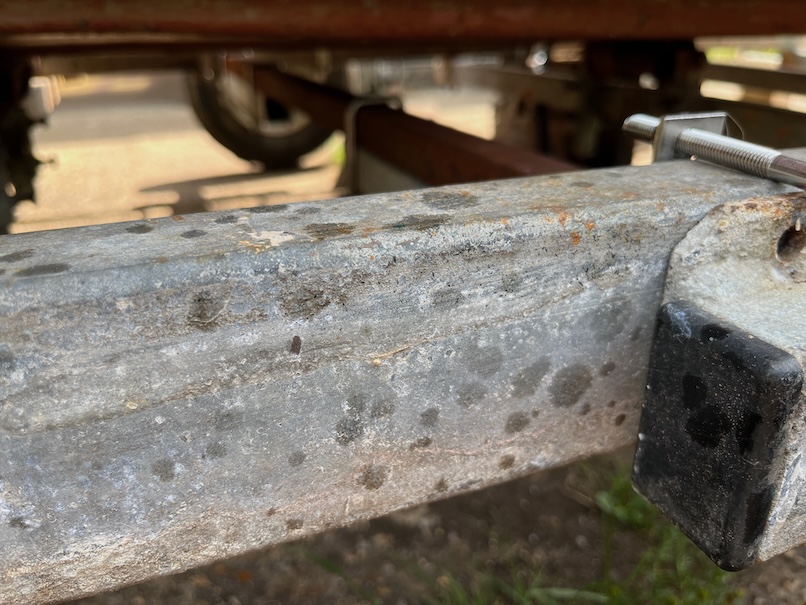
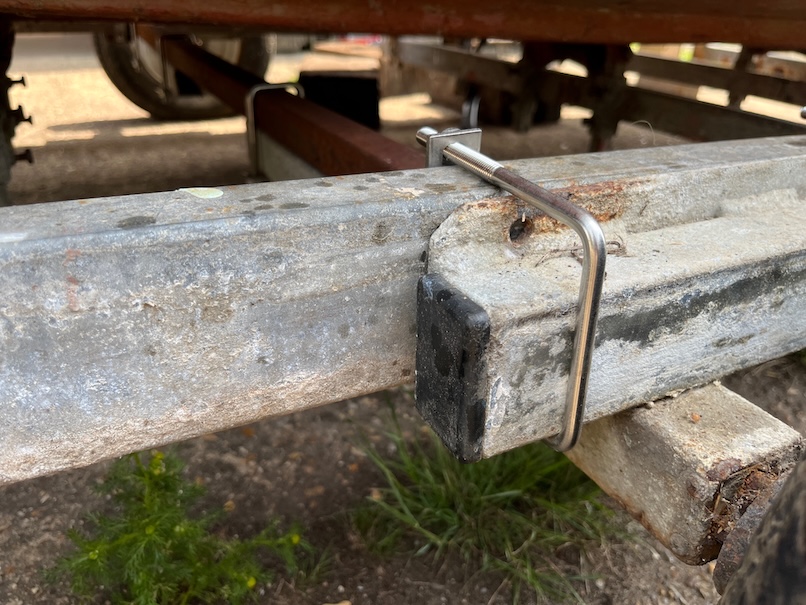
I decided to move the axle forward 100mm or 4″, an inch or so more than necessary and marked the spot on both sides where the axle should end up. Then it was a case of loosen the nuts on the u-bolts and wriggle the axle forward to the new position. I say wriggle but in practice it was hit it with a mallet as the axle is heavy!
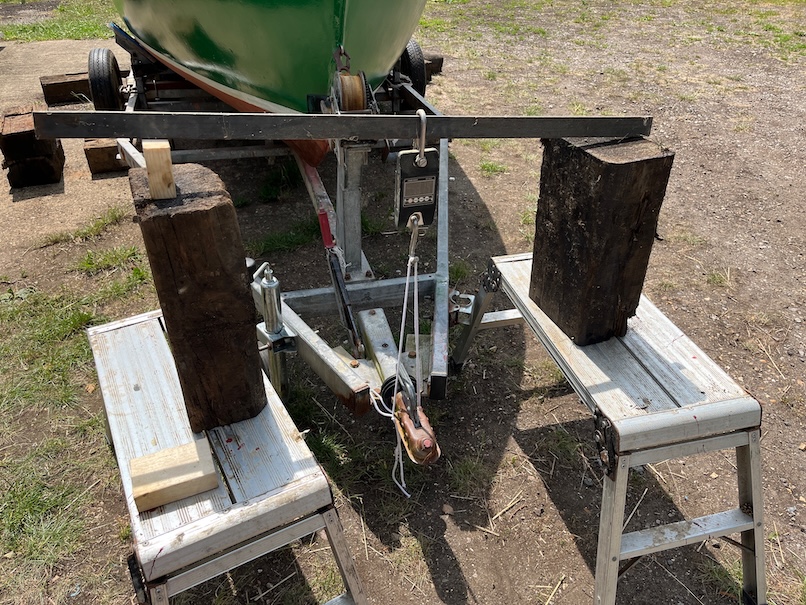
After a dozen or so small moves the axle was in the correct place and I tightened up the nuts again, jacked the trailer up again and took out the blocks. Now for the acid test. I suspended my 350kg scales above the hitch and measured the weight.
Not pretty but it works well.
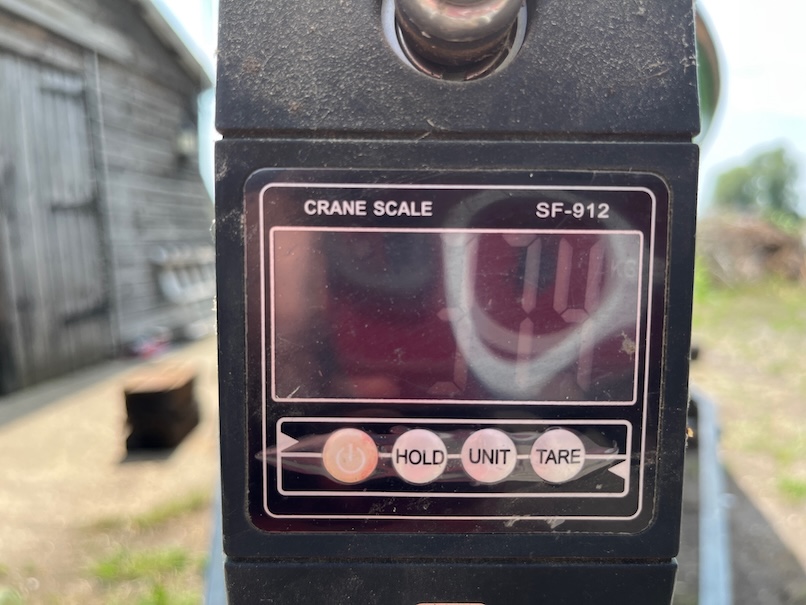
Not easy to see in the bright sunlight, but the tongue weight of the trailer and empty boat is 37.4kg. That is pretty close to being correct, not that I’ll be towing this trailer anywhere but if I have to do that, then the tongue weight is not far off the correct value.
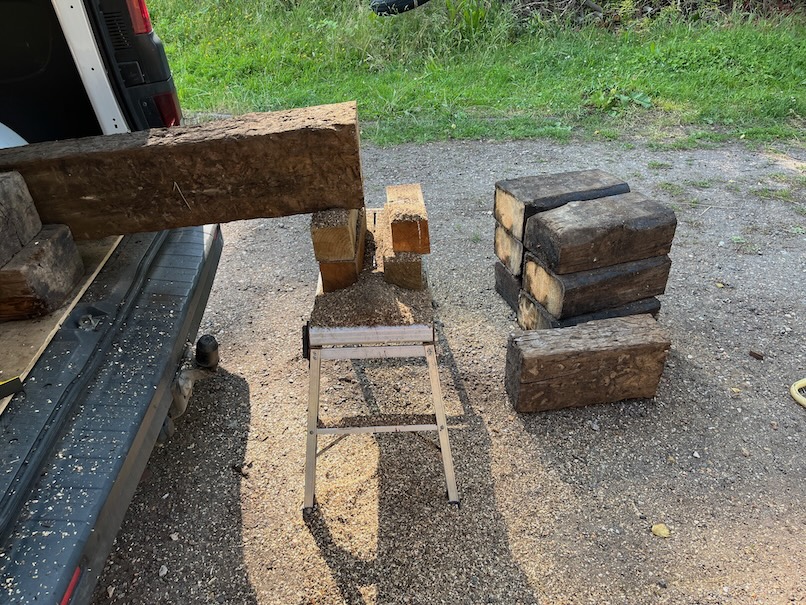
So, first things first. Off to the local timber merchant to buy six reclaimed railway sleepers. These need to be cut into blocks which will be used to support the trailer and the boat when necessary.
Railway sleepers are heavy so I cut them up by sliding them out of the minibus and cutting the end off, five times per sleeper.
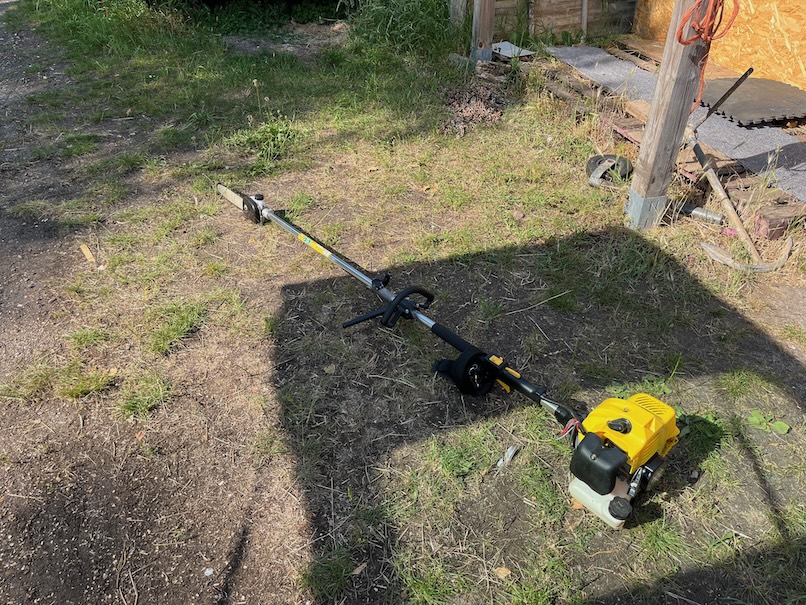
Our super new electric chain saw wasn’t quite wide enough to cut the sleepers so I used the saw that came with the gardening tool thingy and that worked well.
With the boat now on her trailer with wheels but pretty much empty, now would be a good time to check her weight. We do have a local weighbridge but you need to make two trips, one with the boat on the trailer and one with it off. This is not really practical for fairly obvious reasons. Fortunately, there is an easier option and that is to use a simple method taking advantage of what the physicists would call moments of inertia summing to zero. Fancy name for the fact that the centre of mass of the boat times the distance from the centre of the wheels pressing down must equal the length of the trailer to the jockey wheel pushing up.
But what about the weight of the trailer and the boats centre of mass, to say nothing of the centre of mass of the trailer, I hear you ask, well if you do the measurement twice with the boat moved a bit on the trailer between the measurements, all the unknown bits cancel out (I’ll publish the maths in another post for those that don’t believe me).
So, here is the method.
Move the boat backwards on the trailer about 4″ or 100mm. The more the better but don’t overdo it so that the boat tips the trailer back. Make a pencil mark on the trailer somewhere using a plumb bob from the bow of the boat. Now measure the weight at the jockey wheel, call it M1. You can use bathroom scales if you like but I use a 350 kg scale suspended over the hitch. Now measure the distance from the centre of the wheels to the point at which you made the measurement and call that L. Be as accurate as you can. Now move the boat back to its normal position and make another pencil mark on the trailer using a plumb bob from the same place that you made the first mark. Carefully measure the distance between the two pencil marks and call that D. Measure the weight on the jockey wheel again and call that M2.
Now, the weight of the boat is the (M2 – M1) * L / D
That’s it.
The only hard part about it is moving the boat backwards and forwards, but at least you don’t have to move the boat off the trailer completely and then back on again.
But before I can do any of that, I need to adjust the trailer in two ways. Firstly, the swing arms on the new axle are 3″ shorter that those on the old axle and I now need to move the new axle forward at least 3″ to compensate. Secondly, all the boat supports on the trailer are down very low. Too low to be able to put a beam under the hull but over the trailer that is strong enough to hold the boat up off the trailer, so the trailer has to come out from under the boat so that I can raise the supports as high as they will go.
Before Shoal Waters could be relaunched a number of things needed to be done both structurally and cosmetically, but in order to do this, she had to be moved from the Goldhanger Sailing Club premises to my workshop in West Norfolk. Normally this would not be a problem, but in this case the road trailer upon which she rested was not road worthy and another means of transport had to be arranged.
In the end I hired a tipping car recovery trailer which had to be collected from Grantham, driven to Goldhanger where Shoal Waters on her trailer would be winched onto the car transporter. The whole kit and kaboodle would be driven to my home where she would be unloaded and the trailer returned to Grantham.
Sounds easy. Spoiler alert, it wasn’t.
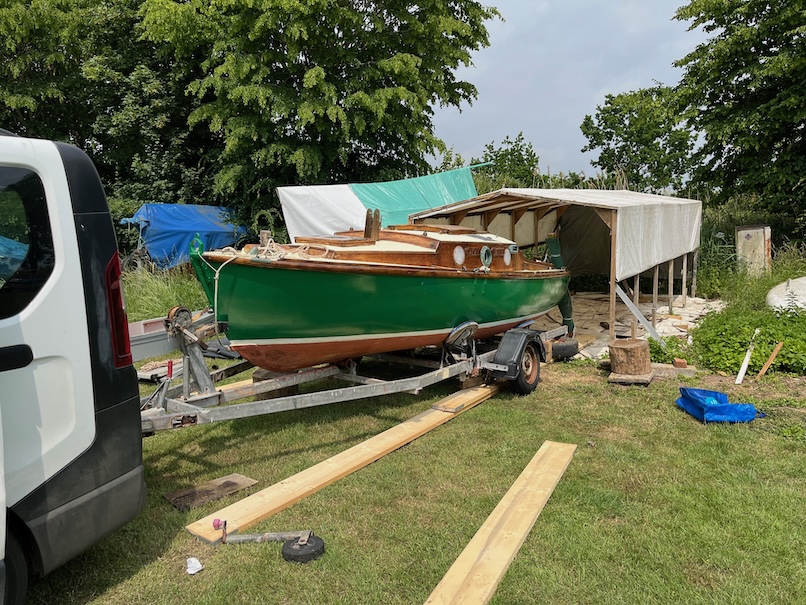
Collecting the trailer and driving to Goldhanger was easy enough, but when Jim and I arrived at the club and tried to pull the boat out from canopy that had been erected over her to keep her out of the weather during off-seasons, we found that one of the trailer wheels had collapsed.
This was a problem. Although we were not rushed, I had hired the trailer for 4 days, getting the boat and trailer onto the car transporter was going to be taxing. Since I had no idea what exactly would be required to load Shoal Waters on the the transporter, I brought along everything I thought might even remotely be required and it was a good thing I did.
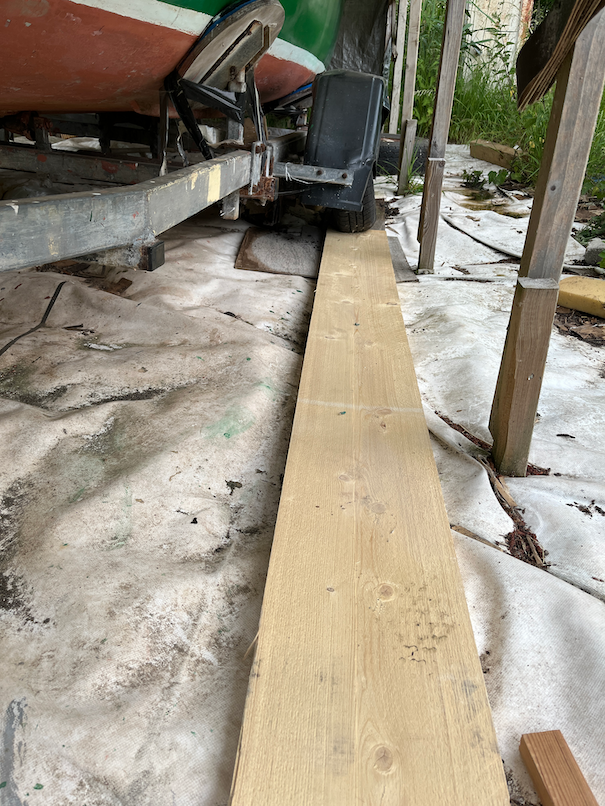
Amongst the paraphernalia in the minibus were 4 brand new scaffold planks and, quite frankly, these saved the day. Essentially, we put two boards under the trailer just inside of the collapsed wheel with wooden blocks to support the trailer such that the wheel was not carrying any load and then pulled the trailer out with the minibus until it was clear of the canopy. The top plank slid over the bottom plank a bit like the Egyptians were thought to have moved some of the blocks for the Pyramids.
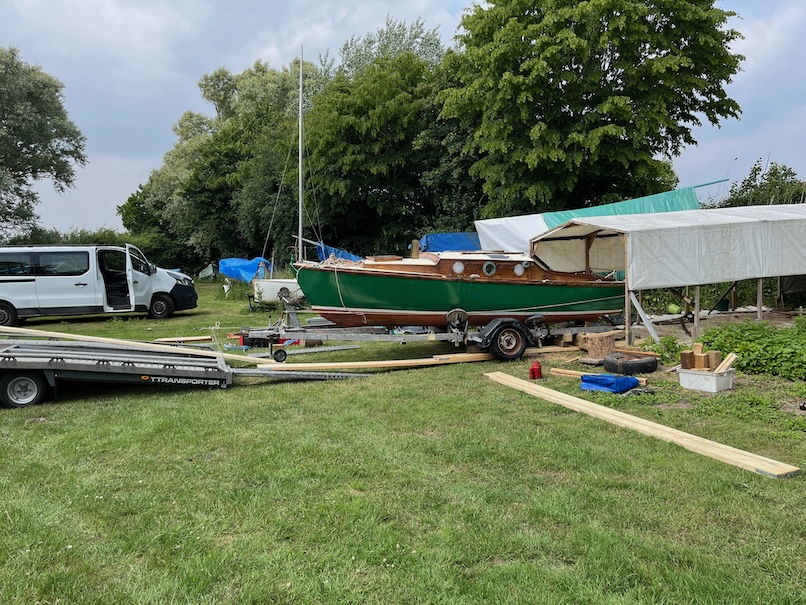
The minibus was moved out of the way and we manhandled the transporter in front of the boat, rigged the ramps and tipped the whole thing up. Then the lower of the two planks was encouraged to start up the ramp whilst we took it in turns to winch the whole thing onto the transporter.
Then it was a case of winch the boat up a few inches, check that nothing was in danger of falling off, reposition various blocks under the trailer so that if anything did go awry the trailer would only fall down an inch or two, then rinse and repeat.
It took a very long time.
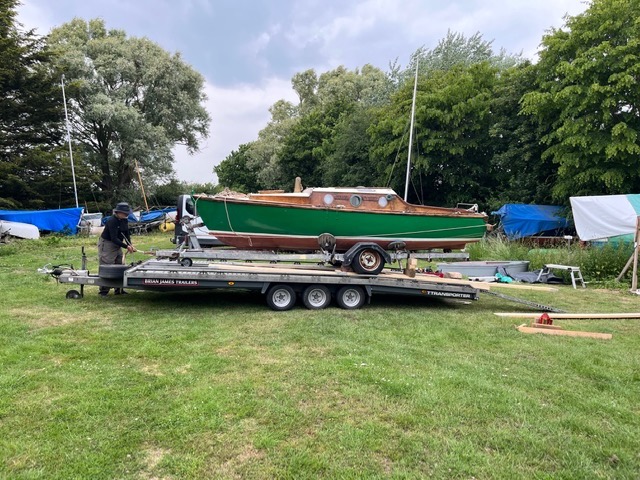
Finally, the boat and the road trailer had been successfully loaded onto the transporter and we could tie it all down securely.
Of course, we still had to load everything else into the minibus, except the mast which was too long, that was tied to the transporter under the boat along with the scaffold planks. The minibus was hitched on, the lights checked and we were ready to depart.
We had arrived at 11am and it was now just before 6pm and we were exhausted. Both of us still had two hours of driving to get back to our respective homes, but after that we could at least sit down and take a rest.
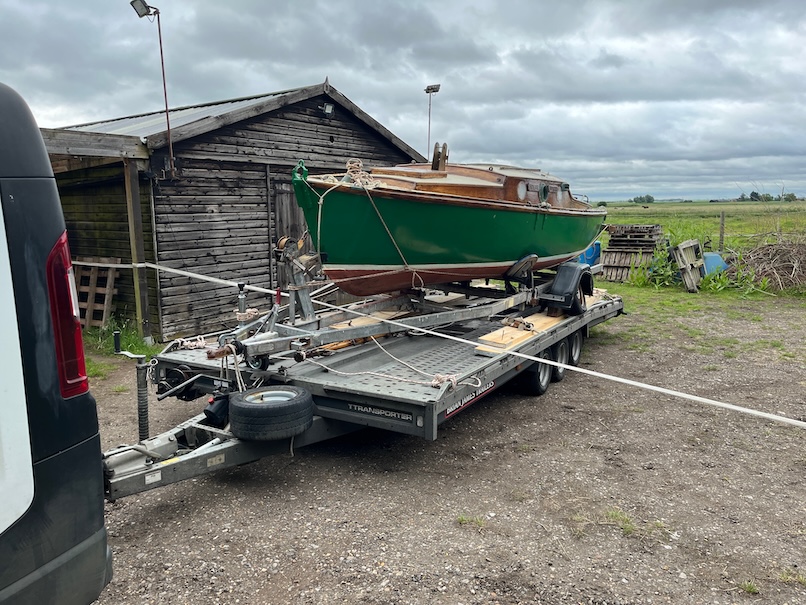
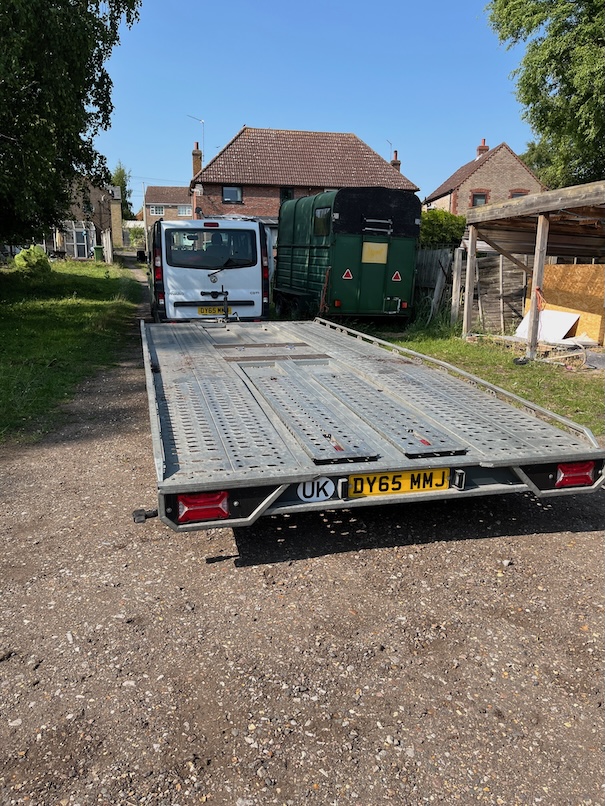
The drive home, being after going-home time for most people, was uneventful and uninterrupted except for a fuel stop and three stops to check the load, but I was very glad to get home. This is how I left the minibus and the transporter after getting home, as far as I was concerned doing anything else could wait until the following day.
I can say without a shadow of a doubt that despite the trials and tribulations of the day, we both arrive at our homes tired but very happy.
I was able to see the problem with the collapsed wheel the next day, it really does look like it’s in trouble, doesn’t it. The cure for this was to completely remove the axle and both wheels and replace them. Fortunately, I had kept the axle and wheels from Naiad’s trailer repair and these were used to make a new fitting for Shoal Waters’ trailer.
I say I had kept them but to be honest I had intended to take them to the tip but I always forgot when we made a trip to the Recycling Centre and over time they had become so overgrown that we had forgotten about them completely. Until now.
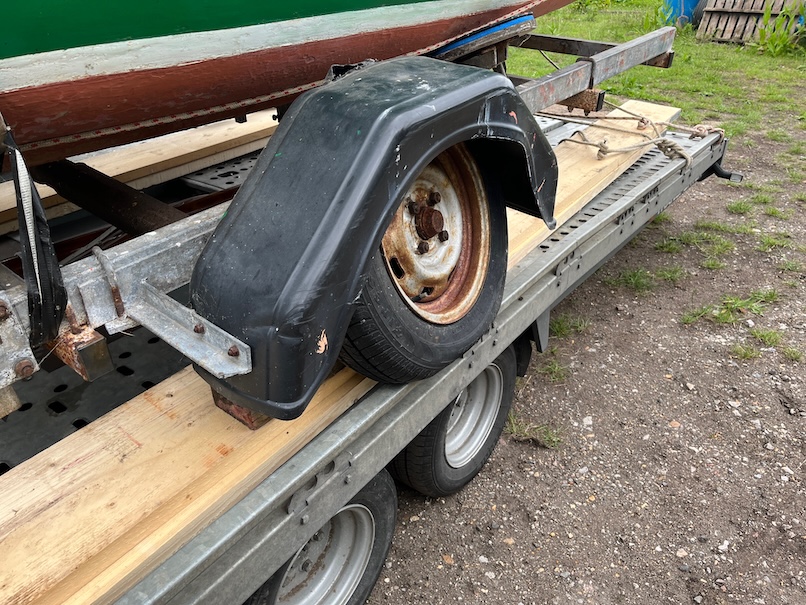
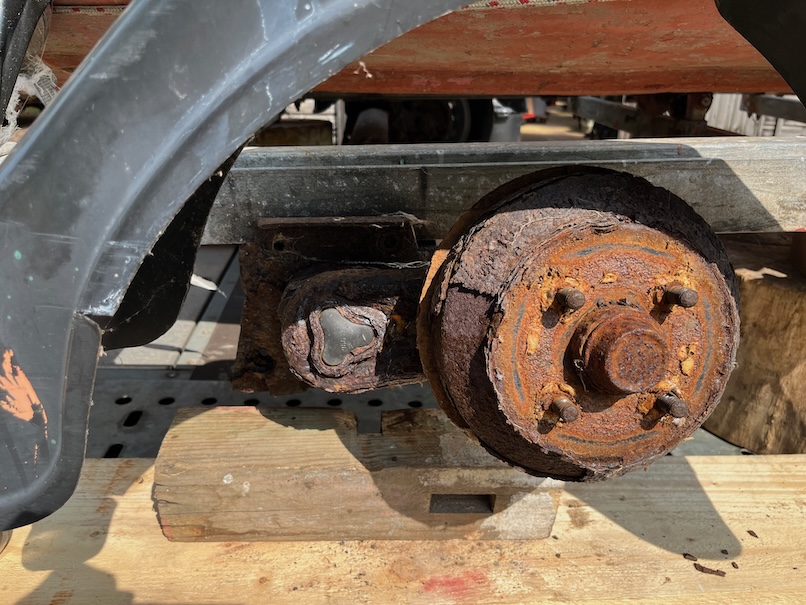
With the first wheel off the damage is pretty evident. The whole wheel and axle assembly on both sides was completely rusted through. We were very fortunate that the other wheel stayed connected. Surprisingly, the rest of the trailer is in very good shape with only a little rust here and there. The axle and wheels must not have been properly protected from the seawater.
After wrestling with the very heavy axle assembly, we managed to get it removed and out of the way leaving behind trails of thick rust.
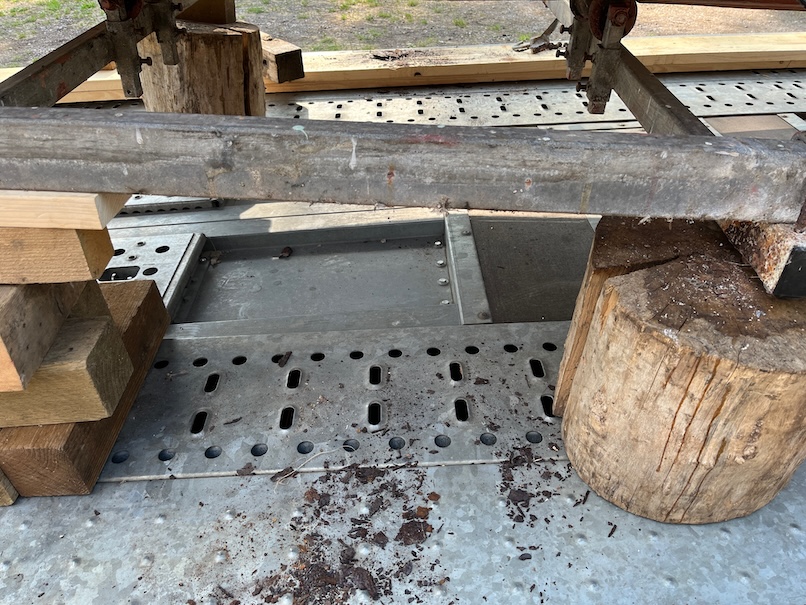
This makes it look very precarious but in fact, we blocked up the trailer at four points to prevent anything from tipping over. And at this point we had to stop. I needed some u-bolts to make the new axle assembly as the ones I had in the workshop were the wrong size, much too small. Thankfully, Amazon Prime had some which I ordered forthwith and retired for the evening.
As soon as the U-Bolts arrive the following afternoon, I made up the new axle and wheels and fitted it to the trailer. The tyres were smaller in diameter that the ones we took off and those did not fit onto the wheel boss on the new axle, but this is not intended to be a road trailer so if it sits a little close to the ground, well, so what?
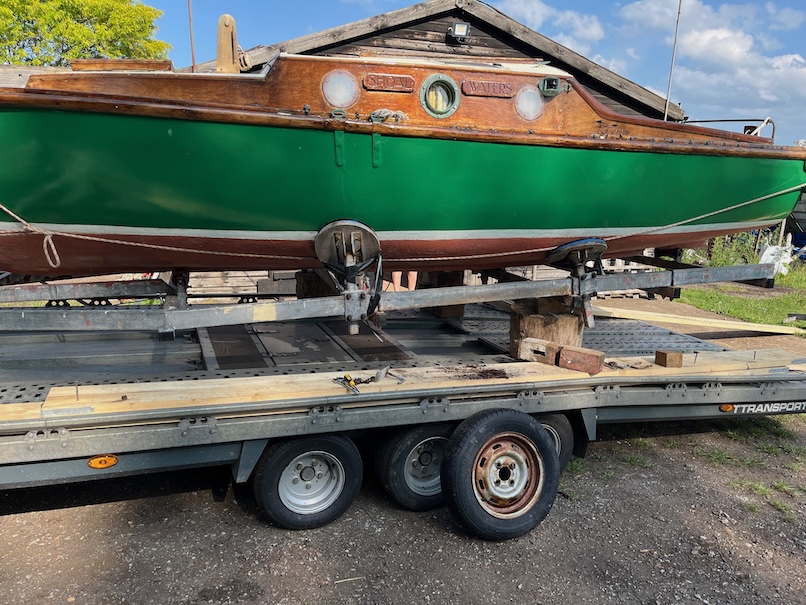
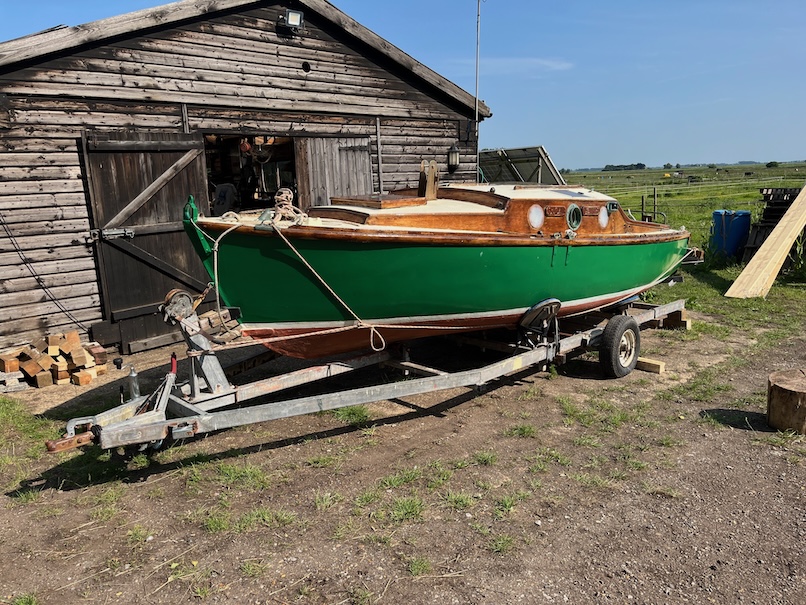
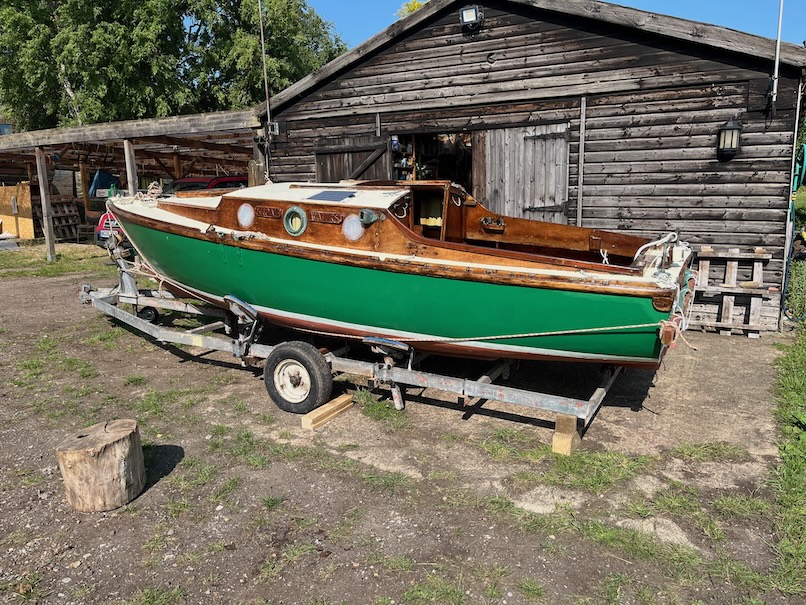
Rolling Shoal Waters off the transporter was ridiculously easy compared to getting her loaded on, and soon we had the trailer ready to be returned to Grantham.
Shoal Waters herself will stay in front of the workshop for the moment as I need to drop the centreplate out and that mean lifting the boat up off the trailer about 10″ or so, to allow the centreplate to be removed from under the hull.
I’ll probably weigh the empty hull in the process so that I know what her base displacement is without having to guess.